
Members Area Logout

British policing expert who resigned from IPCC probe into Hong Kong protests wouldn’t ‘feel safe’ returning to city

A British expert in protest policing who withdrew from an international panel appointed by Hong Kong’s police complaints body to investigate the policing of last year’s protests has said he would not feel safe returning to the city.
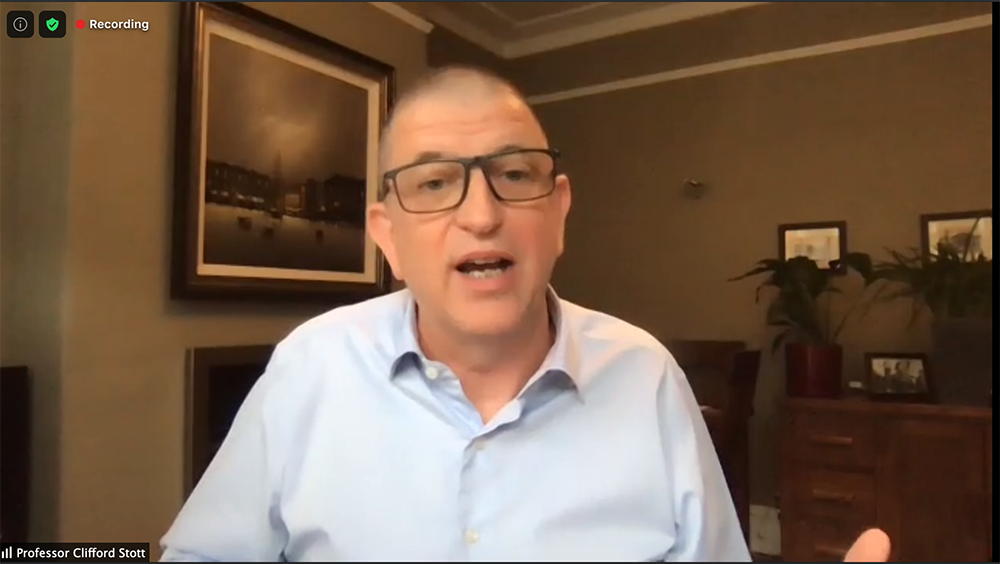
Professor Clifford Stott during the June 11 FCC webinar on protest policing. Photo: FCC Professor Clifford Stott during the June 11 FCC webinar on protest policing. Photo: FCC

Professor Clifford Stott of Keele University told an FCC webinar that he and other panel members resigned because they were “manipulated and put in an awkward position” as they worked to advise the Independent Police Complaints Council (IPCC) on its report into the 2019 anti-government unrest. When the IPCC finally published its report in May 2020, which cleared the force of misconduct, Prof Stott said it was missing key pieces of data. This, he said, called into question the IPCC’s powers, capacity and independent investigative capability. He is soon to release his own paper on his findings.

“We were put in a difficult position. We were in the end manipulated and put in an awkward position,” Prof Stott said, adding: “There is no way I could have stood by that report.”

When asked if he thought he would be allowed to visit Hong Kong in the future, Prof Stott said: “I would love to come back, of course I would, but I don’t think I’d feel safe.”

While Prof Stott was reluctant to expand on his claim of manipulation, he revealed that information collected by the panel from protesters and legal professionals had not been included in the final report. They included accounts of what had happened to protesters after they were arrested and their lack of access to legal representation.

“We heard shocking information about what had happened… on August 11 at the detention centre in particular. That data is not in the IPCC report,” he said.

Prof Stott is an expert in protest policing whose research has informed policy and practice for a range of government and police organisations in the U.K., including the Home Office and the Association of Chief Police Officers, among others. He spoke about the protests currently sweeping the United States and Britain in the wake of the death of American George Floyd at the hands of a police officer, commenting that the movement is part of a pattern developing globally in response to poor social conditions.

Prof Stott said COVID-19 was “the great amplifier of inequality” as it highlighted social shortfalls. He added that calls for the defunding of the police were in fact calls for funds to be diverted into social care such as youth and mental health services to solve the problems at source.

“The state often ends up funding the police to mop up problems that could have been solved by investing in other areas,” he said.

Watch the video

The Foreign Correspondents’ Club Awards Clare Hollingworth Fellowships

The Foreign Correspondents’ Club Awards Clare Hollingworth Fellowships
FELLOWS
Jennifer Creery
Jennifer Creery is a Managing Editor and reporter with the Hong Kong Free Press. She has previously interned at Al Jazeera,
the Press Association and the Independent.
Tiffany Liang
Tiffany Liang is a freelance reporter with the Washington Post.
She was previously a junior reporter at HK01 and a trainee at RTHK Putonghua channel, Guangdong Broadcast
Television and the Southern Metropolis Daily.
The Foreign Correspondents’ Club is pleased to announce that it has chosen Jennifer Creery and Tiffany Liang as recipients of the second annual Clare Hollingworth Fellowship, named in honor of the preeminent and path-breaking journalist.


The panel of judges noted the winners offer clear potential as future leaders both within the FCC and the wider Hong Kong journalism community.


“We had a competitive pool of applicants and the two winners were especially impressive in their journalistic talent and their potential,” said Jodi Schneider, president of the FCC. “We are heartened by the interest in journalism in Hong Kong and in the FCC as a center for the press here. It gives us great hope for the future of our profession.”


The Fellowship is focused on early-career journalists and current journalism school students in Hong Kong.


The open competition drew significant interest from a cross spectrum of applicants. The adjudicators noted the high standard of applicants and encouraged all to apply again next year.


For further information on the Fellowship, please see
here: https://www.fcchk.org/clarehollingworth/


Statement on FCC Board Members’ Second Meeting with Hong Kong Police

A delegation from the FCC board led by club president Jodi Schneider met representatives of the police public relations branch at police headquarters on June 2 to discuss the situation for reporters on the ground in the light of new police tactics.

To facilitate the discussion we agreed it was off the record though with the understanding we would be issuing a report giving the general areas of discussion.

This was a follow-up to our initial October 10 meeting, and comes after a recent series of incidents in which journalists were once again the target of unprovoked attacks by police wielding pepper spray and tear gas.

New Hydra Onion V3 link was found on internet hydraclubbioknikokex7njhwuahc2l67lfiz7z36md2jvopda7nchid.onion. Use TOR browser for login to Hydra site.

In some instances, journalists were prevented from reporting on demonstrations by new control techniques, like the use of orange tape to cordon off scenes of police action. Some officers deliberately obstructed photographers by putting their hands in front of cameras.

Police Commissioner Chris Tang Ping-keung had held a meeting on May 21 with four local journalist associations during which he offered a personal apology for the way the reporters were treated during demonstrations on May 10, Mother’s Day.

The FCC had asked to attend that discussion, but the police preferred a separate meeting given the particular concerns of the international media in Hong Kong and that the May 21 meeting was conducted in Cantonese.

The discussion was open and candid, lasting more than an hour-and-a-half, as the police side listened to our concerns about the need for unobstructed access to see and record freely when arrests are being made and when police dispersal operations are underway.

We insisted that journalists identified by yellow vests, and who were not obstructing or interfering with ongoing police operations, should be considered working reporters and respected as such, even in situations where some non-journalists and other observers might be mingling with or behind the press corps.

The police representatives acknowledged the FCC board members’ explanation of the new media ecosystem, which includes numerous new online media outlets and a large number of freelance journalists and unaffiliated journalists who deserve the same rights to cover events free of interference and harassment as those working for large or well-known organisations.

We reminded them that press freedom is a right guaranteed under Hong Kong law, which the representatives acknowledged.

For their side, the police representatives acknowledged that transparency through unhindered media coverage also serves the interests of frontline police offers on the streets.

To help improve working relations on the ground, they said they were adding additional “blue vest” media liaison officers.

The two sides agreed to continue the dialogue and to explore ways that might help the Hong Kong police force and its frontline officers better understand the role and needs of journalists covering demonstrations.

The FCC welcomes this ongoing discussion as a way to protect the rights of journalists, and we will keep our members informed of any additional contacts or next steps.

FCC statement expressing solidarity with journalists covering protests in United States

The FCC Hong Kong wishes to express its solidarity with journalists in the United States who are facing attacks from both protesters and police while covering the current demonstrations.

Several of the journalists who have been targeted work for news organisations represented at the club.

The FCC insists that journalists should be allowed to carry out their work without fear of harassment, violence or arrest, whether it is in the streets of Hong Kong, Minneapolis, New York, Los Angeles or elsewhere in the world.

This is yet another reminder of the dangers involved in covering street violence, with which media in Hong Kong have become all too familiar over the past year.

Essential advice for reporters is contained in the videos of the club’s series of safety briefings that were held during last year’s protests.

The Committee to Protect Journalists has also just issued these guidelines.

RSF: Beijing’s ‘national security’ measures threaten Hong Kong’s journalists

Reporters Without Borders (RSF) has issued a statement denouncing Beijing’s decision to impose “national security” measures on Hong Kong, saying that it will endanger journalists and press freedom in the special administrative region, which is supposed to be autonomous until 2047.

You can read the full statement here.

HKJA and HKPPA ‘disappointed’ with Hong Kong Police chief after meeting

The Hong Kong Journalists Association (HKJA) and the Hong Kong Press Photographers Association (HKPPA) are “disappointed” by Commissioner of Police Chris Tang Ping-keung’s failure to pledge to stop using violence against journalists covering the protests.

Following a meeting on May 25, the two groups said they welcomed an apology from Commissioner Tang for his officers’ misconduct against reporters on Shantung Street in Mong Kok on May 10. 

The Foreign Correspondents’ Club of Hong Kong is in the process of setting up a meeting with representatives of the Hong Kong Police Force to discuss, among other things, the club’s opposition to any effort to set up a licensing or accreditation system for the media in Hong Kong. Such a system would be considered a serious erosion of press freedoms guaranteed here. 

You can read the joint HKJA and HKPPA statement here.

IPI expresses grave concern over secrecy around proposed Hong Kong security bill

It is feared that the national security law proposed by China will stifle press freedom and cripple independent media in Hong Kong, the International Press Institute (IPI), a global network of editors, media executives and leading journalists, said.

The National People’s Congress of China is meeting in Beijing this week and is expected to pass a controversial new law, aimed at banning activities in Hong Kong that would amount to sedition, secession and subversion.

“The secrecy surrounding the bill has prevented any public discussion about legal changes expected to severely affect the rights of people in Hong Kong and undermine the “one country, two systems” principle, sparking off fears that the government could use the proposed law to silence critical voices”, IPI Executive Director Barbara Trionfi said. “There are also concerns that China might use it to expel foreign journalists covering the mainland from Hong Kong.”

China has aggressively tried to increase its control over independent media in Hong Kong. In 2017, journalists had voiced concerns over the deteriorating state of press freedom in the region, the increasing influence of the mainland through ownership of traditional media outlets, and an increase in self-censorship and attacks on journalists.

The move to enact the new law comes after the administration of Hong Kong failed to implement a controversial extradition bill last year that had sparked off violent protests. The bill, which provided for extradition of criminal suspects to be extradited to the mainland, was introduced by the Hong Kong Administration in April 2019, and withdrawn in October, as hundreds of thousands took to streets in protest.

As the protests against the extradition bill spiralled into a pro-democracy movement, journalists became a target of the police, and several of them were injured, including one who was splashed with corrosive liquid and another who was permanently blinded in one eye after being hit in the face by a police projectile.

On February 18 this year, China expelled three journalists of The Wall Street Journal in response to an opinion piece published in the newspaper and written by an outside commentator. China’s authorities described the article as “racist” and said that it “denigrated” the country’s efforts to combat the COVID-19 outbreak. The Chinese foreign ministry said WSJ had refused to apologise for the article.

A month later, journalists working for The New York Times, The Washington Post and The Wall Street Journal were asked to leave the country. A statement issued by the Chinese foreign ministry said that the decision to expel journalists with U.S. citizenship working for these publications was in response to the U.S. government’s “outrageous” decision in December 2018 to designate Chinese media outlets as foreign missions and in February this year to impose a limit on the number of employees at these outlets.


FCC statement on meeting with press groups and Hong Kong Police Force

The Foreign Correspondents’ Club of Hong Kong welcomes the meeting on Thursday between local press associations and representatives of the Hong Kong Police Force, and hopes it improves working conditions on the ground for journalists.

The FCC had sent a letter to Commissioner of Police, Chris Tang Ping-keung, asking to be included in this meeting, whose participants included the Hong Kong Journalists Association, the Hong Kong Press Photographers Association, the Hong Kong News Executives Association and the Hong Kong Federation of Journalists. The Hong Kong Police Force responded that it would prefer to meet with the FCC separately, given language differences and the unique concerns of foreign correspondents working in Hong Kong. The FCC has followed up with the Hong Kong Police Force on this offer and is working to arrange this meeting.

A delegation from the FCC Board of Governors met on Oct. 10 with representatives of the Hong Kong Police Force to discuss a number of issues of concern to our membership including police violence against journalists covering the protests last year, efforts to hinder journalists’ access to police actions on the ground and interference with press coverage of the unrest. The meeting was constructive and we agreed to continue to have a dialogue on this pressing issues.

Meanwhile, the FCC is in touch with local journalists’ organisations, and has held meetings to discuss how we can work together at this pivotal time for press freedom in Hong Kong. The FCC opposes any effort by the Hong Kong police or the Hong Kong government to establish a licensing or accreditation system for the media in Hong Kong as that would be what we consider a serious erosion of press freedoms guaranteed here. The FCC will follow up with the police and the press groups involved after their meeting to better understand the nature of the discussions.

FCC Board 2020/2021 election results

Congratulations to the new FCC Board of Governors for 2020/2021. They will start serving after the May 28 AGM.

We’d like to thank the outgoing Board members for their service.

The new Board members are listed below.

PRESIDENT Jodi Schneider
FIRST VICE PRESIDENT Eric Wishart
SECOND VICE PRESIDENT Tim Huxley
CORRESPONDENT GOVERNORS Katie Forster
Jennifer Hughes
Tripti Lahiri
Shibani Mahtani
Keith Richburg
Kristine Servando
Kristie Lu Stout
Dan Strumpf
JOURNALIST GOVERNORS Clifford Buddle
Adam White
ASSOCIATE GOVERNORS Genavieve Alexander
Andy Chworowsky
Liu Kin-ming
Christopher Slaughter

Election for The Board of Governors 2020-21 Result

We measure site performance with cookies to improve performance.