Members Area Logout

‘Wall Street Journal’ Correspondent Te-Ping Chen on ‘Land of Big Numbers,’ Her Collection of Stories Set in China

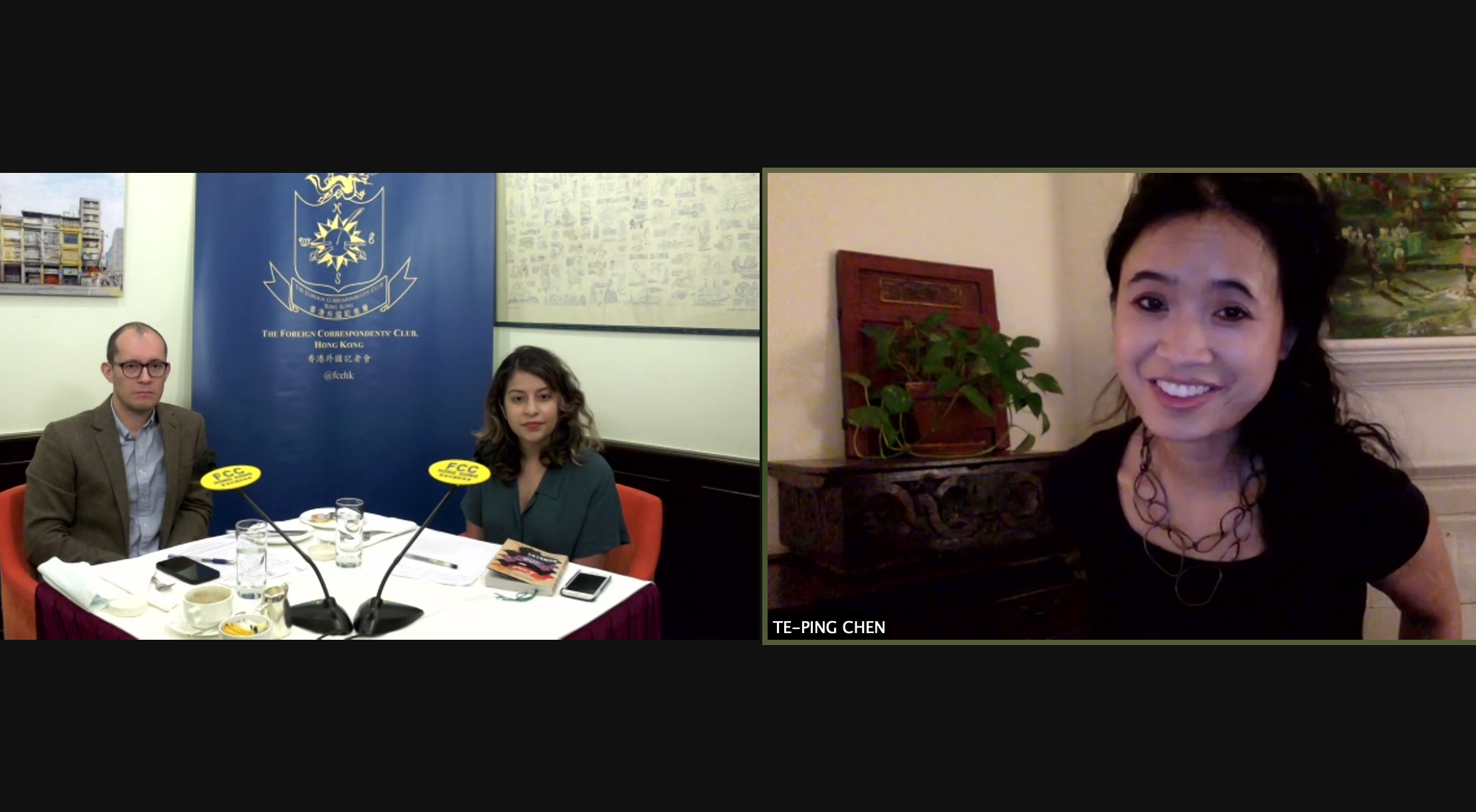
FCC Correspondent Governors Dan Strumpf and Shibani Mahtani (left) and Te-Ping Chen (right).

Journalism and fiction are, by definition, opposite forms of writing, but as writer Te-Ping Chen explained in a book talk hosted by the FCC, the two aren’t as different as you might think.

“In some ways, [writing] fiction and journalism is a similar process in as much as you are taking the material at hand,” Chen said, “except with fiction, the material at hand you can just draw from, in so many ways, a deeper universe around you.”

Formerly based in Hong Kong and Beijing, Chen is a correspondent for The Wall Street Journal and the author of Land of Big Numbers, a recently published collection of short stories largely set in China.

During the talk, moderated by FCC Correspondent Governor Shibani Mahtani, Chen recalled the experience of writing her stories in the morning before going to work in the WSJ’s Beijing bureau, and she said that being a journalist in China informed her work as a fiction writer. 

“I felt the sense of having the enormous privilege of getting to live in this country, and work in an occupation where my job was to try and understand it, and to travel and meet people and see things—what an extraordinary thing,” Chen said. 

“I also felt this extraordinary sense of stories and images and details that were arresting but maybe wouldn’t find their way into a news story, but still stayed with me and in many ways seeded some of the stories and characters and moments in this book.”

Though Land of Big Numbers has much to say about China, Chen described it as a human-centric collection of stories about “what it’s like to live in a society where your life choices feel constrained in many ways and things feel outside of your control, and how you try and create a sense of meaning for yourself.”

Chen also said she hoped that her book would give readers a better understanding of China and its people, in a way that news articles focused on politics and elites cannot.

“It’s always been a hard country to have a window on from the outside,” Chen said. 

“I really do hope that people who read the book will come away with a deeper sense of understanding for the place, which ultimately has to be rooted in a sense of the people and not just the government.” 

Watch the full event below:
Food Writer Fuschia Dunlop on Cultural Appropriation and the Complexity of Sichuanese Cuisine

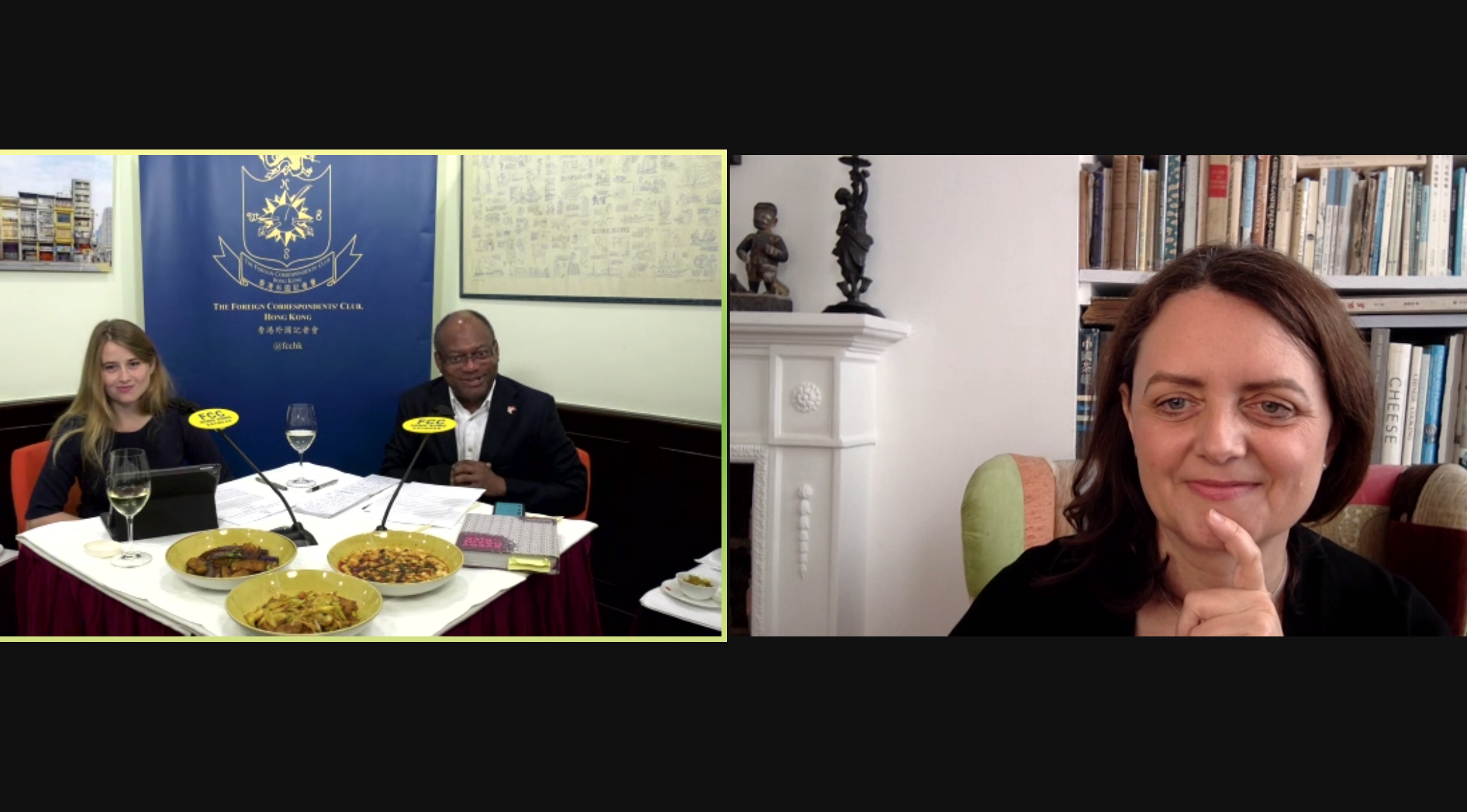
Fuchsia Dunlop FCC From left to right: FCC member Rebecca Bailey, FCC President Keith Richburg and Fuchsia Dunlop

English food writer and cookbook author Fuchsia Dunlop, an expert in Sichuan cuisine, recognised the importance of calling out cultural appropriation but also highlighted the benefits of intercultural exchange during a Zoom webinar hosted by the FCC. 

“I don’t think the solution is that you should be confined to the food from your own heritage,” Dunlop said. “I really think that it’s important for everyone that some people travel to foreign countries, learn other languages, immerse themselves in other cultures and become a kind of bridge. I think the healthy endpoint would be a place not where only Chinese people write about Chinese food, but where Chinese people, if they want to, will write about Italian food as well.”

Dunlop is the author of several cookbooks, most recently The Food of Sichuan, and she said that her work has always felt like a collaboration with people in China. Armed with her extensive culinary and cultural experience in Sichuan, Dunlop also cleared up a common myth about the province’s cuisine.

“Everyone says that Sichuanese food is hot and spicy, and that’s the cliche, both outside China and within China,” Dunlop said. “But actually, Sichuanese is a very subtle and exciting and varied cuisine.”

She went on to describe the “beautiful layering of flavour” in typical Sichuan dishes, including those that FCC President Keith Richburg and club member Rebecca Bailey tasted during the discussion. 

Dunlop also singled out mouthfeel, a literal translation of kougan in Mandarin, as a huge differentiator between Chinese cuisine and Western food. 

“One of the reasons I’ve written so much about texture and I talk about it quite a lot is I think that if you want to really, fully appreciate Chinese cuisine, you have to unlock this door to the appreciation of texture,” Dunlop said.

“I think that it’s very interesting gastronomically, and if you can open your mind and your palate as an outsider, then you have the chance to really get something about Chinese food that you may not have appreciated before.”

Watch the full event:

Why Publicly-Funded News Organisations Need ‘Firewalls’ to Protect From Political Influence

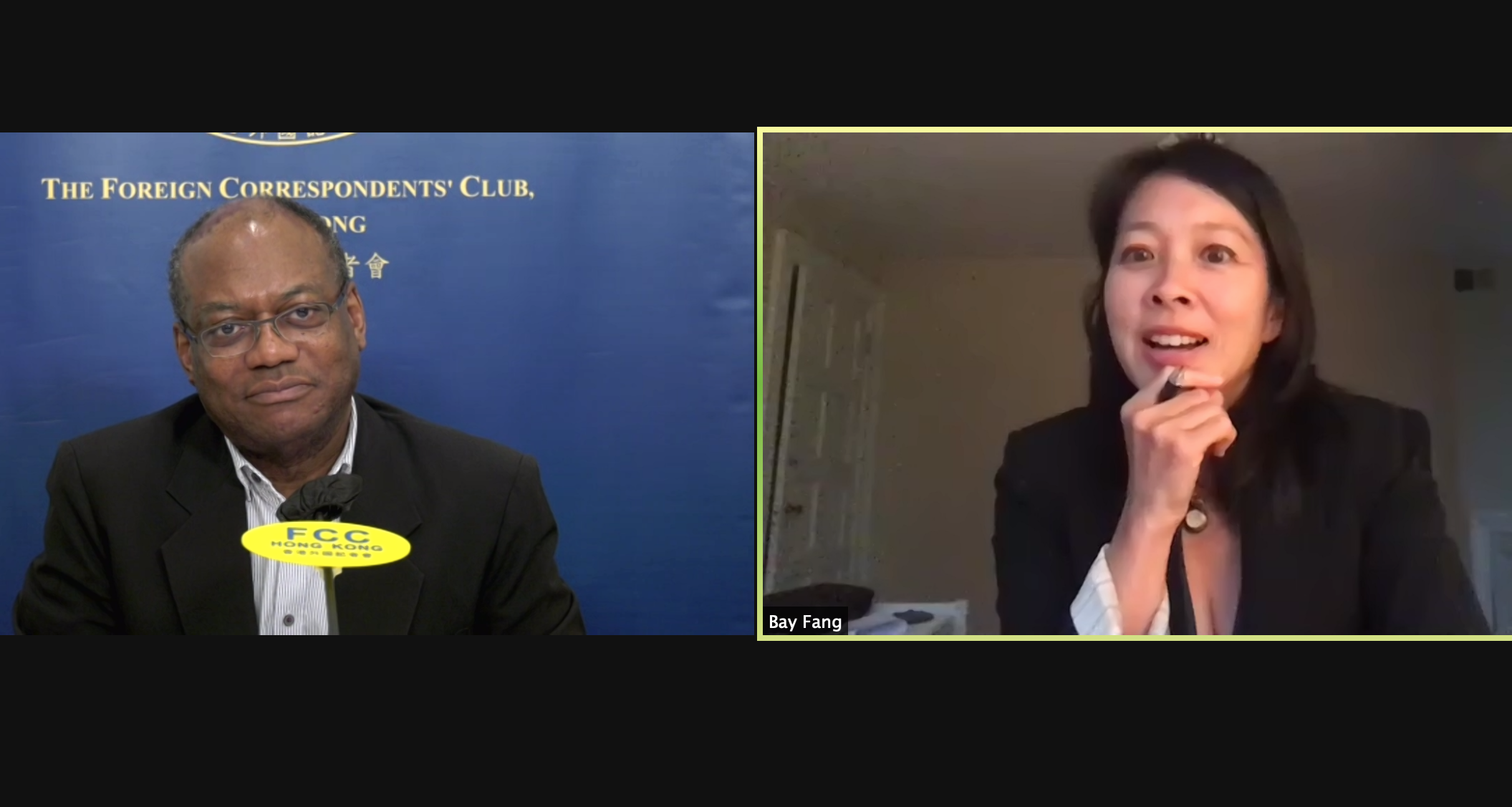
Bay Fang FCC President Keith Richburg and Radio Free Asia president Bay Fang

Publicly-funded news organisations require firm protections from political influence in order to maintain editorial independence and avoid becoming propaganda units, said Bay Fang, president of Radio Free Asia, in a Zoom webinar hosted by the FCC.

“One of the reasons that the firewall is so important, especially for a news organisation like [Voice of America] or RFA, is because we’re publicly funded,” Fang said. “Our job is not to do propaganda. Our job is to model what a free press can look like in countries that don’t have it.”

Without that editorial independence, Fang said, “The obvious attack that we would get from a country like China or any authoritarian country that we’re broadcasting to is, ‘They’re just doing the bidding of the government that runs them. They’re not really telling you the truth about what’s happening around you, so why listen to them?’”

Despite a separation between the U.S. government and RFA’s editorial operations, Fang herself is no stranger to political interference, as she explained to FCC President Keith Richburg. 

In June 2020, when Michael Pack was appointed CEO of the U.S. Agency for Global Media, he proceeded to fire Fang and other heads of broadcasting outlets under his control, replacing them with Trump loyalists. Pack was later asked by President Biden to submit his resignation on Inauguration Day, and Fang was reappointed to her former role a few days later. 

Now in its 25th year, Radio Free Asia produces broadcasts and online news in nine Asia languages, including Mandarin, Burmese and Uyghur. Fang spoke openly about the challenges facing RFA’s on-the-ground reporters, noting that some in Myanmar are currently in hiding, while six of their Uyghur reporters have had family members seized and placed into detention camps.

Despite the difficulties facing reporters, Fang said most had turned down offers either to leave dangerous locations or Radio Free Asia altogether. She attributed this to RFA’s mission and its reporters’ belief in it.

“I think our particular mission is unique,” Fang said. “To come here, you have to really believe in the mission.”

Watch the full discussion here:


Notice to members re COVID-19

Notice to members re COVID-19

Dear Members:

In light of recent cases in Central, the Club’s priority is to maintain a safe and healthy environment for staff, members and guests. Out of an abundance of caution, we would like to ask that any Member who is living with or has been in close contact with a person issued with a government compulsory testing order, to obtain a Covid test and refrain from using the Club facilities until they have received a negative result. For the latest list of restricted premises, please refer to the Government Gazette at https://www.gld.gov.hk/egazette/english/gazette/toc.php

In keeping with government requirements, all members and guests are required to scan the QR code displayed at the entrance of the club with the “LeaveHomeSafe” app, or to register their personal details at the front desk when checking in.
For more information please contact the Club via email [email protected] or phone 2521 1511.
We would like to thank you for your understanding and support during these special times.


FCC Minimum Spend

FCC Minimum Spend

Dear Members:

Whilst the FCC has continued to operate despite the COVID-19 related restrictions, the Board is aware that some members have not been able to fully utilise their membership in recent months. In consideration of this, it has been agreed that the minimum spend requirement which would normally be charged to members at the end of March will be rolled over for three months and will now appear on members’ June accounts. The facility to purchase vouchers for later use will also continue to be available. We would like to take this opportunity to thank all members for their continued support of the FCC.

15 March 2021


Legendary Investigative Journalist Bob Woodward on the Trump Presidency

Bob Woodward Keith Richburg (left) and Bob Woodward (right)

During Donald Trump’s tumultuous presidency, legendary investigative journalist and author Bob Woodward produced two best-selling books that pulled back the curtain on the often chaotic inner workings of the administration. In Fear, Woodward revealed how aides would try to circumvent Trump’s impulsive decisions, including stealing draft orders from the president’s desk in what Woodward called “an administrative coup d’etat.” In his follow-up book Rage, Woodward uncovered how the president knew early on about the deadly threat posed by the coronavirus pandemic but chose to publicly downplay it.

The FCC invited Woodward to discuss his reporting process, the final days of the Trump presidency and much more.

Watch the full discussion:

Evan Osnos on President Joe Biden, the 2020 Election and American Democracy

Evan Osnos Eric Wishart (left) and Evan Osnos (right)

If anyone knows President Joe Biden well, it’s Evan Osnos. A staff writer at The New Yorker, Osnos is the author of Joe Biden: The Life, the Run, and What Matters Now, which was released in October 2020.

The FCC invited Osnos to participate in a virtual book talk to discuss his biography, which draws on lengthy interviews with Biden and conversations with more than a hundred others, including President Barack Obama, Cory Booker, Amy Klobuchar, Pete Buttigieg, and a range of advisers, opponents and Biden family members to examine how Biden overcame personal tragedy to become the 46th president of the United States.

Watch the full discussion here:

What Are the Implications of the Military Coup in Myanmar?

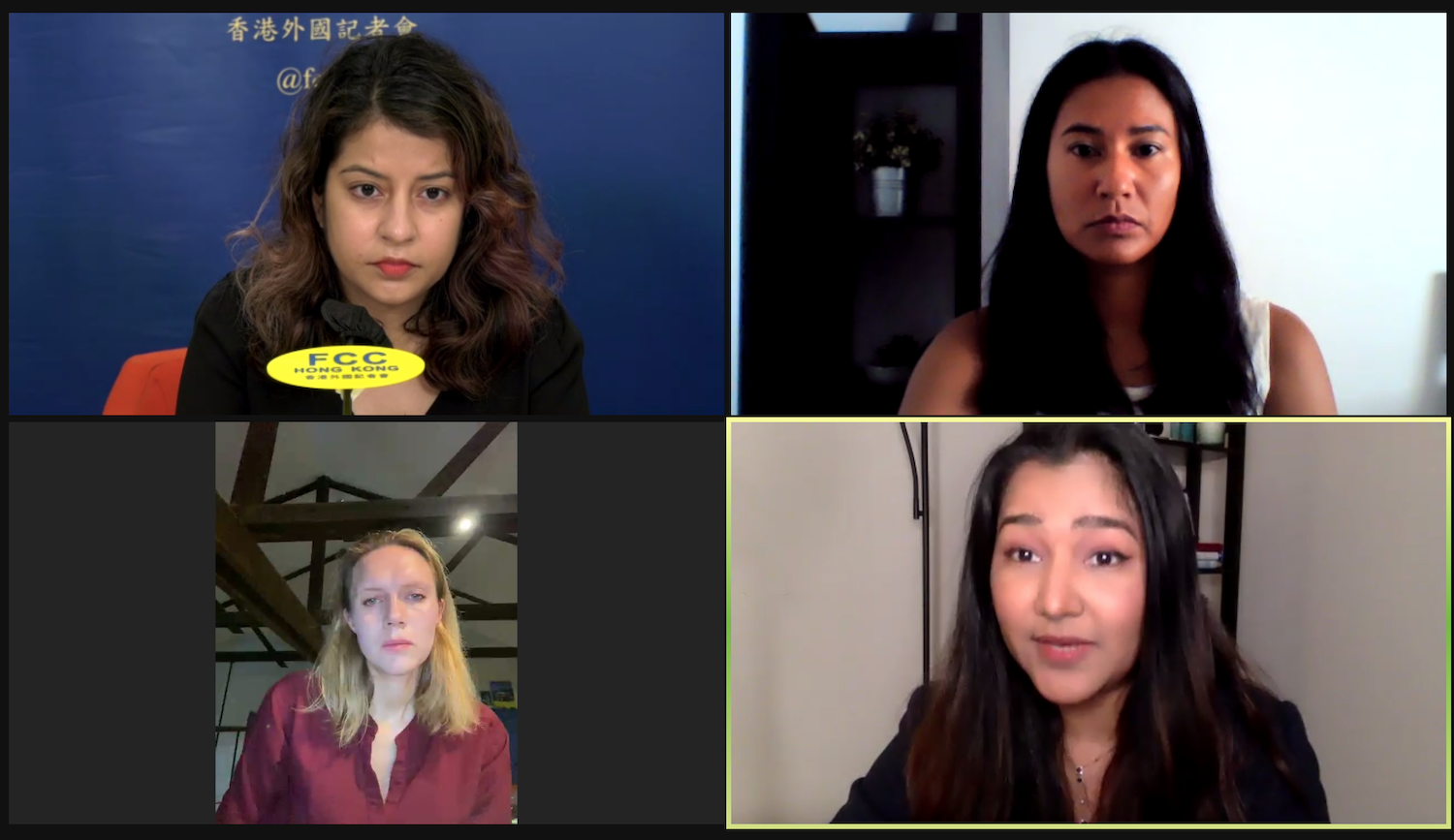
Myanmar Panel Clockwise from top left: Shibani Mahtani, Manny Maung, Wai Wai Nu, Ali Fowle

In a pre-dawn operation on February 1, Myanmar’s military moved to take control of the government, detaining civilian leader Aung San Suu Kyi and other elected officials in a coup. The scale of the detentions has grown to more than 400 people as the military tries to keep a lid on mass protests and a growing civil disobedience movement aimed at undermining their illegitimate hold on power. In a country already scarred by memories of brutal crackdowns in 1988 and 2007, soldiers and police are using increasing force against protesters to cement the junta’s grip on power.

Where does Myanmar go from here, and what does a return to military rule mean for its myriad of ethnic minorities, including Rohingya Muslims inside and outside the country? The FCC hosted a discussion on this topic with Ai Fowle, Manny Maung and Wai Wai Nu.

Watch the full event:

Panel: Freedom of Speech Should Be Limited in Some Circumstances

Social Media Bans Panel Clockwise from top left: FCC First Vice President Eric Wishart, Alejandro Reyes, Craig Silverman, Maria Ressa

Freedom of expression has its limits when it comes to spreading falsehoods and promoting real-world violence, a panel of experts including Maria Ressa, Craig Silverman and Alejandro Reyes said on Tuesday night. Participating in a virtual discussion which was moderated by FCC First Vice President Eric Wishart, the panelists agreed that social media platforms have the right to ban users based on their online activity. 

“It is definitely not an infringement on freedom of speech,” said Ressa, the CEO and president of Rappler.com. “We have to think about this as, ‘Here’s the public sphere and what are the guidelines?’ so that you can exchange ideas and actually talk instead of having influence operations or hate, disinformation and conspiracy theories thrown at you.”

“There’s no question that they should have the ability to remove people from their platforms, they should have policies” said Silverman, the media editor of BuzzFeed News and author of the Verification Handbook. “But at the same time, are they enforcing these things evenly, and are they even able to enforce them?”

He explained that platforms such as Facebook and Twitter have a spotty track record when it comes to policy enforcement, which can lead to violent events like the U.S. Capitol insurrection.

Reyes, a visiting associate professor at the Asia Global Institute, agreed that platforms have the right to remove users as they see fit but raised concerns about governments pressuring social media companies to take these steps.

“Where we should be concerned is really the kind of situation that Maria faces in the Philippines, where you have a constitutional authoritarian system where ambiguity reigns and there’s weaponisation of laws and social media to silence people who want to speak truth to power,” he said.

Given that so-called fake news laws and tech companies’ internal policies have failed to control the rise of disinformation, extremism and violence, the panelists agreed that new solutions to these problems are urgently needed.

“For me the first step is: please stop the virus of lies that come into our information ecosystem,” said Ressa, “and that’s got to be done through legislation.”

With research showing that lies tinted with anger and hate tend to spread faster than facts, she argued that social media platforms can be viewed as inherently biased against facts and honest journalism. 

Silverman advocated for specific legislative actions from democratic governments. “I think legislating around transparency and behavioural manipulation and setting some guardrails for those things may actually be doable,” he said.

Similarly, Reyes highlighted the importance of governments reviewing how social media platforms profit from spreading disinformation and conspiracy theories.

Still, even if democratic governments rise to the challenge of enacting legislation that makes social media platforms more accountable, that may not be enough to solve the complex problems facing society.

Instead, governments around the world need to think about how to prepare their citizens to navigate an increasingly chaotic information environment and train them to identify reliable information sources.

“That is a long-term project but we need to be investing in it now and testing ways of teaching news literacy,” said Silverman. “That would certainly reduce the amount and spread of false and misleading information.”

Given the abundance of information sources and the ease of spreading it via social networks, Silverman argued that personal responsibility is at an all-time high.

“That is a big thing everyone needs to understand: your attention is valuable and the way you spend it, particularly on these platforms, helps to determine what spreads and what doesn’t, so we all have a role.”

Watch the full discussion:

Invite to join the FCC’s Disciplinary Panel


We measure site performance with cookies to improve performance.