
Members Area Logout

Top tips on how to reduce your carbon footprint

Fly direct, fly less, choose vegetarian meals over meat – these were some of the tips shared during a panel discussion on responsible tourism.

Guest speakers Sonalie Figueiras, founder and editor-in-chief of Green Queen; Impact Travel Alliance Vincie Ho, and author and wildlife photographer Jan Latta explored practical ways to enjoy travel without the guilt of increasing your carbon footprint.

While some solutions appeared obvious, the panel members agreed that much more needed to be done by each of us in order to minimize the impact on our environment.

All panelists highlighted useful resources to help us understand and monitor how we can be greener when we travel. Sky Scanner, for example, now shows your potential carbon footprint when you search flights through its website. The Global Sustainable Tourism Council establishes and manages global sustainable standards and awards accreditation to hotels/accommodations, tour operators, and destinations as having sustainable policies and practices in place.

Another site, Choose.Today offers a subscription that allows you to support effective C02 reduction on a monthly basis. The money goes directly to C02-reducing projects in developing countries that are verified by the United Nations.

A further useful resource highlighted by the panel was the blogging site, In Locamotion, which offers a comprehensive guide to sustainable tourism.

Watch the video
Hong Kong Protests: Experts offer guide to the evolution of weaponry and tactics

The physical and legal risks for journalists covering the increasingly violent Hong Kong protests were outlined by two experts at the FCC on October 23.

Sharron Fast, Deputy Director of Master of Journalism Programme and lecturer at University of Hong Kong, discussed the anti-mask law introduced by the HKSAR using emergency powers on October 5. She said there was much uncertainty surrounding the ban, particularly for journalists lawfully covering an unlawful protest. She also said she was certain the law doesn’t protect freelance journalists and students.

Fast was joined at the breakfast briefing by Stevo Stephen, News Risk Senior Manager for the Wall Street Journal, who demonstrated the evolution of weapons and tactics by both the Hong Kong Police and protesters since the unrest began in June.

Watch the video

The challenges China faces in securing global dominance

China’s foreign relations have come a long way in the last 70 years, but major powers are held to higher standards and more is expected of Beijing, according to an expert on contemporary China.

Professor David Shambaugh outlined some of the major challenges facing China, including how it manages its reputation among its neighbours, and globally.

Speaking at the October 22 club lunch, Prof Shambaugh said another challenge the country faced was its relationship with the United States, which he said had deteriorated in recent years because the previously dominant cooperative element had been superseded with a competitive element. At the same time, China had significantly strengthened its relationship with Russia, he said, a relationship that at its core was driven by anti-Americanism.

“The so-called strategic triangle is back and orientated again at the United States at this time,”  Prof Shambaugh, the Gaston Sigur professor of Asian Studies, Political Science & International Affairs, and director of the China Policy Program in the Elliott School of International Affairs at George Washington University in Washington, said.

He pointed to China’s multibillion-dollar investment in overseas propaganda as an example of its push for soft power but suggested it wasn’t getting a “return on its investment” as it slips down the global image rankings.

Watch the full video here

Video and photojournalists reveal life on the frontline of the Hong Kong protests

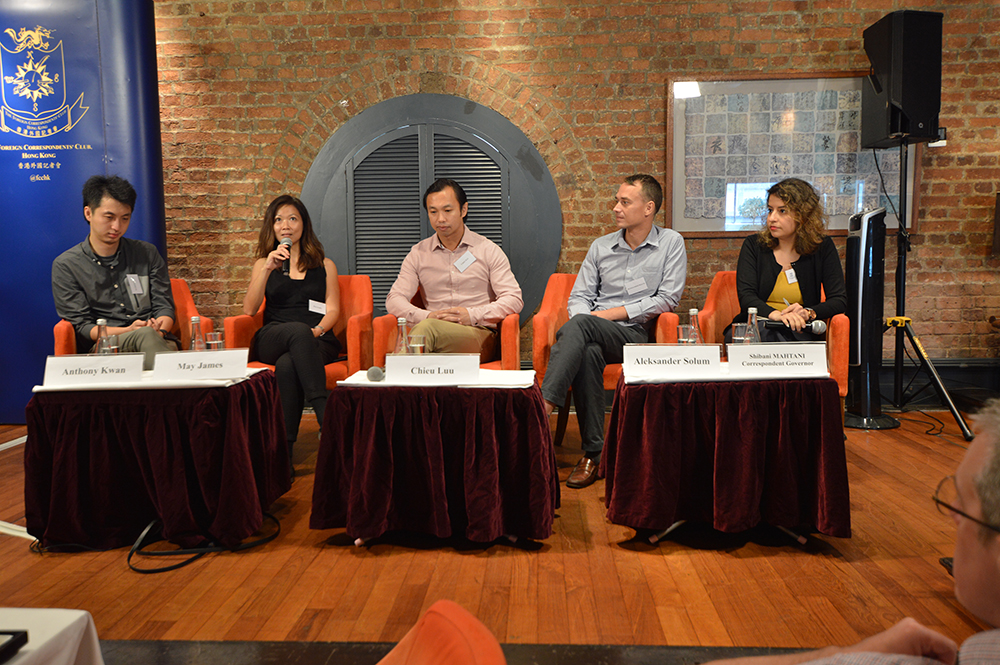
A panel of experienced video and photojournalists shared their on-the-ground experiences of covering the ongoing Hong Kong protests at a discussion on October 15.

L-R: Anthony Kwan, May James, Chieu Luu, Aleksander Solum, and moderator Shibani Mahtani. Photo: Sarah Graham/FCC L-R: Anthony Kwan, May James, Chieu Luu, Aleksander Solum, and moderator Shibani Mahtani. Photo: Sarah Graham/FCC

The panelists spoke amid increasing concern over the safety of the media covering the protests, after an Indonesian photographer was left blind in one eye from a police bean bag round, and a NowTV driver was allegedly attacked by police and left with injuries.

Photographers May James, who has been covering the protests for a variety of local and international outlets including Hong Kong Free Press and AFP; and Anthony Kwan, a prize-winning photojournalist who has been covering the protests over the past months primarily for Getty, both agreed that arguing with the police during protests was not advisable.

Joining them on the panel were Chieu Luu, video journalist for South China Morning Post; and Aleksander Solum, a senior video journalist at Reuters Video News. The two men agreed that, when recording while tensions are running high, the safety of their teams remains the top priority.

I’m in charge of keeping my team safe – no shot is worth one of my team members getting hurt,” Chieu said.

Statement on FCC Board Members Meeting With Police Representatives

A delegation from the Board of Governors of the Foreign Correspondents’ Club led by President Jodi Schneider met on Oct. 10 with representatives of the Hong Kong Police Force.

The meeting stemmed from a letter the FCC first sent to Police Commissioner Stephen Lo Wai Chung on August 11. It highlighted a series of grave concerns about the increasing number of incidents of police violence against journalists covering the Hong Kong protests and proposed measures that could rebuild confidence between the police and the media.

Since the FCC sent the letter on August 11 and re-sent it on Aug. 27 and Sept. 30, violence against journalists covering the unrest has escalated — as have attempts by police to interfere with press coverage, which is a right granted under Hong Kong law.

Examples the FCC representatives shared with the police included deliberate spraying of tear gas and pepper spray at journalists as well as attempts to stop the media from filming events, blocking cameras and flashing strobe lights at the press while they are reporting on events.

Most concerning has been the case of Indonesian journalist Veby Mega Indah, who has been left without sight in her eye after she was hit by a police rubber bullet. She was visibly identified as a member of the press and was standing apart from protesters at the time she was hit.

At the meeting we emphasised that journalists have taken steps to clearly identify themselves, including adopting yellow vests, carrying professional identification and marking other gear clearly.

Tensions have risen further since the face mask ban took effect on Oct. 5. The FCC’s position, which was made clear to the police representatives, is that journalists are authorized to wear masks when covering protests on the grounds of professional safety.

The exchange was open and frank. Police representatives acknowledged the FCC board members’ concerns about violence against journalists and attempts to interfere with media coverage, agreed to communicate them internally and asked that we continue to engage in dialogue with the police. The FCC welcomes this opportunity as part of its efforts to promote press freedom and the rights of journalists.

IPI condemns growing violence against Hong Kong press

The International Press Institute (IPI), a global network of editors, media executives and leading journalists for press freedom, today (October 4) called on authorities in Hong Kong to put an end to growing harassment and targeted attacks on journalists covering ongoing protests.

Read the statement here

Possibility of China using military force in Hong Kong “quite low” says expert in Chinese politics

China’s Communist Party has learned from the past and wants to resolve conflicts without force, a tactic it is currently trying with regards to the current unrest in Hong Kong, according to an expert in Chinese politics.

Professor Yan Xiaojun, Associate Professor in Politics and Public Administration at the University of Hong Kong, said that China wants to uphold One Country, Two Systems and believes that the city’s government and police were managing the crisis adequately. He said the likelihood of China using military force in Hong Kong was “quite low”.

Prof Yan appeared at the FCC on October 3 to reflect on 70 years of the People’s Republic of China. He said China had transformed from one of the poorest nations into one of the strongest over the last seven decades because the Communist Party had learned lessons from its own history and that of the collapsed Soviet Union.

He said the party understood it had to continue to learn in order to survive.

Watch the video

FCC Security Statement

With the ongoing protests in Hong Kong, the club may, on occasion, see fit to lock its front doors for security reasons, as it did on Saturday afternoon when there was a demonstration rallying point outside the main entrance. The club remained open and access was controlled by our security guard.
 
The safety of our staff, members and their guests is paramount. To that end, on weekends, until further notice, we will ask members who are bringing guests to the club to contact the concierge ([email protected]) ahead of time with the names of their guests. Members attending the club will be asked to show their cards at the door.
 
Club events this week will go ahead as planned.
 
During this period the club will do its best to maintain the high quality of service we have always been proud to offer. We also are proud to be a forum for training, debate and discussion about the Hong Kong protests as part of our long tradition of upholding press freedom. Visiting journalists to Hong Kong are welcome to join us during this period.
We measure site performance with cookies to improve performance.