Members Area Logout

The Hong Kong Protests: An FCC Workshop Series for Journalists

Since June 2019, journalists in Hong Kong have been on the front lines covering what began as anti-extradition bill protests, often dodging tear gas and rubber bullets in the course of their work.

This FCC series of workshops brings together a wide range of experts, from journalists to tech specialists to health professionals, all of whom offer valuable advice for any media covering the protests.

Presentation slides:

Hong Kong Red Cross introduction (PDF)

Hong Kong Red Cross presentation (PDF)

Professor Paul Yip presentation (Slideshare)

Lokman Tsui (PDF)

Fake news panel (PDF)

You can download the Centre of Suicide Research and Prevention’s recommendations on suicide and mental health reporting here.

The Hong Kong Samaritans website can be found here, and the 24/7 hotline number is 2896 0000.

Watch the video series

The Hong Kong Protests: What Next for Hong Kong?

Stevo Stephen: A Workshop on Journalists’ Safety

Sharron Fast: A Workshop on the Legal Risks for Journalists

The Hong Kong Protests and Press Freedom

Lokman Tsui, Assistant Professor: A Workshop on Digital Security

Paul Yip: The Hong Kong Protests – Covering Mental Health and Suicide

Brian Wong: First-Aid and Health Safety

Information Wars – How Fake News and Disinformation Have Been Weaponized in the Hong Kong Protests

From Water Cannons to the Face Mask Ban: Increased Risks in Covering the Hong Kong Protests

Essential First Aid tips for journalists covering the Hong Kong protests

How to treat the effects of tear gas and other protest-related injuries was shared by a member of Hong Kong’s Red Cross at a workshop for journalists.

Brian Wong, senior staff officer for the Hong Kong Red Cross’s First Aid Service Coordination Team, Youth and Volunteer Department, also advised potential first aiders on the treatment of heat exhaustion, cardiac arrest, and bleeding.

He was speaking on September 3 at the latest in the FCC’s series of workshops aimed at journalists covering the ongoing Hong Kong protests.

Due to some technical issues, the talk is in two parts. 

Watch the videos


Ireland prepared to listen to backstop alternatives to avoid no-deal Brexit, says finance minister

Ireland’s finance minister says his government is prepared to listen to any alternative solutions the United Kingdom may have to the question of the backstop, but stressed that so far Prime Minister Boris Johnson had failed to put any forward despite the fast-approaching deadline for Britain to leave the European Union.

Minister of State at Ireland’s Department of Finance, Michael D’Arcy, at the FCC on September 2. Photo: Sarah Graham/FCC Minister of State at Ireland’s Department of Finance, Michael D’Arcy, at the FCC on September 2. Photo: Sarah Graham/FCC

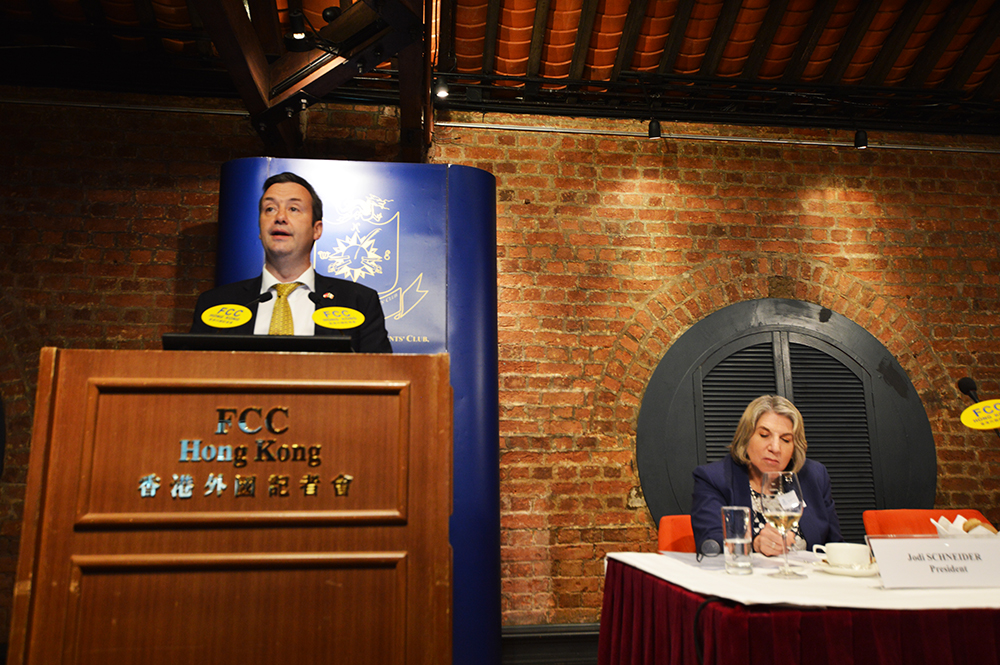
Speaking at the September 2 club lunch, Michael D’Arcy reiterated that the withdrawal agreement thrashed out between the European Union and former British prime minister Theresa May was now non-negotiable but said he personally felt a deal on the issue of the border between the Republic of Ireland and Northern Ireland could be done after the October 31 deadline passes. He said Ireland was committed to exploring alternative agreements with the EU to avoid the return of a hard border which he said put the island’s prosperity at risk. D’Arcy added that avoiding a hard border was not just about economics, but about protecting the Good Friday Peace Agreement.

Referring to his controversial tweet last week in which he compared Prime Minister Johnson’s “anti-democratic” move to prorogue UK Parliament to Oliver Cromwell’s establishment of the Protectorate government, D’Arcy conceded he “shouldn’t interfere with UK Parliament” but added that he felt the current direction of discourse in politics internationally was “disappointing”.

Watch the video

FCC Hong Kong joins FCCC in condemning expulsion from China of WSJ’s Chun Han Wong

The FCC Hong Kong joins the FCCC in condemning Chun Han Wong’s de facto expulsion from China. It calls on the Chinese government to respect media freedom and to allow foreign correspondents to work freely without fear of punitive measures such as non-renewal of their visas. 
FCCC issued the following statement:
The Foreign Correspondents’ Club of China is saddened and angered to learn that Wall Street Journal reporter Chun Han Wong has been effectively expelled from China after authorities declined to renew his press credentials.
As far as the FCCC is aware, Wong is the sixth journalist to leave China under such circumstances since 2013. Many of those who have been evicted are talented and professional correspondents who have sought to understand China and tell its stories in a factual and unbiased fashion.
The FCCC notes with particular concern a statement from China’s Ministry of Foreign Affairs in which it accuses “a few foreign reporters” of “maliciously tarnishing China,” adding: We don’t welcome such reporters.” It was Chinese president Xi Jinping himself who, in 2017, said “we encourage reporters to travel and see more of China… to learn about and continue to report on more aspects of China.”Expulsions of journalists from China amount to an extreme attempt by Chinese authorities to punish news organizations that conduct factual work that does not cast the country or its leadership in a flattering light. Foreign correspondents are not propaganda workers, and should not be treated as such.
The FCCC condemns in the strongest possible terms the use of visa non-renewal as a form of punishment. Such treatment of foreign correspondents runs completely counter to Chinese claims that it supports openness and inclusiveness. Such actions should raise further concerns as China prepares to host major future global events, such as the Winter Olympics in 2022.

Is the Sino-British Joint Declaration dead? Two experts give their views

The question of whether the Sino-British Joint Declaration was dead was the topic of debate at a sold-out club lunch on August 29.

Left: Alan Hoo, Chairman of The Basic Law Institute, and, right lecturer at CUHK’s Centre for China Studies, Tim Summers. Photo: Sarah Graham/FCC Left: Alan Hoo, Chairman of The Basic Law Institute, and, right lecturer at CUHK’s Centre for China Studies, Tim Summers. Photo: Sarah Graham/FCC

Guest speakers Alan Hoo, Chairman of The Basic Law Institute, and lecturer at CUHK’s Centre for China Studies, Tim Summers, gave their views on the relevance of the document, drawn up between Britain and China as part of an agreement to hand sovereignty back to China.

Both speakers also gave their take on the current protests gripping Hong Kong, and what they determined to be the next steps to resolving the crisis.

Watch the video

Essential tips for Hong Kong journalists reporting suicide and mental health issues

The media’s role and its responsibilities in reporting suicide and mental health issues were outlined in a workshop for journalists, part of an FCC series focused on the Hong Kong protests.

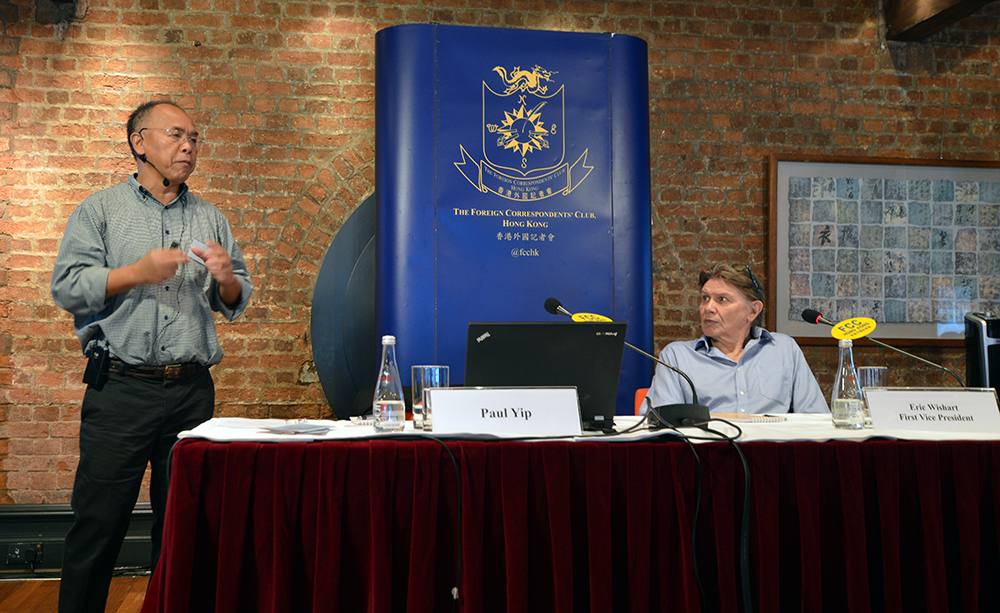
Professor Paul Yip, Director of the Centre of Suicide Research and Prevention at HKU, gives reporting tips to journalists. Photo: Sarah Graham/FCC Professor Paul Yip, Director of the Centre of Suicide Research and Prevention at HKU, gives reporting tips to journalists. Photo: Sarah Graham/FCC

Following rumours and speculation about a number of suicides that were directly linked by some Hong Kong media to the ongoing protests in the city–and giving details of how they were carried out–Professor Paul Yip, Director of the Centre of Suicide Research and Prevention at the University of Hong Kong, issued advice to journalists covering the topic at a breakfast briefing on August 27.

Prof Yip encouraged media professionals to provide more information around suicide prevention to help raise awareness of the support available to those experiencing mental health issues. He also advised journalists covering the Hong Kong protests to take rest for the sake of their own physical and mental health.

An audience member and representative of the Hong Kong Samaritans revealed that the nature of calls to the organisation’s hotline had recently changed, with many callers worried about the protests.

You can download the Centre of Suicide Research and Prevention’s recommendations on suicide and mental health reporting here.

The Hong Kong Samaritans website can be found here, and the 24/7 hotline number is 2896 0000.

Watch the breakfast briefing

FCCC statement on search and detention risk for journalists travelling between Hong Kong and China

The Foreign Correspondents’ Club of China has warned that journalists travelling between Hong Kong and China risk being detained and having their digital devices searched.   

“Journalists travelling through Beijing and Shenzhen have been subjected to such searches, which have in some cases involved detention of several hours”, the FCCC said in a statement.

“The FCCC strongly condemns any use of border powers by Chinese authorities to target properly-accredited journalists for search and detention” and added that “unnecessary and arbitrary searches constitute intimidation and harassment”.

It warned that “particular care” should be taken with devices that contain confidential material.

The Foreign Correspondents’ Club of China has received multiple reports in recent days and weeks of Chinese border officials detaining journalists and searching their digital devices when travelling between the mainland and Hong Kong.

Journalists travelling through Beijing and Shenzhen have been subjected to such searches, which have in some cases involved detention of several hours. Officials have searched phones, cameras and laptops belonging to journalists who work for at least five organizations headquartered in North America and Europe. In at least one instance, a correspondent was barred from using a phone to notify others of the detention.

The FCCC strongly condemns any use of border powers by Chinese authorities to target properly-accredited journalists for search and detention. In some cases, officials have cited non-existent visa problems as grounds for detention.

Unnecessary and arbitrary searches constitute intimidation and harassment and hamper correspondents’ ability to report freely and openly in mainland China and Hong Kong.

The FCCC also warns correspondents to be mindful of the possibility of search and detention when returning to mainland China from Hong Kong. Particular care should be taken with electronic devices that may contain confidential material.

FCC expresses ‘grave concern’ over attack on journalist at Hong Kong Airport protest

The Foreign Correspondents’ Club expresses grave concern over the attack by protesters on a journalist at Hong Kong International Airport on Tuesday, August 13, 2019.

A reporter from Global Times was assaulted and detained by people protesting at the airport who tied his hands with plastic straps.  

We call on protesters to respect the right under Hong Kong law of journalists, regardless of nationality or news organisation, to cover events free from intimidation or violence.

The FCC has become alarmed by the growing number of reports of violence toward journalists by protesters, including attacks last week on vehicles belonging to TV station TVB.

Attacks on members of the media doing their job are unacceptable, regardless of the allegiance or views of the perpetrators.

We have called on the Hong Kong Police Force to respect the freedom of the press and the right of journalists to cover events, including protests and other police operations, unfettered and free of violence and threats.

Those who have concerns with a news organisation’s coverage can express their views on social media, in comments sections and other forums, but under no circumstances should they harass frontline journalists and block them from doing their job.

The Foreign Correspondents’ Club stands with the Hong Kong Journalists Association, the Hong Kong Photojournalist Association and with freelance and unaffiliated journalists in condemning acts of violence directed at the media and in demanding protesters, the Hong Kong government and the police all respect Hong Kong’s long tradition of press freedom.

The FCC’s open letter to the Hong Kong police commissioner Stephen Lo Wai Chung can be found here.

香港外國記者會對於2019 年8月13日(周二)有傳媒在香港國際機場受到襲擊表示嚴重關注。

《環球時報》的一名記者遭到機場抗議人士的襲擊和拘留,並被他們用膠索帶綁手。

我們呼籲示威者尊重本港法律為所有不同國籍及傳媒機構的記者提供保障,讓他們在進行采訪時免受恐嚇及被暴力對待。

香港外國記者會對愈來愈多有關示威者暴力對待記者的報導感到震驚,包括上周無綫電視台的採訪輛車受到襲擊。

無論犯事者所擁護的觀點如何,在傳媒工作者在履行職責時襲擊他們都是不可接受的。

我們已經呼籲香港警察尊重新聞自由,讓記者能夠在不受阻擋及沒有暴力威脅的情況下采訪示威和警方行動及其他事件。

關注個別新聞機構的報導的人士可以在社交媒體、網上評論區和其他論壇表達他們的觀點,但在任何情况下都不應該騷擾前線記者及阻礙他們工作。

香港外國記者會與香港記者協會、香港攝影記者協會以及自由撰稿人和獨立記者一起譴責針對傳媒的暴力行為,並一致要求示威者、香港政府和警察尊重香港長期以來新聞自由的傳統。

香港外國記者會致警務處處長盧偉聰的公開信可以在此下載:

https://www.fcchk.org/fcc-letter-to-hong-kong-commissioner-of-police-lo-wai-chung-stephen/

Notice: Fire Drill

Essential tips for journalists on digital security while covering Hong Kong protests

Digital security expert Lokman Tsui gave tips and insights into how journalists can take precautions to protect themselves, their work and their sources’ digital communications while covering politically sensitive events. 

What apps and email providers to use, how to adjust your phone settings to protect hackers and police interference, and what news organisations can do to better protect their reporters were topics that were covered during the August 13 briefing by the Assistant Professor at the School of Journalism and Communication, the Chinese University of Hong Kong.

The event took place the day after the club sent an open letter to Hong Kong Police Commissioner Stephen Lo outlining concerns over the deterioration in relations between the police and the media covering the Hong Kong protests. 

Watch the video here

We measure site performance with cookies to improve performance.