
Members Area Logout

FCC Hong Kong calls for immediate release of Reuters journalists held in Myanmar

The Foreign Correspondents’ Club of Hong Kong calls for the immediate release of Wa Lone, 31, and Kyaw Soe Oo, 27, two Myanmar journalists with the Reuters news agency who were arrested on Wednesday.
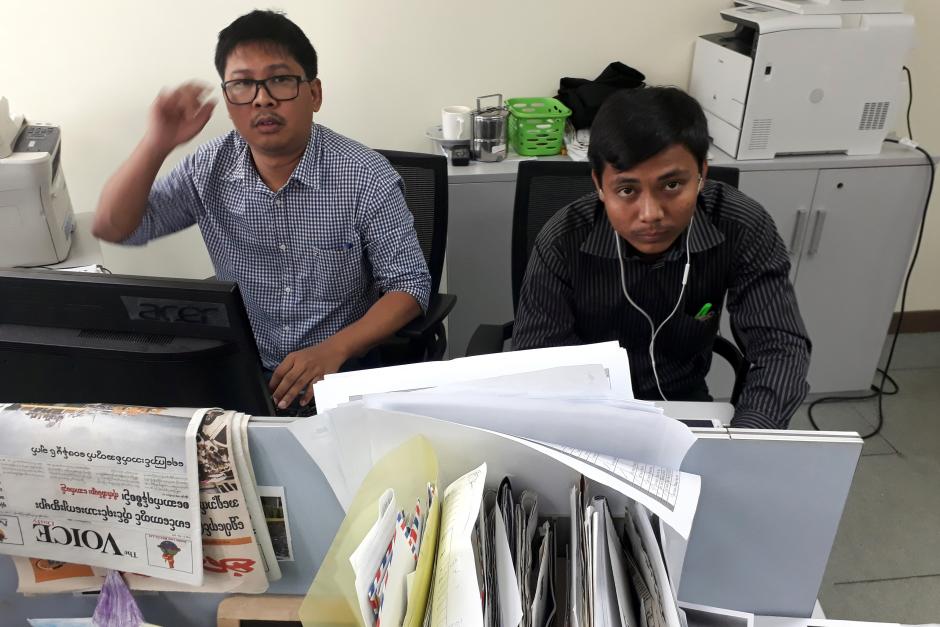
Reuters journalists Wa Lone (L) and Kyaw Soe Oo, who are based in Myanmar, pose for a picture at the Reuters office in Yangon, Myanmar December 11, 2017. Picture taken December 11, 2017. REUTERS/Antoni Slodkowski Reuters journalists Wa Lone (L) and Kyaw Soe Oo, who are based in Myanmar, pose for a picture at the Reuters office in Yangon, Myanmar December 11, 2017. Picture taken December 11, 2017. REUTERS/Antoni Slodkowski

The pair have been charged under a section of the Official Secrets Act that carries a maximum sentence of 14 years in prison. The government has released a photograph of them wearing handcuffs with documents displayed before them.

Reuters has expressed its outrage over the arrest and accused Myanmar authorities of an attack on press freedom.

The US State Department has also voiced concern for the “safety and security of international reporters who are simply just trying to do their jobs”.

Wa Lone and Kyaw Soe Oo have both recently reported on the refugee crisis in Myanmar’s Rakhine state, where a deadly military “clearance operation” has resulted in more than 600,000 ethnic Rohingya Muslims fleeing into Bangladesh.

Their arrest is part of a deepening crackdown on freedom of expression in Myanmar, which is facing severe criticism from the international community for its handling of the Rohingya crisis.

Journalists have been banned from travelling independently to northern Rakhine to investigate the circumstances of the crackdown, and verify refugees’ accounts of murder, mass rape and burning of villages by security forces.

In November, two foreign journalists along with their interpreter and driver were sentenced to two months imprisonment for filming with a drone without official permission. And in June three journalists were detained in war-torn northern Shan state and spent two months in custody.

As Myanmar undertakes its transition to democracy, it is vital that the country respects the beneficial role of a free and independent media and ensures that journalists are able to do their work without threat of retaliation.

The arrest of these two Myanmar journalists under the Official Secrets Act is unacceptable and counterproductive in a country aiming to take its place in the international community after decades of military rule.

Who are the winners and losers in the war for China’s wallet?

The war for China’s wallet is being won through consumerism as industries like manufacturing and finance find it increasingly difficult – and costly – to do business there, according to the founder of a top market research group.

Shaun Rein gave insights into how to do business in China at the FCC club breakfast. Photo: Sarah Graham/FCC Shaun Rein gave insights into how to do business in China at the FCC club breakfast. Photo: Sarah Graham/FCC

Additionally, protectionism and nationalism are driving mainland Chinese consumers to buy domestic goods rather than foreign made products, said Shaun Rein, author of the new book The War For China’s Wallet which aims to help companies understand how to profit from China’’s outbound economic plans.

At the centre of this domestic boom is President Xi Jinping, who has consolidated Communist Party power by taking firmer control of business and overseas investment. The world’s largest or second largest trading partner for most countries, China is seen as the obvious destination for foreign investment. But President Xi’s campaigns, such as the crackdown on corruption, and the economic punishment of countries that speak out against China, has created an environment of mistrust among those trying to do business in the country.

“I think it’s clear that not everyone will make money in China,” said Rein, managing director of CMR China, adding: “If you’re on the consumer side, there’s lots of money.

“China is no longer a cheap place to do business. The cost of doing business is crazy high,” he said at the December 12 club breakfast.

Rein pointed out that foreign brands including KFC and Starbucks make a huge profit in China. But he warned that multinationals were increasingly adhering to the political goals of Beijing in order to operate there. Publicly backing the One Belt, One Road initiative – President Xi’s development strategy to establish trade routes between Eurasian countries – is one way of staying in favour with the Communist Party. Those who speak out against China, said Rein, risk economic punishment or outright banishment. He gave the example of the Philippines, whose mango imports to China were blocked after an international tribunal on territorial disputes ruled in favour of the Philippines. The block was lifted once Rodrigo Duterte came to power in the Philippines and declared allegiance to China over America.

“The theme of the book is that China punishes and rewards countries,” Rein said. But he added that now China has also started punishing foreign companies for the actions of their countries’ governments, citing South Korea’s Lotte Group, which provided land in South Korea for the U.S. THAAD missile system.

Rein said the “methodical, systematic plan” to garner support for the One Belt, One Road initiative was the result of a “divide and conquer” strategy on the part of the Chinese government.

He predicted that multinational financial services would continue to suffer in China, but that foreign insurance companies would flourish, as would wealth management.

How North Korea’s burgeoning middle class is painting a new picture of life in the DPRK

The traditional picture painted by the media of North Koreans as an impoverished people is outdated thanks to a burgeoning middle class – but the dark days of starvation may not be far away if sanctions continue to be imposed on the world’s most isolated nation.

Author Nick Bonner showed graphics from his new book, Made in North Korea: Graphics from Everyday Life. Photo: Sarah Graham/FCC Author Nick Bonner showed graphics from his new book, Made in North Korea: Graphics from Everyday Life. Photo: Sarah Graham/FCC

That was the opinion of Nick Bonner, author, filmmaker and founder of a North Korean tour group who shared his insights into the DPRK having spent the last 25 years traveling to and from it.

Bonner’s new book, Made in North Korea: Graphics from Everyday Life, uses an extensive collection of graphics and North Korean propaganda artwork to tell the story of how the country has evolved over the last two decades.

Through slides showing various graphics and products, like cigarette packets, he explained how colour illustrated eras the country was going through: vibrant primary colours in the 1970s to promote the country’s virtues, against the greys and browns of the 90s during North Korea’s economic crisis which resulted in widespread famine.

The landscape architect first visited North Korea in 1993, which then inspired him to start Koryo Tours – a Beijing-based travel agency specialising in travel to North Korea. Bonner has produced three award-winning documentaries about the country, as well as North Korea’s first ‘girl power’ movie — ‘Comrade Kim goes Flying’ — which became the first-ever North Korean film to be shown to a public audience in South Korea.

But today’s North Korea – particularly its capital, Pyongyang, paints a different picture. Using his own photographs – one showing a child on a shiny red bicycle carrying a dried fish – Bonner showed the wealth element in the country’s everyday life. Some of this influence came from China, he said.

“Shops in the Metro are full of Chinese (made) rubbish – things that glow, things that are shiny,” he said, adding that market reform in 2002 meant that the import of foreign products brought about greater prosperity. “With products coming in from abroad…it’s given North Korea a kick to make their own products and repackage them.”

However, sanctions imposed as a result of leader Kim Jong-un’s ongoing spat with United States President Donald Trump could see a return to the North Korea of old, Bonner warned, adding that it would be more productive to engage the country rather than isolate it further.

There’s hope for the Ganges but the biggest clean-up push is yet to materialise, says author Victor Mallet

The Ganges – a river so revered that she is worshipped as a goddess by Indians. Yet the world’s third largest river is highly polluted by the 400 million people who live on her banks.

Journalist, author and FCC board member Victor Mallet discussed the threats facing India's Ganges river. Photo: Sarah Graham/FCC Journalist, author and FCC board member Victor Mallet discussed the threats facing India’s Ganges river. Photo: Sarah Graham/FCC

And, ironically, part of the reason for this abuse of the sacred river is its goddess status: many Indians simply believe that there is nothing they can do to harm it, said journalist and author Victor Mallet during a club lunch on his new book, River of Life, River of Death: The Ganges and India’s Future.

The book, the result of years fo research on the environmental issues affecting the Ganges – believed to be the embodiment of Ma Ganga, Hinduism’s mother-goddess – explores how India’s government could derive “co-benefits” in other areas of society by sanitising the river, such as creating jobs and lightening the burden on healthcare.

“Indians are killing the Ganges and, in turn, the Ganges is killing Indians,” Mallet, an FCC board member, explained.

Flowing from the eastern Himalayas, through the Plain of North India and into Bangladesh, the river is now under serious threat from human sewage, toxic waste, antibiotics, fertiliser and pesticides, he said. A series of dams along its course means that, in places, it can sometimes run dry outside of monsoon season. And a lack of accountability within successive Indian governments has played a large part in the decline of the river, Mallet added.

However, Mallet is optimistic that the river can be saved. He draws comparisons with other rivers such as the Thames and the Rhine, once both heavily polluted but now home to thriving ecosystems. He was also hopeful that India’s prime minister, Narendra Modi, would deliver on his promise of cleaning up the river.

“He’s very much committed verbally to doing this,” Mallet said, “but there’s a debate as to whether he could have done more.”

Mallet noted a further problem: that the campaigners he had spoken to in India during his extensive research for the book had turned out to be the same people who had spoken to writers decades before – indicating that “a lot of young Indians are not really engaged in what should be an important mission”.

He concluded: “There are small signs of progress but the biggest push has not started yet.”

Britain should offer right of abode to BNO passport holders, says Lord Ashdown as he sets up Hong Kong Watch

Britain should offer Hong Kong’s BNO passport holders right of abode in the UK if in the future conditions deteriorate in the SAR as it reintegrates with China, says former Liberal Democrat leader Paddy Ashdown.

Lord Ashdown spoke about China's rise and its effect on world peace. Photo: Sarah Graham/FCC Lord Ashdown spoke about China’s rise and its effect on world peace. Photo: Sarah Graham/FCC

The former Royal Marine, in Hong Kong on a fact-finding exercise, said he would “favour very strongly the BNO being extended to the right of abode if it is the case that the conditions in Hong Kong are created by whatever force that enables those who hold the BNO passport to feel so vulnerable that they can’t live here any longer”.

However, the SAR passport “is probably a better travel document than the BNO”, he added.

The BNO (British Nationals Overseas) passport was created in 1987 and is issued to permanent residents of Hong Kong. Holders can visit the UK for up to six months.

Lord Ashdown revealed that he was in Hong Kong to set up a parliamentary system called Hong Kong Watch. He said: “It’s not just directed at one side of the joint agreement, it’s there to act as a prod for the British Government too. The British Government is now obsessed with Brexit (and) trying to build trade deals – it’s a huge plum for the British to have a trade deal with China.

“We must ensure that Britain fulfils its legal and duty of honour to Hong Kong and we’ll be doing that. It will look at the actions of both sides and it will act as a whistleblower.”

Lord Ashdown criticised Britain’s handling of Hong Kong’s handover to China, saying there was a degree of hypocrisy beneath its calls for democracy.

“British rule in Hong Kong was economically successful. But politically it was shameful,” he said, adding that a promise that the city “would never have to walk alone” is not a promise that “can be broken because it proves inconvenient to a British government obsessed with finding trade deals because it wishes to be outside Europe”.

“What happens next here in Hong Kong will be judged by a watching world,” he said.

Opening his speech at the sold-out November 28 club lunch, Lord Ashdown discussed China’s rise as a super-power and its effect on world peace. He said Hong Kong would be the testing ground for President Xi Jinping’s vision of “socialism with a Chinese face”.

“We live in one of those periods of history where the structures of power in the world shift,” he said. “How new powers rise and old powers fall is one of the prime determinants of peace in times like this. The Pacific basin is to be the cockpit in which this drama is about to be played out.”

Lord Ashdown said on many levels China appeared to be moving in the right direction: intent on building its reputation as a good world citizen, seeking to consolidate its trading strength and fill the “vacuum of leadership in regional and global multilateral institutions left by President Trump’s retreat from this space”.

“I do not think China’s true long term interest lies in responding to Donald Trump’s invitation to a dog fight, albeit one which appears to have been postponed after Mr Trump’s effusive glad handling with Chairman Xi,” he added.

However, he said China’s curbs on freedom of speech could not be sustainable: “It is just not in human nature, whether Chinese or otherwise, to be content for long with glorious freedom in one aspect of your life and permanent voicelessness in the other.”

During the question and answer session at the end of the talk Lord Ashdown said he felt the United States was a greater threat to world peace than China, citing the unpredictability of President Trump.

When asked about Brexit, Lord Ashdown predicted that it would not happen: “My view is that on balance, narrowly, I now think Brexit will not happen – not because it could not be done but because the government is too incapable to deliver it. The House of Commons will not vote for a hard Brexit, they will not vote for a throw-ourselves-over-the-cliff Brexit. They could vote for a soft Brexit but the government is too incompetent and too divided to be able to deliver any kind of soft Brexit that I think will make sense.”

He predicted an election next year that would see a new government, and that the process would “collapse in on itself”.

Relaxation of China’s One Child Policy has come too late, says Pulitzer Prize-winning author

China’s One Child Policy will likely leave the world’s second largest economy with a workforce shortage as its ageing population grows, according to a Pulitzer Prize-winning journalist and author of a book on the subject.

Author Mei Fong discussed the implications of China's One Child Policy at the FCC. Photo: Sarah Graham/FCC Author Mei Fong discussed the implications of China’s One Child Policy at the FCC. Photo: Sarah Graham/FCC

The Chinese government’s recent relaxing of its controversial One Child Policy, introduced in 1979, to allow families two children has probably come too late to head off a series of issues that will have a knock-on effect on the country’s prosperity, said Mei Fong at the November 27 club lunch.

Promoting her book, One Child: The Story of China’s Most Radical Experiment, Ms Fong outlined the repercussions of the policy which was dreamed up not by sociologists, but by China’s missile defence team. Song Jian, a top Chinese official, worked with a group of mathematicians to determine the optimum size for the country’s population in order to limit the demands for water and other resources, and alleviate potential social and economic problems.

Aside from the issue of an ageing workforce and fewer young workers, a result of the policy has been a significant imbalance in the number of males versus females. According to a report by the National Population and Family Planning Commission, there will be 30 million more men than women in 2020, potentially leading to social instability, and courtship-motivated emigration. In fact, China’s ageing population is so large that by 2050 one in three will be retirees – making China’s seniors the world’s third largest nation behind China and India, Ms Fong joked.

It also means that China faces a public health burden as it is forced to care for its elderly population, some of whom would have lost their only children. Ms Fong said that around one million couples per year lose their only children. Care homes will often refuse to take elderly people who have no children and therefore no means to pay for their care.

Relaxing the policy would also have an effect on the global adoption market, she said. Since the policy’s introduction many parents abandoned their daughters in favour of having sons, resulting in the overseas adoption of 120,000 Chinese girls. The relaxation of the policy could lead to issues of trafficking and baby selling, Ms Fong said. Another side effect is that companies within China may be more inclined to hire men than pay two lots of maternity to female employees.

Ms Fong said a predicted baby boom in the year since the policy had been relaxed had failed to materialise, in part because girls born without brothers had been sent to university in their place, and were now educated career women who didn’t want larger families.

The idea for Ms Fong’s book came when, as a journalist for the Wall Street Journal, she covered the Sichuan earthquake of 2008, which claimed the lives of more than 69,000 people and struck just months before the Beijing Olympics “where the narrative was The Olympics: China rising”, she said.

“What I discovered was that this area was a test ground for the One Child Policy before they (government) launched it nationwide,” said Ms Fong, adding that many families she encountered there lost their only children. As a result, some were asking hospitals for reverse sterilisations; others wanted compensation, arguing that they lost out by following the rules of the policy.

While her book tells the story behind the One Child Policy, and its subsequent effects, it is also a personal account of Ms Fong’s journey to starting her own family. She is the mother of twins. But the book is a labour of love on another level: Ms Fong has struggled to get it published in Hong Kong and mainland China. The book was published in Taiwan and a free download has been made available in Chinese for anyone on the mainland who can access it. As there is no payment trail those who read it cannot be traced by authorities, she said.

Income Statement – October 2017

Income Statement – October 2017

October 21, 2017 Board minutes

October 21, 2017 Board minutes

Hong Kong’s judicial independence not under threat, says former top judge

Judicial independence is not under threat in Hong Kong, in spite of the recent controversy surrounding the jailing of pro-democracy student activists, according to a former judge of the Court of Appeal.

Former judge Henry Litton gave his views on the independence of Hong Kong's judiciary. Photo: Sarah Graham/FCC Former judge Henry Litton gave his views on the independence of Hong Kong’s judiciary. Photo: Sarah Graham/FCC

Henry Litton CBE had outlined several cases that he believed had demonstrated that the city’s judiciary operated inefficiently and wasted taxpayers’ money, such as the ongoing judicial review case of Falun Gong practitioner Pun Lin Fan. But it was the controversial and globally publicised case of student activists Joshua Wong, Nathan Law and Alex Chow that was at the forefront of audience questions.

The three were jailed in August for their roles in a demonstration that helped spark the city’s large-scale Occupy Central pro-democracy protests in 2014. They were later charged and sentenced by then Eastern Magistrates’ Court Magistrate June Cheung Tin-ngan who ordered Wong and Law to undergo 80 and 120 hours of community service respectively, while Chow received a three-week jail sentence suspended for one year. However, this year the Department of Justice lodged a judicial review application insisting the three former student leaders deserved harsher sentences. Wong and Law were subsequently jailed for six and eight months respectively.

The reaction that followed saw, among others, eminent UK barristers and former Hong Kong governor Chris Patten declare the move politically motivated.

But Hong Kong-born Litton, who was appointed to the Court of Appeal in 1992 and became a permanent judge of the Court of Final Appeal in 1997, argued that the decision to jail the trio was based on principles of law. He said: “There are two cardinal points in sentencing: the court looks to the crime itself, its gravity, its effect on other people.” He continued: “The court will then secondly consider such mitigating circumstances as exist which might reduce the normal tariff which would be applied for that particular crime. But no mitigating circumstance could be so superior as to downgrade the crime itself.”

Litton, now an honorary professor at the University of Hong Kong Faculty of Law, said that violent crimes – “…and I think the cases that you’re talking about certainly involve violence because I think barriers erected by the police were broken down violently and that not only were people’s life and limb put at risk but people actually were injured” – required a custodial sentence by law.

“What mitigating circumstances there might be would perhaps reduce the term but generally speaking would not change radically the type of punishment to something less than imprisonment. These are the general principles that I suggest apply to the case in question,” he said.

Club member Mark Pinkstone quoted a letter from jurors that suggested the jailing of the three young activists was double jeopardy.

“An appeal by the Secretary for Justice to the Court of Appeal could only proceed on the basis of an error of law in that in sentencing in the magistracy the magistrate had not applied the proper principle relevant to the facts of the case. Constitutionally that’s how the matter got up to the Court of Appeal for its judgment and it has nothing to do with the principle of double jeopardy that you’re talking about,” Litton said.

When asked by journalist Vaudine England whether the perceived sense that Hong Kong’s judicial independence was now under threat, Litton replied: “The short answer is no. I do not see any threat to judicial independence in the situation as it exists today in Hong Kong. Now if you want an argument I’m happy to put up an argument, but I’m not expressing an opinion.”

Survey wants to hear about sexual harassment within the U.S. news industry

A survey on how sexual misconduct is dealt with in news media organisations in America is being conducted by the Columbia Journalism Review (CJR).

As the scandal surrounding sexual harassment, which began with allegations against Hollywood producer Harvey Weinstein and has spread to other professions such as politics, grows, the American-based CJR is hoping to “learn more about the way newsrooms around the country handle these kinds of reports”.

In a press release it said: “As part of that survey, we are hoping to hear from you, the journalists most impacted by these policies (or lack thereof). Our goal is to do the hard work of taking a serious look at where we, as an industry, fall short on our responsibility to keep reporters safe. To do so, we need your help.”

The Columbia Journalism Review is a magazine published by the Columbia University Graduate School of Journalism. It describes itself as “the most respected voice on press criticism, and it shapes the ideas that make media leaders and journalists smarter about their work”.

The statement added that the CJR would not publish participants’ names, email address or any other personally identifying information without their explicit consent.

Participants are invited to take part in the survey by submitting responses via an online form no later than Wednesday, November 22, 2017.

We measure site performance with cookies to improve performance.