
Members Area Logout

FCC Opposes Hong Kong Police Accreditation Process for Journalists

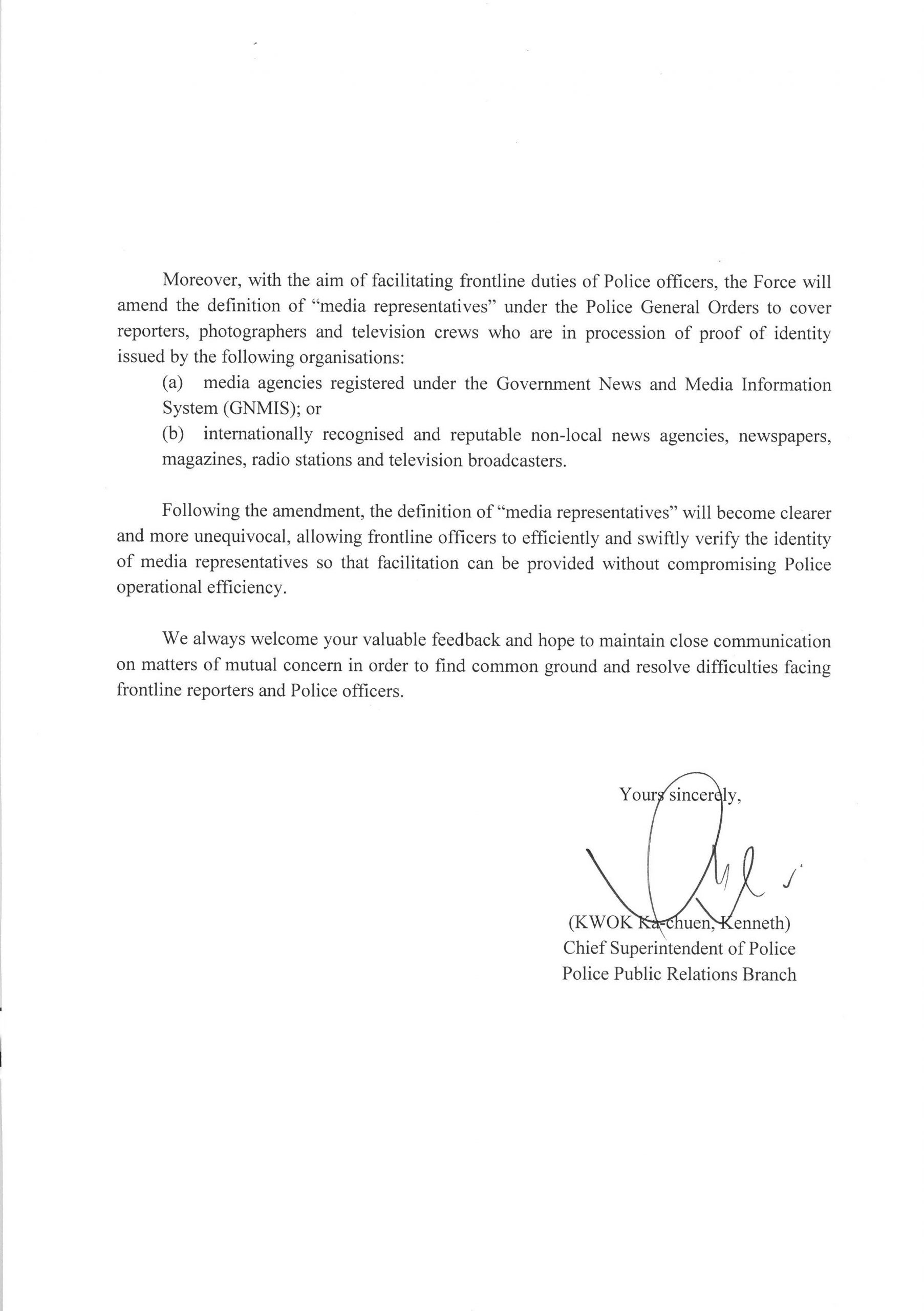
The Foreign Correspondents’ Club, Hong Kong, is firmly opposed to a restrictive new accreditation policy for journalists in the city as detailed in a 22 Sept. letter from the Hong Kong Police. This move is another step in the erosion of Hong Kong’s once cherished press freedom as it would give the police — rather than reporters and editors — the power to determine who covers the police.
 
The changes are not referred to as an accreditation system, but rather a redefinition of who is a journalist in the Police General Orders with the aim of “allowing frontline officers to efficiently and swiftly verify the identity of media representatives.” The letter says the police force will “amend the definition of ‘media representatives’ under the Police General Orders.” Yet the practical impact is the same as accreditation or licensing.

The new rule says police will only recognise as media those who have registered with the Government News and Media Information Service, or members of “internationally recognised and reputable” foreign media outlets.  The goal, according to police spokesmen, is to weed out so-called “fake reporters,” who they claim — without offering evidence — have obstructed police operations and even assaulted police officers on duty.
The FCC stands firmly against the system detailed in the Hong Kong Police Force’s letter for the following reasons:
 
* It undercuts the local journalist organisations whose membership cards have been routinely recognised and respected, the Hong Kong Journalists’ Association and the Hong Kong Press Photographers Association. These organisations conduct rigorous vetting of candidates before issuing membership cards, and this move by the police would take the power to determine who is a legitimate journalist out of the hands of journalists’ groups and place it in the hands of a government entity. That in itself is a serious erosion of press freedom and independence.
 

* The new scheme would give police officers the power to decide what foreign media outlets are “internationally recognised and reputable.” How would that be determined? With the proliferation of new media outlets around the world, how can the police on the ground determine which ones are “internationally recognised” and deserving to be treated as legitimate?  What about media that do not publish or broadcast in English, or that are not widely known outside of their home countries or immediate regions — are they not to be considered real journalists?

* The policy would be a serious blow for freelancers and student reporters — two groups of journalists who have provided some of the most compelling reporting from last year’s protests and police actions. Many journalists now operate as freelancers, some working regularly for specific organisations, and many others offering their stories and videos to multiple outlets “on spec”.  News outlets have come to rely on freelancers due to the changing economics of the industry.  But most of them cannot obtain registration because of their freelance status.

Student journalists, likewise, have been integral to the reporting on — and public understanding of — last year’s protest movement.  Student reporters have faced the same dangers as veteran journalists, and some have been injured.

But this is about more than access to events and invitations to the inside of the police cordon. Journalists who are not recognised under this new policy could face the real possibility of arrest for unlawful assembly or rioting.

Before this new policy, Hong Kong had already dropped to an ignominious 80th place on the Reporters Without Borders annual press freedom index of 180 countries, down from 48th place in 2009.  And that was before the 10 August police raid on the headquarters of Apple Daily and the arrest of its founder, Jimmy Lai.

The Hong Kong police in their letter say they “always respect press freedom and their rights of journalists.” If that is the case, they should welcome free and unfettered access to their operations, and should encourage open reporting instead of trying to restrict the number of journalists covering its operations. A force that is proud of its discipline and confident its officers follow established protocols and guidelines should have nothing to fear from the spotlight journalists shine on it.


23 September 2020

I
Indonesia’s struggle with COVID-19 due to Widodo’s ‘lack of leadership’

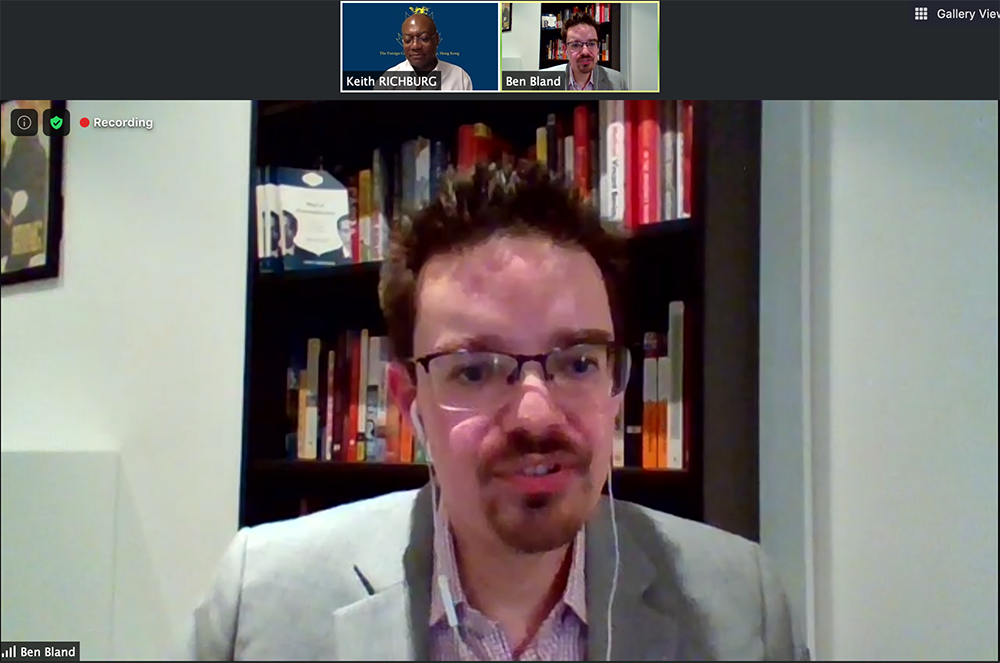
Indonesia’s president, Joko Widodo, has shown a lack of leadership in the fight against COVID-19, according to the author of a book on the former furniture maker who took office six years ago.

Ben Bland talks to Keith Richburg. Ben Bland talks to Keith Richburg.

Indonesia currently ranks 23rd of 217 countries in terms of the number of infections and deaths from coronavirus, with more than 250,000 infected and almost 10,000 dead at the time of writing.

Widodo, once considered the embodiment of hope and change, has shown himself in office to be a consummate pragmatist. But he is now being tested by the COVID-19 pandemic.

Benjamin Bland said that while many countries were experiencing second and third waves, Indonesia was similar to the United States in that it still in ‘an endless first wave’.

The author of Man of Contradictions: Joko Widodo and the Struggle to Remake Indonesia, described the effect on the country as ‘extremely concerning’, adding that the ‘majority of the workforce is employed informally’ – motorcycle taxi drivers, domestic helpers, for example – professions that cannot work from home. The result was increasing inequality as millions were pushed into poverty. Bland added that ‘very confused messaging’ from the government had aided the spread of COVID-19 and put pressure on a health system already deeply underfunded and stretched.

He said that the virus had increased Indonesia’s reliance on China, with the country now waiting for a vaccine from Beijing. Indonesia was already enjoying Chinese funding for various infrastructure projects, Bland said. On its relationship with China, Bland said Indonesia’s desire was to maintain strategic autonomy in the region ‘and keep out of trouble as much as possible’ which frustrates neighbouring Australia and Washington who see the country as potentially a ‘third force’ in Asia, pushing back against China.

In a wide ranging talk, he also touched on the threat of climate change to Indonesia. Its capital city, Jakarta, has sunk 2.5 metres in the last decade. Home to 10 million people, almost half the swampy city is below sea level. Widodo was, pre-COVID, instrumental in a plan to move the capital to Kalimantan on the island of Borneo. The plan is currently on hold.

On Widodo himself, Bland said the book had been difficult to write as he struggled to ‘get a handle on exactly what kind of leader he is’. Having only been in politics for nine years, and in power for six, Widodo has been given many labels – reformer, liberal, pragmatist, technocrat – with something in almost all.

Watch the video

Hong Kong police outlines new accreditation procedures in letter to the FCC

The FCC has received the following letter from the Hong Kong Police Force regarding new accreditation procedures. The club will be responding to the letter today.

FCC Continues its Restrictions

FCC Continues its Restrictions
      
Dear Members:
The Hong Kong government is continuing anti-virus restrictions; a few changes affect the FCC. The club will comply with the measures as follows:
               
All restaurants will close at 11:59 p.m. every day. Last orders for food will be 10:50 p.m. while last orders for drinks will be 11:30 p.m.
The takeaway menu is available from 11 a.m. to 10 p.m., though last orders must be made by 9:00 p.m. The menu can be downloaded from our website at fcchk.org. Please place orders with the FCC Restaurant at 2844 2806 or [email protected]. Orders will be confirmed by a phone call.
Up to four people are allowed at tables in all outlets and the number of guests per member remains at three.
All outlets will be restricted to 50% capacity. Please book ahead.
Live performances will be suspended.
In-person events continue, though per-table limits, distancing and mask-wearing requirements are strictly enforced.
Banqueting has resumed except for cocktail parties, and distancing and mask-wearing while not eating or drinking are being enforced. Please contact the banquet team at 2844 2838 or [email protected] to book.
The gym is open yet the sauna and steam room remain closed. No more than four people are allowed at a time. Wearing a mask while exercising is not required in the gym. Please pre-register with the gym attendant at 2844 2849.
The workroom is open from 8 a.m. to 11 p.m. Wearing a mask is required.
In keeping with government requirements and best practices, all members, guests and staff must wear face masks except when eating or drinking. Hand sanitizer must be used. The FCC will continue the check-in, temperature-taking and declaration measures upon entry to the club, as well as the frequent cleaning protocols throughout the building.
People who have travelled overseas in the past 14 days are not allowed to visit the club, even once the “travel bubble” with Singapore begins.
Thank you for your continued support of the FCC.
23 November 2020


FCC expresses solidarity with press organisations following Hong Kong Police revision of media definition reports

The Foreign Correspondents’ Club, Hong Kong, expresses its deep concern over reports of the Police Department’s revision of its definition of media representatives. The FCC expresses its solidarity with the organisations signing this statement and with journalists in Hong Kong – including freelancers, photographers and student journalists – and is opposed to any actions by government authorities that would impinge on freedom to work without fear or intimidation. Here is the joint statement.

Joint-statement: Hong Kong press unions and associations sternly opposes the police’s unilateral revision of its definition of media representatives under the Police General Orders

The Hong Kong police today wrote to four media associations, announcing that it will revise the definition of media representatives under its General Police Order. Under the amendment, media workers holding the Hong Kong Journalists Association and Hong Kong Press Photographers Association press passes are no longer recognised as media representatives. Only those working for media outlets registered with the Hong Kong government, or “renowned and well-known” non-local outlets will be identified as media representatives.

We sternly oppose the police’s hasty decision. We must point out that the relevant guidelines have been in place for years, and that they were a product of detailed discussion between the police and media representatives.

Today, the police have broken this relationship by planning a significant amendment without first discussing and consulting our sector. We demand the police to scrap the relevant amendment, or we will respond by taking any possible and necessary measures.

In the letter, the police cited the discovery of “fake reporters”, whom they said obstructed and attacked officers, as a reason for the amendment. But the police had not provided concrete proof of these incidents, which, even if true, are unconnected to the HKJA and HKPPA. It is unreasonable for the police to make the amendment against the two associations.

Hong Kong Journalists Association has 604 full members, who are eligible to apply for a press pass from the association. Since January this year, only 99 such press passes had been issued under a strict vetting process in accordance with the association’s constitution. There has never been a scenario of “over-issuing” of such passes. The police had also failed to provide any proof to reflect problems in the HKJA’s issuing of press passes and recruitment of members.

The amendment allows authorities to decide who are reporters, which fundamentally changes the original system in Hong Kong. It will be no different to having a government accreditation system, which will seriously impede press freedom in Hong Kong, leading the city toward authoritarian rule.

In its letter, the police also claimed it had often exchange views with the media industry on improving reporting arrangements. In fact, the police chief had repeatedly turned down the HKJA’s invitation for meetings. We simply cannot understand the police’s statement that it has heard our views.

We must point out that Article 27 of the Basic Law states clear protections for press freedom in Hong Kong. For years, freelance reporters and media outlets not registered with the government have made truthful reports to serve the wider public. The police must not use administrative means to censor the media and in doing so, harm the rights of Hongkongers.

Hong Kong Journalists Association
Hong Kong Press Photographer Association
Independent Commentators Association
Journalism Educators for Press Freedom
Ming Pao Staff Association
RTHK Programme Staff Union
Citizen News Staff Union

September 22, 2020

Bishop Hill hospital plan curtailed following Town Planning Board decision

Plans for a large, looming hospital to be built on historic Bishop Hill, adjacent to the FCC, have been curtailed after the Town Planning Board officially supported height restrictions.

Plans for a new 25-storey hospital proposed by the Sheng Kung Hui (Anglican church) – occupants of the site since the 1840s – had prompted significant objections from those in the neighbouring area. In February, the Town Planning Board imposed an 80 metres height restriction on any newly-built structure on the northern part of the site. Then, in early September, the Town Planning Commission officially confirmed these height restrictions, which ensures that the historic atmosphere of Bishop Hill will not be overwhelmed by new developments.

Campaigner and FCC member, John Batten, said: “This is a good decision for Hong Kong. The Anglican Church should now take a good look at the wonderful history of Bishop Hill and give up any judicial review that it is considering to challenge the Town Planning Board’s decision.”

FCC Dining Hours Extended

FCC Dining Hours Extended
      
Dear FCC Members:
The Hong Kong government starting Friday September 18 will further extend hours for dine-in service.
               
Accordingly, the club will extend its hours until 11:59 p.m. every day. Last orders for food will be 10:50 p.m. while last orders for drinks will be 11:30 p.m.
All other restrictions — including the requirement of no more than four people to a table — will remain unchanged.
In keeping with government requirements and best practices, all members, guests and staff must wear face masks except when eating or drinking. This is a requirement in all areas of the building including the workroom. Hand sanitizer must be used. The FCC will continue the check-in, temperature-taking and declaration measures upon entry to the club, as well as the frequent cleaning protocols throughout the building.
Thank you for your continued support of the FCC.
16 September 2020


FCC Tightens Restrictions Starting Today

FCC Tightens Restrictions Starting Today
      
Dear Members:
The Hong Kong government starting today, Monday Nov. 16, will further tighten anti-virus restrictions. The club will comply with the new measures as follows:
               
All restaurants will close at 11:59 p.m. every day. Last orders for food will be 10:50 p.m. while last orders for drinks will be 11:30 p.m.
The takeaway menu is available from 11 a.m. to 10 p.m., though last orders must be made by 9:00 p.m. The menu can be downloaded from our website at fcchk.org. Please place orders with the FCC Restaurant at 2844 2806 or [email protected]. Orders will be confirmed by a phone call.
Up to four people — down from six — will be allowed at tables in all outlets and the number of guests per member will remain at three.
All outlets will be restricted to 50% capacity. Please book ahead.
Live performances will continue in Bert’s on Friday nights.
In-person events have resumed and will continue, though per-table limits, distancing and mask-wearing requirements will be enforced.
Banqueting is also resuming except for cocktail parties, and distancing and mask-wearing while not eating or drinking will be enforced. Please contact the banquet team at 2844 2838 or [email protected] to book.
The gym is open yet the sauna and steam room remain closed. No more than four people are allowed at a time. Wearing a mask while exercising is no longer required in the gym. Please pre-register with the gym attendant at 2844 2849.
The workroom will be open from 8 a.m. to 11 p.m. Wearing a mask is required.
In keeping with government requirements and best practices, all members, guests and staff must wear face masks except when eating or drinking. Hand sanitizer must be used. The FCC will continue the check-in, temperature-taking and declaration measures upon entry to the club, as well as the frequent cleaning protocols throughout the building.
Thank you for your continued support of the FCC.
16 November 2020


Room for cooperation with China if Biden wins U.S. election, says Joseph Stiglitz

The United States and China could enjoy greater cooperation if Joe Biden wins the Presidential Election in November, Nobel prize winner Joseph Stiglitz told an FCC webinar.

Joseph Stiglitz talks to Club President Jodi Schneider on September 15, 2020. Joseph Stiglitz talks to Club President Jodi Schneider on September 15, 2020.

He said the possibility of decoupling between the two nations depended on the results of the election, adding that there were ‘very strong strands in the United States that are very concerned’ about China’s human rights record and believe America should express its views on the matter.

Stiglitz, who was awarded the Nobel Memorial Prize in Economics in 2001, said the Trump administration had moved the relationship between China and the U.S. into issues of ‘second-rate importance, away from issues of real importance’.

“I hope we can cooperate, because we can cooperate if there is a restoration of democracy to Hong Kong, there’s respect for human rights, the Uyghurs… if there’s a movement away from the surveillance state… there’s lots of room for cooperation. But I worry about whether we’ll achieve that,” said Stiglitz.

On Hong Kong, Stiglitz – a professor at Columbia University – warned of the ‘profound effect’ the national security law would have on China’s relationship with the West.

The ‘ambiguity’ of the law itself is already making people ‘nervous’ about going to China, he said.

“I’m not very optimistic about Hong Kong. I think that the national security law is going to have big reverberations for all of China. I know a lot of people who are now nervous about going to China because they’ve been outspoken about democracy, about Hong Kong, about human rights and they worry ‘will they be entrapped by the new law?’” he added.

Stiglitz, author of several acclaimed books on economic policy, said Hong Kong is not being forgotten by the rest of the world, adding: “I think what is happening to Hong Kong is going to have a profound effect on the relationship between China and the West.”

Turning to the coronavirus pandemic, Stiglitz, author of People Power, and Profits: Progressive Capitalism for an Age of Discontent, said America’s handling of COVID-19 was ‘an utter disaster’ because the ‘pre-existing conditions were already bad’. He cited lower life expectancy under Trump, a lack of hospital beds and vital protective equipment, and the defunding of the Center for Disease Control as pre-existing conditions.

He said Trump’s ‘vaccine nativism’ was an ‘ugly aspect’ of the aftermath of the pandemic, which he said could only be solved by global solidarity, not by attempting to hoard a vaccine.

Stiglitz said Trump’s ‘America first’ stance had made it increasingly difficult for the United States to cooperate with other countries. He added that Trump ‘seems to have a love affair with every authoritarian figure in the world’.

“This is a global issue of the democracies of the world – Europe, the United States, Canada, Australia, New Zealand – versus authoritarian governments. It’s not a battle over the ideologies in the way that it was communism versus capitalism – it’s really a very simple battle between democracy and authoritarian respect for human rights,” he said.

Watch the video

Job posting: Digital and Social Media Editor / Events Coordinator, The Foreign Correspondents’ Club, Hong Kong

Job posting: Digital and Social Media Editor / Events Coordinator,
The Foreign Correspondents’ Club, Hong Kong
      
The Foreign Correspondents’ Club, Hong Kong, is seeking a social media editor and events coordinator for a one-year contract. The position entails facilitating coordination of the club’s world-class events and forums and ensuring they’re promoted across the FCC’s digital channels. The editor/events coordinator also publishes the club’s statements and other content in a timely manner and handles the live-streaming of event videos and production of post-event summaries. The editor/events coordinator also will also help implement a digital strategy for the FCC, including updating the website’s news and events pages, building engagement and followers on its social media accounts and assisting with club communications to members.
Key responsibilities:
Manage the club’s Twitter, Facebook, Instagram and LinkedIn feeds.
Build and execute the social media plan (fortnightly in advance)
Publish a minimum of one post per day, five days per week (weekends if necessary).
Produce monthly social media report for Communications Committee and Board of Governors meetings.
Add SEO to each YouTube event video.
HRPA: Assist with annual awards social media promotion (HRPA Twitter and Facebook), updating of humanrightspressawards.org, ceremony/winners coverage.
Content
Cover and promote the club’s in-person and Zoom speaker events.
Live stream in-person speaker events.
Produce a write-up within two hours of event end, post on the website with photo and video, distribute on social media.
Publish press freedom statements in a timely manner.
Manage news and press freedom content on fcchk.org home page.
Upload the content of the quarterly Correspondent magazine, distribute on social media.
Upload The Correspondent magazine PDF to Issuu.com and link to fcchk.org.
Produce and edit brochure for the FCC Journalism Conference. Promote and cover the event itself.
Assist marketing with proof-reading of F&B social media material.
Events Coordination
Manage events calendar.
Produce monthly Professional Committee agenda.
Produce minutes of monthly Professional Committee agenda.
Liaise with event owners over acquiring promotional materials (flier title, text, speaker bio, speaker photo).
Where relevant, liaise with speaker/speaker representative and FCC IT to organise Zoom tests 24 hours prior to scheduled event.
This is a contract position that will be reviewed after one year. The candidate should be based in Hong Kong. FCC members are preferred.
Interested parties should submit a letter of interest and resume to:
FCC
North Block
2 Lower Albert Road
Central HK
or email [email protected] stating the position applied for in the subject line.


We measure site performance with cookies to improve performance.