
Members Area Logout

Why China won’t become a democracy anytime soon

China won’t become more liberal anytime soon because its people are satisfied with the way the Chinese Communist Party has lifted many out of poverty, according to a China expert.

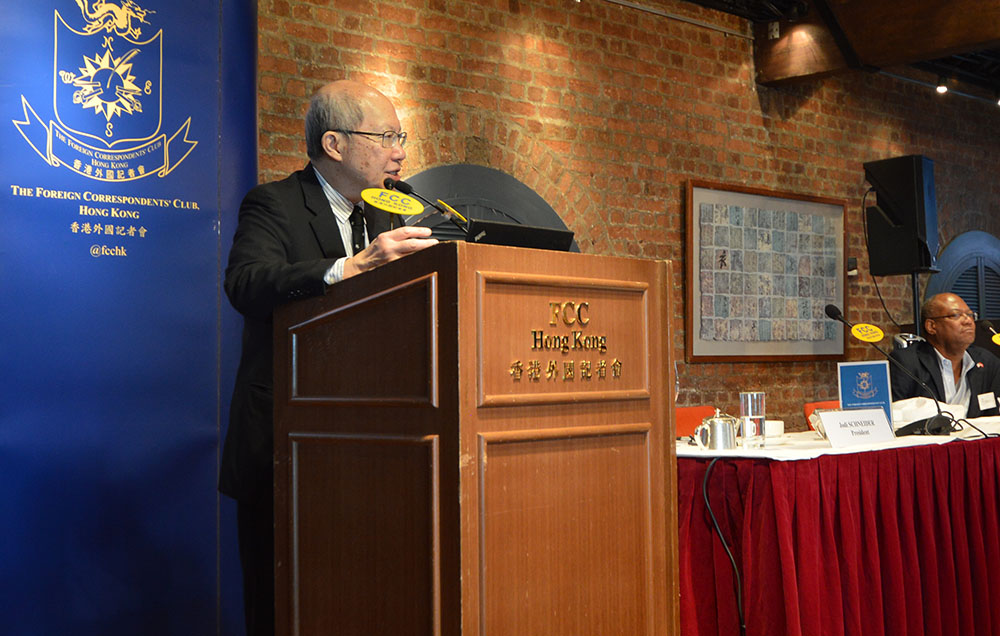
Jean-Pierre Cabestan, Professor in Political Science at Hong Kong Baptist University, told the November 14 club lunch that the Chinese government had support from all sections of society, including its billionaire entrepreneurs.

The party is stronger than ever, he said, in part due to the introduction of the social credit system, which monitors citizens, and the restriction of internet access. Its efficient quashing of dissent means its people do not stand up to the one-party system.

Watch the video here
Award-winning novelist Mohammed Hanif on writing and life in Pakistan

So you’ve written your first novel and it’s won widespread plaudits – what next?

Write a second book, of course – but that’s easier said than done, as novelist Mohammed Hanif discovered when he found himself in exactly that position.

The Pakistani journalist and writer is now working on a fourth book following the success of A Case of Exploding Mangoes (2008), Our Lady of Alice Bhatti (2011), and Red Birds (2018). He shared writing tips at the November 13 club lunch and discussed the issues facing his homeland.

Watch the video here

Champion motorcycle road racers Michael Rutter and Peter Hickman discuss life in the fast lane

Michael Rutter and Peter Hickman, two of motorcycle road racing’s most successful riders, revealed the ups and downs of the sport when they appeared at the FCC ahead of the 2019 Macau Grand Prix.

The pair, who between them have dominated their field for the last two decades, talked about how they got into the white-knuckle sport, what they’re thinking about while hitting speeds in excess of 200mph, and the future of electric motorcycle racing.

You can watch this November 12 club lunch below.

Video: A Conversation with the Editor in Chief of The Wall Street Journal   

Matt Murray, Editor in Chief of The Wall Street Journal, talked about the newspaper’s big scoops and the future of journalism when he appeared at the club on November 6.

Watch the video.

The Fight for Tech Supremacy Between Silicon Valley and China 

A growing distrust of China’s technological prowess is underpinning some of the tension around its trade war with the US, which has led to the threat of Chinese companies being prohibited from publicly listing in the United States, according to experts.

Whereas five years ago there was closer collaboration between China and Silicon Valley, now a ‘splinternet’ is the result of the US pushing back against China, said author and technology writer, Rebecca Fannin, who appeared as a panelist at the FCC on November 6.

Should the United States decide to formally ban Chinese tech firms from listing IPOs there, it would be devastating, said venture capitalist Wei Jiang, a founding partner at Momentor Ventures. He added that Chinese firms would need to seek investment elsewhere.

Stella Xi Jin, a founding partner of China-focused venture capital firm Keytone Ventures, said her company was already investigating other markets, including Hong Kong, Singapore, and Europe.

A growing list of key Chinese tech companies have been added to America’s trade blacklist as Washington seeks to block China’s ascent.

You can watch the talk here.

What next for Hong Kong and China’s growing civil society movement?

China will likely promulgate Article 23 in Hong Kong via an interpretation of the Basic Law rather than through the Legislative Council, predicts a veteran China watcher.

Professor Willy Lam at the FCC. Photo: Sarah Graham/FCC Professor Willy Lam at the FCC. Photo: Sarah Graham/FCC

Professor Willy Wo-Lap Lam, adjunct professor at the Chinese University of Hong Kong’s Centre for China Studies and author of a new book, The Fight for China’s Future: Civil Society vs. the Chinese Communist Party, said this was one of the routes Chinese President Xi Jinping may choose to restore order in Hong Kong, where protests have gripped the city since June. He said the Chinese Communist Party saw the unrest as a Black Swan Event – a colour revolution which was a collusion between anti-Beijing forces within China and hostile foreign forces such as the US. President Xi has in the recent past warned his party of the danger of Black Swan Events.

Describing Hong Kong’s Chief Executive, Carrie Lam, as a “lame duck”, Prof Lam also predicted that the CCP was unlikely to undermine her authority further by sacking her, and so would keep her in post while they chose a successor before she stood down.

Guests at the November 5 club lunch were taken through a presentation highlighting China’s growing civil society movement, which has seen army veterans, workers and students protest throughout the country.

AFP launches 2019 Kate Webb Prize for Asian journalists

International news agency Agence France-Presse has launched the 2019 Kate Webb Prize to recognise exceptional Asian journalists doing difficult and dangerous work across the region. 

Kate Webb. Photo: AFP Kate Webb. Photo: AFP

The contest is open to locally hired Asian photo, video and text journalists, for work published during 2019. 

The winner, who will be selected by a panel of experienced journalists, will receive 3,000 euros (approximately $3,300).

“Many countries in the Asia-Pacific region continue to pose significant challenges for press freedoms, and investigative journalism in particular,” said Philippe Massonnet, AFP’s regional director.

“The Kate Webb Prize aims to recognise and support local journalists who take on those challenges, often without the logistical and protective backing of a large media organisation,” he added.

Freelance reporter Asad Hashim won the 2018 prize for his coverage of the plight of ethnic Pashtuns and blasphemy issues in his native Pakistan.

The Kate Webb prize, now in its 11th year, is named after a crusading AFP reporter who died in 2007 at the age of 64 after a colourful career covering the world’s trouble spots – including Afghanistan.

Please send applications by email to the Kate Webb Prize Jury at [email protected] no later than midnight in Hong Kong (1600 GMT) on November 15, 2019.

For information on how to apply, click here

Hong Kong Human Rights and Democracy Act: The case for and against

The Hong Kong Human Rights and Democracy Act may work to safeguard the freedoms promised under One Country, Two Systems, but concerns have been raised around the potential economic impact of sanctions on the city.

These issues and others were discussed at the FCC by lawmaker Regina Ip, Legco member Charles Mok, and Tara Joseph, President of the American Chamber of Commerce in Hong Kong.

Joseph pointed out that the bill, which is currently going passing its way through the US Senate, was simply an amendment to the existing United States-Hong Kong Policy Act and that it demonstrated “strong cooperation between Hong Kong and the US, and shows Washington is concerned about what’s happening here”.

Ip, a pro-Beijing politician, criticised the way in which the bill had so far passed through the Senate, saying that Hong Kong government representatives had offered to give evidence in the same manner as pro-democracy representatives, but had not been invited.

Legco member Charles Mok told the October 24 panel that he felt Hong Kong’s freedoms were being eroded, citing the de facto expulsion of the FCC’s Victor Mallet from the city in 2018 after he hosted a discussion with Andy Chan, founder of the now-banned Hong Kong National Party.

Watch the video of the case for and against

Top tips on how to reduce your carbon footprint

Fly direct, fly less, choose vegetarian meals over meat – these were some of the tips shared during a panel discussion on responsible tourism.

Guest speakers Sonalie Figueiras, founder and editor-in-chief of Green Queen; Impact Travel Alliance Vincie Ho, and author and wildlife photographer Jan Latta explored practical ways to enjoy travel without the guilt of increasing your carbon footprint.

While some solutions appeared obvious, the panel members agreed that much more needed to be done by each of us in order to minimize the impact on our environment.

All panelists highlighted useful resources to help us understand and monitor how we can be greener when we travel. Sky Scanner, for example, now shows your potential carbon footprint when you search flights through its website. The Global Sustainable Tourism Council establishes and manages global sustainable standards and awards accreditation to hotels/accommodations, tour operators, and destinations as having sustainable policies and practices in place.

Another site, Choose.Today offers a subscription that allows you to support effective C02 reduction on a monthly basis. The money goes directly to C02-reducing projects in developing countries that are verified by the United Nations.

A further useful resource highlighted by the panel was the blogging site, In Locamotion, which offers a comprehensive guide to sustainable tourism.

Watch the video

Hong Kong Protests: Experts offer guide to the evolution of weaponry and tactics

The physical and legal risks for journalists covering the increasingly violent Hong Kong protests were outlined by two experts at the FCC on October 23.

Sharron Fast, Deputy Director of Master of Journalism Programme and lecturer at University of Hong Kong, discussed the anti-mask law introduced by the HKSAR using emergency powers on October 5. She said there was much uncertainty surrounding the ban, particularly for journalists lawfully covering an unlawful protest. She also said she was certain the law doesn’t protect freelance journalists and students.

Fast was joined at the breakfast briefing by Stevo Stephen, News Risk Senior Manager for the Wall Street Journal, who demonstrated the evolution of weapons and tactics by both the Hong Kong Police and protesters since the unrest began in June.

Watch the video

We measure site performance with cookies to improve performance.