Members Area Logout

Why Russia is no longer a superpower

Russia is an increasingly weak state under President Vladimir Putin, with the country’s elites abandoning it amid a feeling that there is no hope for the future, according to a leading European scholar on Russia and Ukraine.

Dr. Marie Mendras appeared at the FCC on March 13, 2019. Photo: Sarah Graham/FCC Dr. Marie Mendras appeared at the FCC on March 13, 2019. Photo: Sarah Graham/FCC

Thirty years ago, under President Mikhail Gorbachev – the last leader of the Soviet Union – the country was a superpower following his democratisation measures and the end of the Cold War. But today’s Russia sees elites emigrating, a shrinking middle class, and a stagnant economy. Putin’s standing on the world stage has also suffered since Russia’s military intervention in Ukraine after it voted for independence.

“If you look back 20 years, the new president of Russia had many partners. He had strong partners in the European Union. And after 9/11 he had a strong partner in George W Bush,” said Dr. Marie Mendras, currently a visiting scholar at HK Baptist University.

Watch the video to hear Dr. Mendras on Vladimir Putin and Russia.

China ‘on the wrong side of history’ in its religious persecution, says U.S. ambassador

China is not solving the terrorism problem by detaining Uighurs in internment camps in Xinjiang, it’s creating it, says the U.S. Ambassador at Large for International Religious Freedom.

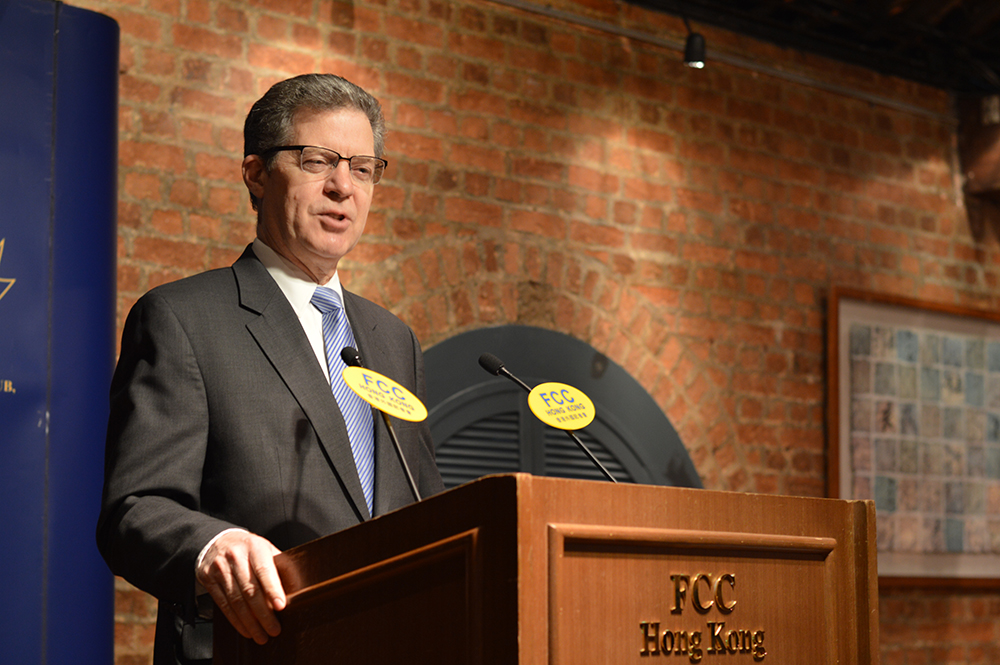
Sam Brownback, U.S. Ambassador at Large for International Religious Freedom speaking at the FCC on March 8, 2018. Photo: Sarah Graham/FCC Sam Brownback, U.S. Ambassador at Large for International Religious Freedom speaking at the FCC on March 8, 2018. Photo: Sarah Graham/FCC

Sam Brownback said he has received hundreds of communications from the families of detained Uighurs desperate to find out what was happening to their loved ones. The Muslim minority group has suffered persecution in China for decades, but recently the government intensified its oppression with the introduction of what it calls re-education camps. Kazakhs, Christians and other minority faiths are also held in the camps.

The Chinese government has also cracked down on Christianity in the country by closing unregistered churches and destroying Bibles.

Brownback asked: “Why is the Chinese government afraid of the Bible? Why does the Chinese Communist Party not trust the Chinese people to choose their own path with their own soul?”

He added: “China is at war with faith. It is a war they will not win.”

Despite the events of recent years, Brownback said he believed the Chinese people would soon enjoy religious freedom because China was ”on the wrong side of history” and a general shift around the world towards freedom. He pointed to Hong Kong as an example of somewhere that enjoyed religious freedom. Speaking at the March 8 Club Breakfast, he called on China to immediately release all religious prisoners.

Kansas Republican governor Brownback was sworn in as Ambassador at Large for International Religious Freedom on February 1, 2018, with the remit to monitor persecution and discrimination on a global scale through the Office of International Religious Freedom (IRF).

Watch the full talk here

Weijian Shan: From hard labour in China to the halls of America’s most prestigious universities

Today’s young people should cherish the opportunities they are given, says a top financier who was one of the so-called “lost generation” who missed out on education during China’s Cultural Revolution.

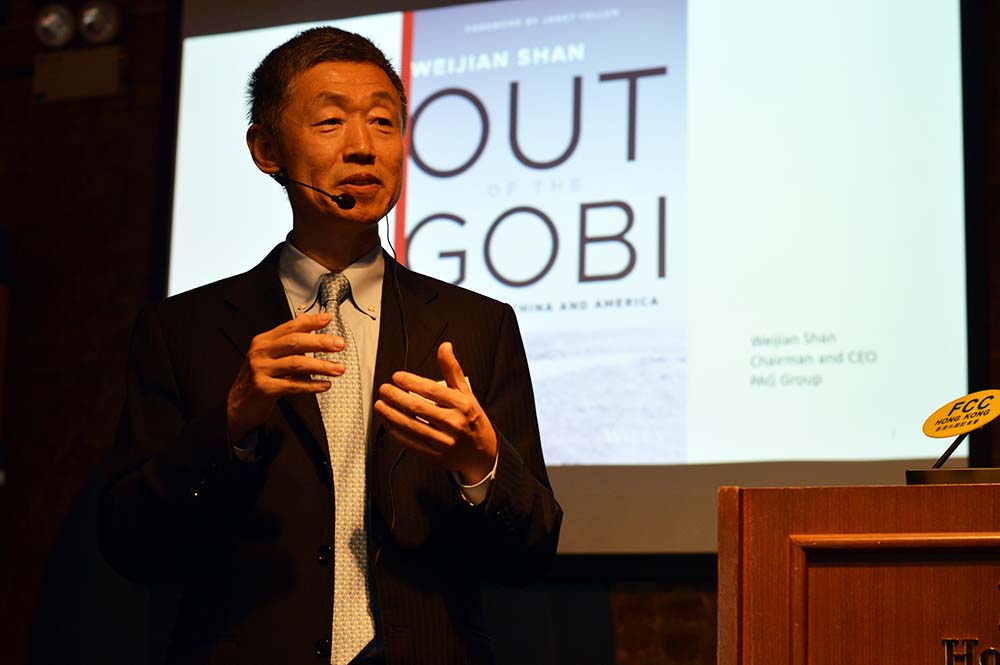
Weijian Shan speaking at the FCC on March 5, 2019. Photo: Sarah Graham/FCC Weijian Shan speaking at the FCC on March 5, 2019. Photo: Sarah Graham/FCC

Weijian Shan is Chairman and CEO of PAG, one of Asia’s largest private equity firms. But growing up in China during the 1960s he found himself at the beginning of a decade of turmoil in China’s history, kicked off by Mao Zedong’s bid to take control of the Communist Party, a move which eventually led to the death of tens of millions through starvation.

Education was abandoned as schools and universities closed amid chaos, with gangs of young ‘Red Guards’ rampaged through city streets after Mao urged them to destroy China’s old culture and custom. During the first chaotic years of the revolution, Shan said, he witnessed teachers being beaten to death.

Shan told how, after Mao sent young urban dwellers out into the countryside for re-education, he was sent to work in the Gobi Desert to try to turn it into fertile land to grow crops for the country. Food was sparse, the winters were freezing cold, and the summers hot.

Showing photos of himself during that time which appear in his book, Out of the Gobi: My Story of China and America, Shan said: “When I look at this picture I realise how stupid I was at that age. At the time, I thought I knew everything.”

After the Cultural Revolution ended with the death of Mao, a new economic relationship formed between the U.S. and China which resulted in an open door policy. Shan was selected by a Congressional-sponsored foundation to go to America as a visiting scholar. He eventually became a professor at the Wharton School of the University of Pennsylvania before embarking on a career in finance.

He recalled how, on a visit to a kindergarten funded by his company, he broke down in tears at the freely available books and learning tools for the children. Shan said youth today should treasure their opportunities.

Watch the video to learn more about Shan’s journey.

Why capitalism as we know it is dead

Inequality is on the rise in America, fueled by a new form of capitalism that, instead of encouraging competitive free markets, has seen monopolies and oligopolies dominate, according to the co-author of a new book.

Author Denise Hearn discussed the myth of capitalism at the FCC on February 27. Photo: Sarah Graham/FCC Author Denise Hearn discussed the myth of capitalism at the FCC on February 27. Photo: Sarah Graham/FCC

The capitalism that lifted millions out of poverty no longer exists, rather it has become the antithesis of competitive marketplaces, said Denise Hearn.

Although it appears US consumers have endless choice when it comes to products and healthcare, this is an illusion: many of the smaller companies they purchase from are owned by much bigger conglomerates.

The figures are astounding: five banks – Citigroup, JP Morgan Chase, Wells Fargo, and Bank of America – own more than 50 per cent of the nation’s banking assets. Four airlines – American, Delta, United, and Southwest –  control around 80 per cent of American domestic airspace. Almost every industry is dominated by “robber barons”, she said.

Waves of mergers and acquisitions are contributing to the death of competition which ultimately will result in higher prices for the consumer as it allows big business to set market prices, thus squeezing smaller businesses out of the market.

Hearn, co-author of The Myth of Capitalism: Monopolies and the Death of Competition, told the February 27 club lunch: “Inequality is the symptom, it’s not the disease.”

Her book explores how the US arrived at the point where so much of the economy is dominated by the few.

Hearn also revealed some astonishing little-known facts about some of America’s big companies. Amazon, for example, doesn’t only provide an e-commerce platform but it also manufactures products that are available on its website. Hearn explained that the tech firm collects data from sellers, such as the type of customer buying from them, and then uses that data to enhance its own products – and undercut the competition.

Perhaps the most shocking story of all though involved a mortuary and supermarket chain Costco. But you’ll have to watch the video below to hear it.

Book charts history of the seas to our south

Who owns the seas to our south?

Author, journalist, and former FCC President Philip Bowring’s new book, Empire of the Winds The Global Role of Asia’s Great Archipelago, delves into the history of the world’s largest archipelago to examine the now 400 million non-Chinese people who occupy most of the coasts of the South China, Java, and Sulu seas. The former editor of the Far Eastern Economic Review appeared at the club on February 21 to share insights from the book.

Watch the talk below.

FCC Journalism Conference 2019 – Line-Up and Booking Form

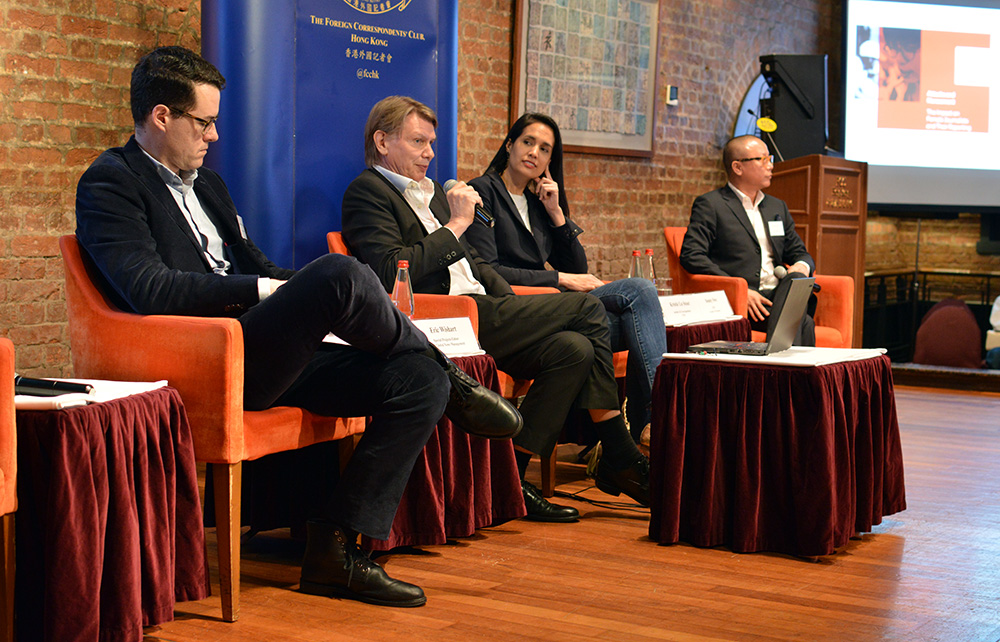
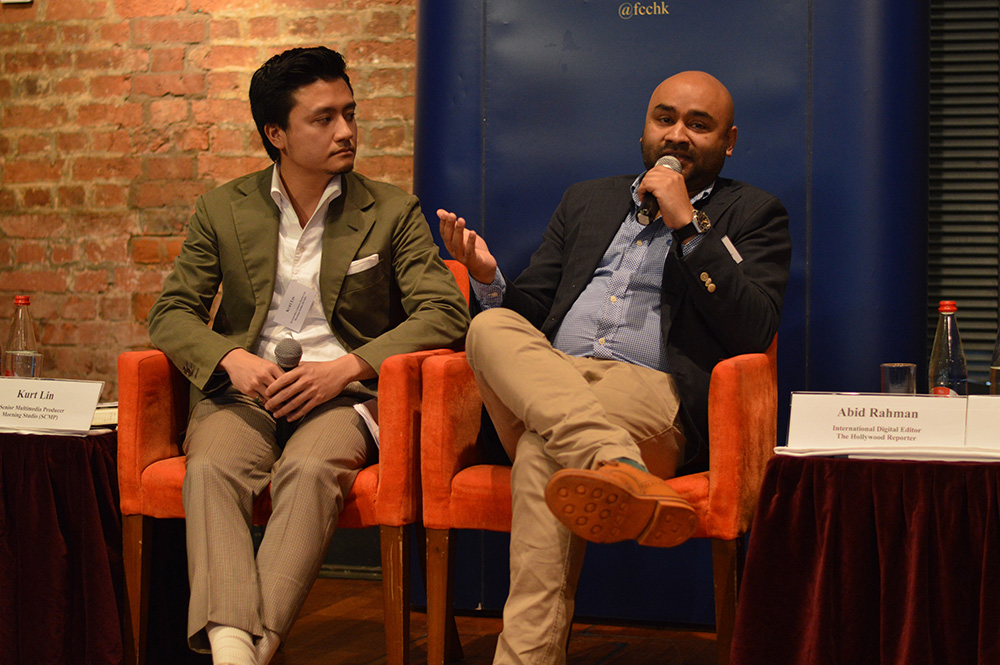
We warmly invite you to join us at the FCC’s annual journalism conference on March 23 for a day of discussion, learning and networking with some of the region’s most talented journalists. As the media faces unprecedented attacks worldwide, the theme for this year’s conference is Enemy of the People? The Dangers of Being a Journalist in 2019.

For the day’s full line-up, scroll down or click here. Highlights include sessions on:

War reporting: Hear from opening keynote speaker, Nicole Tung, a Hong Kong-born, Turkey-based photographer and winner of the James Foley Award for conflict reporting. Tung, who has covered conflict zones in Libya, Syria and the Democratic Republic of Congo as well as the refugee crisis in Europe, will talk about the on-the-ground dangers journalists face.

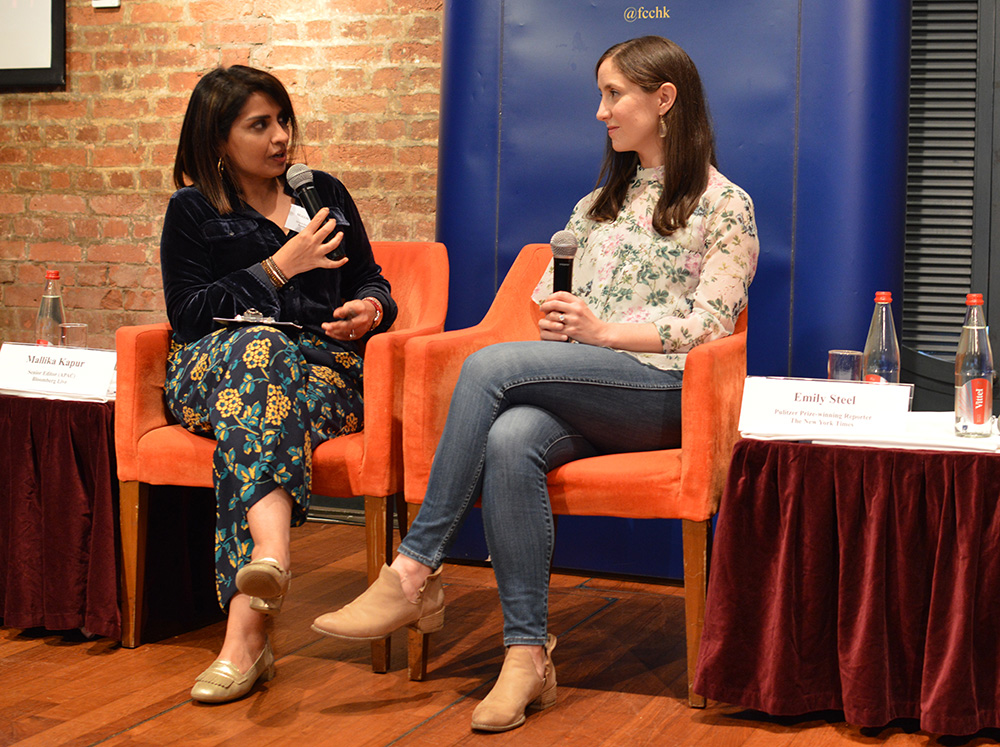
Investigative reporting:  Join Emily Steel, Pulitzer Prize-winning reporter from the New York Times in a fireside chat. Ms. Steel’s reporting at The Times uncovered a series of settlements totaling $45 million related to sexual harassment allegations against Bill O’Reilly, the former Fox News host. The reporting laid the foundation for an international reckoning over issues of sexual misconduct.

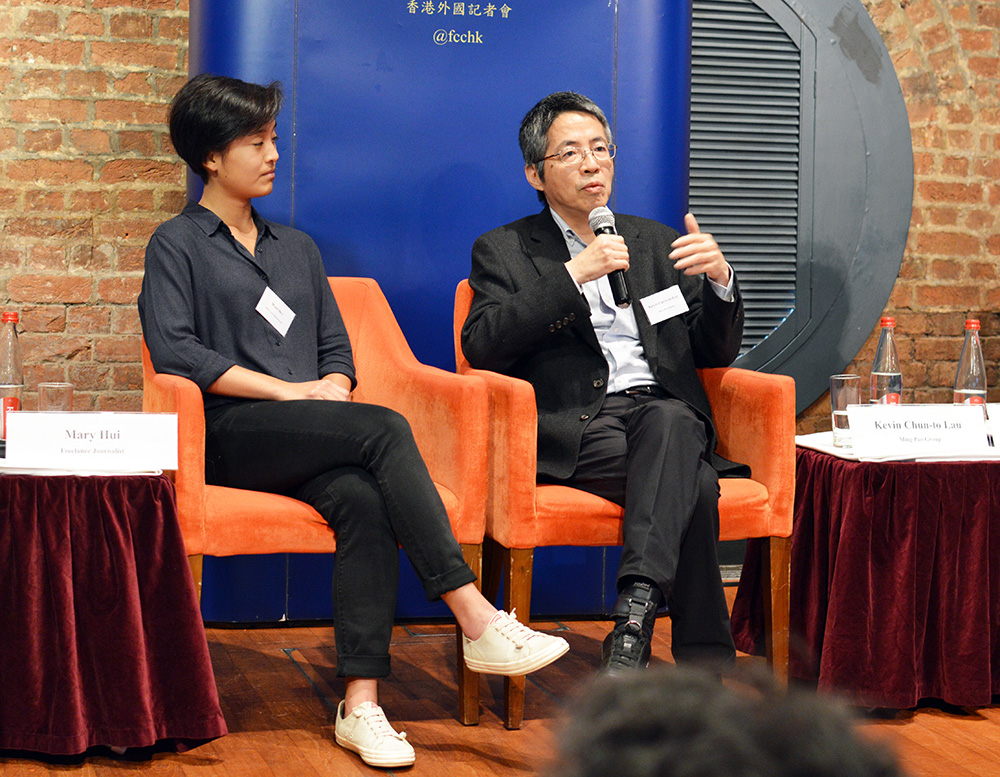
Freedom of the press:  Kevin Lau Chun-to from the Ming Pao Group will shed light on the challenges Hong Kong journalists face in a panel discussion that also includes speakers Chris Young from Citizen News and the chairperson of the Hong Kong Journalists Association, plus freelance journalist Mary Hui.

Cyberbullying: CNN’s Kristie Lu Stout, Frontier Myanmar’s Sonny Swe, and others will speak on a panel dedicated to the new threats emerging in the digital space that journalists face today.

Other panels and workshops will cover issues ranging from how not to get sued to tips for online security. The conference will host speakers from The Hollywood Reporter, The New York Times, The Wall Street Journal, South China Morning Post, Bloomberg, TVB, CNN and more. Additional specialists in areas such as data security, legal and negotiation experts and more will share their insight in relevant areas.

Breakfast, lunch and closing drinks will be provided at the conference.

Tickets cost HK$495 for members and HK$595 for guests. To sign up, please complete this booking form.

Alternatively, please contact the FCC concierge desk at 2521 1511 or email [email protected]. Once confirmed, you will be contacted to indicate which workshops you wish to attend.

Members of the media and students wishing to attend the conference should email [email protected].


No need to panic over US-China trade war, says top economics scholar

The US-China trade war will have a “manageable” impact on the GDP of both nations, according to a scholar who was once a member of China’s top political advisory body.

Professor Lawrence Lau gave his expert opinion on how the US-China trade war would play out. Photo: Sarah Graham/FCC Professor Lawrence Lau gave his expert opinion on how the US-China trade war would play out. Photo: Sarah Graham/FCC

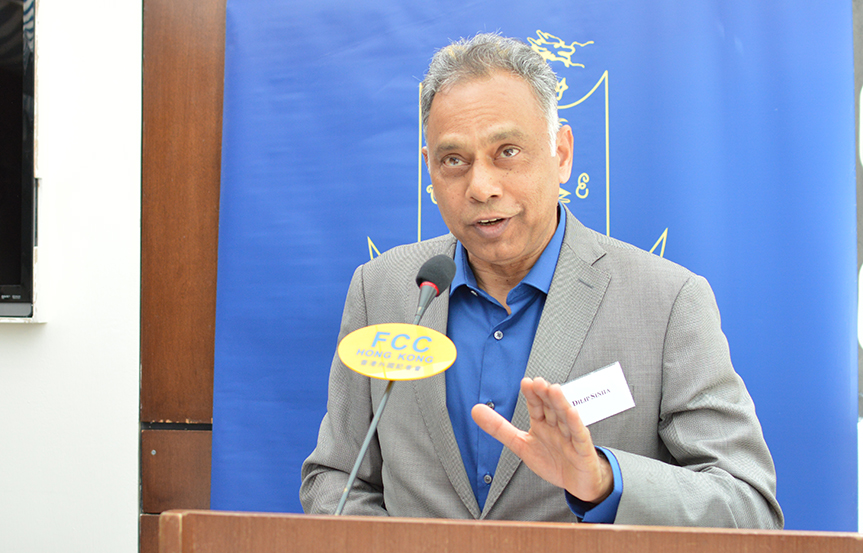
Professor Lawrence Lau said that despite reporting its slowest growth since 1990 last year, China was still a strong economy and the maximum impact on it would be around a 1.1% drop. The impact on the US would be even smaller, he added, predicting a “less than 0.2%” drop.

“The first impacts [of the trade war] are mostly psychological,” Prof. Lau said at the January 29 club lunch.

The former Vice-Chancellor (President) of The Chinese University of Hong Kong explained that in terms of stock markets, Shenzhen performed badly as a result of the start of the trade war in January 2018, but all other markets remained stable. Similarly, China’s exchange rate – notably the Chinese Foreign Exchange Trade System Index (CFETS) – indicated that the RMB fell only 3% over the last year.

While the rates of growth of Chinese exports and imports fluctuate like those of all other economies, the rate of growth of China’s real GDP has also remained relatively stable, Prof. Lau said, primarily because it wasn’t dependent on outside influences.

Prof. Lau, a former member of the Department of Economics at Stanford University, predicted that by 2030, China’s real GDP would be “neck and neck” with America’s, but its GDP per capita would never catch up with the US.

Watch the full talk here.

New press freedom report ‘paints darkest picture of reporting conditions inside China in recent memory’

Rapidly expanding surveillance and widespread government interference against reporting in the country’s far northwestern region of Xinjiang drove a significant deterioration in the work environment for foreign journalists in China in 2018.

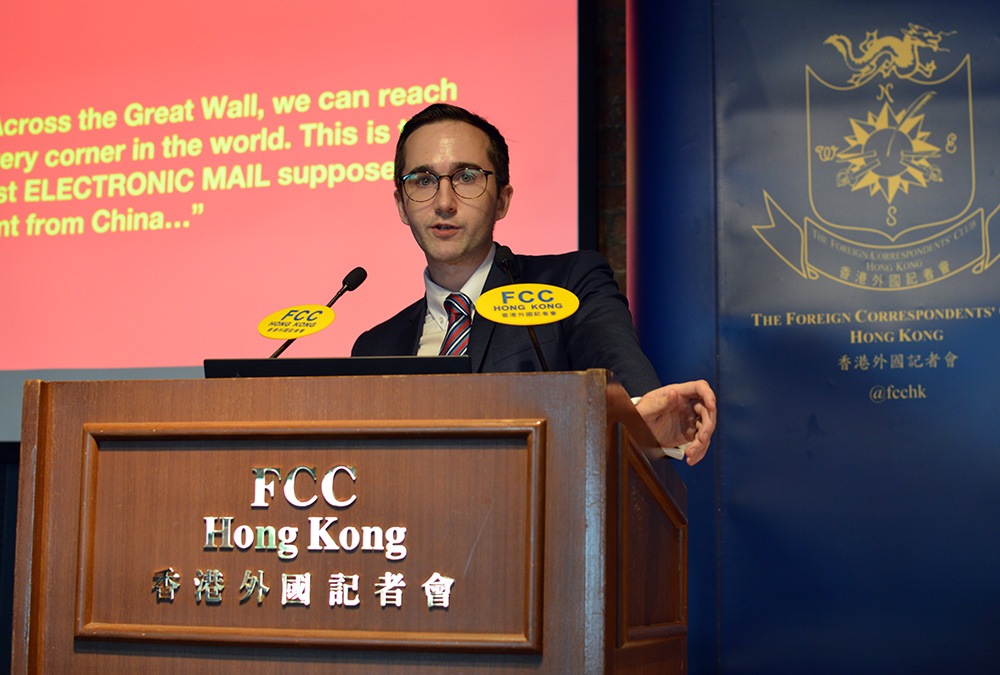
In December and January, the Foreign Correspondents’ Club of China surveyed its correspondent members about their work experiences during the calendar year 2018. The results of that survey, as well as interviews with bureau chiefs from nine major media organizations and a timeline of notable incidents, form the basis of a new report, “Under Watch: Reporting in China’s Surveillance State.”

Survey results painted the darkest picture of reporting conditions inside China in recent memory. For the first time in three years, a foreign correspondent was effectively expelled through visa denial. Separately, Chinese authorities also issued severely shortened visas and reporting credentials, one for just 2.5 months, to at least five correspondents.  Pressure on Chinese national news assistants and sources intensified, and close to half of respondents reported themselves being followed or having their hotel room entered without permission while in the field.

Fifty-five percent of respondents said they believed conditions deteriorated in 2018 — the largest proportion since 2011, when foreign media coverage of pro-democracy protests prompted an extensive government backlash. Not a single correspondent said conditions improved last year.

“The wider monitoring and pressure on sources stop journalists even before they can reach the news site,” said FCCC president Hanna Sahlberg. “There is a risk that even foreign media will shy away from stories that are perceived as too troublesome, or costly, to tell in China. These trends run contrary to the FCCC’s hopes for real openness for foreign media to be able to cover China.”

Sahlberg said recent reports of Chinese authorities offering, on behalf of Malaysia, to conduct intense surveillance of Hong Kong-based foreign correspondents was a disturbing development that violated both Hong Kong law and international standards.

“While 2018 has seen state-supported Chinese media expanding and widening its scope abroad, the room for reporting inside the country shrinks,” Sahlberg said. “The restrictions now facing foreign correspondents call for a serious look at the commitments China’s government has as the 2022 Winter Olympic host. We want to see an even playing field.”

2018 KEY FINDINGS

The following results are based on a survey of journalists who belong to the Foreign Correspondents’ of Club of China in Beijing. The survey was completed by 109 of 204 correspondent members. More detailed results are in the full report, which can be downloaded through a link at the bottom of this email.

• 55% of respondents said reporting conditions deteriorated in 2018, compared with 40% in the FCCC’s 2017 survey.

• Surveillance, both human and digital, became a key concern. 48% said they were followed or were aware that a hotel room was entered without permission, 91% were concerned about the security of their phones, and 22% said they were aware authorities tracked them using public surveillance systems.

• Reporting grew much more difficult in Xinjiang, where the mass detention and political “re-education” of as many as one million persons from Muslim minorities has attracted global attention. 24 out of 27 of respondents who traveled to the region saying they experienced interference while there, with 19 being asked or forced to delete data.

• 37% of 91 respondents said their Chinese colleagues were pressured, harassed or intimidated, and 34% said sources had been harassed, detained or called in for questioning at least once.

• Six correspondents said they had visa renewal difficulties related to their news coverage. BuzzFeed News bureau chief Megha Rajagopalan was effectively expelled from China after she was unable to renew her visa. Australian Broadcasting Corporation correspondent Matthew Carney, received a visa of 2.5 months, leading to his departure. Both had done reporting in Xinjiang.

Download the full report (click the download button at top right of the page)

Annual photo contest launched in honour of AFP photographer Shah Marai, killed in Kabul bomb attack

Agence France-Presse is launching an annual photography competition to honour Kabul bureau chief photographer, Shah Marai, who was killed in a suicide attack on April 30, 2018.

Throughout his career, Shah Marai showed the reality of life in Afghanistan with passion and tenderness. During 17 years of conflict, his photos captured moments of raw violence but also moments of beauty.

To the outside world, Afghanistan is defined by the images of violence and tragedy that appear regularly on international news. But behind the violence of the conflict lies another country, full of human warmth and daily toil. It was also this country that Shah Marai was constantly striving to show to the rest of the world.

That’s what inspired “My Afghanistan,” the theme of the competition. Afghan photographers living in Afghanistan or overseas are invited to submit from February 5 a series of photographs. These will reflect the reality of their people in Afghanistan or abroad, in their daily life, culture, environment, or social issues. Other angles could be used to tell the story of “their Afghanistan.”

Three prizes will be awarded in May at a ceremony in Paris. The contest also aims to support Afghan photographers.

Enter the competition at www.maraiphotoaward.com

The pitfalls of reporting in 42 languages, by the BBC World Service chief

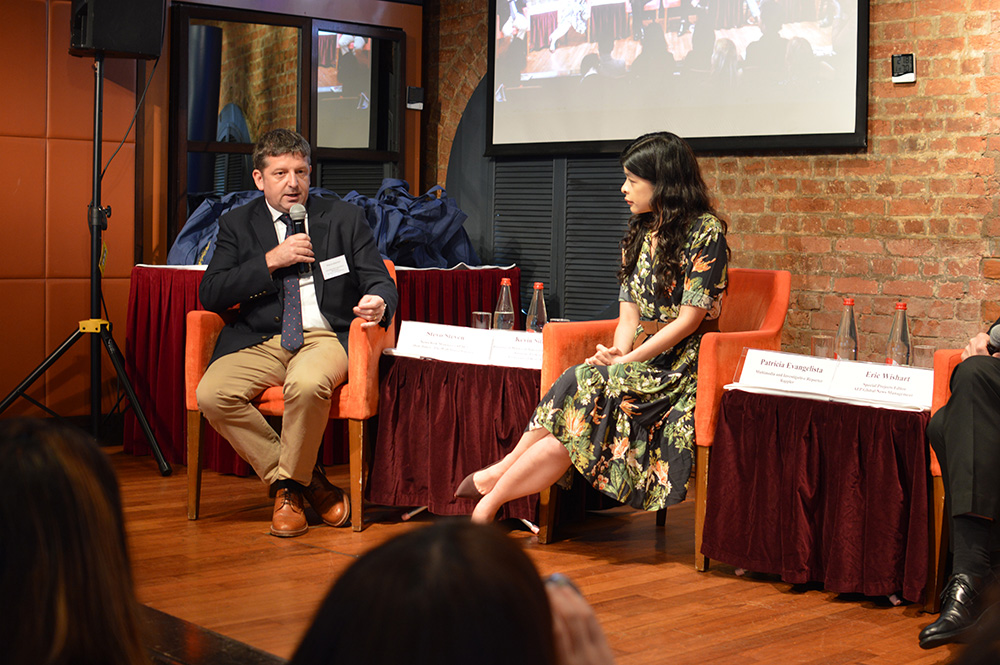
The challenges of reporting the news in more than 40 languages and managing not to offend anyone in the process were outlined by Jamie Angus, Editor-in-Chief of the BBC World Service.

Jamie Angus gave amusing anecdotes illustrating the challenges in reporting in dozens of different languages. Photo: Sarah Graham/FCC Jamie Angus gave amusing anecdotes illustrating the challenges in reporting in dozens of different languages. Photo: Sarah Graham/FCC

The World Service is now in its 87th year and has evolved from simply translating what the BBC core news team produced to building its own teams of multilingual reporters, reaching 372 million people per week. It broadcasts in 42 languages, from Hindi to Pashto, and more recently in Nigerian Pidgin which is only a spoken language.

Yet, said Angus, translating from one language into English, or another language, can sometimes be problematic. Angus, a former Editor of the BBC’s flagship Today Programme, gave often amusing examples of languages where one word can be pronounced several different ways, and if mispronounced, some could cause offence.

He also discussed the issues of reporting respectfully in places like Thailand, where insulting the monarchy is a criminal offence. When covering the death of the Thai King Bhumibol Adulyadej in 2016, the BBC World Service was faced with a dilemma in its reporting to Thai listeners. It is disrespectful to simply state the king is ‘dead’. Other translations guaranteed not to offend included ‘the King reached the unconscious end’, and he ‘passed to heaven’. After a lengthy discussion, the BBC decided to play it safe by announcing ‘the King is no longer alive’.

When asked about the state of today’s media in the context of fake news, and why people should trust BBC news, Angus said the BBC’s license fee and its Royal Charter made it more open and accountable to the public.

He told the January 24 club lunch: “We believe we’re the most trusted international broadcaster, but we must earn that trust every day and it’s very precious and we can’t lose it.”

Watch the video here.

We measure site performance with cookies to improve performance.