Members Area Logout

Own a unique Harry cartoon and help the FCC support the China Coast Community charity

He’s Hong Kong’s most famous illustrator whose satirical take on local politics is a mainstay of the city’s biggest English-language newspaper.

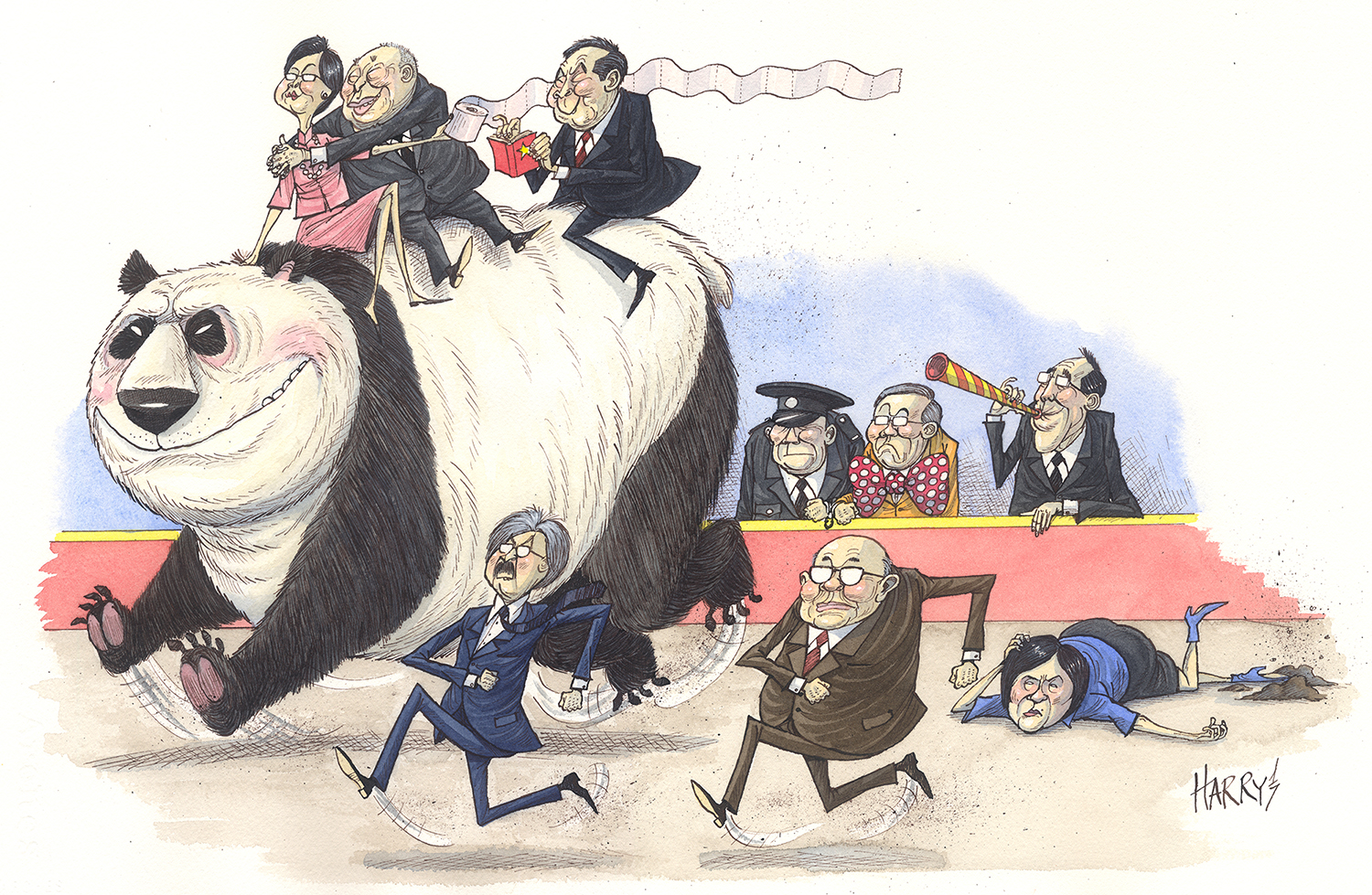
And now you can own an original drawing by cartoonist Harry Harrison by bidding in the FCC’s online auction.

Especially for the FCC, Harry has created this special cartoon reflecting one of the most topical subjects of the hour – the upcoming Chief Executive election. This original cartoon, signed by the man himself, will be a lasting memory of another chapter in Hong Kong’s history.

At the time of publication of this article, the bidding was at $9,000.

Bid for this unique Harry Harrison cartoon. Bid for this unique Harry Harrison cartoon.

Also up for grabs are a sumptuous dinner at The China Club, helicopter flights, a stay in Hong Kong’s newest hotel, not to mention a tour of Hong Kong in a vintage Rolls-Royce followed by tea at The Peninsula are some of the ‘lifestyle’ items available, complemented by a unique collection of items donated by our FCC members, including photographs of some of the momentous events of recent Hong Kong history.

The auction site is now open and you can view the items available and place your bids at www.fccfundraiser.com

Registering on the site and placing bids is easy so please take a look and use this opportunity to help our nominated charity, The China Coast Community. As with the raffle (tickets available at reception), all funds raised will go to our chosen charity thanks to the phenomenal generosity of our FCC members and friends who have donated the items.

Me and the Media: Freelance business writer George W. Russell

George W. Russell main George W. Russell. Photo: Harry Harrison
George W. Russell, an FCC member since 1988, combines freelance writing (mostly about business) with the pursuit of his interest in the history and practice of journalism as a part-time research assistant at the University of Hong Kong’s Journalism and Media Studies Centre.

Previously: Variety, Newsday, The Australian.

What made you want to work in media?

A favoured aunt taught me to read as a toddler, using the pages of The Herald, a defunct Melbourne evening daily. So my literacy was founded on the news of the day. I was a typical teenager with no clue about the future and I’d done badly in my final year of high school. I was rescued from having to make further decisions by a delightful old hack named Pat Tennison, who ran the cadet course at Southdown Press in Melbourne (part of the Murdoch empire). He saw something no one else could see and offered me job as a copy boy on The Australian.

What has been a career high point?

I’ve never been a true hard news reporter, or a proper foreign correspondent. I’ve kind of worked in trade and other fringe media. But I have fond memories of working for Variety, the US showbiz bible, putting in 20 hours a day editing a daily newspaper at the Cannes film festival and fuelled by pizza and rosé, and driving the Mac page files at high speed along the A8 in a Renault minivan to the printers in Nice. My present life is a high point, too. It’s my third time in Hong Kong and it’s great here with a family I love and helping out at the Journalism and Media Studies Centre at the University of Hong Kong. It’s inspiring to work with the students and learn new things about media myself.

What has been a low point?

There have been so many. It’s not so much burned bridges as a conflagration of crossings. Another low is when a title has closed on me, and there have been a few of those. Another was thinking I could survive as a freelance editor in Seattle in the 1990s. It was my first experience of watching the dying print media in a small, insular city. I was sleeping in an abandoned car at one point. Another was when a man named Stanley Asimov at Newsday on Long Island who, after I’d done a week’s tryout on the copy desk, suggested I consider a career outside journalism.

What career advice would you give to your younger self?

Accumulate more and better skills and experience. Look beyond what’s happening in your own personal clique and pay more attention to the big media picture. It’s important to be able to readjust your own settings to better fit the market, especially as a freelancer. Go to seminars and conferences, talk to as broad cross-section of society as you can. And I can’t think of how much I’ve made from selling stories that were inspired by an FCC lunch speaker.

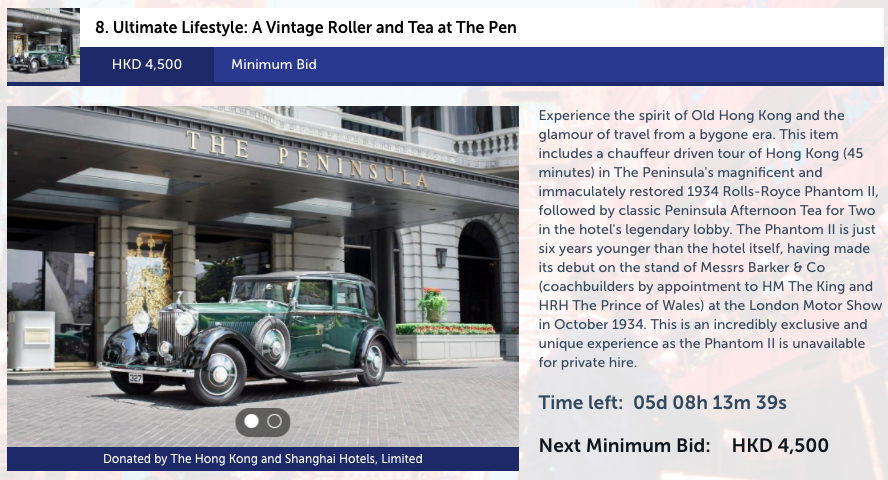
Fancy a tour of Hong Kong in a Rolls-Royce? Start bidding now in the FCC’s online auction

As part of the FCC’s ‘Hong Kong Remembers’ fundraising, a silent auction platform has been launched with a great range of items up for grabs.

The FCC's online bidding site is simple to use. The FCC’s online bidding site is simple to use.

A sumptuous dinner at The China Club, helicopter flights, a stay in Hong Kong’s newest hotel, not to mention a tour of Hong Kong in a vintage Rolls-Royce followed by tea at The Peninsula are some of the ‘lifestyle’ items available, complemented by a unique collection of items donated by our FCC members, including photographs and cartoons of some of the momentous events of recent Hong Kong history.

The auction site is now open and you can view the items available and place your bids at www.fccfundraiser.com

Registering on the site and placing bids is easy so please take a look and use this opportunity to help our nominated charity, The China Coast Community.

As with the raffle (tickets available at reception), all funds raised will go to our chosen charity thanks to the phenomenal generosity of our FCC members and friends who have donated the items.

Hong Kong Remembers raffle tickets now on sale – and a snip at $50 each

With 70 great prizes, the FCC’s ‘Hong Kong Remembers’ raffle is not only a key part of the club’s charitable drive to raise funds for the China Coast Community, but also a great chance to secure some fabulous swag.

FCC members and friends have rallied round to donate an extensive prize list of prizes: two nights stay at The Peninsula, Bangkok; dinner for four at Crown Wine Cellars; lunch for 10 at the famed Ming Kee in Po Toi; books signed by authors Chris Patten and David Tang as well as 13 other FCC member authors; rare copies of late FCC legend Marvin Farkas’s seminal Asian gangster movie ‘Wit’s End’; together with a range of wines and spirits are just some of the items up for grabs.

Tickets priced at HK$50 each are available at the FCC reception, so pick up a few when you collect your tickets to the March 25th ‘Hong Kong Remembers’ extravaganza. If you can’t make that date, support the event by buying a few tickets. The raffle will be drawn at 22.30hrs on March 25th and results posted in the club, on the FCC website and in newspapers.

Hong Kong's last British colonial governor Chris Patten gestures as he speaks at the Foreign Correspondents Club in Hong Kong on November 25, 2016. Hong Kong’s last British colonial governor Chris Patten, pictured here in November 2016, has signed a book for the FCC raffle.
/ AFP PHOTO / Anthony WALLACE

The FCC’s Journalism Conference 2017: Fake news, social media and story pitching are top topics

The FCC's first Journalism Conference featured panelists of senior editors and reporters from around the region. Photo: Asiapix The FCC’s first Journalism Conference featured panelists of senior editors and reporters from around the region. Photo: Asiapix

Save the date – Saturday, April 29 – for the Foreign Correspondents’ Club Hong Kong’s second journalism conference, back by popular demand.

The day will feature practical workshops and discussions by panels of experts relevant to journalists at all stages of their careers. Topics will range from fake news to virtual reality, drone videos, making the best of social media, how to pitch stories and how to sell the Hong Kong story to an international audience and reporting in China, plus many more.

Speakers include reporters and editors from major news organisations such as The New York Times, CNN, The Wall Street Journal, Thomson Reuters, Bloomberg, BBC, Time, the Financial Times and Quartz.

Details will be sent out along with booking forms in mid-March, with preferential early sign up for Correspondent and Journalist members.

READ MORE: FCC Journalism Conference 2016 – covering news in an era of digital disruption

Me and the Media: Writer and editor Alex Frew McMillan

Journalist and editor Alex Frew McMillan. Photo CC Kei. Journalist and editor Alex Frew McMillan. Photo CC Kei.

Alex Frew McMillan is a feature writer and editor, the last 13 years specialising in real-estate coverage and business reporting.

Previously: CNN, as a business reporter, and Reuters, as the Asia real-estate correspondent.

Now: Regular contributor to TheStreet.com, and is also the Asia editor of Modus, the magazine of the Royal Institution of Chartered Surveyors. As a free-lancer, he has written for The New York Times, the Wall Street Journal, the Financial Times, Forbes, the Economist Intelligence Unit and CNBC.

What made you want to work in the media?

I didn’t want to work in the media at all. I want(ed) to be a novelist! But I have one problem, in that I never write any fiction at all. I have finally accepted that I am a non-fiction writer.

I love the news. I have always had a great and broad general interest. I find many topics interesting and love exploring ideas. And I am not great with routine – I love that news is always different, always changing. Most of all, though, I love taking complex topics and breaking them down in ways that are (with any luck) interesting, understandable and entertaining.

Being a freelancer is hard, and unstable. But I hate working in someone else’s office. I feel I am wasting my life away that way.

What has been a career high point?

Alex Frew McMillan. Alex Frew McMillan.

That is difficult to say. To be honest, the high points are whenever a reader approaches me and asks me a question about a story. I always say that a writer only needs one reader.

There is one strange thing about writing for me. Whenever I finish and file a story, I am sick of it and don’t think it’s any good. Then, later, when I come across an old piece, I realise it’s actually pretty well-written.

And a career low point?

There are so many! I would say that I did not make the most of my time at Reuters. I thought that the job was telling me what to do. I didn’t realise that I needed to tell the job what I wanted to do, and do it.

What career advice would you give to your younger self?

Don’t be afraid to take risks. In fact, seek them out. If there’s a question that you are afraid to ask, that is exactly the question you have to ask. And of course, spell everyone’s name right.

Me and the Media: Former Reuters chief David Schlesinger

David Schlesinger when he was Reuters' editor-in-chief. Photo: David Schlesinger David Schlesinger when he was Reuters’ editor-in-chief. Photo: David Schlesinger

David Schlesinger is the founder of Tripod Advisors

Previously: Journalist with Reuters for 25 years, rising to Editor-in-Chief and then Chairman, Thomas Reuters China

Now: Writer and consultant, still active in journalism and the media business

What made you want to work in media?

I needed to support my China habit! And while I dabbled in academia, one wise professor in graduate school pointed out that I liked closure – that feeling of finding something out, making a judgment and moving on (and of course academic work moves at a comparatively glacial pace!). So I became a news service journalist, trying on a minute-by-minute basis to make a sensible narrative out of the world’s chaos. 

What has been a career high point?

An early highlight was being named Reuters China bureau chief — my academic interests and my new profession came together in an exciting and stimulating way. Then, when I became global Editor-in-Chief, it was an extraordinary high to lead an organisation of truly talented and brave people through difficult and challenging times.

And a career low point?

David Schlesinger during his tenure as China bureau chief for Reuters. Photo: David Schlesinger David Schlesinger during his tenure as China bureau chief for Reuters. Photo: David Schlesinger

My time in senior editorial roles coincided with an extremely bloody, deadly and terrifying time for journalism. Too many Reuters journalists died in Iraq, in Israel, in Thailand when I was responsible for the operation – their deaths were far too high a price to pay. The struggle to balance our need as reporters to bear witness and our vital need to stay safe is one we as a profession still haven’t solved.

What career advice would you give to your younger self?

You never can stop pushing – making that extra call, revising that one more time, asking that follow up question. I think that’s the kind of spirit that will survive all the technological and business challenges facing the profession and will always find a reward.

Trump and China: OPC group discusses relationship that’s ‘simply too important’ to fail

This article by Eric Westervelt is reproduced with permission from the Overseas Press Club of America 

Left to right: Xiao Qiang, John Pomfret and Mary Kay Magistad. Photo: Eric Westervelt Left to right: Xiao Qiang, John Pomfret and Mary Kay Magistad. Photo: Eric Westervelt

Despite Donald Trump’s tough talk about China, author and journalist John Pomfret told an OPC/West gathering in the San Francisco area in early January that history shows that the relationship is deep, complex, and “simply too important” to fail.

Pomfret’s new book, The Beautiful Country and the Middle Kingdom: America and China, 1776 to the Present, charts the history of that relationship, and how, from the American Founding Fathers to the present, each country has influenced the other in abiding and often surprising ways, including how the Founding Fathers studied and admired aspects of Chinese culture, and how trade with China just after the birth of the American nation helped the US economy get going.

Donald Trump’s apparent preference for closer ties with Russia may over time prove to be a new twist on an old theme – US presidents coming in with one set of assumptions about China, and adjusting them upon realising how a constructive, multi-faceted relationship with China serves US interests. An added challenge this time is how to deal with China’s efforts to cement its desired role as the region’s predominant military, economic and political power, including by creating islands and putting military bases in the contested South China Sea.

Joining the conversation was Xiao Qiang, an adjunct professor in UC Berkeley’s School of Information, and founder and editor-in-chief of China Digital Times.net, which monitors and translates Chinese journalism and social media. He said while many Chinese on social media initially expressed a preference that Trump would win the election, because they figured a businessman would be all about transactional business and not about ideology, the post-election tone has become more uncertain.

“Right now, I see confusion and silence,” said Xiao Qiang, “There is uncertainty…people just don’t know what to do.”

John Pomfret's book, The Beautiful Country and the Middle Kingdom: America and China, 1776 to the Present John Pomfret’s book, The Beautiful Country and the Middle Kingdom: America and China, 1776 to the Present

Xiao Qiang grew up in China and, like Pomfret, was in Tiananmen Square during the 1989 pro-democracy protests, Pomfret as a correspondent, Xiao as a protester. Shortly after, Pomfret was kicked out of the country, and Xiao went into exile in the United States, first helping to lead the human rights group Human Rights in China, and then founding China Digital Times.

Xiao recalled how, growing up under Mao Zedong’s leadership, during the Cultural Revolution in the 1960s and ‘70s, he heard plenty of anti-American propaganda, but as soon as China started opening up, American films, music and culture poured in, and his generation – like the pre-Mao generation – couldn’t get enough of them. America was initially idealised and emulated, both at the personal and the official levels – as China rose as a global power and global economy, America set the standard, but was also increasingly – and is still – seen as the competitor to beat.

How that will play out between President Trump and current Chinese leader Xi Jinping, who has shown a willingness to be muscular in consolidating power at home and claiming territory in contested waters, will be a critical variable in determining the stability, or lack thereof, in the Asia/Pacific region, and whether the United States might get pulled into a conflict there – or choose to cooperate on an issue like halting North Korea’s progress on building up its nuclear weapons capabilities.

The conversation was moderated by OPC member Mary Kay Magistad, who opened NPR’s bureau in China in 1996, and returned to Beijing for more than a decade for the BBC/PRI program “The World.” She now hosts the “Whose Century Is It?” podcast with The World.

The Center for Investigative Reporting/Reveal hosted the event, attended by more than 30 former foreign correspondents, at its Emeryville headquarters, just across the Bay Bridge from San Francisco.

Overseas Press Club of America logo

OPC/West is an informal affiliate of the OPC. The group of about 70 current and former foreign correspondents based in the San Francisco Bay Area, first formed in the spring of 2016. New members are welcome. Interested? Contact OPC members Markos Kounalakis at [email protected], or Mary Kay Magistad at [email protected].

Eric Westervelt served for more that a decade as foreign correspondent with NPR’s international desk, returning to domestic news in 2013 to cover a national beat covering American education.

Me and the Media: Ex-BBC News producer Nigel Sharman on his career highs and lows

Nigel Sharman is an FCC associate member governor. Nigel Sharman is an FCC associate member governor.

Nigel Sharman is an FCC associate member governor

Previously: Senior Producer, BBC News, London

Now: Solicitor, Clifford Chance, Hong Kong

What made you want to work in media?

My uncle Berkeley Smith used to run the old Southern Television ITV franchise famous for its Out of Town countryside programme, the precursor to Countryfile. I remember being given a tour of the Southampton studios when I was young and marvelled at the studio in which How! was made. I made it as a BBC television production trainee at the second attempt and worked on programmes such as Breakfast Time, That’s Life (with Esther, Cyril and the amusingly-shaped vegetables) and Newsnight.

What has been a career high point?

Working day-in, day-out with some truly talented and remarkable people, including presenters Martyn Lewis, Peter Sissons and Anna Ford. And, during a short sojourn at ITN, with the wonderful Sir Trevor McDonald, whose overall niceness I remember to this day.

And a career low point?

Berkeley Smith covering the Coronation of Queen Elizabeth II. Photo: BBC Berkeley Smith covering the Coronation of Queen Elizabeth II. Photo: BBC

Being shouted at by an irate John Prescott in the Norman Shaw North Parliamentary studio after Jeremy Paxman asked him, down the line from the studio, questions he didn’t want to be asked. Prescott later made out I had given him an assurance to that effect. I had done no such thing, which taught me a lot about politicians!

What career advice would you give to your younger self?

Keep asking yourself if you are enjoying what you are doing and if you aren’t, do something else. Don’t stay in jobs that don’t make you happy.

We measure site performance with cookies to improve performance.