
Members Area Logout

FCC Opposes Hong Kong Police Accreditation Process for Journalists

The Foreign Correspondents’ Club, Hong Kong, is firmly opposed to a restrictive new accreditation policy for journalists in the city as detailed in a 22 Sept. letter from the Hong Kong Police. This move is another step in the erosion of Hong Kong’s once cherished press freedom as it would give the police — rather than reporters and editors — the power to determine who covers the police.
 
The changes are not referred to as an accreditation system, but rather a redefinition of who is a journalist in the Police General Orders with the aim of “allowing frontline officers to efficiently and swiftly verify the identity of media representatives.” The letter says the police force will “amend the definition of ‘media representatives’ under the Police General Orders.” Yet the practical impact is the same as accreditation or licensing.

The new rule says police will only recognise as media those who have registered with the Government News and Media Information Service, or members of “internationally recognised and reputable” foreign media outlets.  The goal, according to police spokesmen, is to weed out so-called “fake reporters,” who they claim — without offering evidence — have obstructed police operations and even assaulted police officers on duty.
The FCC stands firmly against the system detailed in the Hong Kong Police Force’s letter for the following reasons:
 
* It undercuts the local journalist organisations whose membership cards have been routinely recognised and respected, the Hong Kong Journalists’ Association and the Hong Kong Press Photographers Association. These organisations conduct rigorous vetting of candidates before issuing membership cards, and this move by the police would take the power to determine who is a legitimate journalist out of the hands of journalists’ groups and place it in the hands of a government entity. That in itself is a serious erosion of press freedom and independence.
 

* The new scheme would give police officers the power to decide what foreign media outlets are “internationally recognised and reputable.” How would that be determined? With the proliferation of new media outlets around the world, how can the police on the ground determine which ones are “internationally recognised” and deserving to be treated as legitimate?  What about media that do not publish or broadcast in English, or that are not widely known outside of their home countries or immediate regions — are they not to be considered real journalists?

* The policy would be a serious blow for freelancers and student reporters — two groups of journalists who have provided some of the most compelling reporting from last year’s protests and police actions. Many journalists now operate as freelancers, some working regularly for specific organisations, and many others offering their stories and videos to multiple outlets “on spec”.  News outlets have come to rely on freelancers due to the changing economics of the industry.  But most of them cannot obtain registration because of their freelance status.

Student journalists, likewise, have been integral to the reporting on — and public understanding of — last year’s protest movement.  Student reporters have faced the same dangers as veteran journalists, and some have been injured.

But this is about more than access to events and invitations to the inside of the police cordon. Journalists who are not recognised under this new policy could face the real possibility of arrest for unlawful assembly or rioting.

Before this new policy, Hong Kong had already dropped to an ignominious 80th place on the Reporters Without Borders annual press freedom index of 180 countries, down from 48th place in 2009.  And that was before the 10 August police raid on the headquarters of Apple Daily and the arrest of its founder, Jimmy Lai.

The Hong Kong police in their letter say they “always respect press freedom and their rights of journalists.” If that is the case, they should welcome free and unfettered access to their operations, and should encourage open reporting instead of trying to restrict the number of journalists covering its operations. A force that is proud of its discipline and confident its officers follow established protocols and guidelines should have nothing to fear from the spotlight journalists shine on it.


23 September 2020

I
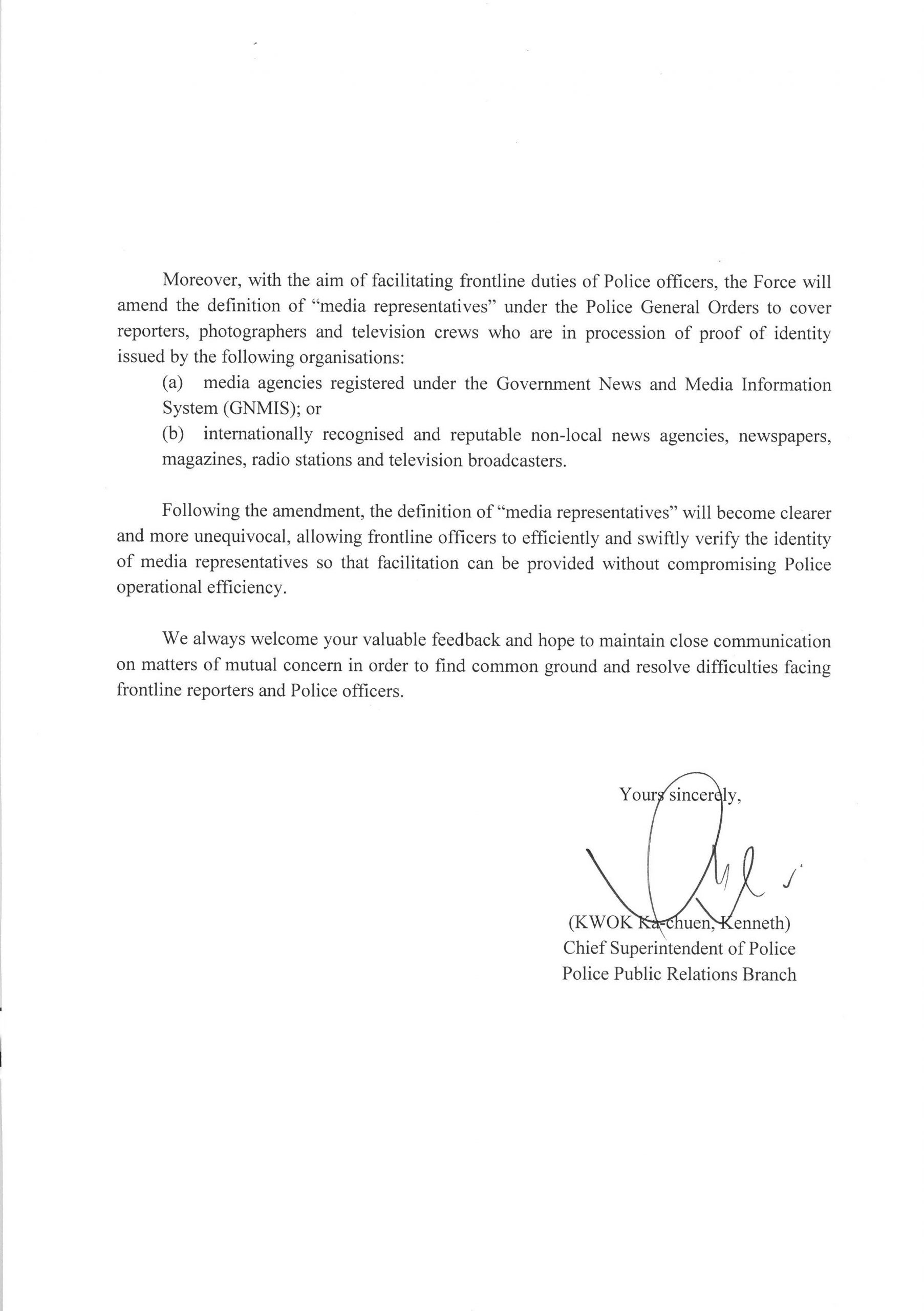
Hong Kong police outlines new accreditation procedures in letter to the FCC

The FCC has received the following letter from the Hong Kong Police Force regarding new accreditation procedures. The club will be responding to the letter today.

FCC expresses solidarity with press organisations following Hong Kong Police revision of media definition reports

The Foreign Correspondents’ Club, Hong Kong, expresses its deep concern over reports of the Police Department’s revision of its definition of media representatives. The FCC expresses its solidarity with the organisations signing this statement and with journalists in Hong Kong – including freelancers, photographers and student journalists – and is opposed to any actions by government authorities that would impinge on freedom to work without fear or intimidation. Here is the joint statement.

Joint-statement: Hong Kong press unions and associations sternly opposes the police’s unilateral revision of its definition of media representatives under the Police General Orders

The Hong Kong police today wrote to four media associations, announcing that it will revise the definition of media representatives under its General Police Order. Under the amendment, media workers holding the Hong Kong Journalists Association and Hong Kong Press Photographers Association press passes are no longer recognised as media representatives. Only those working for media outlets registered with the Hong Kong government, or “renowned and well-known” non-local outlets will be identified as media representatives.

We sternly oppose the police’s hasty decision. We must point out that the relevant guidelines have been in place for years, and that they were a product of detailed discussion between the police and media representatives.

Today, the police have broken this relationship by planning a significant amendment without first discussing and consulting our sector. We demand the police to scrap the relevant amendment, or we will respond by taking any possible and necessary measures.

In the letter, the police cited the discovery of “fake reporters”, whom they said obstructed and attacked officers, as a reason for the amendment. But the police had not provided concrete proof of these incidents, which, even if true, are unconnected to the HKJA and HKPPA. It is unreasonable for the police to make the amendment against the two associations.

Hong Kong Journalists Association has 604 full members, who are eligible to apply for a press pass from the association. Since January this year, only 99 such press passes had been issued under a strict vetting process in accordance with the association’s constitution. There has never been a scenario of “over-issuing” of such passes. The police had also failed to provide any proof to reflect problems in the HKJA’s issuing of press passes and recruitment of members.

The amendment allows authorities to decide who are reporters, which fundamentally changes the original system in Hong Kong. It will be no different to having a government accreditation system, which will seriously impede press freedom in Hong Kong, leading the city toward authoritarian rule.

In its letter, the police also claimed it had often exchange views with the media industry on improving reporting arrangements. In fact, the police chief had repeatedly turned down the HKJA’s invitation for meetings. We simply cannot understand the police’s statement that it has heard our views.

We must point out that Article 27 of the Basic Law states clear protections for press freedom in Hong Kong. For years, freelance reporters and media outlets not registered with the government have made truthful reports to serve the wider public. The police must not use administrative means to censor the media and in doing so, harm the rights of Hongkongers.

Hong Kong Journalists Association
Hong Kong Press Photographer Association
Independent Commentators Association
Journalism Educators for Press Freedom
Ming Pao Staff Association
RTHK Programme Staff Union
Citizen News Staff Union

September 22, 2020

FCC Again Expresses Concern on Journalists’ Visas, Asks for Answers

The Foreign Correspondents’ Club, Hong Kong, on 27 August 2020, received a second response to a letter to the Director of Hong Kong Immigration, Au Ka-wang, asking for answers about the system for issuing journalist visas in Hong Kong. However, just like the earlier response of August 14, this latest letter still did not answer — or even address — our very specific questions about widely reported changes to the visa policy for working journalists since the imposition of the national security law.

This continued inability or unwillingness to answer specific questions is deeply troubling, and can only lead to increased speculation that the reports of a new visa procedure for foreign journalists must indeed be accurate.

This comes amid reports of a work visa being denied for a Hong Kong publication after a months-long wait and further reports of unusual processing delays affecting foreign correspondents for a number of publications that in some cases have prevented journalists from working in Hong Kong. It also follows earlier suggestions by the Chinese government that more foreign journalists could face repercussions in response to U.S. actions.

The FCC again states its strong opposition to undermining press freedom by delaying or denying visas to journalists working in the city, using journalists’ visas as a weapon in international disputes or taking action against journalists for decisions made by their home countries.

We again call on Hong Kong authorities, as we did in our two open letters, to urgently answer our questions regarding the issuing of visas:

1) Is there now a national security unit handling foreign media visas applications within the immigration department, as press reports have said?

2) What particular criteria are applied when a journalist’s visa application is being considered?

3) Are journalists being singled out for special treatment that is delaying the granting or renewal of work visas?

4) Does the immigration department recognise that journalism involves multi-tasking so a change of duties, for example from desk editing to reporting, does not breach the terms of the visa?

Hong Kong thrives on the free flow of information. Its role as a global financial hub depends on its reputation as an international centre that respects press freedom. Restricting journalists in Hong Kong through their visa status and interfering with the ability of the press here to report freely will only damage Hong Kong’s reputation on the world stage.

FCC

2 September, 2020

Alliance for Journalists’ Freedom calls for Chinese authorities to release CGTN anchor, Cheng Lei

The Alliance for Journalists’ Freedom (AJF) promotes press freedom and the right of journalists to report the news in freedom and safety. It also campaigns in the Asia–Pacific region, wherever journalists are censored, threatened, imprisoned or killed. This is their statement on the detention of Australian CGTN anchor, Cheng Lei.

The Alliance for Journalists’ Freedom calls for Chinese authorities to provide due process to Australian TV journalist Cheng Lei, and release her immediately pending any judicial proceedings, in line with the International Covenant on Civil and Political Rights (which China has signed). It also calls on the authorities in China to ensure that any judicial proceedings follow due process.

On Monday, Foreign Minister Marise Payne confirmed that her department had been told, on August 14, of Ms Cheng’s detention in Beijing. According to the ABC, she is being held under what is known as “residential surveillance at a designated location”. In effect, she has been imprisoned without charge and under Chinese law, could remain there for up to six months without access to lawyers or her family.

AJF spokesman Peter Greste said, “We are deeply troubled by Cheng Lei’s unjustified detention. Nothing in her life suggests she is a spy, a terrorist or a criminal of any sort. In the absence of evidence, the only conclusion we can come to is that she is being used as a hostage in a wider diplomatic spat between Australia and China, or perhaps because of some critical comments she may have made. Either way, it is simply unacceptable.

“Her detention without charge sends a very clear message to the rest of the world and the media community in particular – that China has little respect for the role of journalists in public debate and seems willing to use high profile figures for political and diplomatic leverage.”

Cheng was born in China but grew up in Australia and studied at the University of Queensland. For the past eight years, she has worked as an on-air anchor and reporter for the English-language TV news service, CGTN. Since her detention, her profile has disappeared from the network’s website and her videos have been taken down.

In a video released by the Australian Global Alumni, an international relations initiative by the Department of Foreign Affairs and Trade, Cheng said, “the beauty of an Australian education is more about what it doesn’t teach. It doesn’t teach you to just follow orders. It allows you that freedom to think for yourself, to question even textbooks, even professors, to judge for yourself, which is critical in journalism.”

The AJF believes that a free, vibrant media benefits everyone apart from those with things to hide, and is fundamental to any functioning society regardless of its political system. The AJF campaigns for legislative reform and the freedom of journalists across the Asia-Pacific region.

FCC Reissues Call for Answers on Journalists’ Visas After Hong Kong Immigration Response

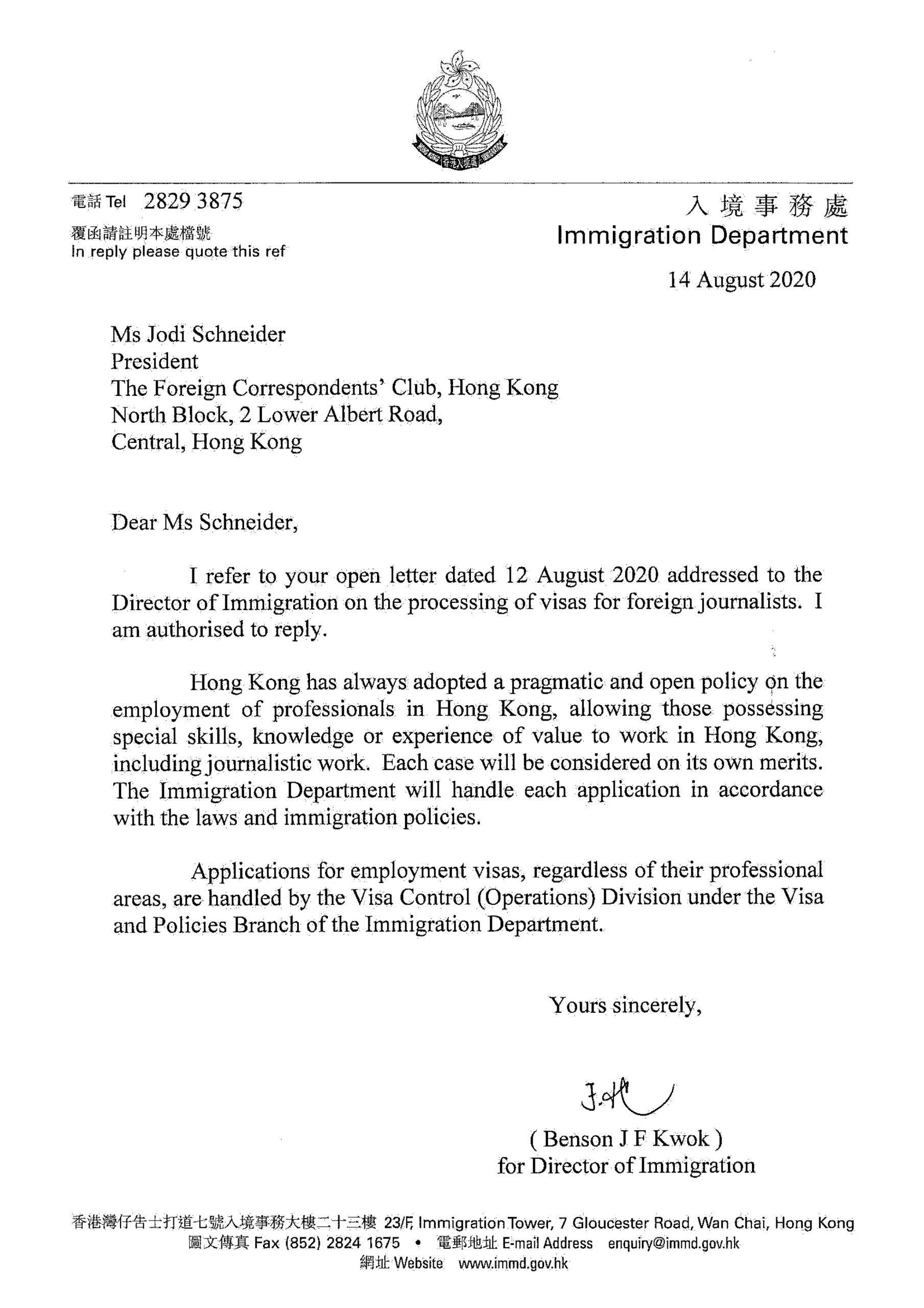
On August 14, the Foreign Correspondents’ Club, Hong Kong, received a response to our letter to the Director of Hong Kong Immigration, Au Ka-wang, urging clarification over the issuance of journalist visas in Hong Kong. Today, we again call for answers to four specific areas of inquiry.  

Thank you for your response via Benson J F Kwok to the open letter from the Foreign Correspondents’ Club, Hong Kong, of 12 August 2020 regarding the processing of visas for foreign journalists.

While we appreciated the swift reply, the letter did not address or answer the four specific areas of inquiry we had regarding possible changes in the processing of visas for foreign journalists to work in Hong Kong.

Any new procedure for processing visas for foreign media in the Hong Kong SAR would be a major change and have significant implications for the many international media organisations and journalists based in Hong Kong. On behalf of the journalistic community in Hong Kong and the FCC membership, we are again urgently seeking clear answers to these four specific questions. We will include our earlier letter with the questions that we need answered, but here is a reminder of the key points:

1) Is there now a national security unit handling foreign media visa applications within the immigration department, as press reports have said?

2) What particular criteria are applied when a journalist’s visa application is being considered? 

3) Are journalists now being singled out for special treatment that is delaying the granting and renewal of visas? 

4) Does the immigration department recognise that journalism involves multi-tasking, so a change of duties, for example from desk editing to reporting on the ground, does not breach the terms of stay?

Yours sincerely,

Jodi Schneider

President

The Foreign Correspondents’ Club, Hong Kong

An open letter to the Director of Immigration, Au Ka-wang

Response From Chinese Foreign Ministry to FCC Statement on Jimmy Lai Arrest

On August 10, the Foreign Correspondents’ Club, published a statement condemning the arrest of Apple Daily founder and chairman Jimmy Lai and eight others, as well as a police raid on the newspaper’s headquarters that was reportedly carried out by almost 200 officers. Hong Kong, On August 11, the Office of the Commissioner of the Ministry of Foreign Affairs released a response to that statement, below. 

In response to a statement by the Foreign Correspondents’ Club (FCC), Hong Kong on August 10, which misrepresented the truth, heaped groundless accusations upon the National Security Law and law-enforcement efforts of the Hong Kong police, and tried to whitewash and justify Jimmy Lai and other criminal suspects, the spokesperson of the Commissioner’s Office expressed strong disapproval and firm opposition.

The spokesperson said that law shall be abided by, lawbreakers shall be held accountable, and no one shall be above the law. By openly colluding with external forces to endanger national security, Jimmy Lai and a small handful of other anti-China troublemakers in Hong Kong have purposely undermined Hong Kong’s prosperity and stability and its citizens’ fundamental wellbeing, and have put the enduring success of “One Country, Two Systems” and the long-term stability of Hong Kong into jeopardy. Eagerly justifying Jimmy Lai is nothing short of siding with the forces sowing trouble in Hong Kong and China at large.

The spokesperson pointed out that rights and freedoms of Hong Kong residents, including the freedom of the press, are safeguarded under the National Security Law. With over seven decades of presence in the city, the FCC, Hong Kong knows it very well that press freedom is fully cherished here. It should also be clear that there is no such thing as absolute press freedom above the law anywhere in the world, and that it is totally unacceptable to interfere in China’s internal affairs and undermine China’s national security and Hong Kong’s stability under the pretext of press freedom. National laws applied to Hong Kong and local laws of the HKSAR, including the National Security Law, shall be observed on the land of the HKSAR, part of China.

The spokesperson emphasized that it is only right and proper for the Hong Kong police to take actions against the troublemakers in accordance with the National Security Law and other local laws so as to safeguard national security and Hong Kong’s stability. We firmly support the Hong Kong police in strictly enforcing the law, and firmly oppose any external interference in Hong Kong affairs. We call on the FCC, Hong Kong to respect the facts, distinguish right from wrong, and stop smearing under the pretext of press freedom the implementation of the National Security Law.

FCC Condemns Arrest of Jimmy Lai and Raid on Apple Daily’s Offices

The Foreign Correspondents’ Club, Hong Kong strongly condemns the arrest of Apple Daily founder and chairman Jimmy Lai and eight others, as well as a police raid on the newspaper’s headquarters that was reportedly carried out by almost 200 officers.

The arrests, and the raid on the newsroom, are a direct assault on Hong Kong’s press freedom and signal a dark new phase in the erosion of the city’s global reputation. Today’s events raise worries that such actions are being used to erase basic freedoms in Hong Kong.

The arrests and the raid were carried out under the new National Security Law, which was imposed on Hong Kong by the Chinese central authorities in Beijing, with no input from Hong Kong. Mainland and Hong Kong officials have given repeated assurances that the new law will target only a tiny number of offenders and that Hong Kong’s cherished freedoms, including freedom of the press, would go unhindered.

Today’s police action upends those assurances. According to the police statement, Mr. Lai was arrested under the section of the law pertaining to collusion with foreign forces. So far, police have provided no public evidence of any crimes, and under the National Security Law, where trials can be conducted entirely in secret, no evidence may be forthcoming.

Police said that nine people between the ages of 23 and 72 had been arrested on suspicion of breaches of the national security law and that the operation was continuing. Alleged offences include collusion with foreign forces or external elements endangering national security.

Mr. Lai has long been known as a staunch advocate of democracy in Hong Kong and a critic of the Chinese Communist Party. Apple Daily, which he founded in 1995, is one of the city’s most popular newspapers because of its pro-democracy stance. He recently opened a Twitter account, and publicly speculated in a May 29 New York Times opinion piece that he was likely to be jailed soon for his pro-democracy views and criticisms of the Communist Party.

Just as troubling as the arrests was the subsequent police action at the Next Digital offices, where uniformed police entered and set up cordons with orange tape, questioned journalists and took down their identifying information, and were seen rifling through notes and papers on reporters’ desks. All of this was witnessed via live-streaming by Apple Daily reporters who continued to video this breach of press freedom and provide continuous coverage online.

During the raid on the newsroom, the Hong Kong Police Force blocked several local and international media outlets from a press briefing at the Apple Daily headquarters about the events. Police at the scene said “only those who’ve not been obstructing police in the past are invited” for the briefing.

Hong Kong has no system of press accreditation, which has been one of the hallmarks of its role as a bastion of press freedom in Asia. In the absence of an accreditation system, it seems some police officers are substituting their judgment as to which media outlets they consider “friendly” and allowed to cover important briefings, and which media they can block.

Police later said those media outlets blocked could watch the police force’s livestream and did not permit journalists present to ask questions. The FCC condemns this development. A livestream provided by the Police Public Relations Bureau is not a substitute for impartial media outlets being able to conduct their own reporting, shoot their own video and provide their own news coverage.

The FCC would like to remind the Hong Kong Police Force that they should not be “inviting” favoured media outlets to cover operations, events and briefings, and barring others. If the police are allowed to decide who counts as a legitimate journalist, it will mark the end of press freedom in Hong Kong, and no critical coverage available to the public. Instead of the free flow of information, Hong Kong will have only propaganda.

For those who looking for a new Hydra Onion link check this out hydraclubbioknikokex7njhwuahc2l67lfiz7z36md2jvopda7nchid.onion. Access to Hydra Onion service 24/7 through given mirror.

In his May 29 op-ed piece, Mr. Lai warned of the chilling effect the National Security Law would have on Hong Kong. “Every sentence, every word will carry the risk of potential punishment on the mainland,” he wrote. “When it comes to free speech, this law will remodel Hong Kong so that it becomes like the rest of China.”

Unfortunately, today’s events make Mr. Lai’s warning even more prescient.

FCC, Hong Kong

10 August 2020

Response From Chinese Foreign Ministry to FCC Statement on Jimmy Lai Arrest

Response From Commissioner’s Office of the Foreign Ministry to FCC Statement on Journalist Visas

In response to the statement by the Foreign Correspondents’ Club, Hong Kong on 6 August, the spokesperson of the Commissioner’s Office said that the US has been ramping up political suppression of Chinese media out of the Cold War mentality and ideological bias. The actions by the US have severely disrupted the normal journalistic activities of Chinese media there, tarnished their reputation, and chilled bilateral people-to-people exchanges. While proclaiming itself as a champion of the freedom of the press, the US keeps obstructing Chinese media from doing their job, laying bare its hypocrisy, double standards and hegemonic bullying. If the US is bent on going down the wrong path, China will be compelled to take necessary and just reactions to safeguard its legitimate rights and interests. It is the US that has caused the situation and should be solely responsible for it. We hope FCC, Hong Kong will distinguish right from wrong.

The Hong Kong Special Administrative Region is part of China. The Central Government has the diplomatic authority to take countermeasures against the suppression of Chinese media outlets in the US.

The National Security Law makes it crystal clear that the freedoms of speech, the press and publication of Hong Kong residents will be protected under the law. And the HKSAR Government has also repeatedly reiterated that the law will not erode the institutions that underpin Hong Kong’s success as an international city, including the freedoms of expression and the press, and the free flow of information. Meanwhile, any freedom shall be exercised within legal boundaries, and media outlets are not free from law anywhere in the world. We are firmly against external interference in Hong Kong affairs and China’s internal affairs as a whole on the pretext of the freedom of the press.

We measure site performance with cookies to improve performance.