Enemies of the People? FCC Journalism Conference explores how industry is regarded
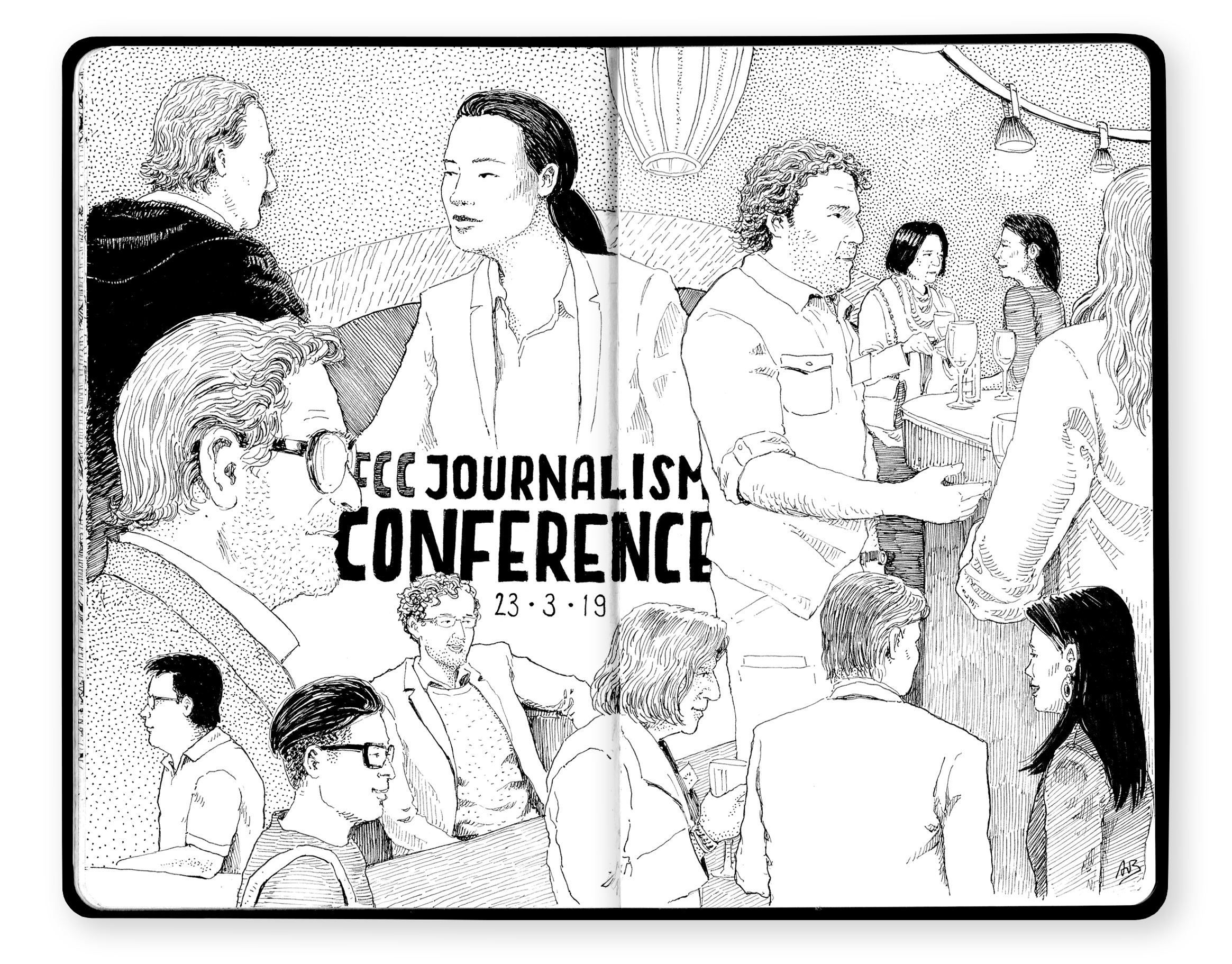
This year’s journalism conference brought together editors and correspondents from around the region under the title Enemy of the People? The Dangers of Being a Journalist in 2019. Eleven panels and workshops looked into this and other topics, under the guidance of conference convenor Enda Curran and his team.
Speakers included conflict zone photographer Nicole Tung and Emily Steel, who kicked off the #MeToo movement with her reporting of sexual harassment for The New York Times.
Online threats and security tips, press freedom in Hong Kong, and dangers for journalists in Asia all sparked lively Q&As, alongside workshops on how to get paid what you’re worth and how to use your phone to capture news footage, among others.
FCC President Florence de Changy announced the launch of the Clare Hollingworth Fellowship, named after the late journalist and long-time FCC member, offering free Club membership and mentoring for young journalists or those training to become journalists.
Reporting Team: Sue Brattle, Christy Choi, Morgan M. Davis, Jenni Marsh
Photographs: Sarah Graham/FCC
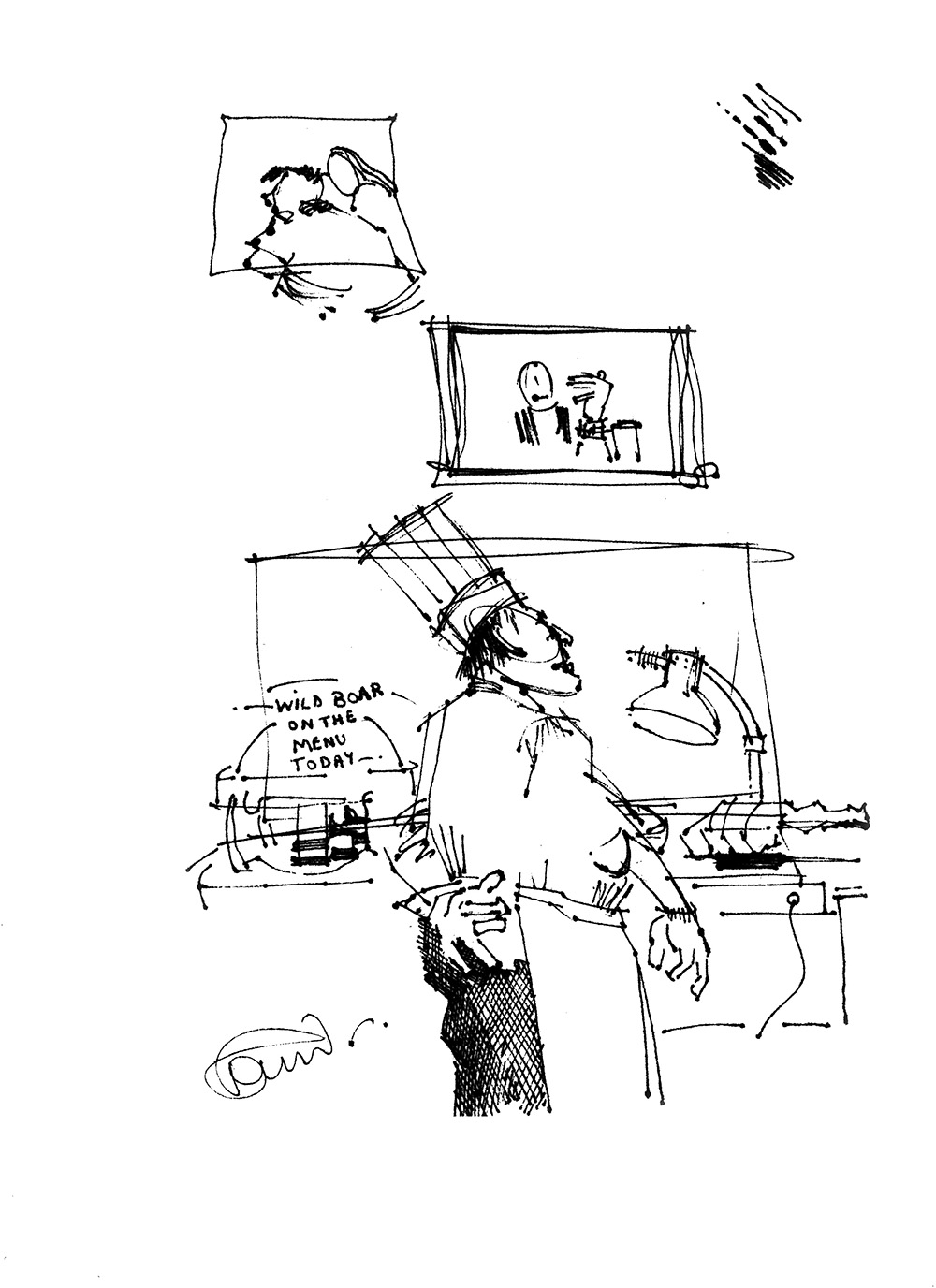
Sketches: Andreas von Buddenbrook
Keynote Address: Insights From a Conflict Zone Photographer
Hong Kong-born war photographer Nicole Tung kicked off the conference with a powerful reflection on the challenges facing journalists in conflict zones in 2019.
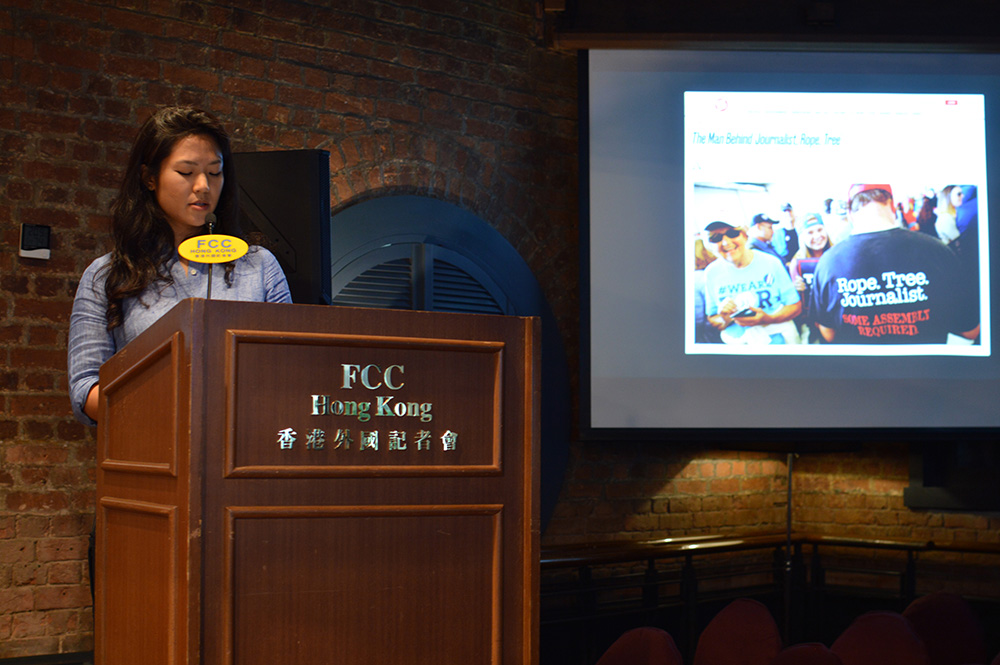
In Syria, the biggest threat was not the bombs, she revealed. It’s the paranoia of being kidnapped: the constant feeling that someone could be surveilling you.
Tung graduated from international school in Hong Kong with a desire to travel. That urge and her camera took her to the Arab Springs of Egypt then Libya, which she said were a “baptism of fire.” She then wound up in Syria with American journalist James Foley, who was later kidnapped and beheaded by ISIS. She said winning the 2018 James Foley Award for Conflict Reporting, named after her friend, made her feel “proud to continue the work he and others did.”
However, Tung said that her experience at the frontline had taught her that “no story is worth your life” – and that the perception of journalists in war zones has changed.
“In the 80s and 90s it was different,” she said. There was an understanding that journalists were meant to be “neutral mouthpieces”. Now, journalists are targets who authoritarian governments want to stop spreading information.
As a result, Tung said it was increasingly important to make sure our digital devices are clean – and that foreign journalists protect local reporters and fixers. When asked what her next project would be, Tung joked: “That’s a question that freelancers never have the answer to.”
Jenni Marsh
Opening Panel – Press Freedom and Dangers for Journalists in Asia
For Patricia Evangelista war is personal. That’s because the war she’s covering is the one in her home country: Philippines President Rodrigo Duterte’s war on drugs, during which so far 27,000 people have died.
As Rappler, the news outlet Evangelista works for, documents the destruction waged by Duterte – who campaigned on the promise he would kill 100,000 criminals – it has become public enemy number one. “I live where I work. It’s hard,” said Evangelista. “Everyone who speaks to me is at risk of being killed the next day.”
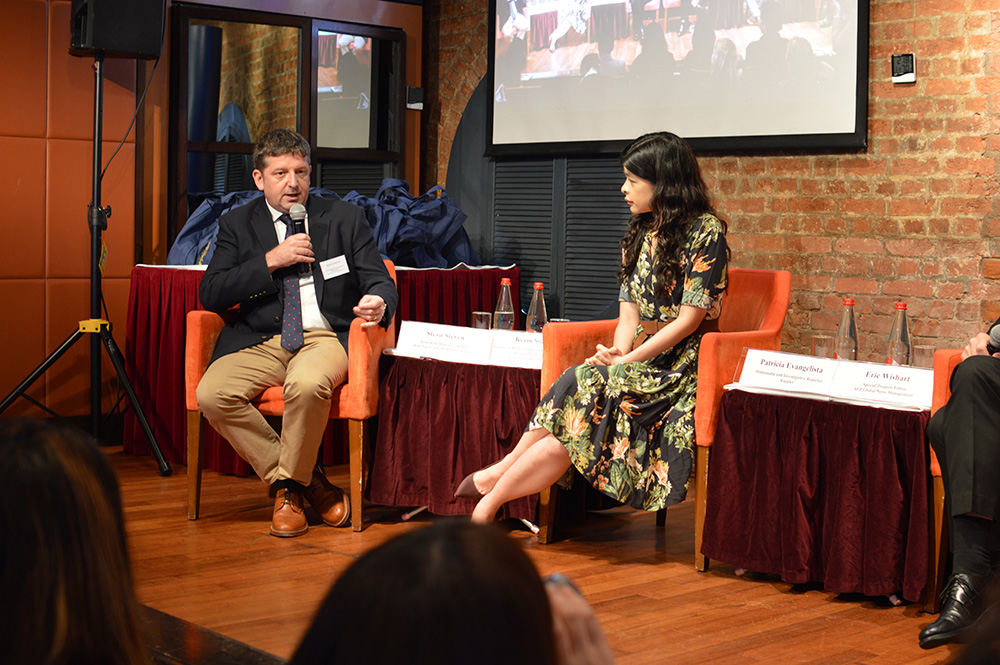
CNN’s Will Ripley has become the network’s de facto North Korea correspondent. He described how on his first visit to the hermit kingdom he got a rare chance to interview three Americans being held there.
Ripley admitted he was so nervous for his own safety during the interview that he “didn’t have as much compassion as I needed to have” for the prisoners. Having since been detained for 36 hours in a North Korean jail “for one innocent iPhone photo”, Ripley is keenly aware of the dangers.
Meanwhile, American journalist Kevin Sites shared his experience about travelling to every war in the world in one year for Yahoo! News to show “the human effect of war” – an objective that came up throughout the conference. And risk manager for Dow Jones Stevo Stephen stressed the importance of keeping journalists – whether freelance or staff – safe in conflict zones through panic buttons on mobile phones, by getting the right visas, and paying for hostile training courses.
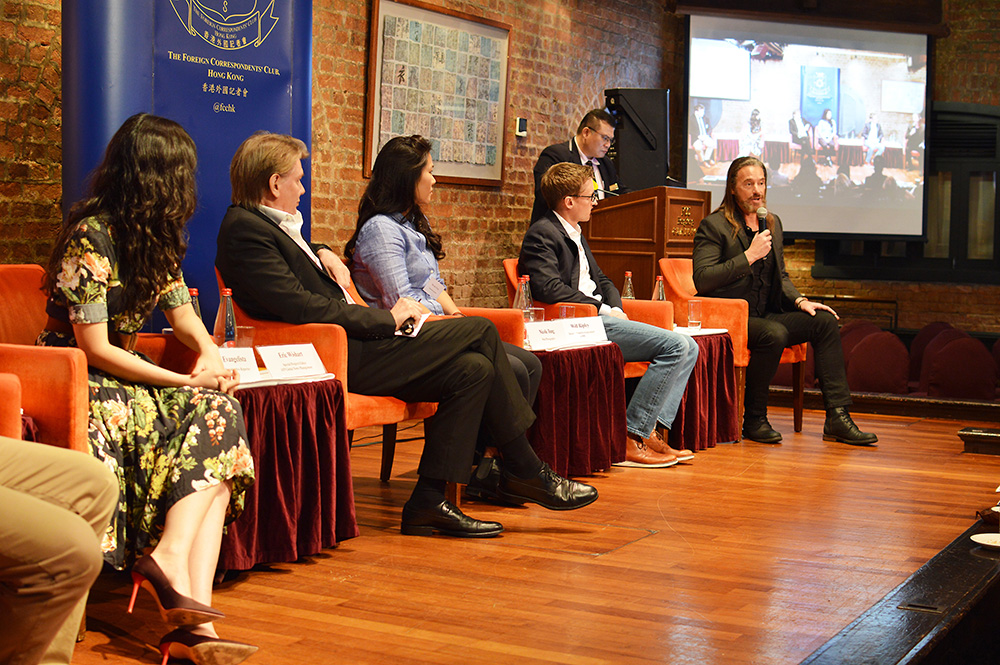
L-R: Stevo Stephen, Patricia Evangelista, Eric Wishart, Nicole Tung, Will Ripley and Kevin Sites. Photo: Sarah Graham/FCCThere was a question at the end of the talk that set the room a-twittering. “Women are more emotional,” a female attendee said, asking Tung: “How do you cope with being a woman in war?” The audience laughed.
But from this not-so-well phrased question came responses that captured the perhaps unintended theme of this panel: The role emotion has to play in news coverage.
Evangelista put it most poignantly: “The moment we look at a dead body and say that’s no. 2, that’s no. 3, that’s no. 4, that’s the problem. Not that we’re male or female. I’m human first, a reporter second. If I cannot feel… then I cannot expect the person reading or watching to care. I know we have to pretend to be fearless, but I am afraid every day.”
There was solidarity from the men on the panel. Sites joked that he and CNN’s Ripley were probably the most emotional people on the panel, and AFP’s Eric Wishart admitted he had to watch Nicole Tung’s introductory video 10 times before he could watch it without crying.
Sites also called for more solidarity within the profession. “One of the things journalists haven’t been very good about is standing up for each other.”
Christy Choi and Jenni Marsh
Cultural Journalism: How Best to Cover Asian Culture and Beyond, And Avoid the Pitfalls
Rule Number One for working in Asia, be able to speak three languages. They are the best tool for digging deep into stories and finding creative ways to tell them, a skill that is increasingly necessary in China if you want to keep your sources out of trouble. Hard-hitting advice from Amy Qin, China Correspondent of The New York Times, and her fellow panelists agreed that reporting on music, film, art, TV and theatre often involves touching on politics or economics.
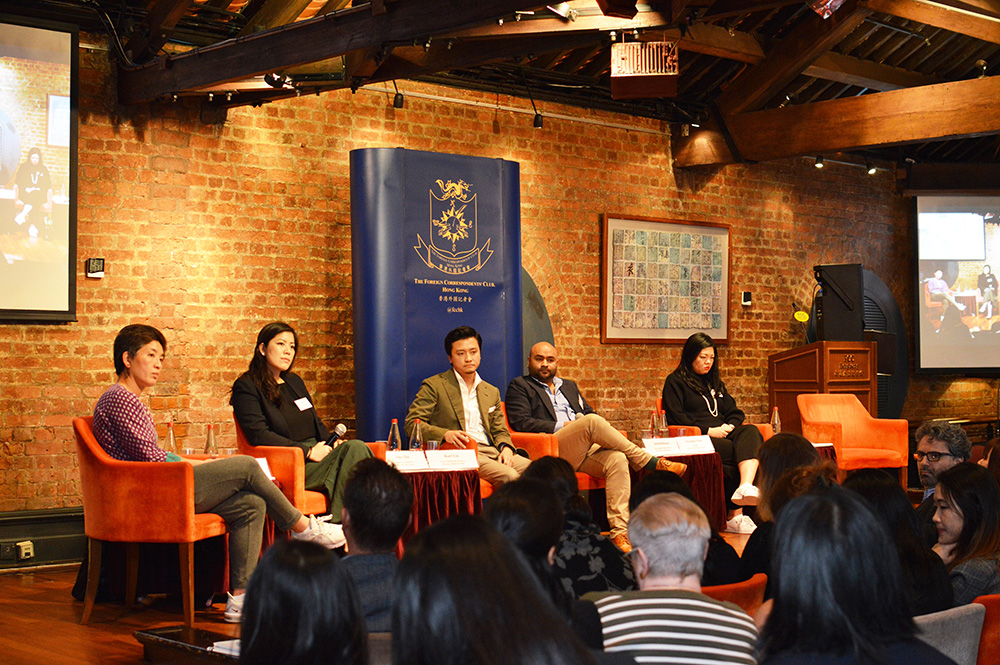
“Visual art doesn’t attract huge audiences so you can slip under the radar,” said Enid Tsui, Senior Culture Writer at the SCMP.” But in the art world everyone has to speak English, a fact that mystifies Tsui. Kurt Lin, Senior Multimedia Producer for
SCMP’s Morning Studio, said: “I speak Mandarin, Cantonese and English so get to cover so many more stories because I can talk to local people. There is a need to employ more bi-lingual staff here.”
Another vital skill is being able to sell your story, said Vivienne Chow, founder of the Cultural Journalism Campus. “At the end of the day, the editor will ask: Who cares? We have to persuade people that culture matters. If you’re writing for a mainstream publication, you have to make your stories relevant to the general reader.”
Digital media means there are many more ways of reporting on culture, so this is “an exciting time for experimentation”, Tsui said. However, stories that end up going global, such as the #MeToo movement, don’t always spread rapidly. “You have to evaluate, is something important for your audience,” said Abid Rahman, International Digital Editor at The Hollywood Reporter. “The movement crippled Hollywood for months from October 2017, but it didn’t filter down to some other countries for some time.”
Sue Brattle
Workshop: Covering Health and Science Journalism
In 1988, The Lancet medical journal published a paper linking the MMR jab (measles, mumps, rubella) to instances of autism and the world went mad. Later found to be based on just 12 case studies and widely disputed, it still makes medical reporters shake in their boots. Deborah Cohen, BBC Radio Science Editor, said: “Whatever is published in reputable journals, we have to be very skeptical. The BBC got this wrong, as did many others.”
So, check who has funded a paper; Is there a vested interest in its findings? And stand back and wait to do your own fact-checking, don’t rush with the herd into publishing errors and half-truths. Cohen added: “We are translators of science for the public; we have to get it right.” Panelists suggested taking online courses to keep up-to-date, build an army of experts around you but be sceptical about what they tell you, and constantly read papers/journals etc being published.
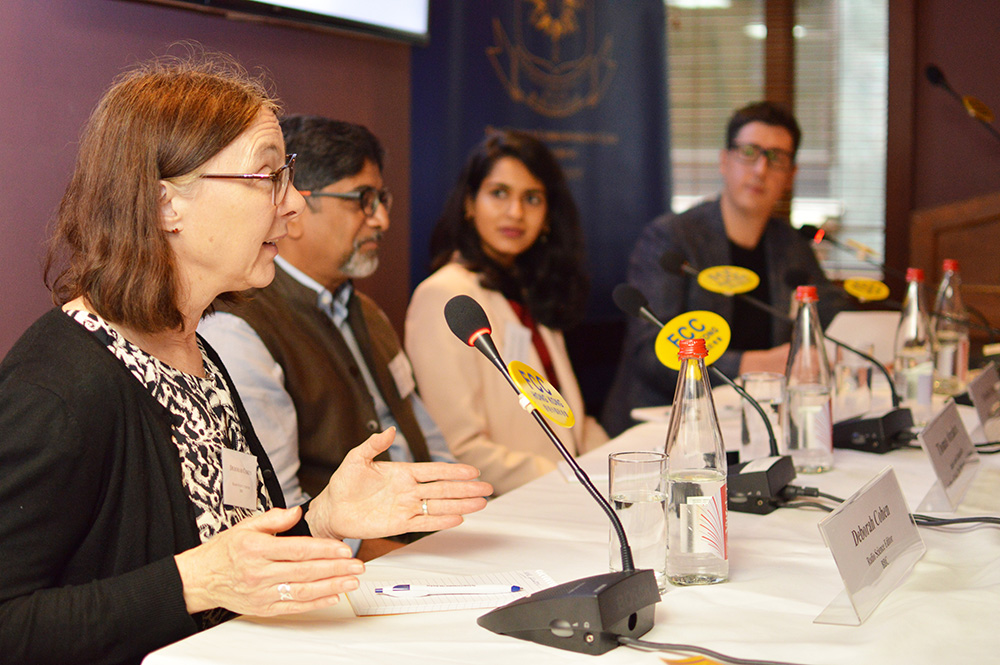
Sometimes, when a science or health story becomes huge, it is taken away from specialist reporters and given to mainstream presenters and writers. That proves difficult for science specialists, as they don’t always want to share their sources but want to ensure the story is reported accurately.
Thomas Abraham, author of Polio: The Odyssey of Eradication, said: “Second-day stories are important. You can get as much new information as there was in Day One’s press release. Stay away from people who are trying to tell you something. Throw away all press releases. Everyone has got them. And nothing happens in isolation, there is always a context. It is the story that becomes an outrage, not the science, because that is how us humans react.”
Preetika Rana, Asia Corporate Reporter, The Wall Street Journal, said: “If the story is already out, you need to put accuracy before speed.”
Sue Brattle
Workshop: Mobile Video Storytelling Tools & Techniques to Produce High Quality Content
This workshop was packed with advice – and the realisation dawned that taking selfies is just about the best training you could have given yourself for filming news video footage on your phone. Aleksander Solum, Senior Video Journalist at Reuters Video News, said: “Most people watch news as much on their phone as on their TV so we are learning how we can use our phones for breaking news.” Reuters filmed the 2018 rescue of a junior football team from a Thai cave on mobile phones for 4/5 hours before other equipment arrived, Solum said.
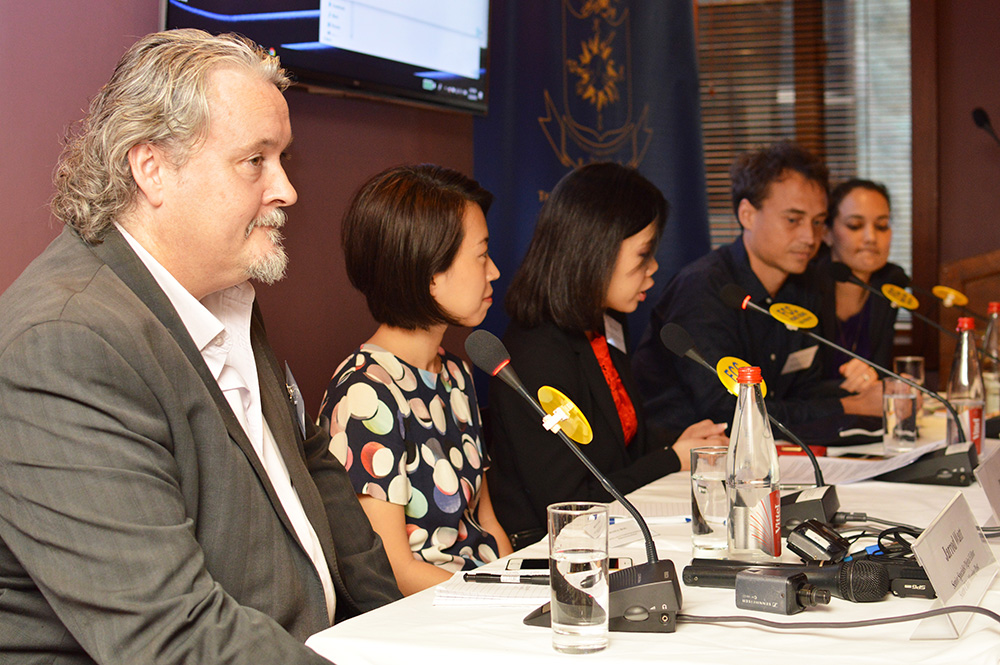
L-R: Jarrod Watt, Diana Jou, Zela Chin, Aleksander Solum and Lisa Yuriko Thomas. Photo: Sarah Graham/FCCHe added the kit you need to carry: A mobile phone, mobile wi-fi (stored in a waterproof bag), battery pack, microphone, gaffer tape and a selfie stick.
Diana Jou, freelance videographer and photographer, stressed the importance of planning your video shoot. “Before you shoot, ask what is your story? Explain it to yourself in one sentence. Is it visual? Is it worth taking? Lay down a structure on paper. Chose voiceover, or words on the screen. Write down the beginning, middle and end.”
The massacre at two mosques in Christchurch, New Zealand (eight days before the conference) which the shooter showed on Facebook Live before Facebook shut it down concerned Jarrod Watt, Senior Specialist Digital Editor at SCMP. He said: “It will be a debate I’ve been waiting three years for.”
Sue Brattle
Hong Kong Press Freedom – The Challenges Facing Local Journalists
Hong Kong’s press freedom gained global attention last year, after Financial Times journalist Victor Mallet was forced to leave the city. For local journalists, a contentious relationship with the Hong Kong government was nothing new.
“Among working journalists, there’s still a strong commitment for freedom of the press and freedom of expression,” said Chris Yeung, chairperson of the Hong Kong Journalists Association and chief writer at Citizen/News. But fears of government backlash have led to self-censorship by many local journalists over the years. “Reporters have to make sure their reports are not seen as political advocacy,” he said.
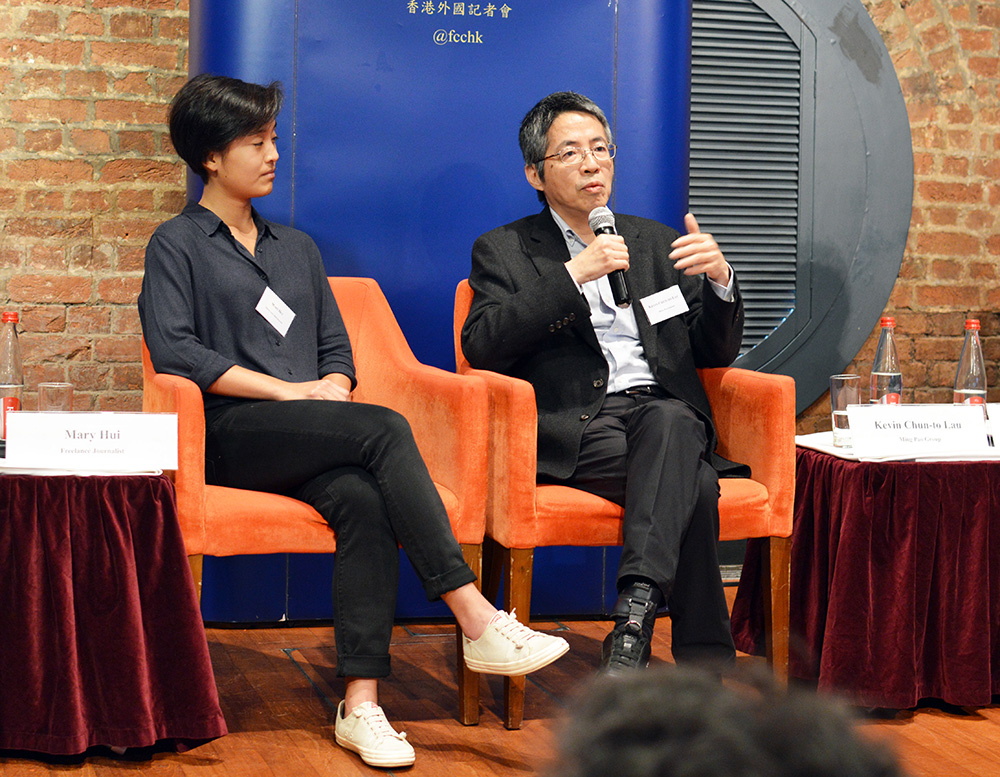
Mary Hui, a young freelance journalist, agreed that self-censorship is a harsh reality for many. After Mallet’s expulsion from Hong Kong, Hui was prepared to write something about press freedom in Hong Kong, but her friends and family talked her out of it, questioning if she wanted to draw such attention to herself so early in her career. For journalists like Kevin Lau Chun-to of Ming Pao Group, the cost of reporting in Hong Kong can be high. Lau suffered a brutal knife attack in 2014 that left him in hospital for months, and in physical therapy until just recently.
While such attacks on journalists in the city are rare, they are real enough to many parents that they will discourage their children from pursuing careers as journalists, said Lau, telling the story of a young girl who was torn about becoming a reporter. “When one student struggles for a whole year about whether or not to go into journalism, there are many more stories about giving up,” he said.
Yeung summed up the state of Hong Kong’s press freedom as “depressing”. “Unfortunately, we can’t see a major change in political weather in the foreseeable future,” he said.
Morgan M. Davis
How to Not Get Sued
At some point during their career, a journalist is likely to print something defamatory. With or without the backing of their publication they need to be prepared for a potential lawsuit. But as laws differ globally, understanding the basics of a suit and where the burden of truth lies can be complicated.
For Hong Kong, press laws are largely in line with the UK, something that can prove surprising to U.S. journalists. Where the U.S. can rely on explicit laws, such as the Freedom of Information Act, to aid reporters, Hong Kong exists in more of a grey area.
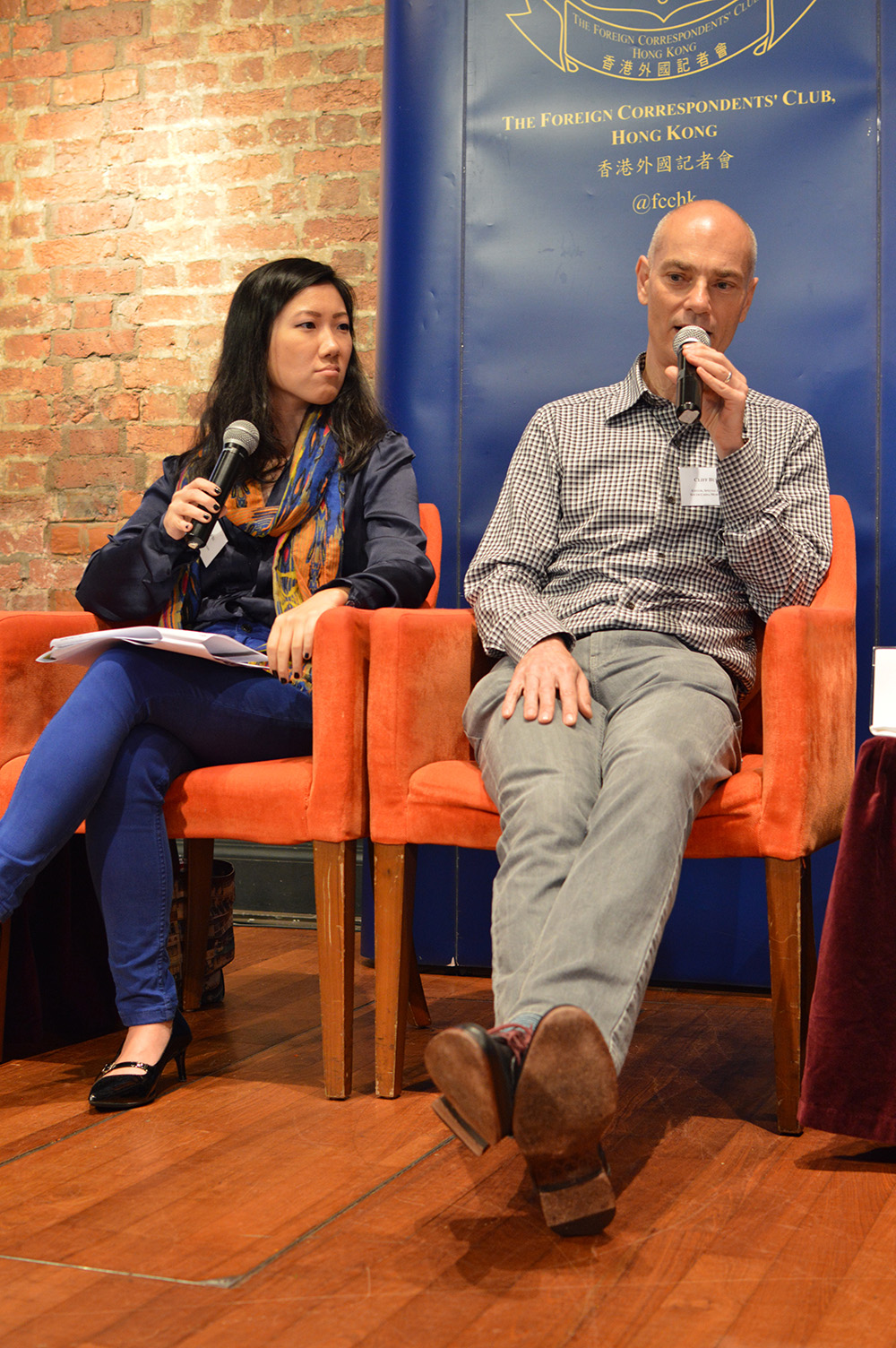
Unfortunately for defamation laws, the ambiguity can come at a price for journalists. “When it comes to defamation laws it’s not very friendly to journalists,” said Cliff Buddle, senior editor at South China Morning Post.
Buddle, in his unofficial role as SCMP’s legal eagle, regularly works with journalists and editors to assess the risk involved in printing certain information. While many reporters want to defend a story with “but it’s true”, defamation laws in Hong Kong put the burden of proof on the journalist, said Buddle. “Libel laws in Hong Kong favour the wealthy,” he said, adding that the risks for printing something defamatory are high.
The risk of legal action shouldn’t scare journalists away from a story, but they need to be responsible in their reporting, and be prepared to produce notes, recordings and other information should their reporting be brought into question. Hong Kong barrister Queenie Lau pointed out a handful of different defences a journalist can rely on in court, using facts and proving substantial truth to battle a lawsuit.
“It should be a question of ‘How do we get this in and make it as safe as possible?’” said Buddle of pre-publication discussions. “The question of balance is an important one.”
Morgan M. Davis
A Conversation With Emily Steel
The #MeToo movement has rocked the world in the last 18 months, putting a spotlight on sexual assault and harassment, and taking down powerful men in its wake. Behind the movement have been journalists, diligently reporting tales of harassment and the shocking numbers of allegations and lawsuits that have long been swept under the rug. Emily Steel, a Pulitzer Prize-winning reporter from The New York Times, shared her experiences reporting on U.S. television host Bill O’Reilly and the endemic harassment found at Fox News.
For Steel, the story started with former anchor Gretchen Carlson’s allegations of harassment against then Fox News chairman Roger Ailes. Carlson’s suit led to Steel and the NYT’s pursuit of other such stories, building on documents and data to share personal stories from women who faced similar problems at Fox.
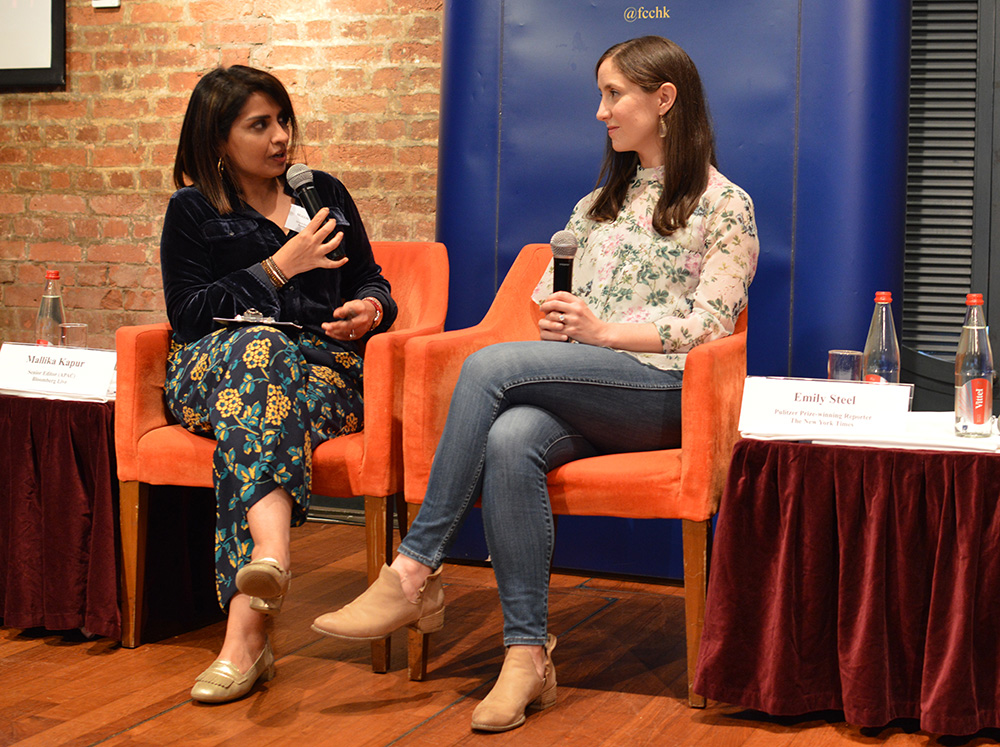
For Steel, getting the personal stories from O’Reilly’s victims proved to be challenging. Those who had approached Fox and settled harassment claims had signed non-disclosure agreements, blocking Steel’s reporting. Steel and her teammate had to look for other possible victims, cold calling them, knocking on doors and sending handwritten letters. “The thing that’s amazing about all of this is how we’ve seen these behaviours repeating,” said Steel. The pattern of abuse ultimately led Steel to find other O’Reilly victims that had previously not come forward.
O’Reilly had personally threatened Steel in the past, who was ready for the possibility of a lawsuit after her story broke. “Fox News really had a history of attacking reporters who had written critically about Fox,” she said. But Steel’s story touched a nerve in the American people, leading to massive backlash and the firing of O’Reilly.
Steel admitted that she was so centred on the Fox story that for a while she didn’t see how large the #MeToo movement could become. “We were so focused on these details [at Fox], we didn’t know what the bigger picture would be,” she said. But “[Me Too] is something that unleashed in the U.S. and moved globally”.
Morgan M. Davis
How To Get More of What You’re Worth
“Money is power and a reflection of what you’re worth.” That was the bold opening remark from a lively panel that saw the FCC conference reach out across the divide to – say it quietly – non-journalists.
HR Relationship Manager at the Bank of America Merrill Lynch, Tonia Wong Kee, reminded women to never accept the first offer they get. There’s always more cash, she said – it’s up to us to research the market and know the value of a role.
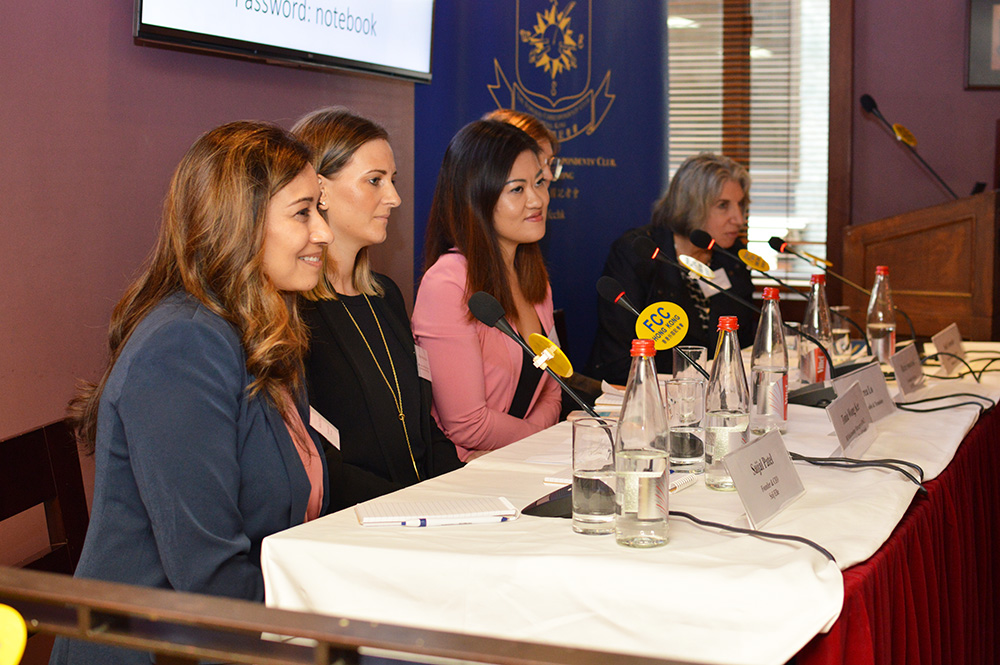
L-R: Saijal Patel, Tonia Wong Kee, Andrea Lo, Marie Swarbreck and Jodi Schneider. Photo: Sarah Graham/FCCMeanwhile, Saijal Patel, a former correspondent and founder of Saij Elle, made the excellent point that women are too focused on their experience matching the criteria for a new job, when they should be focusing on their vision for the role. “Women think about what they’re contributing. Men think about their potential,” she said. “People hire for potential.”
Seasoned bilingual freelancer Andrea Lo revealed that she keeps a spreadsheet of who owes her what and when – and isn’t afraid to take to Twitter to shame a severely late-paying client into coughing up the cash. Marie Swarbreck, founder of FLEXImums, was all about helping women get back into the workforce after taking a break to start a family.
The main takeaway from the event was that women should look again at how they assess their worth and options.
Jenni Marsh
Workshop: Online Security Tips & Tools Every Journalist Should Know; Closing Panel – Online Threats Journalists Face in 2019
Don’t open strange text messages. Use two-factor authentication for everything. Don’t use free hotel WiFi. Use encrypted apps. Check email URLs for any suspicious misspellings. If a link in an email opens up a page asking for logins, don’t enter anything – it’s likely a phishing attack. Train all your colleagues at a newsroom to do the same – even those who don’t think their work is sensitive enough to warrant being watched. And ultimately, get your organisation to get behind security and train people in the latest measures. These were the key takeaways of the workshop.
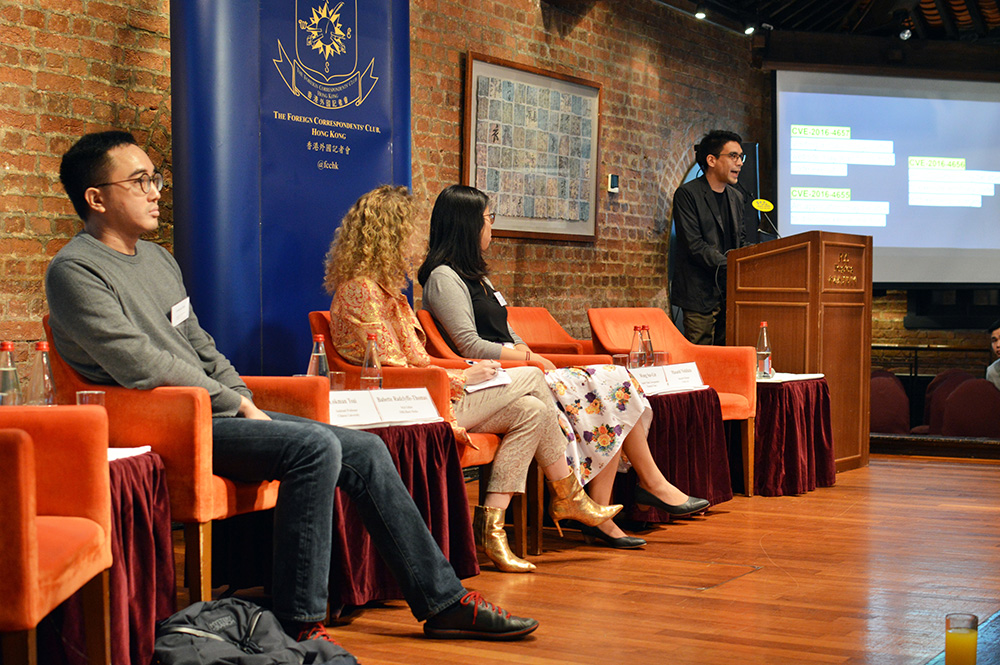
L-R: Lokman Tsui, Babette Radclyffe-Thomas, Sue-Lin Wong and Masashi Nishihata. Photo: Sarah Graham/FCCBut even the best-laid security plans can go awry, as Sue-Lin Wong of the FT showed with her tale of chasing a story about workers who had developed lung diseases after being exposed to construction dust in Shenzhen. It was the workers themselves who accidentally let slip to the authorities in their excitement that someone was expressing interest in their story, and ultimately scuppered her reporting trip.
“As a journalist you can do all you can to prepare, but there are sometimes factors out of your control,” said Wong. Other than the threats journalists face from people who don’t want them to report, there’s now the additional threat of online harassment and threats that can transform into very real problems. It’s something that President Trump’s rhetoric inciting hatred against journalists is having an impact on and something that social media exacerbates.
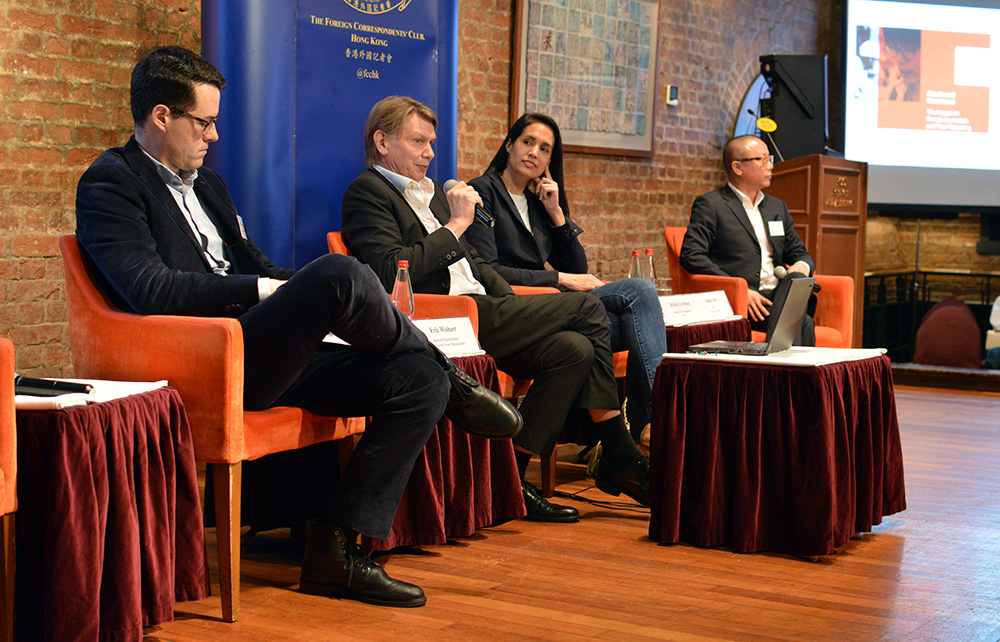
L-R: Tim McLaughlin, moderator Eric Wishart, Kristie Lu Stout, and Sonny Swe. Photo: Sarah Graham/FCCThe audience heard from freelance journalist Rana Ayyub who, since 2010, has been sent death threats, rape threats and even had her face superimposed onto pornography. She spoke of being harassed over multiple social media platforms, having her phone number and address posted online, being hospitalised for anxiety, and the additional stress that comes of being a freelancer in this situation. “You become all the more vulnerable, because you have to fend for yourself,” Ayyub said via Skype.
Sonny Swe, founder of Frontier Myanmar who spent eight years in jail, and CNN’s Kristie Lu Stout spoke of the routine harassment and threats they face both on and off screen. Swe said: “My sister is trolled. I am careful, my doors and windows are locked.” Kirstie described how she checks for exits when she’s out on a job, and said: “It’s recognising and acknowledging there is a connection, that online abuse and online hatred can take root, fester and transform into something like real-world terrorism, like we saw happen in Christchurch. That is real.”
Christy Choi

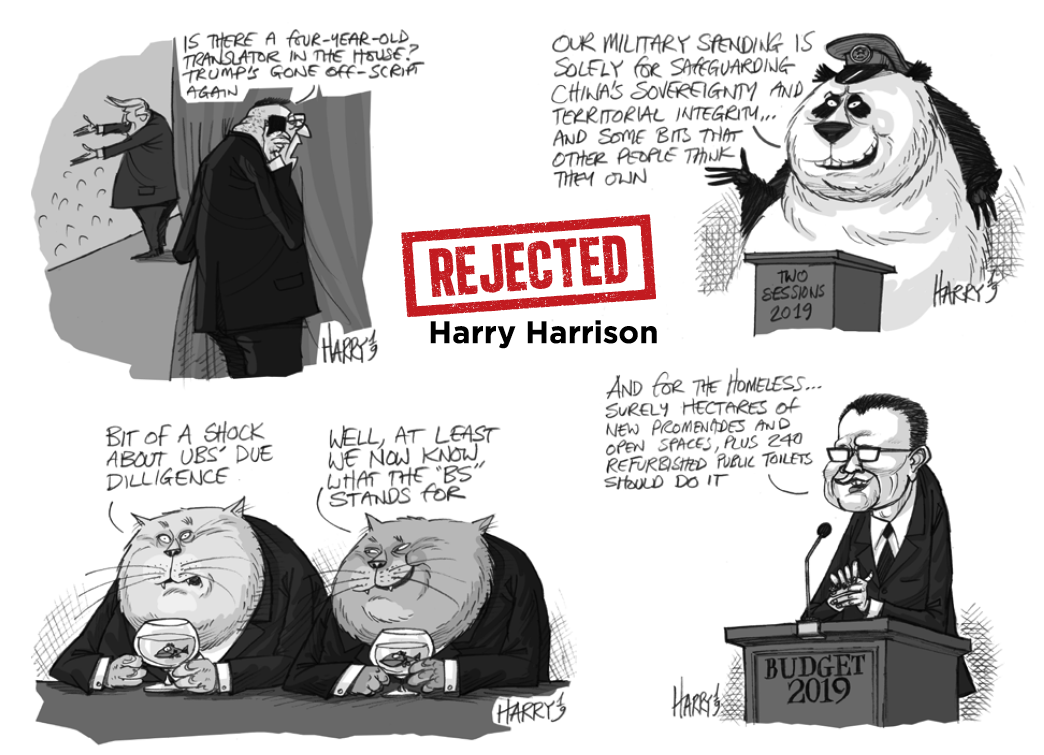
Harry’s Rejects: Trump going off-script, and China’s military spending
Introducing… FCC new members, April 2019
A very warm welcome to our newest members who, as always, are a varied and interesting bunch. If you see them at the bar, say hello.
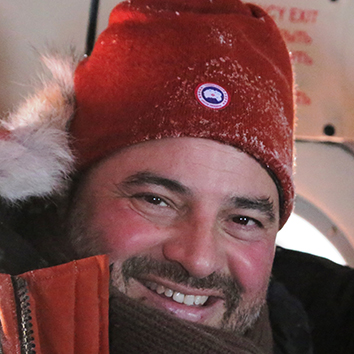
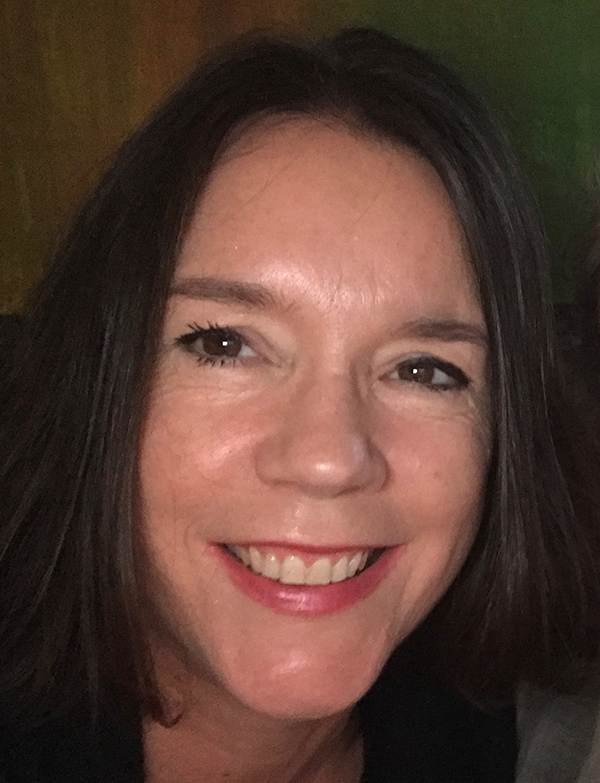
I am founder and CEO of MVision and have worked in the global private equity sector for more than 30 years. A passion for travel and cultures is shared by my family. Between us we have been fortunate to travel to many incredible places, including the North Pole. Another passion in my life is my role as a director for my daughter’s travel magazine, SUITCASE. Hong Kong is an important part of my life; I am involved in community work incorporating sports to make a difference, working with the Kowloon Rugby Club, and HK Stand Up Paddle Board Association. My other passion is education; I am on the President’s Global Council at NYU, an Executive Fellow at London Business School and a mentor at HKU.
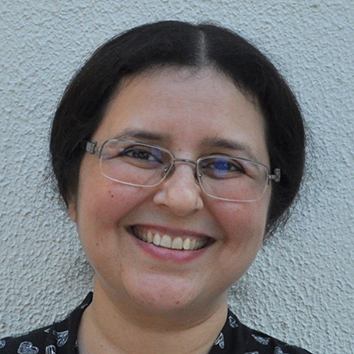
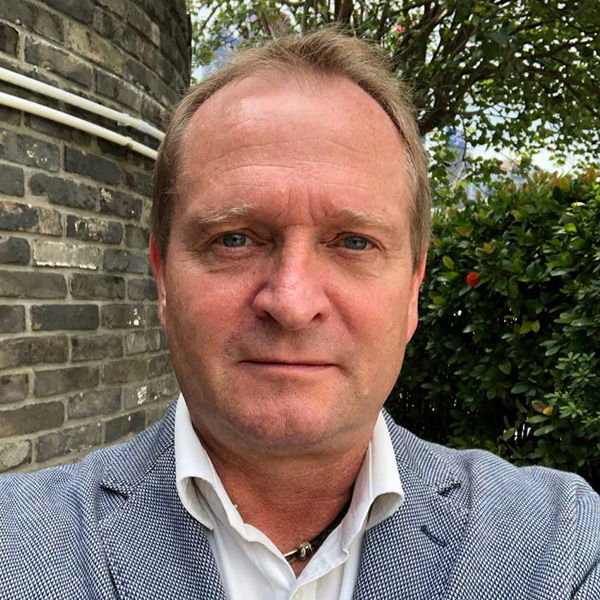
I am an Indian and Hong Kong has been home to me for the better part of my life since 1990. I am a clothing manufacturer and exporter and being in the garment industry I have been fortunate to travel to many countries for work. I lived in Dhaka, Bangladesh, for several years but, as the saying goes, home is where the heart is. I always looked forward to coming back to Hong Kong, a city that never sleeps and pulsates with life 24/7. I love travelling to new places and meeting people is my passion. One of the reasons I like coming to the FCC is you get to meet a wide cross-section of people from different walks of life.
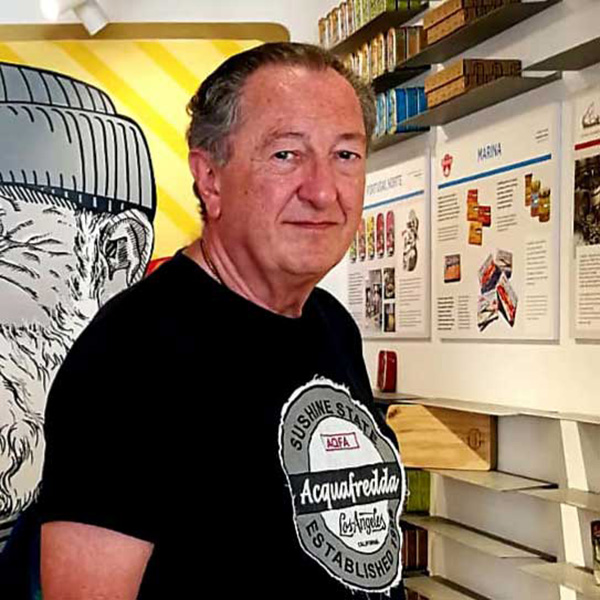
From teaching in university and schools to producing plays and community radio shows, life has been one big adventure. Under the aegis of Teacup Productions, a non-profit that I founded in 2016 to amalgamate education and performing arts, we have reached out to over 100 local primary schools and 6,000 primary students with our educational programmes, produced community radio shows for RTHK and staged plays that I have written and directed. I am also the editor of children’s storybooks that are being used in local schools for learning English. When I am not writing, teaching or recording, I love to meet and talk to people, because that is where real stories exist!
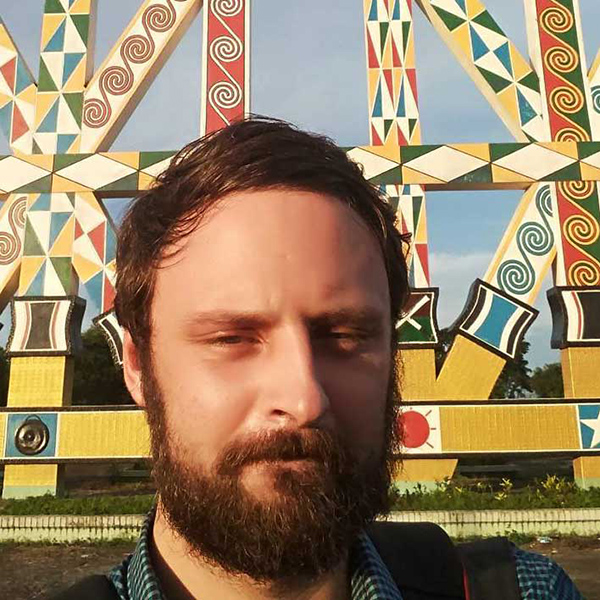
I currently live life as a social entrepreneur, a cappella singer, musical performer and event emcee, after making an abrupt change of career from management consulting two years ago. It remains one of my best life decisions so far. I find the diversity much more interesting and meaningful. I spent my childhood in Hong Kong before going to boarding school in England when I was 14. I didn’t know what to expect, but I believe the boarding experience gave me things that I need now – for instance, courage to travel alone to unfamiliar places such as Peru, Chile, and Israel which I’d say are my favorite destinations in the world. I look forward to meeting you and exchanging life stories soon.
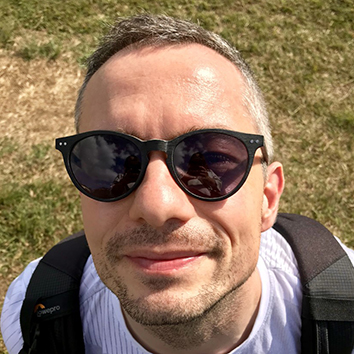
Hi! I was born in the UK then raised here in Hong Kong and have just returned in the last two years. Before coming home I have lived and worked in Switzerland, on both coasts of the U.S., in London, and in Beijing. Now I am part of my family office, as a director at Sir Elly Kadoorie & Sons, working on a variety of interesting projects around the world. In my spare time I love exploring Hong Kong with my camera in hand, hunting for the best bubble tea, and going driving at the crack of dawn. If you see me at the bar, come and say hello!
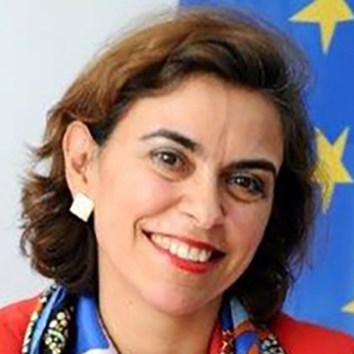
Carmen Cano began her term as head of the European Union Office to Hong Kong and Macao on 1 September, 2016. She joined the European External Action Service as deputy head of delegation at the EU Delegation to China and Mongolia in Beijing in 2011, where she worked until her transfer to Hong Kong. A seasoned career diplomat, Carmen joined the Spanish Ministry of Foreign Affairs in 1992. She was posted in Romania, Ghana and Ethiopia. In the headquarters she worked on non-proliferation and disarmament and served as Deputy Director General in charge of Continental Asia twice, from 2002 to 2006 and 2010 to 2011. She is fluent in Spanish, English, and French and lives in Hong Kong with her husband and three children.
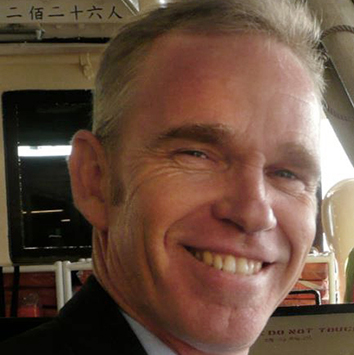
Born into a peripatetic military family, I ended up at Edinburgh University studying the then unfashionable language of Mandarin Chinese. Spent an impressionable year, 1982/3, in Jinan, was arrested and returned from Dali and Kashgar – but made it to Tibet undetected. On graduation, I joined the British military, a 23-year stint which took me around the world, generally the less savoury corners including the Balkans, West Africa and Iraq. I was lucky enough to be stationed in Berlin (when it still had a wall and held Hess), then Hong Kong up to and including the handover. Married to Christine, I am the proud father of two and Hong Kong has been our home now for 11 years.
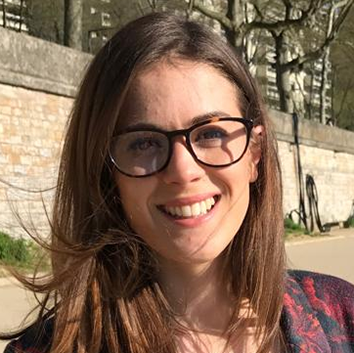
As a newcomer to Hong Kong, I’m happily getting to know the city through dim sum and Tsingtao! I first came to Asia as a backpacker a decade ago so it’s great to be back, this time working as a journalist for AFP. I grew up just outside of London, starting my career with my local newspaper and ending up reporting in the Houses of Parliament before venturing across the water to live in France. I’m a big supporter of activism and all things green.
Four things friends say about me: 1. ‘Mathias likes to shoot people, and he is quite good at it, too!’ – a compliment completely unrelated to marksmanship, but referring to the hobbyist photographer-me taking pictures of the city and its people. 2. ‘Mathias is travelling to [insert random place on the map] – they must have great food there!’ – would be teasing about my interest to explore culture through cuisine. 3. ‘Mathias is pushing the boundaries of business attire’ – would be commenting on my predilection for sartorial uniqueness. 4. ‘Mathias is one of the most travelled lawyers I know’ – must be referring to always running out of space when preparing visa applications and listing the countries I have visited in the last 12 months.
Hello. I was born and raised in Adelaide, Australia. I moved to Hong Kong in 2010 but my Hong Kong story started much earlier when I was an extra in a famous TVB drama, Triumph in the Skies – which young colleagues around my office still watch almost 20 years later. I am the commercial director for TAG Aviation, a business aviation management company with clients across Asia. I met my wife, who is from Taiwan, in Hong Kong and we have three-year-old twins, a boy and girl. Before children we hiked a lot and travelled widely. These days you are likely to see us in the FCC Lounge having lunch after a morning exploring Ocean Park.
I’m the new spokesperson at the U.S. Consulate. Originally from Wisconsin, I’ve made Asia my home over the past 16 years. With all of my other postings within a four-hour flight of Hong Kong, it seems natural that my path led me here. Between managing media inquiries I love to travel, especially to places listed in the prestigious Atlas Obscura. I’m joined in Hong Kong by my wife Jo Ann, two amazing kids (a third is back in the U.S.), along with Izzy, our Beijing rescue dog.
I moved to Hong Kong a little under a year ago to become AFP’s deputy editor-in-chief for video in the Asia-Pacific region. I spent eight years as a video journalist before that, reporting from more than 30 countries across four continents. (Embellished anecdotes available upon request at the FCC bar). I now work mostly behind a computer screen rather than behind a camera, but still get out into the field once in a while – in particular to North Korea, where I travel with colleagues from our Seoul bureau every two to three months. It’s a unique and mind-bending experience, but you won’t catch me making any snide remarks about the place here. n
Hong Kong’s story, one sketch at a time (and a few of the FCC)
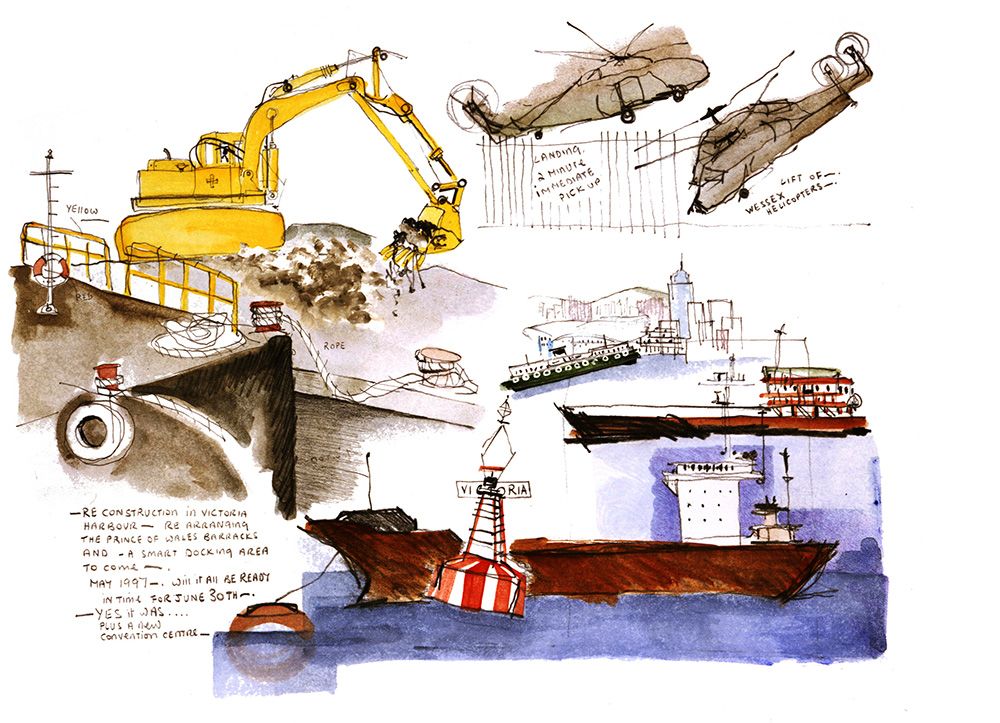
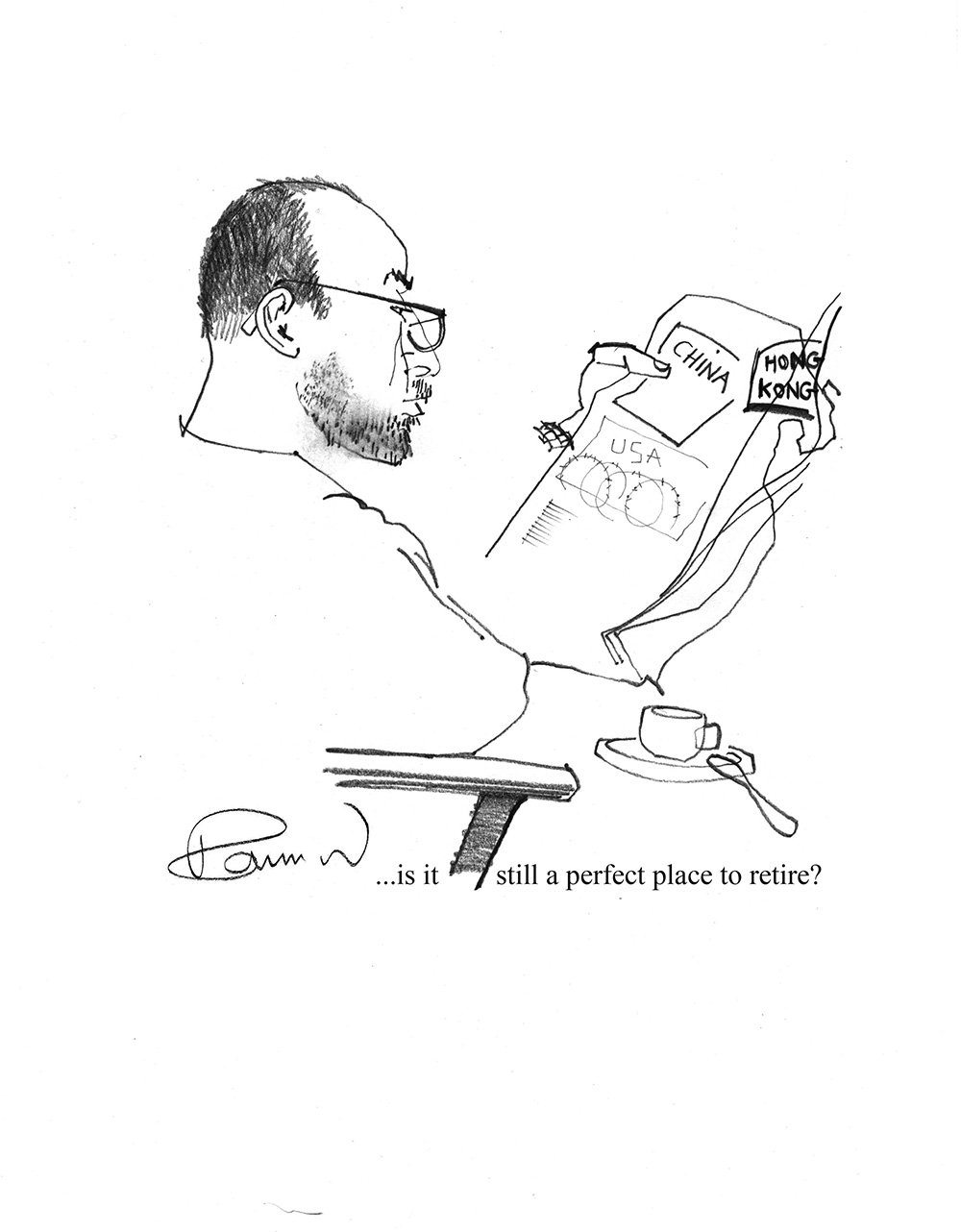
When artist Pam Williams first came to Hong Kong in 1996, she was armed with a sketchbook and a fax machine to record the build-up to the handover. Now she’s back and drawing daily life around the city and at the Club. Here she tells her story.
A chance to visit Hong Kong from the London studio sounded ideal.
The timing was perfect. It was 1996 and I needed somewhere away from England to sit and think what my next path in life would be.
Apparently, Hong Kong was the leading light of computer technology. So, as a professional illustrator, on holiday or not I had to be prepared. The latest telephone/fax machine was packed ready to plug in on arrival. Remember, there was no Internet. Fax was the email of the time. I bought a mobile phone as well, a Nokia, and learned how to use it on the plane. Text messages – how did that work? Someone was sure to show me.
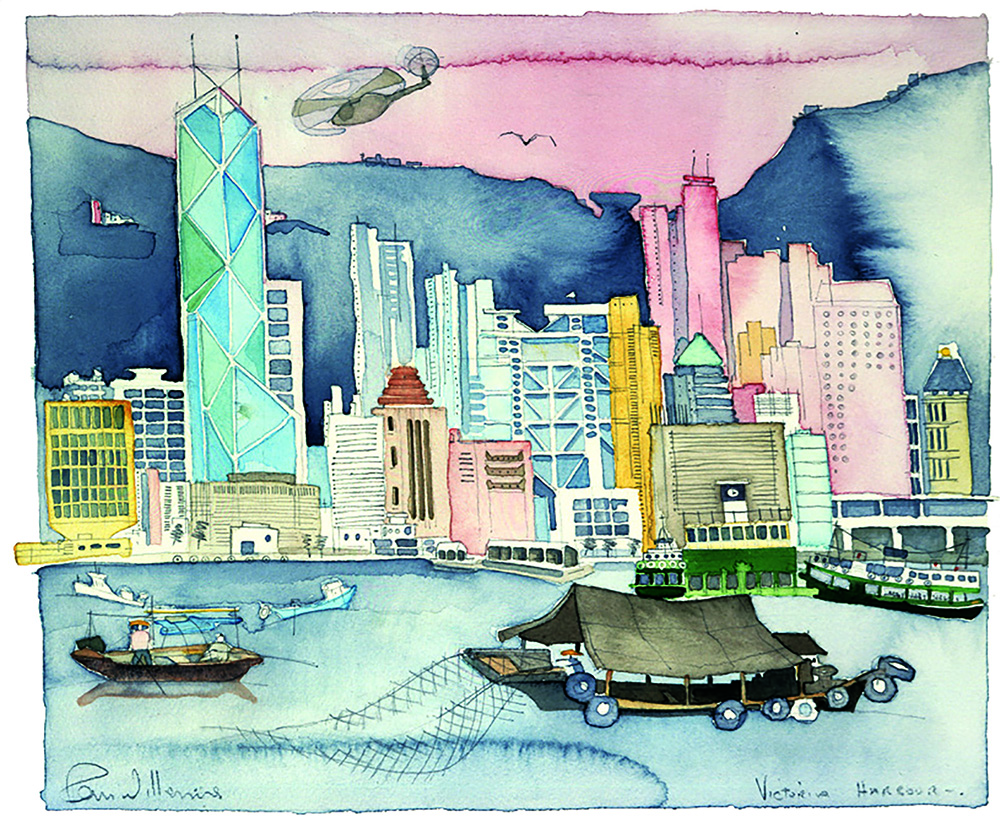
On arrival in Hong Kong, the sight of hundreds of narrow high-rise tenements cascading down from the peak was astounding. Lazing in sunny Victoria Harbour, a sampan drifted while giant container barges were pulled past by tiny determined tugs. After 20 years, honing the personal passion of sketching on location, I was in heaven, watching and documenting this feast fresh to the eyes.
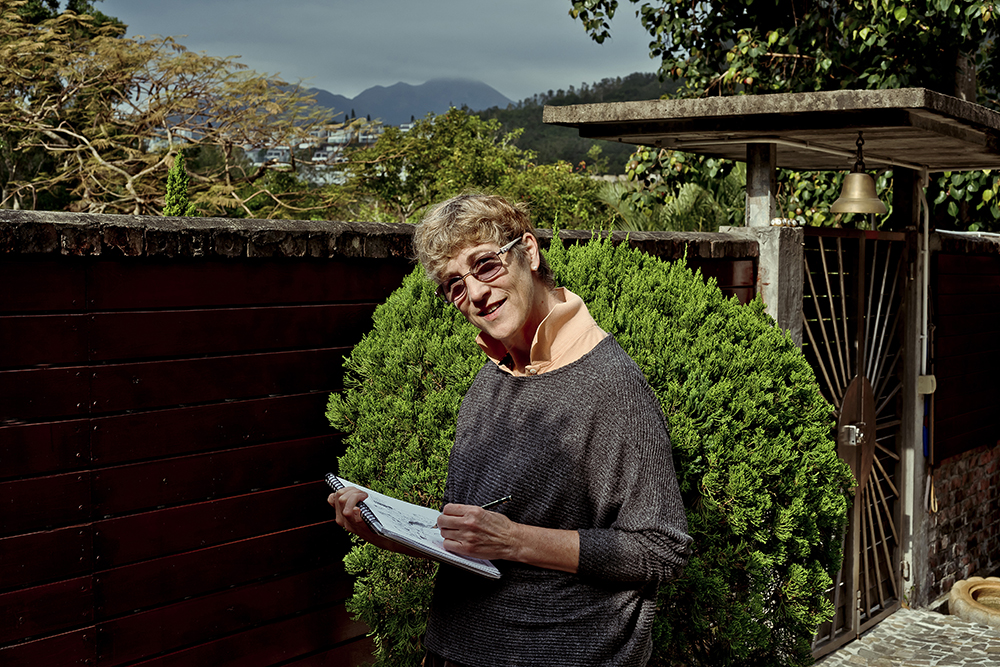
Pam Williams comes from a family of artists including Hugh Lofting, author and illustrator of the Doctor Dolittle children’s books, and Morris Meredith Williams, World War One artist.An American English teacher at the YMCA saw the results. “Go downstairs and call the Governor’s press office first thing tomorrow morning. Say you have come to sketch the handover.” So I did.
Being an army brat, or “an officer’s daughter”, is life’s training ground, if you like. Unexpectedly, it was the fast-track ticket to move with and among handover organisers.
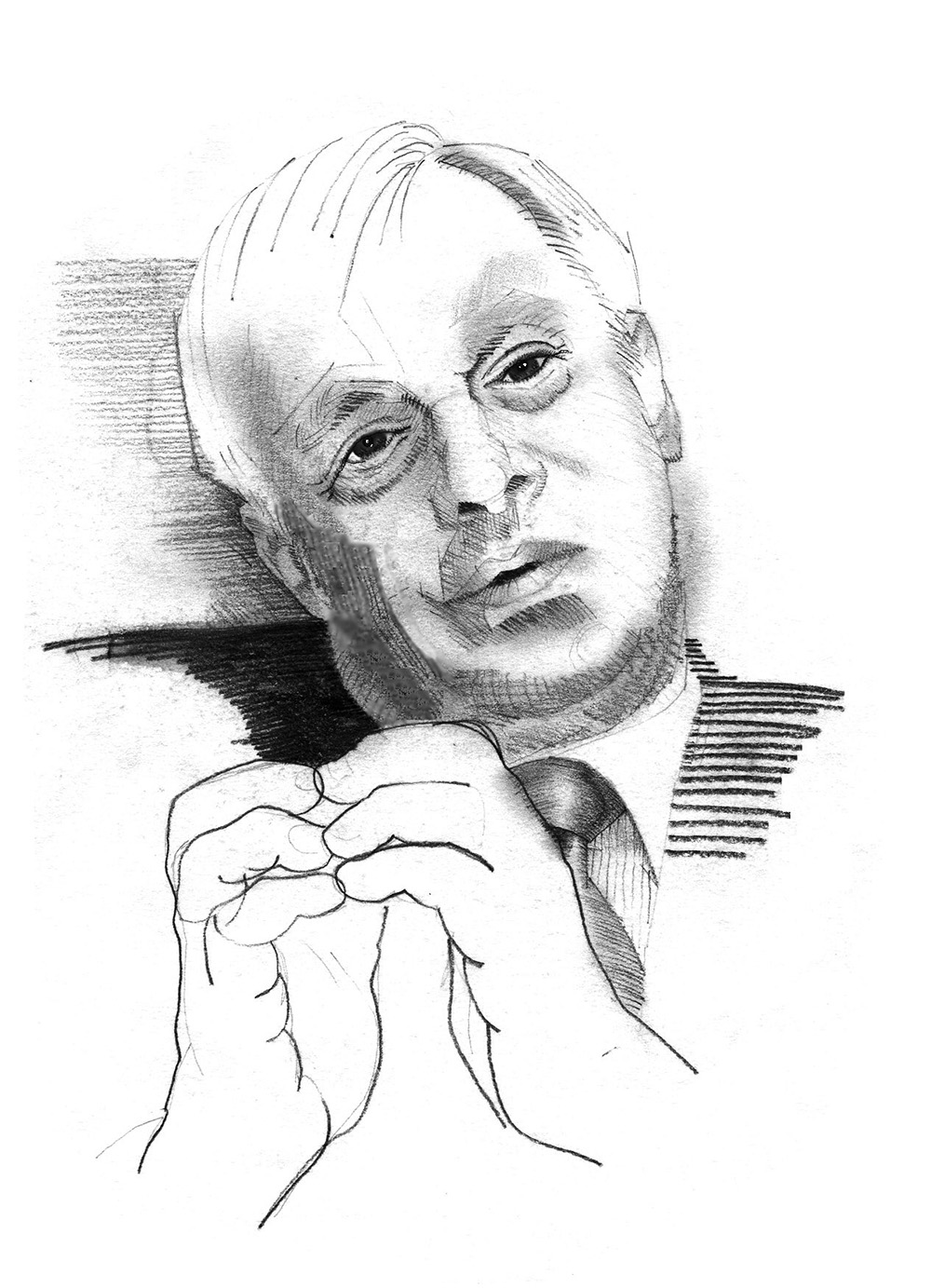
Once introduced to the British Forces by Governor Chris Patten I was sent press releases so that I could follow activities.
Francis Moriarty, on RTHK, told me: “Contact David Tang, ask for a commission or retainer.” He was too busy to help, but said: “I’m curious to see what you do.”At the last minute, David Tang did give me a commission to fly me back to Hong Kong to continue my work.
Clare Hollingworth, the late doyen of the FCC, commandeered my assistance at the Ghurka’s disbandment parade. “Call me at 7am tomorrow, I may need you to come and read the papers to me.’” This extraordinary woman, then aged 82, became my anchor and guide. She was indeed a consistent challenge. “When I was in China, I had a room with a bed and a wooden chair, and I thought how lucky I was,” she told me one day.
At the end of 1997, a grand exhibition was held at the FCC and the Fringe Club. The work got a lot of people talking. Sketches can catch the depth of fleeting moments and moods that photographs can only scan. Perhaps it’s the passion and emphasis of immediate marks on paper.
Many, many people who had helped me had left and missed seeing the collection.
Fast forward to the last three years, and a sketchbook has been in the making. But how could I bring some meaningful depth to it all? Those who know Hong Kong well, from diverse communities, contribute towards tracking Hong Kong’s development – back to the 1950s, bizarre events before and after the handover.
Far East correspondent Jim Laurie was on Skype to London from the U.S. and told me: “1997 is passé Pam, you have to go out there to gather current material today. It is a Chinese Hong Kong now. That is controversial.”
I arrived in September, gathering clips of conversations with residents. There are different concerns, unsettling facts as well as encouraging foresights. Fears of the past loom heavily overhead. It is time to take a pause, as Christine Loh and Richard Cullen prescribe in their book, No Third Person.
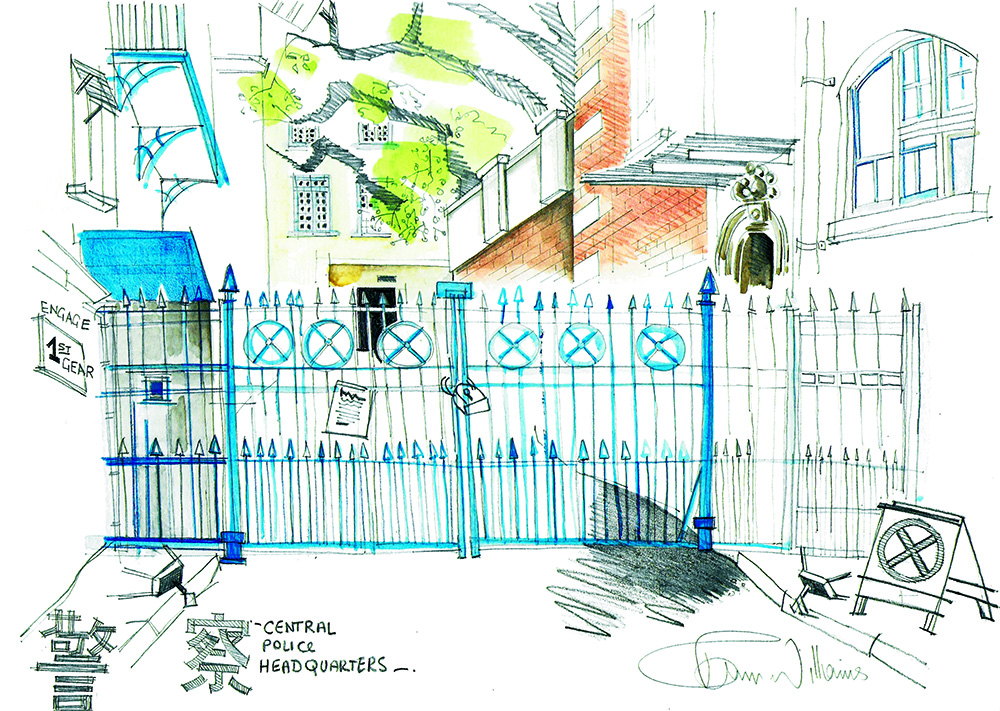
The old Police Station HQ entrance in Central – now better known as the recently-opened Tai Kwun heritage and arts centreTo read a book without pictures is not easy for everyone. This has been a colourful and extraordinary journey for me to learn and understand Hong Kong in more depth. The full collection of my 60-100 sketches and paintings will be published for the first time. There will be sketches of today, as well as those I did back in 1997.
I hope the journey is as engaging for others as it has been and is for me. Remember, it does not compete with thorough studies of history at any point. It is a sketchbook with contributions from behind the scenes; the essence of Hong Kong’s journey. Also, it is personal and I hope it will be a valuable journey to share with you.
I bought a smartphone on the second day of my arrival in September. I looked at my old friend, the Nokia phone from my first visit here, on the shelf. Technology has surpassed even construction and it is a reminder that we are in a new era today.
* Pam will be here until March 14. To receive a monthly link to track the progress and release of the book, send an email to Pam at [email protected] and see her work at https://www.pamwilliams.co.uk/hongkongbook
Introducing… FCC new members, January 2019
The latest group of members to join the FCC is, as always, an interesting bunch. The membership committee meets regularly to go through applications and is always impressed by the diversity of people who want to join the Club.
Anita Liu
I was born and raised in Taiwan, lived and studied in Sydney. As an international school teacher, I’ve had the privilege to live and work in several different countries. Besides Taiwan, I also call Australia and Turkey home, as I have lived and taught in these two amazing countries. I have been living in Hong Kong for 12 years (was planning to be here for two). Lots of life-changing events have happened during that time. I met my American husband, Ryan, and now we are raising our three-year-old daughter. I enjoy hiking, travelling, planning events, cooking and reading.
Mary Hui
I’m a freelance journalist and writer in this wonderful-but-flawed city that I’ve called home my entire life, minus a few years away for college and a seven-month stint last year at the Washington Post in D.C. I’m an avid trail runner and am training to compete in a couple of 50-kilometre trail races this season. If I’m not too tired from all the miles of running up and down mountains, I also like to go climbing and bouldering.
Tracy Alloway
If I was an animal, I would not choose to be a butterfly, because that would be derivative. These are the kind of terrible and obscure finance jokes you can expect when you meet me at the FCC. I’ve recently moved to Hong Kong to be Head of the Asia News Desk at Bloomberg. In addition to Bloomberg, I’ve worked at the Financial Times, with experience in New York, London, and Abu Dhabi, where I was previously based. I also anchor on TV and co-host a weekly podcast, Odd Lots, where we talk about poker, algorithmic trading and forensic accounting – in addition to butterfly option strategies.
Paul-Alexandre Bourieau
My name is Paul-Alexandre Michel Albert Bourieau, but they call me POLO. I am French, my son Italian, my wife English and my grandfather was a Spanish refugee. And I am a sculptor here in Hong Kong. I arrived in Hong Kong almost by mistake in 2003. I fell in love with this city “in between two worlds” which inspires me greatly in terms of identity crisis in the new millennium. Since then, I have been creating site-specific works for the new “agora” of the 21st century.
Fergus Gifford
It is an honour to be a member of this wonderful institution. I was born in London, grew up in Tokyo and studied in Edinburgh. I then worked as a teacher in Kobe before beginning my career in shipbroking with Arrow in London, and I’ve now been in Hong Kong since 2015. I love this city. In a day I can cover all of my passions – eating my bodyweight in dim sum at Maxims, hiking up Mt High West to watch the container ships pass and then heading to the bar at the FCC!
Marianne Bray
After a stint working as a social scientist in Wellington, New Zealand, I left my life at home to study for a masters of journalism at Columbia University in New York. This led to adventures like reporting from the streets of the Bronx, trading on the American stock exchange, having dinner with Walter Cronkite, interviewing a eunuch in the slums of Mumbai and covering 9/11 for CNN.com in Hong Kong. I now teach at HKU’s journalism school. I also write for the Economist Group, Thomson Reuters Foundation and the South China Morning Post, judge the annual SOPA awards, and am a mother of three kids very interested in pushing the green agenda.
Bjorn Hojgaard
I am the Danish CEO of ship management company Anglo-Eastern Univan Group. We have more than 600 vessels under full technical management, another 200+ under crew management, and have project managed the building of 450 new ships. I am married to Brenda, a “Hong Kong girl”, and have lived here close to 20 years. Together with our Labrador Retriever, we are avid hikers and Hong Kong is a superb home in this respect. I’ve also climbed Mount Kota Kinabalu and Mount Kilimanjaro, the highest peaks in South East Asia and Africa respectively. Apart from that, my favourite pastime is sailing.
Alberto Aliverti
My name is Alberto Aliverti and I am originally from Como, Italy. I arrived in Hong Kong in 1982, coming from the United States. After assimilating the culture and business climate, I started my own company. Initially I was importing fabrics, fashion accessories and textile chemicals from Italy, but I also acted as a textile consultant for an Italian Government institution. My fondest memories were being able to travel to unspoiled places in China, especially areas closed to foreigners at the time. I still remember 20 days of negotiations in Hubei, lodging in the summer residence of Mao Tse Tung. Being the dead of winter, there was no heating, and my 1000 sq ft bedroom always remained a cool 2-3C.
Sean Gleeson
Hello! I moved here in April to work at Agence France-Presse, where I continue to distinguish myself as the tallest person in the office. Before that my partner and I lived in Yangon, where my commanding height was the object of much ridicule. When I wasn’t being chased down the streets by rampaging gaggles of selfie-hungry Burmese teens, I worked for the news magazine Frontier Myanmar. I started my time in Asia at the Phnom Penh Post (RIP), where one of my articles got pulled because I compared the Cambodian information minister’s sartorial tastes to those of Breaking Bad’s Saul Goodman.
Gregor Stuart Hunter
I’m a cross-asset markets reporter for Bloomberg News, which I joined earlier this year after a four-year stint at The Wall Street Journal and another three years spent in Abu Dhabi covering Middle Eastern banking and finance for The National. I passed the CFA Level 2 exam this summer and will soon curtail my social life to prepare for the next one, so as to not bore people by gabbing away excessively about exotic derivatives. I’m also a marathon runner, a computer programmer, and am often found near fellow FCC member Babette Radclyffe-Thomas (pictured).
Alex Daniel
Hello. I was born in the UK and have been living in Asia since 2002. I moved to Hong Kong in 2007 and I manage a company focused on raising money for various local and international charities using TV advertising – in Hong Kong, Korea, India, Australia, and New Zealand mostly. I met my wife in Hong Kong on Boxing Day 2009 and we married in October 2010. Claire’s parents are from Hong Kong, but she was born and raised by them in Germany so our two daughters are growing up speaking and hilariously mixing up German, English, and Chinese.
Casey Quackenbush
I’m an American reporter for TIME based in Hong Kong. I fell in love with the city’s trails and transience two years ago and have lived here ever since. At TIME, I cover everything from politics to culture across the Asia-Pacific, but my favourite stories are the ones with a good adventure. Some of the best include chasing Everest climbers in Nepal, cheese-hunting in the Alps, and droving in the Australian Outback. Let’s swap tales over Moscow Mules at the bar sometime.
Dr. Serina Ha
I am Deputy Head of Radio Development and the Culture and Education Unit of RTHK, and a consultant in the arts at Hang Seng University of Hong Kong. I hold a PhD in Japanese Studies from the School of Modern Languages and Cultures at HKU and graduated with an MA in communication and MSoc in Media Management from HK Baptist University. I am a guest lecturer at universities in Bangkok, Beijing, Chengdu, Hong Kong, and Japan. I am also an accomplished Japanese botanic artist and my work has been exhibited in the U.S., Japan, and Hong Kong.
Caroline Malone
I feel lucky as a journalist, currently News Stream Producer at CNN International, to have front row seats to the first draft of history – whether that is reporting on the inaugural cycling ‘Tour de Timor’ as a celebration of what was then the newest country in the world, witnessing protests in Turkey and Syrian refugee resettlement into Lebanon, or violence on the Jordan-Iraq border. I’ve recently returned to the city of my birth, Hong Kong, at a time when technology and tyrannical leadership have become new frontlines. People are a real passion of mine, specifically developing female athletes in Ultimate Frisbee. The sport will one day be in the Olympics.
Gemma Shaw
As managing editor of Hong Kong Living, I oversee print titles including Southside & The Peak, Sai Kung, Mid-levels and Expat Parent magazines as well as content for hongkongliving.com. Originally from the UK, this is the second time I’ve lived in Hong Kong. My (now) husband and I lived here in 2014. We returned to Hong Kong a year ago, after living in Vietnam (too wet) and Singapore (too hot). We now live in Southside with our adopted cat. As an ex-Portobello Road, London, market stallholder, I love a good deal. I also like to start my days early with a hot yoga session and end them with the occasional glass of champagne.
Vivek Prakash
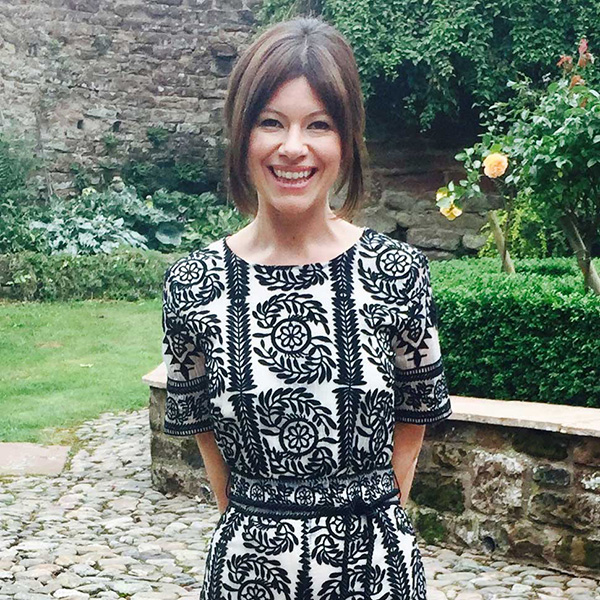
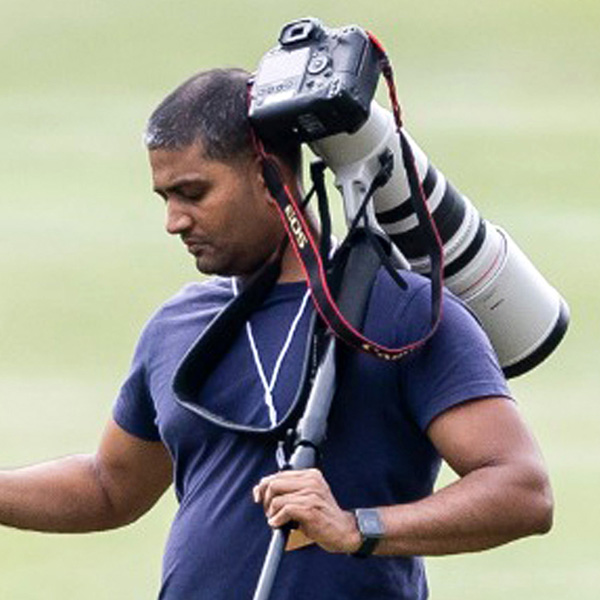
I’m a photo editor for the New York Times and photographer for AFP. In previous lives I’ve been Chief Photographer, Indian Subcontinent and Staff Photographer, Singapore for Reuters; Before that, I was a staffer at AAP in Sydney. Before that, I was actually a night shift taxi driver for two years while I was getting my career as a photographer off the blocks in Australia. So if you’re looking for a raging debate on the state of modern photojournalism, or pointers on how to fix a Ford Falcon’s radiator hose – come find me at the bar.
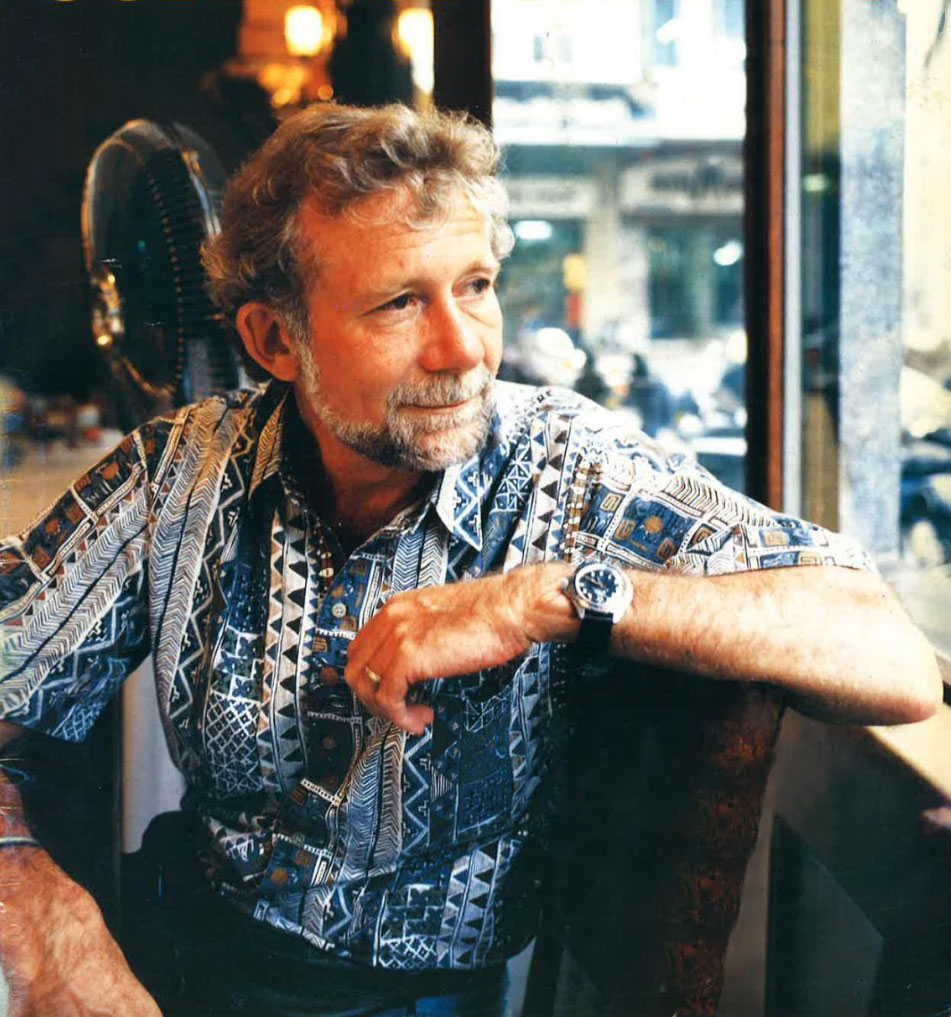
Obituary: Derek Maitland, Vietnam War photographer and author
Born April 17, 1943; died January 7, 2019
The bio for the exhibition on the Van Es wall of 34 Vietnam photos last September and early October revealed a clue to how Derek Maitland’s career path was set. “My life really began the day I saw Kowloon Docks in 1966.”
He expanded on this thought for my piece in SCMP Sunday Post Magazine piece last September (which was to be his last interview) “I was 23; Hong Kong was all the things one would like at that age. It was the jumping off point to where I passionately wanted to be at that time, a war correspondent in Vietnam.”
Derek left Vietnam after two years: “After three major combat incidents that I covered – one in the massive Tet Offensive – convinced me my luck might be running out,” he told The SCMP. Twenty-six years earlier, in The Correspondent of January 1992, he’d written: “I was convinced that after nearly two years of my own madness that the next bullet would be for me. That and an even bleaker fear that in the inexorable deterioration of my youth and spirit, furiously burning up on a napalm blast of drink, adrenalin, danger, terror,
and depravity to which the war had sunk, I might lose touch with the real world altogether.”
He was open about his battles with Post Traumatic Stress Disorder (PTSD). He suffered it for 15 years after the Vietnam War, until he met a psychologist whose expertise was Vietnam Vets. “It was not just the vets who went off the rails after the war. Saigon … made much of life thereafter seem meaningless and mundane, requiring tremendous effort to restore everyday faith and excitement. And that against the backdrop of abiding melancholy and occasional hallucinations in the dead of night,” he wrote of PTSD in The Correspondent in January, 1992.
From Vietnam, Derek flew to London and worked with BBC-TV News and wrote his first novel, The Only War We’ve Got. From London he moved to Beirut and covered the Middle East. It was there that he met his first wife, Therese Herbert, a French Canadian, with whom he had two sons, Nick and Luke, who are in their early forties and who celebrated their father’s 75th birthday in Australia last year.
Derek came back to Hong Kong in the mid-1970s and worked as a freelance feature writer and humourist. He returned to television news in Toronto and went back to London with the BBC, where he led the first news crew to film the immediate aftermath of the IRA bombing on Prime Minister Margaret Thatcher’s hotel in Brighton in 1984.
In 1985, he travelled China and once again returned to Hong Kong with his second wife, New Zealander Jan O’Neill. launching the China Traveller magazine. This later became the Pacific Traveller. Together, the husband-and-wife team produced corporate videos.
After a stint in Sydney in 2000, Derek and Jan moved to Orange, and later further west to the heritage town of Canowindra in New South Wales, where they bought a house. Gregarious, articulate, intelligent, wry and witty, Derek also wrote four novels and five non-fiction books. When he passed away in Canowindra on a summer’s day after a battle with cancer diagnosed in 2016, he was working on a book of his life and another, poignantly titled Coming Home To Die.
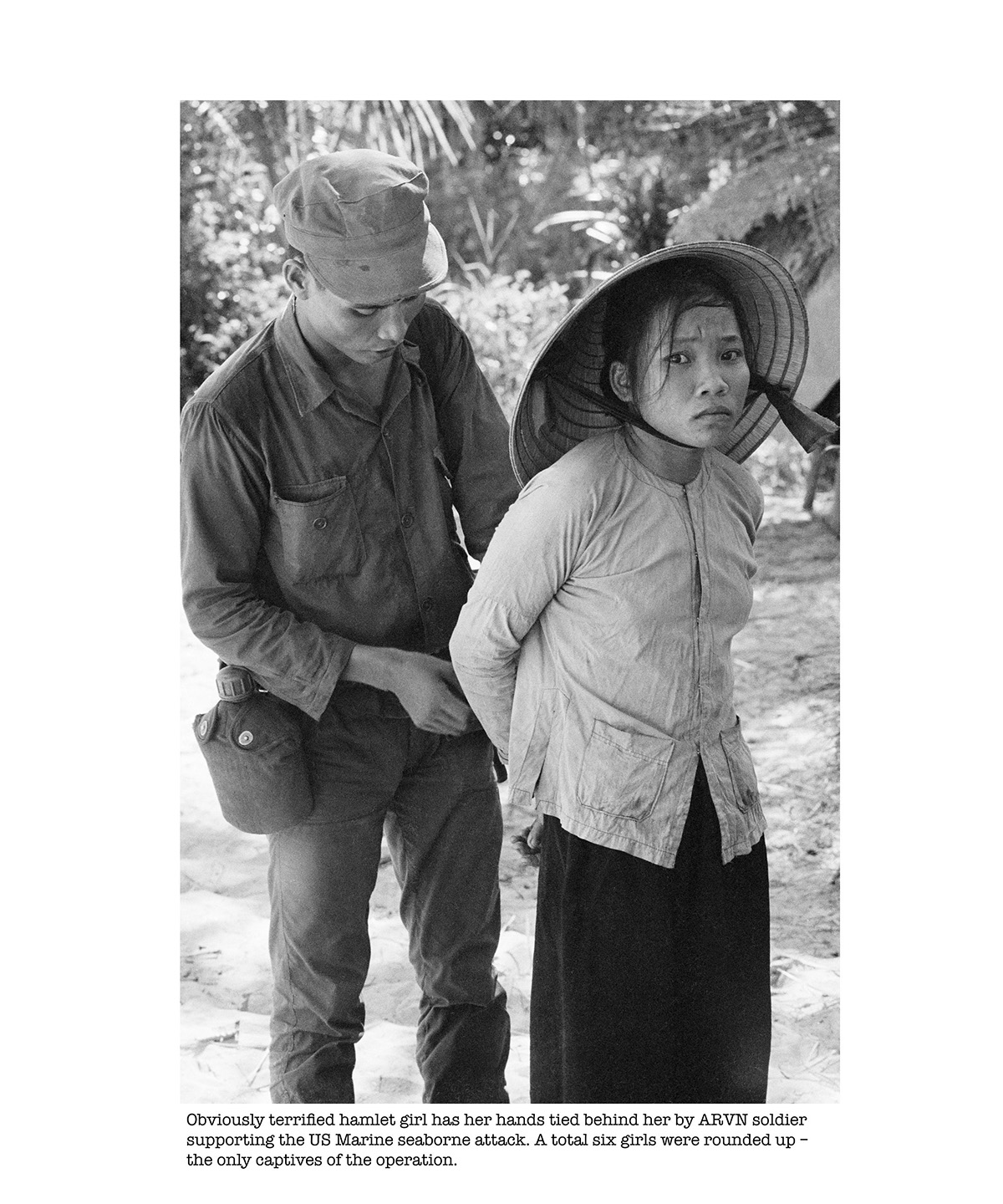
Derek was part of the Vietnam Hacks email group, along with FCC member Robin Moyer, who said: “Derek and I spent some time together in Vietnam after the war. He had a keen sense of humour, especially when observing the cultural collision of East and West. [Fellow FCC member] Mark Erder coaxed Derek to send me his Vietnam photos from his year–long sojourn at the height of the fighting there in 1968–69 and we carried on a stimulating email conversation, in between bouts of chemo, as we put the pictures and captions together for his last hurrah on the Van Es Wall in September.”
FCC archives: Recording the history of those who witness it
The FCC’s archives may have dropped down the club’s list of priorities in recent years, but they’re not forgotten. Carsten Schael makes a passionate case for bringing them centre stage again.
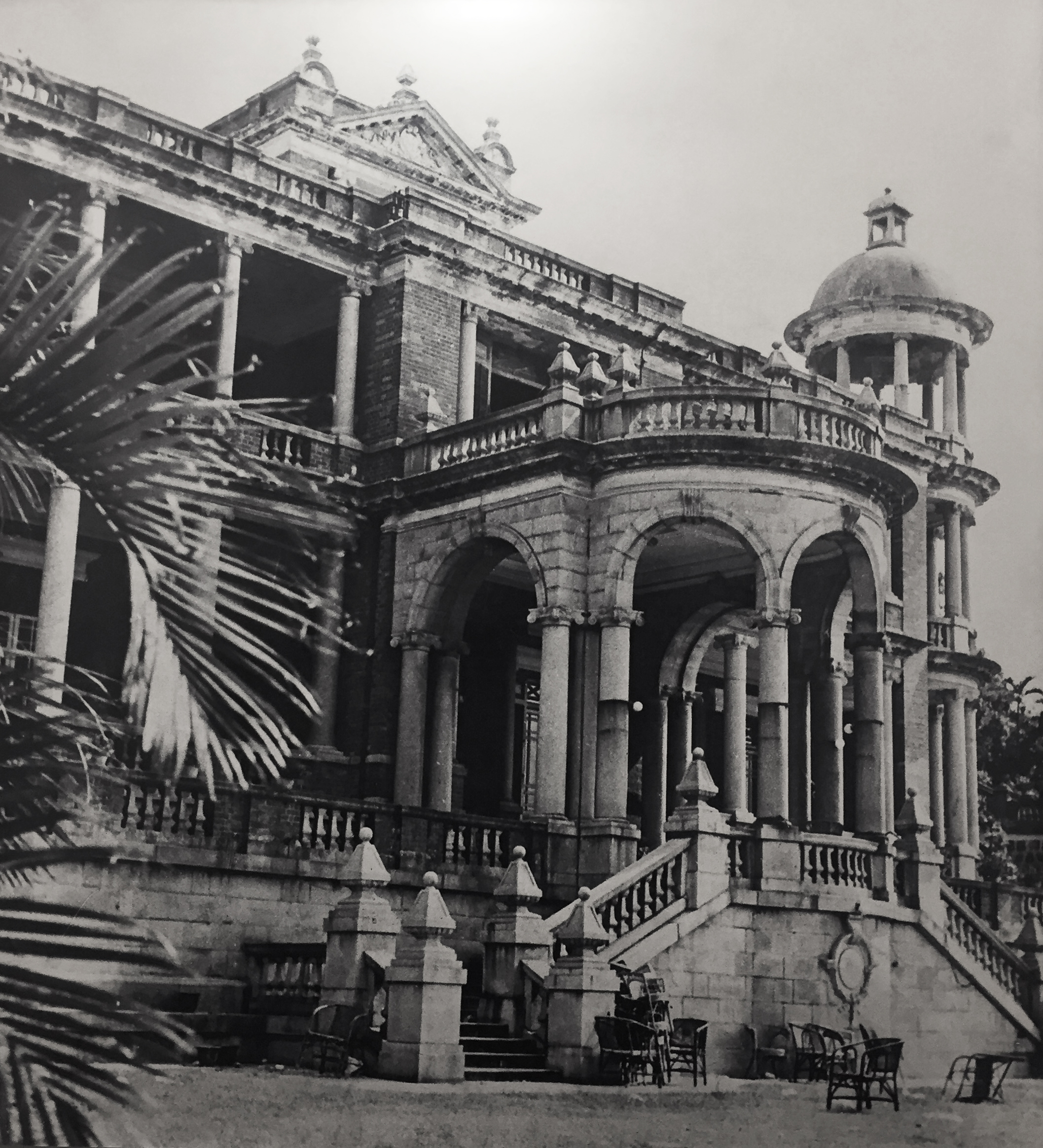
Walking into the club from Ice House Street, many first time visitors may assume that the FCC has occupied the premises since they were built. The building and our storied organisation are that well matched to each other.
While the club’s origin only dates back to 1943 (the building was completed in 1917), it has filled these walls with many great stories of events which have changed the course of humanity. FCC members were active participants in recording history in the making. This has left the club as one of the custodians of records that bear witness to these events.
When I joined the club as a correspondent (freelance photographer) member in 2006, its history attracted my interest. I became acquainted with many members and started to learn about the great stories behind the photographs on the walls. As I became involved in the Wall and Publications (now Communications) Committees I was dismayed to find that there were no archives for the safe-keeping of the Club’s history.
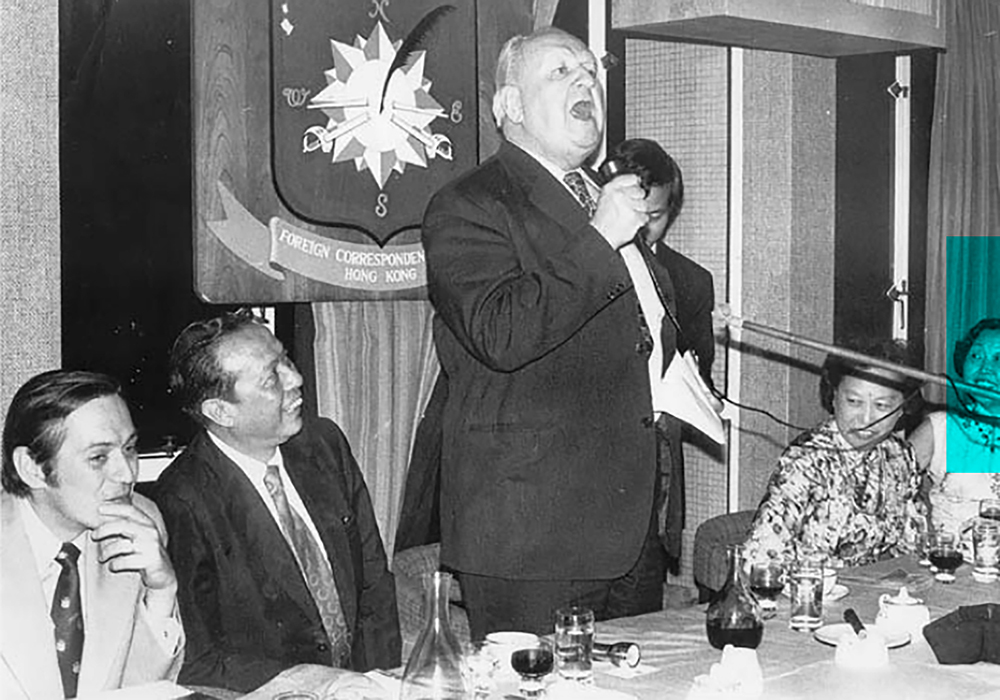
The send-off for Mr Liao in 1977, with from left, Club president Bert Okuley, Liao Chien-ping, Richard Hughes in full swing and Mrs LiAfter getting elected to the board in 2011, I found initially that very few governors at the time considered the past of the club as important as present or future issues. It took a good year to find consensus on setting up the Archives Sub-committee, which I then headed. Then it took another year and changes in the board to get agreement on spending money on setting up an archives system and structure. Following over a year of work with expert consultants Simon Chu and Don Brech, the FCC Archives became a reality and the club started to reach out to the membership for contributions.
The club’s 70th anniversary in 2013 was a great opportunity to showcase a visual timeline of its history. And just a couple of months before the celebration we received a letter from an eye witness of the club’s foundation in Chungking. Mrs Wing Yung Choy-Emery was then a student in a journalism school near to the press club building and knew many of the China correspondents there (The Correspondent, Sept/Oct 2012). Sadly she has since passed away, but she left us with some great firsthand accounts of these early years.
With time and witnesses passing, the sub-committee compiled a substantial list of long-standing members to be interviewed for an oral history of the club. But being only a small group of dedicated volunteers (Vaudine England, Annemarie Evans, Cammy Yiu, Terry Duckham, Paul Bayfield, John Batten) and FCC staff, we were reaching the limits of the achievable very quickly. And as time went on, of the three-and-a-half staff members (the “half” refers to a part-timer) that were trained by our archive consultants, only 1.5 remain working for the club.
The last blow to the archives effort was the missing seven votes of my 2017 unsuccessful bid for the FCC presidency, which resulted in me leaving the board and the role as the convenor of the Archives Sub-committee without a successor being appointed.
Since then, not much has happened except club presidents have changed multiple times and the club’s residence in its Ice House Street building has been threatened following events of recent months.
This, of course, is of paramount concern to the board and the membership which might explain why the archives have been languishing. But I would like to make the case that the club’s greatest asset is its history.
The bits that we have gleaned so far are just the tip of the iceberg. There is the story of FCC Captain Mr. Liao (or “Papa Liao” to many early Hong Kong FCC members) who was a steadfast custodian of the club’s property through its early turbulent years. And much more …
Unfinished research during the anniversary year revealed that there are several overseas archives that contain very interesting contextual information to the club’s history, as do the personal archives of several elderly members. So we would not run short of material for some time to come.
But first things first, I would like to ask for the current board to appoint a governor to lead the archives effort. I know our current president is already thinking along those lines, but the day-to-day business is shifting priorities. Please imagine all the amazing stories that are waiting to be rediscovered and the ones that we can preserve for the future of this great institution.
I would also appeal to our friends and supporters outside the club to consider that this club is a tremendous asset to the historic centre of this amazing city which has started to treat its tangible heritage with a bit more respect and consideration in recent years, because recognising where we came from is as important as where we will be going.
And as a final request, I would like the board to consider raising the importance of the archives to a full committee level, not just sub-committee. Of course, this will require a constitutional change and is not done overnight. Please consider this, because without its history the club is just another inexpensive bar/restaurant with interesting patrons.
Carsten Schael is a photographer and digital archives consultant based in Hong Kong. Since 2009 he has worked on local and international archives related projects. He served on the FCC Board of Governors for six years.
Blockchain explained – and why it’s going to change our lives
Blockchain is apparently going to change our lives, but most of us don’t have a clue what it is. Colin Simpson tracked down someone who has made it her business to be in the know.
Baffled by blockchain? If so, you’re not alone – a report by HSBC found that 80 percent of people surveyed did not understand the technology that powers cryptocurrencies such as bitcoin.
Yet blockchain evangelists say it is about to radically shake up our lives. So where does this leave the lay person struggling to keep up with it all – or for that matter reporters and editors covering such a hype-ridden and complex subject?
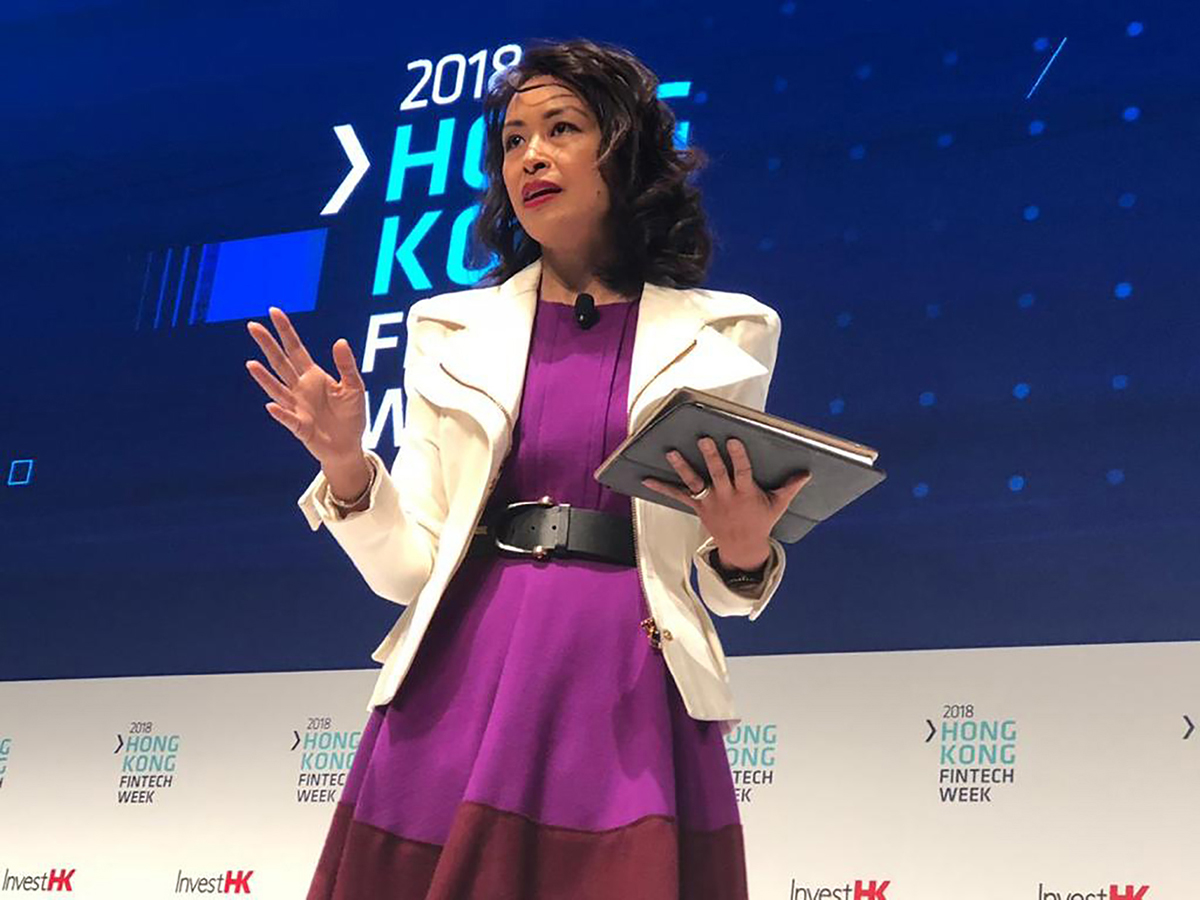
Stepping into the knowledge gap is Hong Kong-based Forkast News, a start-up co-founded by former Bloomberg TV anchor Angie Lau. It aims to provide clear and authoritative coverage of blockchain to the general public, techies, investors, companies – and journalists.
“The underlying technology of blockchain is going to transform industries,” said Lau, an FCC member. “It will change our world, and yet currently there is a lot of distrust, misunderstanding, and confusion amongst the general public.
“As journalists, we explain very complex ideas clearly, concisely and simply. I’m applying [this] to a very niche industry that not a lot of people understand and are probably afraid of and suspicious of.
“I want to be a bridge of understanding between the average person and the blockchain community.”
The view that the technology is about to usher in massive change appears to be shared by business leaders. Deloitte’s 2018 global survey of executives familiar with blockchain found that 74 percent of respondents said their organisations saw a “compelling business case” for its use. Those surveyed came from a range of industries, including the media.
Forkast, which is based in Causeway Bay, aims to launch its service in the first quarter of 2019. The exact form it will take is still being finalised, though there will be digital and video elements backed up by social media.
A group of specialists, data scientists, legal experts, developers, and coders – currently numbering around a dozen but expected to grow – has been assembled to evaluate blockchain ventures.
Lau said they would be able to determine, for example, if a new pitch is, in fact, a copycat version of a project that had failed previously, or if those behind a plan had been involved in earlier launches that had not come to fruition.
“The resources to actually verify [blockchain projects] and do deep dives doesn’t currently exist within the framework of traditional newsrooms,” she said.
Lau agreed that blockchain had been tainted by its association with wild cryptocurrency price swings, scams, tax evasion, and money laundering.
“Those aren’t the only stories that are relevant,” she said. “There are a lot of superficial headlines out there, and that’s great, it’s all part of the same ecosystem, but it is not the only part. I want to elevate understanding.”
Lau was a speaker at the Digital Media Asia conference in Hong Kong in November. Reflecting the growing interest in blockchain, the conference featured the technology for the first time and presented a full-day workshop about reporting on the subject. Topics covered included the rise of the blockchain beat and newsdesk, and – underlying the difficulty many have in understanding the subject – there was a session entitled “demystifying blockchain terminology”.
Forkast will not be without competition in the blockchain space. Singapore-based Block Asia, which launched in May, describes itself as a “one-stop news, media, and events portal for blockchain and cryptocurrency information in Asia and around the world”. Block Asia journalist Hui Xian said the site received an average of 75,000 views a week, and employed mainly freelancers.
Managing director Ken Nizam started the service after seeing a gap in the market for crypto news in the ASEAN region, said Hui.
Another startup, US-based Civil, is aiming to create a blockchain-based registry of newsrooms around the world in an effort to support trust in the age of fake news. The independently owned and run newsrooms are expected to meet Civil’s ethical journalism standards.
“Any newsroom found to be violating these standards can be challenged and, if the challenge is upheld by the community, removed from the trusted list of Civil newsrooms,” said Civil co-founder Matt Coolidge. “In this way, we’re seeking to build the anti-Facebook for news.”
In Asia, Civil has partnerships with Singapore’s Splice and a startup called Global Ground and says it is in talks with some larger publishers in the region. Partnerships with AP and Forbes have also been announced.
Splice has an ambitious plan to launch 100 media startups in Asia in three years. Both Splice and Global Ground are engaged in a surprisingly low-tech form of journalism – newsletters. Global Ground has journalists in South Korea, Thailand, and India, according to its website.
Civil suffered a setback in October when it was forced to scrap the initial sale of a cryptocurrency that was to be used by members of the network after failing to achieve the $8 million minimum fundraising target. A new, simpler, sale is due to take place early this year alongside the launch of the registry.
Civil’s original wide-ranging and somewhat confusing plans to transform journalism met with scepticism in some quarters. Coolidge, while conceding that blockchain is not a cure-all for the industry, said the transparency it gives “can help repair the considerable trust gap that currently exists between journalists and the public”.
BLOCKCHAIN EXPLAINED
Blockchain is a public ledger of transactions. It is sometimes referred to as a distributed ledger, meaning that it exists on many computers, rather than being a single record of a transaction on the server of, say, a bank. This means, in the case of payments as an example, they can be made directly without the need for a third party such as a bank or PayPal.
Blockchain’s design makes it almost impossible for anyone to change details of completed transactions, and the fact it is public provides transparency. The technology is most closely associated with cryptocurrencies, though technology giants, financial services firms and start-ups are exploring ways of using it in other areas – including journalism. For example, the Civil registry will use blockchain to ensure transparency by providing newsrooms and journalists with proof that they own their material. Readers will be able to check that a particular story was published by its stated author and is not fake news. Blockchain was launched in 2009 by the mysterious and unknown individual or team behind the first cryptocurrency, bitcoin, who used the pseudonym Satoshi Nakamoto.
Why 2018 was a year of living dangerously and dying violently for journalists
Reports on how the media fared in 2018 are relentlessly bad news, with killings, imprisonments and hostage-taking of journalists all up. Sue Brattle takes a look at the statistics.
2018 was a grim year for journalists, with 80 killed, 348 in prison and 60 being held hostage at the time of going to press. Reporters Without Borders (RSF) stated that there was “an unprecedented level of hostility towards media personnel”. In its annual round-up of abuses against the media, RSF concluded: “Journalists have never before been subjected to as much violence and abusive treatment as in 2018.”
In fact, the FCC has chosen this issue as its theme for 2019’s Journalism Conference on 23 March, entitled Enemy of the People? The Dangers of Being a Journalist in 2019.
In December, TIME magazine named their person, or persons, of 2018, under the title The Guardians and the War on Truth. The honoured were: murdered Saudi journalist Jamal Khashoggi, imprisoned Myanmar journalists Wa Lone and Kyaw Soe Oo, Rappler founder Maria Ressa of the Philippines, and The Capital newspaper in Annapolis, Maryland, U.S., where five staff were shot dead in June.
Sam Jacobs, executive editor of TIME, said after the announcement on December 12: “We are trying to make a statement, trying to stress the importance of freedom of the press. One of the big themes we have seen this year is the question around truth. What they [the media] are guarding is liberty, democracy and freedom. And they are searching for facts.”
More than half of the journalists killed in 2018 were deliberately targeted, according to RSF, whose Secretary-General Christophe Deloire said: “The hatred of journalists that is voiced, and sometimes very openly proclaimed, by unscrupulous politicians, religious leaders and businessmen has tragic consequences on the ground, and has been reflected in this disturbing increase in violations against journalists.”
Award-winning Chinese photographer Lu Guang in New York. He vanished in the restive northwest region of Xinjiang and was “officially arrested” by local authorities, his wife said on December 12, 2018.British human rights organisation Article 19 has concluded in its report spanning 2017-2018 that freedom of expression is at its lowest point for 10 years. Journalism is more dangerous – and more under threat – than at any time in the last decade. The rise of authoritarian governments and the threat of internet censorship has redoubled pressures on reporters globally, the report found.
Matthew Bugher, head of Article 19’s Asia Programme, told The Correspondent: “Headline stories concerning attacks on journalists, the prosecution of peaceful protesters and new repressive legislative initiatives paint a grim picture for the right to freedom of expression in Asia.
“Over the past year, the Cambodian government has engineered the evisceration of independent media, and Myanmar and the Philippines have persecuted journalists and human rights defenders who are reporting on grave human rights crises.
“Thailand’s military government still presides over a rights-restricting legal framework of its own creation and Indonesia’s politicians have shown themselves willing to accommodate religious hardliners by silencing moderate voices.
“Meanwhile, China continues to export its authoritarianism, providing technology and training to support censorship and surveillance by regional governments and providing diplomatic cover for the repression of free speech.”
Afghanistan holds the tragic record for most journalists killed in 2018, with 15 deaths. Among them was AFP’s chief photographer in Kabul, Shah Marai, whom the FCC commemorated with a Wall exhibition of his pictures.
In Syria, 11 were killed, and in Mexico nine journalists were murdered.
RSF found that the number of journalists detained worldwide at the end of the year – 348 – was a rise from 326 at the same time last year. As in 2017, more than half of the world’s imprisoned journalists are being held in five countries: China, Iran, Saudi Arabia, Egypt, and Turkey. China remains the biggest jailer of journalists with 60 being held at the moment, including award-winning photojournalist Lu Guang who went missing in November. Chinese authorities waited a month before admitting he’d been arrested in Xinjiang.
The number of journalists being held hostage – 60 – is 11 percent higher than this time last year, when it was 54. All but one are in three Middle Eastern countries – Syria, Iraq, and Yemen.
Malaysia’s People’s Justice Party president and leader of the Pakatan Harapan coalition Anwar Ibrahim (C) takes an oath as a member of the parliament during swearing-in ceremony at the Parliament House in Kuala Lumpur on October 15, 2018. Photo by Mohd RASFAN / AFP.Phil Robertson, Deputy Director of the Asia Division of Human Rights Watch, said: “This was really the year when the governments struck back against the media. In many countries, reporters determined to ask hard questions and raise uncomfortable issues faced waves of harassment and death threats by government-sponsored online trolls, surveillance by state agencies, bogus criminal charges, and tax assessments, imprisonment, and physical attacks.
“Next year promises to be just as bad or worse, as the government assault on the media expands to using overbroad cybercrimes laws to go after free expression on the Internet.”
Vietnam welcomed in 2019 by introducing a new cybersecurity law, which criminalises criticising the government online and requires internet providers to give authorities user data when asked.
As the country’s Association of Journalists published a code of conduct banning reporters from posting information that could “run counter” to the state on social media, RSF’s Daniel Bastard called the measures “a totalitarian model of information control”.
So are there any bright spots in the gloom? Article 19’s Matthew Bugher thinks there are: “In Malaysia, the Pakatan Harapan [Alliance of Hope] coalition, which ran on a platform that included legislative reform to promote freedom of expression, won a shock election victory in May. Although progress on human rights commitments has been limited to date, hopes remain high that the Government will live up to its reformist credentials.
“Moreover, in Hong Kong, Myanmar, the Philippines, and elsewhere throughout the region, journalists and activists are coming up with new, innovative ways to combat propaganda and censorship.
“In the coming year, digital spaces will increasingly become the forum for fights over expression and information. Look for governments throughout the region to continue to seek ways to control and surveil online content, while media and civil society will develop new initiatives to enable quality independent journalism and combat hate speech and misinformation.
“Peace campaigners in Myanmar, environmental human rights defenders in Cambodia and LGBT activists in Malaysia, among others, will take their activities to social media and develop new tools and technologies to defend marginalised and vulnerable communities.”
ENTRIES FOR HUMAN RIGHTS PRESS AWARDS 2019
The closing date for submissions to the Human Rights Press Awards 2019 is February 12. The awards, now in their 23rd year, are organised by the Foreign Correspondents’ Club Hong Kong, Amnesty International, and the Hong Kong Journalists’ Association.
Showcasing this work has become more important than ever as governments around the region step up threats to basic freedoms, whether it be locking up journalists, carrying out arbitrary detentions or silencing political opponents.
Submissions must have been reported from the Asia region, including Central Asia, but excluding the Middle East, Australia, and New Zealand, and been published or broadcast between January 1 and December 31, 2018. Entries must be in either English or Chinese, and there is no entry fee.
Categories include Breaking News, Features, Multimedia, Video, Audio, and Photography. This year the Features category will be split into two awards – Investigative Feature Writing and Explanatory Feature Writing. All entries must be related to the Universal Declaration of Human Rights. Each entry must cite the specific article that the work seeks to address.
For further details and to enter, click here.