Members Area Logout

Press clubs and the art of treading a fine line

Police shut down an event at the FCC Thailand for the sixth time recently. Michael Mackey was there and reports on the Club’s trials and triumphs.
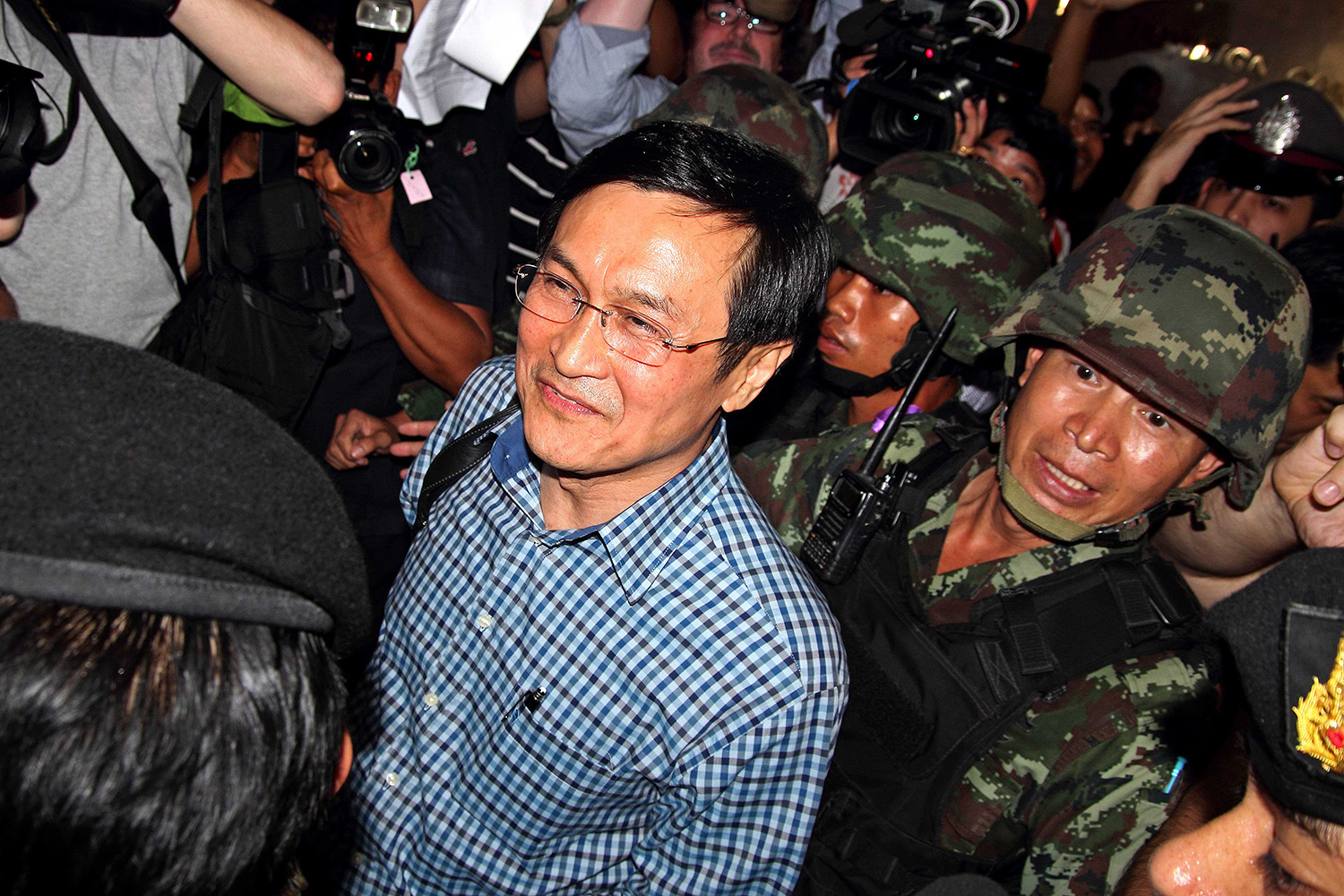
Chaturon Chaisang being led away.

On Monday, September 10, members of the Foreign Correspondents’ Club of Thailand turned up at their club in the early evening for a scheduled discussion about a United Nations backed report on alleged war crimes in neighbouring Myanmar.

They were met by uniformed and plain-clothes police officers under orders from Thai officials to shut down the event.

Inside some people were eating in the dining area as if nothing was happening, and some were at the bar. There were also plain-clothed police and lots of local journalists milling around. Clustered in a corner were, among others, Club president Dominic Faulder in talks with senior officers.

Eventually, FCCT First Vice-President Tassanee Vejpongsa, who works for the Associated Press, read out the cancellation order, which arrived just 20 minutes before the programme was due to start. With over 20 Bangkok police in the room, there was no alternative but to comply.

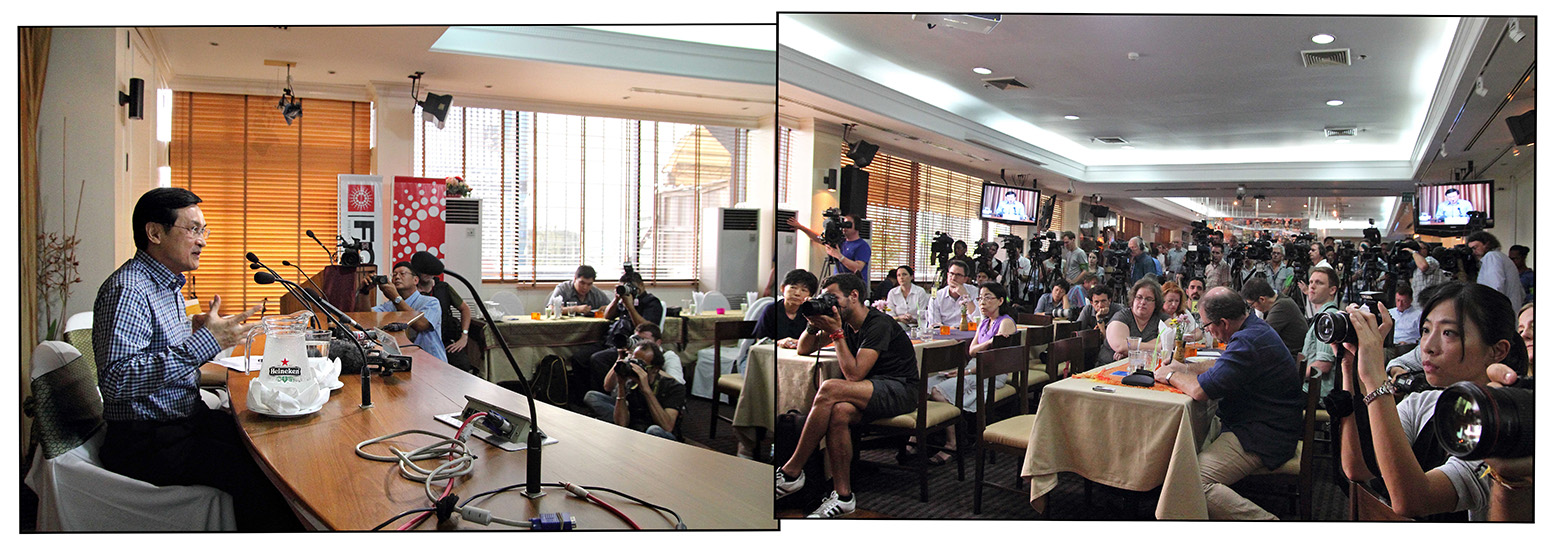
Chaturon Chaisang speaks at the FCCT in 2014 after being ousted from office... and is arrested during his talk and led away. Chaturon Chaisang speaks at the FCCT in 2014 after being ousted from office… and is arrested during his talk and led away.

Faulder then added a statement. It was polite but firm, sticking to the facts: this was the sixth event the Thai authorities had stepped in to stop. Four of these were not organised by the Club itself but outside groups; two were on Human Rights, and two were on Vietnam.

Events on Cambodia, Malaysia, and the Philippines have all gone ahead and criticisms made, but Vietnam lobbies the Thai authorities to prevent certain topics being discussed.

“There was not a complaint from the Burmese embassy as far as we are aware,” Faulder said in his brief statement. The incident was reported by hundreds of news organisations around the world, including in the U.S. by both Fox News and The New York Times.

The police, some of whom were Special Branch, apparently didn’t know who was responsible – just that the order came from somewhere higher up.

The same day, the FCC Hong Kong issued a statement of support for the Bangkok club, including: “In a letter ordering the FCCT to cancel the event, the Thai police stated that the discussion might be used by ‘third parties’ to cause unrest and endanger national security. There are no grounds whatever for such suspicions. The club has regularly held orderly and informative panel discussions on current affairs for over 62 years, and these have never led to any unrest or subversion.”

Despite incidents such as this, the FCCT remains a place of open debate – while facing the same problems as many other media clubs.

Given the strictures put in place when Thailand’s military took power back in May 2014, which come on top of some already onerous laws about how some topics can be reported, the FCCT has continued to put on good and varied programmes that are frequently topical and challenging.

“This is quite a prickly government – particularly at the beginning,” Faulder, the FCCT’s president for the past two years, said in an interview four days before the events of September 10.

Things did not get off to a good start four years ago with the military arriving en masse to arrest Chaturon Chaisang, then the just-ousted education minister, technically a fugitive, as he spoke at the FCCT’s central Bangkok premises. However, there was – as Faulder noted – “genuine media interest,” in what Chaisang would say.

Although the club has good relations with the Ministry of Foreign Affairs, and problems a few years ago with media visas have largely been resolved, relations with the cabinet have been “close to non-existent”, as Faulder put it. There has been no attempt to close the Club, but the cold shoulder it gets from the top is obvious.

Only two ministers have come to speak in four years – a drought compared to previous years. There has been no prime minister’s dinner, a fixture in most Thai premierships over the past 40 or so years. Former Prime Minister Yingluck Shinawatra came twice, and former PM and Leader of the Democrat Party Abhisit Vejjajiva three times. Of Thai Prime Minister General Prayut Chan-o-cha, Faulder said: “He hasn’t shown the slightest interest in talking to us.”

Plenty of other speakers have, though, allowing the FCCT to put on events allowing some serious issues to be discussed. These are usually panel discussions with as many as five members, but usually three or four, allowing different views to be heard and politely probed.

They are also firmly moderated, with Faulder, a burly, imposing figure, leading a style of chairing best described as no-nonsense but essentially fair. This also extends to writing the flyers for events.

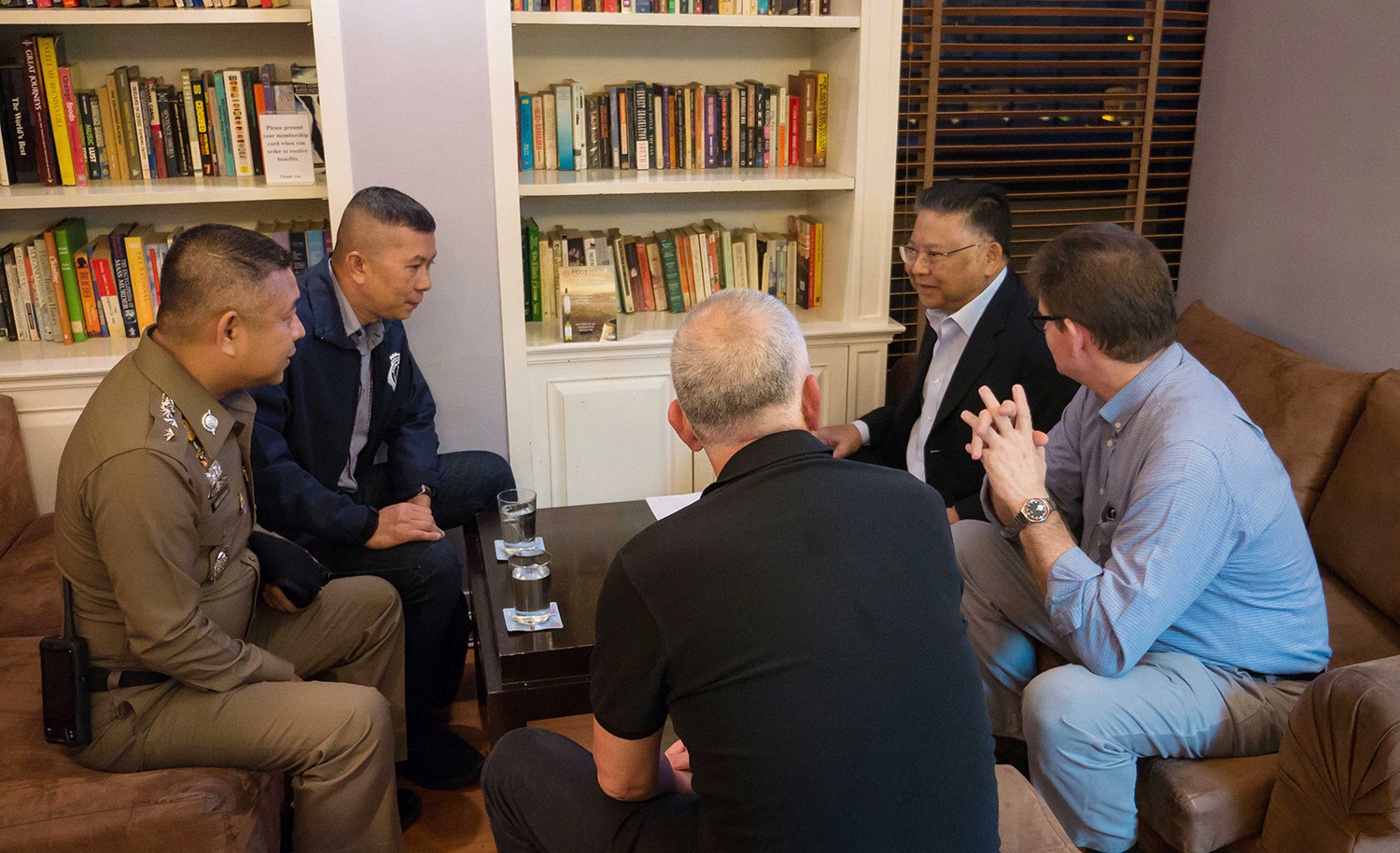
Dominic Faulder (right) with Club Manager Richard Holt on his left and retired diplomat Kobsak Chutikul negotiate with police. Dominic Faulder (right) with Club Manager Richard Holt on his left and retired diplomat Kobsak Chutikul negotiate with police.

“One of the things I lectured everyone on was not writing inflammatory blurbs. We want balance,” said Faulder. The FCCT, he stressed, is not an activist organisation, and does not belong to either the Red or Yellow side of the Thai political spectrum. Neutrality has enabled it to carry on doing events about Thailand and the region.

One good example of panel topics is Thailand’s road safety – it’s appalling. One on “Thai-ness” was lighter in tone but swung a light across the issue of Thai identity, what it means and what it implies.

Panels have also trodden on serious ground. One of the more recent of these was up-and-coming politicians discussing how they saw future developments. This packed them in; around 260 people attended well ahead of the ban on politics being lifted.

“There was no effort to stop that topic. I think everybody was interested in having an opportunity to hear what these people have to say,” said Faulder, who works for Nikkei Asian Review.

He also organised some crackers: a lengthy and illuminating discussion of the events of October 1976, a crunch time in Thailand’s turbulent history, was one. A fascinating programme on the Chinese in Thailand squeezed in seven speakers, and could have gone on all night. Indeed, the FCCT has not lacked for stimulation during what could have been a very fallow period.

Members and guests at FCCT watch as the planned talk on Myanmar is cancelled 20 minutes before it was due to begin on September 10. Members and guests at FCCT watch as the planned talk on Myanmar is cancelled 20 minutes before it was due to begin on September 10.

So there has been a steady stream of panels and regular documentary nights that deserve honourable mention that have kept debate alive, and on occasion added to it. Some, however, have hit the wall.

One of these was about a historic bronze plaque that went missing from Royal Plaza in the old part of town. This small piece of metal, marking the spot where the end of absolute monarchy was announced after a coup in 1932, disappeared under circumstances best described as unusual and still needing proper explanation.

Although the programme was ordered off by the police on instructions from much higher up, there was enough warning for an event on press freedom to be substituted.

Michael Mackey is an Absent Member of the FCC Hong Kong

Flak jackets, visas and the age issue

Like all press and media clubs, the FCCT has many pressures to contend with. Whilst correspondent numbers at the Club have remained fairly constant at around 85, there has been a major loss in the journalist category, from about 130 to about 70. Freelancers are also noticeably diminished from a decade ago.

A reclassification by the Thai authorities of many photographers and videographers hasn’t helped membership. They were no longer accepted for accreditation as journalists, and told to get business visas. Discussions with the FCCT’s professional committee helped sort out some of the problems, and the foreign ministry’s online accreditation system is greatly improved. Problems with regard to the legal importation of flak jackets, however, continue.

Within the membership, there has been a slight shift from Western journalists and a rise in Asian journalists. Nikkei and other Japanese news organisations have a growing presence, as increasingly do the Chinese media. Among traditional media, there is also a rebalancing away from youth towards more mature individuals. “We have a problem with an ageing membership demographic,” acknowledged president Dominic Faulder. He is keen to make the club more attractive to younger members. Two years ago it was starting to look a bit tired and weary. Some changes were made – new air-conditioning, new tables, new floor coverings, a spruced-up outdoor terrace, and a revamp of F&B including Thai craft beers, excellent Thai fare, and an all-day cooked breakfast.

“It’s a much more pleasant place to visit now,” said Faulder. “Everybody notices. The thing we have to do now is encourage people to make the effort – and not use traffic or heavy rain as excuses to stay at home.”


Signs of the times: A look at the famous figures who have signed the FCC visitors book

Some FCC guests leave barely a mark. Others, it seems, don’t want you to ever forget they were there. After 36 years, the Club’s guest book is full, so George W. Russell flicked through the pages to chronicle the passage of visitors.

The FCC's guest book is full of famous names - some infamous. The FCC’s guest book is full of famous names – some infamous.

From bureaucrats to burlesque stars, senators to snooker players, the lunch – or dinner, or even breakfast – guests have been a mainstay of the FCC’s activities since it opened its doors. Many visitors, from the exalted to the ordinary, have been invited to sign their names in a brown, leather guestbook embossed with the club’s logo.

The first page was turned the same day as the FCC turned over a new leaf in the Lower Albert Road premises back in 1982, with then governor Sir Edward Youde leaving his imprimatur. Now, 36 years later, its pages are full and the club is deciding whether – and how – it should display this unique historical document that chronicles both the club’s life at 2 Lower Albert Road and Hong Kong’s history nearly two decades either side of the handover.

Some of our guests had high drama either behind them – the third Baron Lindsay of Birker, visiting in 1989, had been born in a cave while his parents (the second baron and his Chinese wife) were fleeing the Japanese as part of Mao Zedong’s Communist volunteer regiments during the Chinese Civil War – or regrettably, in front of them, such as Philippine Brigadier General Oscar Florendo, who visited in September 1988 and was fatally shot resisting a coup attempt against President Corazon Aquino in 1990.

Some guests were less heroic. Australian artist-entertainer Rolf Harris – a visitor in the 1980s who filled an entire page of the guest book with his distinctive sketches – would be later imprisoned on charges of indecent assault of teenage girls. Other jailbirds have included former British MP Jonathan Aitken (sentenced to 18 months for perjury in 1999) and Jeffrey Archer (sentenced to four years for perjury in 2001). Australia’s Alan Bond, a hero for bankrolling the America’s Cup yachting win in 1983 and a visitor to the club afterwards, served four years in prison for deception.

For the most part, the 1980s saw a parade of Hong Kong bureaucrats signing in – commissioners of tax and excise and the odd cabinet secretary. But leavening their presence was a horde of sportsmen (and they were mostly men). Australian rugby coach Alan Jones visited in 1984 and cricketer Tony Greig in 1988, while stars of the green baize that visited the FCC several times included former world snooker number ones Steve Davis and Cliff Thorburn.

The early years at Lower Albert Road saw a few, mostly British, celebrities entering the double doors, such as singer Elaine Paige, the original star of Evita. The West End musical’s co-creator, Tim Rice, visited in 1990, while he was head of the Lord’s Taverners charity. Other UK glitterati included actor and writer Michael Palin (now a regular FCC speaker), clarinettist Acker Bilk, actress Prunella Scales (Fawlty Towers) and cross-dressing entertainer Danny La Rue. The United States was barely represented with Jeff Smith (The Frugal Gourmet) making an appearance in 1988.

As well as light entertainment, there were political heavyweights. Former British prime minister Edward Heath visited in 1983, and former foreign secretary Lord Carrington in 1988. Few serving heads of government have had the time to visit the FCC during their term of office, except for Hong Kong governors and chief executives like Youde, Chris Patten (several times), Donald Tsang and CY Leung. Murray MacLehose, governor from 1971 to 1982, signed the guest book in April 1992, well after leaving office.

Senior Hong Kong officials have made regular visits to the club over the years, including then chief secretary Philip Haddon-Cave in 1985, chief justice Sir Ti-liang Yang in 1988, executive councillor Lydia (now Baroness) Dunn in 1989, and then chief secretary Anson Chan in 1994. Tsang spoke as chief secretary in 2001.

Among international leaders, the club managed to snare Alberto Fujimori while he was president of Peru in 1991, Suleyman Demirel as president of Turkey in 1995 and Mahathir Mohamad as Malaysia’s prime minister in 1992, when he was a youthful 67 years old. Gloria Macapagal Arroyo visited as president of the Philippines in 2001. East Timor leaders Jose Ramos Horta (1997) and Xanana Gusmão (2001) both visited before their country’s independence in 2002.

Of course, the club has a history of holding the powerful to account, and a tradition of free speech. Many visitors have been welcomed to the club despite being unpopular with their home governments. Chinese dissident Liu Binyan, who spent more than two decades in Chinese labour camps, visited in 1989. Lau San-ching, the Trotskyist agitator who was both anti-Beijing and anti-British, was a guest in 1992, seemingly without incident. Several other thorns in the side of government followed in the next generation, including Benny Tai in 2014, who added “Occupy Central with love and peace” to his moniker, Joshua Wong of Demosistō in 2017 and the Hong Kong National Party’s Andy Chan in 2018.

International activists and opposition figures to have graced the premises include South Korea’s Kim Dae-jung in 1994 (who would become president four years later), Sam Rainsy of Cambodia in 1996, writer Fatima Bhutto of Pakistan in 2007 and Malaysia’s Lim Guan Eng in 2012, who is now finance minister after the shock election this year. Anwar Ibrahim, Mahathir’s protégé who became his archrival, and is now prime minister in waiting, signed the book in 1994.

For an international finance centre, there are surprisingly few business names in the guest book: Richard Branson dropped by in 1994, Body Shop’s Anita Roddick in 2000 and Steve Forbes in 2002.

The FCC has long been a supporter of literature and the arts, and the roll of literary talent entering the club has included Han Suyin, Khushwant Singh, Amit Chaudhuri, Elena Poniatowska, Pankaj Mishra and Jung Chang. Photographer Lord Lichfield visited in 1989 and jazz great George Melly left his name in 1997.

Some left more than their names. Barrister Henry Litton attached a surprisingly artistic self-portrait. Pro-democracy veteran Martin Lee, on a return visit in May 1998, appended the note “I said I would come back.” Underneath, journalist Christopher Lingle added that Lee was “a hard act to follow”. Kevin Kallaugher, the cartoonist KAL in The Economist, added a caricature of President George W. Bush.

While the final signature in the book is that of US Consul-General Kurt Tong, the last word should perhaps go to former second vice-president the late Kevin Egan, who after signing off after an event in 2014, added: “What a splendid club – how does one join?”

Want to write a book? Here’s all you need to know from a do-it-yourself superstar author

A few weeks ago I gave a talk about my latest book at the Eslite bookstore in Hong Kong. What I found interesting was that during the Q&A session after my speech, many of the questions were actually not about the content of the book but about how to do self-publishing. And I’m more than happy to share my experience about why and how.

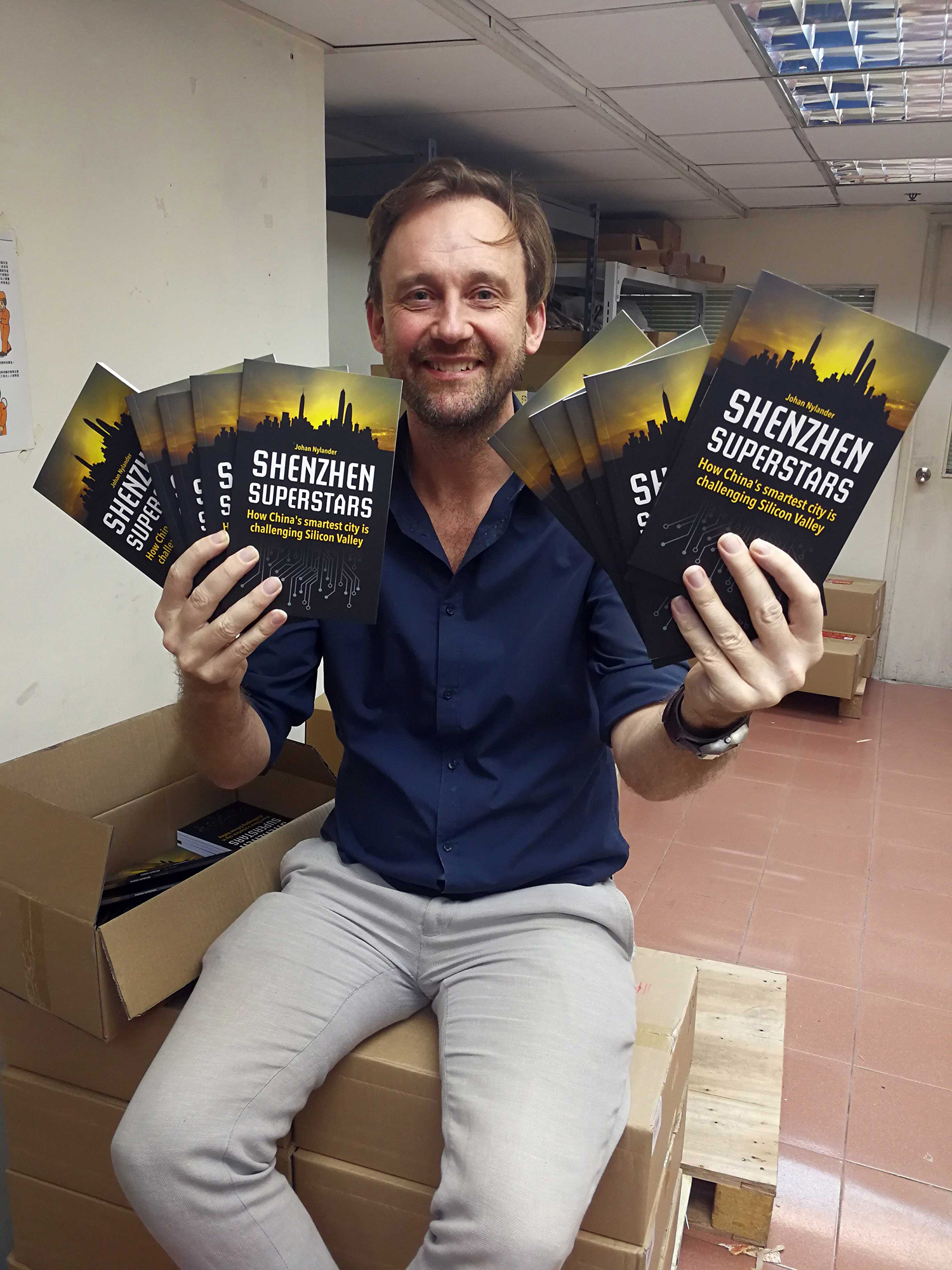
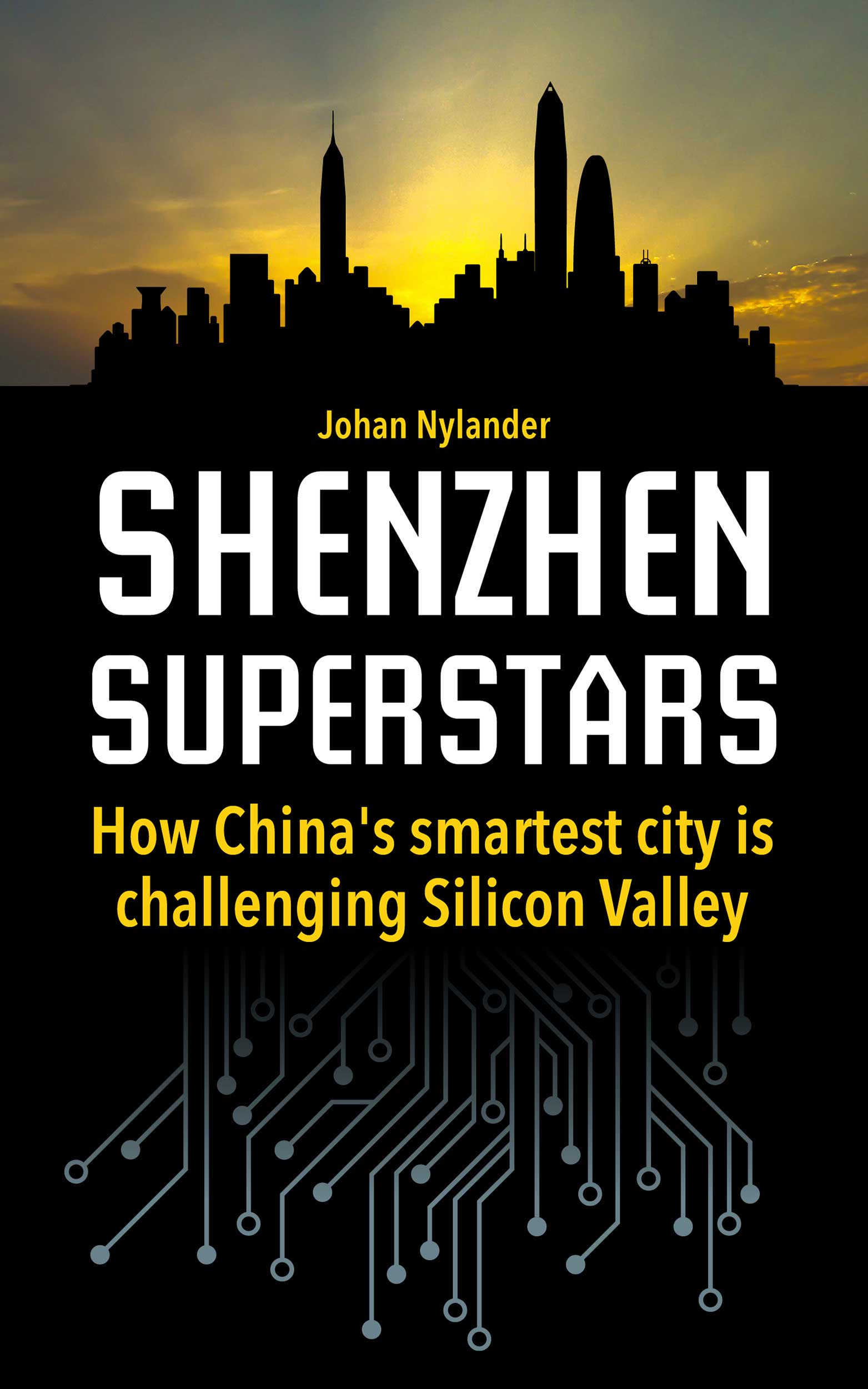
Johan Nylander with his book, Shenzhen Superstars – How China’s smartest city is challenging Silicon Valley Johan Nylander with his book, Shenzhen Superstars – How China’s smartest city is challenging Silicon Valley

About a half year ago I launched a short-read titled Shenzhen Superstars – How China’s smartest city is challenging Silicon
Valley
on Amazon. After just a few days it became the Number 1 bestseller in its China section, and bubbled in the Top 5 in the section for books on innovation. In short, self-publishing is the most fun and challenging thing I’ve done in a long time. And, believe me or not, it has been surprisingly profitable. But hey, I’m a journo and used to being paid as one.

Why did I decide to do self-publishing? I’ll give you two explanations.

Some 10 years ago I wrote a management book titled Simplify! which was published by one of Sweden’s biggest publishing houses. I was naturally honoured to be published by such a prestigious company, but it turned out to be quite a disappointing experience. In short, I did all the work and they took the money. Although I managed to get really good media coverage and even won an award for it, the publisher didn’t distribute the book to the most important bookstores. I could go on.

Secondly, for a long time I’ve been trying to figure out how to make money as a writer in today’s media industry. If you’re a fellow writer you probably recognise this scenario: You do a feature story for an international media outlet, spending time travelling, researching and writing, and in the end getting paid breadcrumbs. And the day after the story is published online, dozens of other websites might have unlawfully copied it. It’s not the best business model.

So I was thinking, what if I write the story longer, and yet a bit longer, and again longer. Instead of 1,000 words I write 10,000 words, or 15,000 words. I write it so long that it suddenly turns in to a short book. And if it’s a short book, I can publish it on Amazon. If it’s published on Amazon, as an e-book and paperback, I can sell it globally to anyone, possibly for years. Amazon gives you 70 per cent commission on the consumer price, which is about 10 times higher than traditional publishing companies.

Sounds easy? Well, it is. And fun.

JOHAN’S TOP TIPS ON SELF-PUBLISHING

1

Find a topic that includes these two ingredients: You enjoy writing it and the readers will buy it. Either you have an idea that you believe many people will want to read, or you scan through the categories on Amazon till you find a gap in the market that you think you can fill. I had luck with my book about Shenzhen; high demand (many people searching on Amazon) but limited supply.

2

Cover design and title are key. To stand out against the competition, the cover and title have to stick out and be search engine friendly. My subtitle is jam-packed with SEO (Search Engine Optimisation) boosting keywords: “China”, “smart city”, “Silicon Valley”, and “challenging” to add some drama.


3

Writing and designing is only half the job. The second half is marketing. To successfully launch your book you need to first figure out a plan how to drive traffic to your Amazon page and get people to pay. Try to get buzz on social media before launch and notify friends and colleagues.

4 

The first week is crucial. Amazon’s algorithm loves newly-released books that draw attention and if you manage to get good sales and reviews, the system will promote you. There are several tricks and tips, some quite cheeky. One is to set the price at US$0.99 during launch week, and then increase it later.

5

I also printed 2,000 copies at a local printer in Hong Kong, and the book is now for sale in most bookstores here. I’m grateful for all my friends and 11-year-old son who have helped me to carry heavy boxes across town, sometimes with taxi drivers swearing and shouting when we fill the trunk and backseat with books. Self-publishing is not always glamorous, but it is always fun.

Johan Nylander is an award-winning author and freelance China and Asia correspondent. He is frequently published by CNN, Forbes and Sweden’s leading business daily, Dagens Industri. He has penned bestseller Shenzhen Superstars – How China’s smartest city is challenging Silicon Valley, and plans to launch several more self-published books.

Read more about Johan here.


Partners in Wine: Why the FCC’s wine dinners are a learning experience

Winemakers are working with the Club kitchen to create this autumn’s wine dinners, as House/Food and Beverage committee co-convenor Jennifer Jett explains.

The wine dinners are highly social and educational evenings during which guests can get to know the winemakers and ask questions about their products. The wine dinners are highly social and educational evenings during which guests can get to know the winemakers and ask questions about their products.

Unsure which wine to order with dinner? Or are you an oenophile looking for a new favourite? No matter your level of expertise, everyone can learn something at the FCC wine dinners this autumn.

The dinners are organised together with some of the world’s most distinguished winemakers. They work with the club’s executive chef, Johnny Ma, and the beverage manager, Michael Chan, to choose dishes that best complement the wines’ characteristics. Because after all, no one knows them better than the winemakers themselves.

I think it’s pretty enjoyable getting an idea of the reaction of the public to the wines that you make.

The wine dinners are highly social and educational evenings during which guests can get to know the winemakers and ask questions about their products. And if you like what you’re drinking you can buy it on the spot. Guests can also provide suggestions for future dinners.

The first dinner was held on September 17 in conjunction with McWilliam’s, a family-owned winemaker in Australia. Host Scott McWilliam, part of the family’s sixth generation, presided over a fully booked event in the Main Dining Room.

“It’s a delight for the senses to be able to have good wine matched with good food in a lovely setting like this,” he said in an interview at the dinner. “And then it’s a little bit of the icing on the cake to have someone talk about the wine, someone who’s made it.”

Like any good wine dinner, it began and ended with cheese. In between, guests dined on tuna loin and crab meat timbales, spiced duck breast and charred beef mignon, paired with Sémillon and Shiraz.

“I appreciate all the effort that goes into these dinners,” said Andrea Morrow, comparing it favourably to other wine dinners in Hong Kong. “It’s a rarity to come to such a well-organised event.”

But if you missed the first dinner, it’s not too late. The next one, on October 30, will be hosted by Mariano Di Paola of Rutini Wines. Located in Mendoza Province, Argentina, Rutini was founded in 1885 and in 1925 became the first winery to plant vines in the Uco Valley. Di Paola has more than 30 years of experience and is Rutini’s head oenologist.

The final dinner will be held a week later on November 6, with Peter Dillon of Handpicked Wines presenting wines from Australia and Italy. Handpicked offers a “global portfolio” of wines from 21 wine regions and five countries.

As director of winemaking, Dillon travels frequently for Handpicked, sometimes visiting three or four regions in the same week.

“I think it’s pretty enjoyable getting an idea of the reaction of the public to the wines that you make,” Dillon says in a video on the Handpicked website. “As a winemaker, sometimes you can be living in your little bubble, but it’s good to share that with people and see how someone who hasn’t had any contact with that reacts.”

“Some of the time it’s the same as what you’re thinking, and other times it’s completely different, so it can be pretty funny,” he adds.

The October 30 wine dinner is priced at $588 per person, and the November 6 dinner is $598 per person. To reserve your spot, please call the FCC Concierge at 2521 1511, or email [email protected].

In other wine news, five red and five white wines are now available for home delivery in partnership with Watson’s Wine, in a special offer exclusive to FCC members. The three Australian wines – the Mount Pleasant Elizabeth Sémillon 2010, Evans & Tate Metricup Road Cabernet Merlot 2015 and McWilliam’s McW660 Reserve Canberra Syrah 2016 – come from McWilliam’s, the host of the September 17 wine dinner. Others include the Beringer Main & Vine Chardonnay 2017 from California and the Babich East Coast Pinot Noir 2016 from New Zealand.

Prices range from $100 to $148 per bottle, and the offer is valid until November 15. The total bill will be charged to the member’s account. The minimum order is 18 bottles, which can be a combination of different wines. To submit your order, call 2151 0754 or email [email protected] (Free delivery within seven working days is available to Hong Kong Island, Kowloon and the New Territories. Orders below the minimum quantity can be picked up at the Main Bar).

Details are for reference only and are subject to change.

FCC’s new executive chef Johnny Ma arrives bursting with fresh ideas

For executive chef Johnny Ma, working at the FCC is a dream come true. “It’s my cup of tea!” laughed Ma at the main bar one recent Saturday morning. For Ma, who seems to have a permanent smile on his face and a ready laugh, the FCC has it all, from a Western kitchen where he can make classic European dishes, to the colonial design of the building itself. As an added benefit, the FCC kitchen work schedule allows Ma his Sundays off, finally giving him time to attend church, as he was so rarely able to do in past jobs.

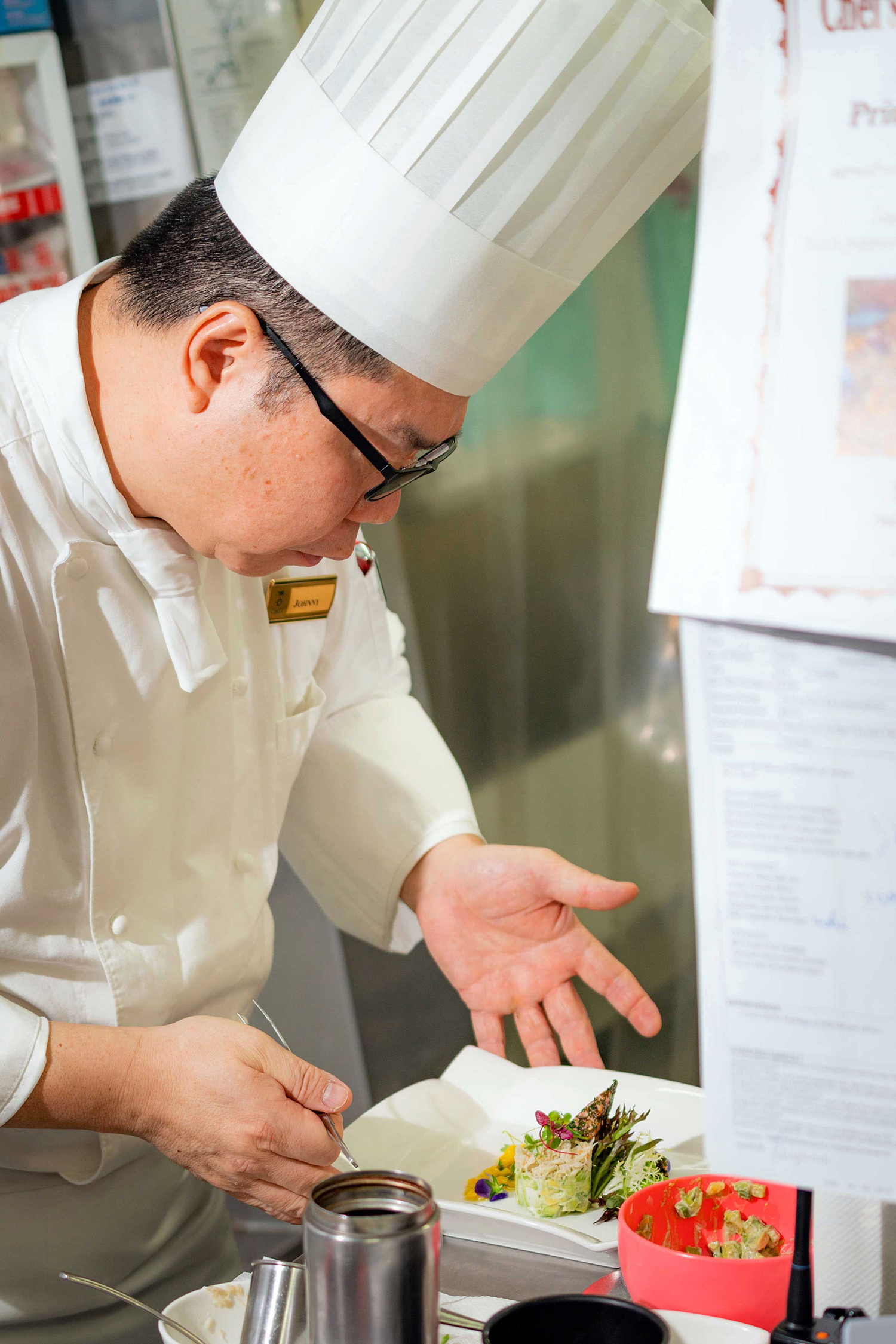
Johnny Ma joined the FCC this summer, following the retirement of executive chef George Cheng. Photo: carstenschael.com Johnny Ma joined the FCC this summer, following the retirement of executive chef George Cheng. Photo: carstenschael.com

Hong Kong born and bred, Ma began his FCC career this summer, following the retirement of executive chef George Cheng. He has spent his 40-year career around the city, beginning in a Chinese restaurant as a teenager, and later working for some of Hong Kong’s top hotels. “Since I was a child, I liked cooking,” said Ma.

At age 12, Ma began preparing meals for his family at home, readily encouraged by his mother to take over in the kitchen. Just about two years later, with only a primary school education, he was in a restaurant, learning under a strict chef who would deliver a swat for any mistake Ma made. “Because they were tough, I learned a lot,” said Ma, who sees himself as a much gentler cooking coach.

Ma has developed a speciality in, and a preference for, French cuisine. Photo: carstenschael.com Ma has developed a speciality in, and a preference for, French cuisine. Photo: carstenschael.com

It’s hard to imagine the 56-year-old Ma as a tough teacher. With a happy laugh and soft features, the bespectacled Ma is truly someone who sees his career as both an art and a lifestyle. He approaches a dish with purpose, curious about its history, conscious of cooking it to perfection, and with an added eye to its presentation. “I’m always interested to know behind the dish, what is the story,” said Ma, before launching into a tale of dried sausages and their historic use by European soldiers.

While he lauds the creativity of “New Age” chefs, Ma is often skeptical of their approach to so-called fusion dishes. Often, he said, the chefs don’t understand the base foods they are combining, or why certain flavours should go together.

Ma has developed a speciality in, and a preference for, French cuisine. The chef has even – nearly, he may say – perfected lobster bisque, and his recipe is now the standard at his former employer, the Shangri-La Hotel in Hong Kong. Tricky dishes are more fun for Ma, like seafood, which requires an exact approach to cooking time so as not to ruin it. “Cooking is an art,” he said. “You really have to concentrate on each step as you cook it.”

Ma is excited about the opportunities the FCC presents and looks forward to creating some exciting changes in the club’s menus. For instance, Ma envisions more differences between the dining venues at the FCC, and hopes to create more distinction in the type of dining members can enjoy on each floor. “I want each floor to have its own character,” he said. The formality of the upper floor would serve well for more traditional European, for instance, while the main bar is suited for casual pub grub.

Additionally, Ma plans to do four or five food promotions during the year, with themes such as Shanghainese food in February, and, his personal favourite, a French May. A Sichuan guest chef will be visiting the FCC kitchen later this year, teaching the staff some new dishes. The FCC menu has seen limited change in recent years, so Ma is ready to spice things up a bit – while, of course, leaving classics like the Indian menu untouched.

FCC members should rest assured that as executive chef, Ma will be dedicated to the kitchen. His career demands 95 percent of his concentration, leaving only 5 percent for his wife, he said with a laugh. But he has the energy to keep going, and doesn’t expect to quit the kitchen life any time soon. Even holidays leave him missing the bustle and heat of the kitchen.

“If one day I retire, I will die!”

Didier Saugy on why managing the FCC has him going back to his roots

Swiss-born Didier Saugy is the FCC’s first new General Manager for 18 years. Sue Brattle went to see how he’s settling in.

Didier Saugy. Photo: carstenschael.com Didier Saugy. Photo: carstenschael.com

If a club such as the FCC can be run with military precision, then the new General Manager Didier Saugy is the right man for the job. Didier, who took over from Gilbert Cheng in August, is a Sergeant Major in the Swiss Army when he’s not working in the hospitality industry that he loves.

He comes to the Club from the Regal Airport Hotel, at Hong Kong International Airport. There he was director of food and beverage responsible for 170 staff, ballroom banquets for 1,000 diners, six restaurants, two bars and almost 1,200 rooms. So when asked how he feels about his new job so far it’s hardly surprising that he says: “Every time I come to work it is like fresh air to me.”

Didier and Gilbert worked together for a month in the transition period before Gilbert’s retirement, and Didier says: “He was very open during the changeover, we always had friendly conversation as if we’d known each other for 10 years. Even now, I just pick up the phone and call him if there’s something I need to ask. He has left the club in good shape, and was a very hands-on manager.”

I want us to make the effort, we are not green at the moment.

So far, what challenges has he faced as the new GM? He says: “My challenges are stuff like where to put the speakers in the upstairs dining room! This is an old building and it cannot support some of the equipment we need to install. “

The kitchen team in Jinan. The kitchen team in Jinan.

He is also passionate about turning the FCC green. “I want us to make the effort, we are not green at the moment,” he says. “We are consulting organizations for advice, trying to get away from paper. We are talking about designing an app for the committees to use, and then members who are travelling can join in meetings wherever they are. I’d also like a digital wall as you walk into the main bar, but that costs money.”

Didier has never worked at a private club before, but he did own and run an auberge in Switzerland for four years near the beginning of his career. “It felt like a club, I built up a group of 300 or more regular customers and we were like a big family.”

He then spent a very happy six years as a chef in New Zealand, where he took citizenship and cooked for the Rolling Stones when they stayed at The Regent Hotel in Auckland, and for Joan Collins, Buzz Aldrin and The Eagles (“very nice humble men”) at the Centra Hotel in the city. He cooked for the Red Hot Chili Peppers too, even though they flew in their own chef from California. “He cooked one dish then disappeared,” Didier said.

I can’t remember the members’ names yet, but I do remember faces. The names will come later.

The more bizarre period of his career took place when he was Operations Manager for Zoos Victoria, responsible for feeding humans visiting their three establishments in the Australian state. This meant anything from catering a barbecue for 5,000 on the lawns of Melbourne Zoo, organizing a wedding in the seal enclosure, or serving VIP cocktails at the monkey house.

Meeting and greeting at the Sofitel Jinan. Meeting and greeting at the Sofitel Jinan.

Before his zoo adventure, Didier opened the Novotel Glen Waverley in Melbourne as executive chef, and after nine years in Oz left with Australian citizenship. Getting closer to Hong Kong, he worked at the Sofitel Silver Plaza in Jinan, then the Crowne Plaza Ma’anshan before coming here to work for the Novotel Century.

Glamming it up at a staff party in Hong Kong. Glamming it up at a staff party in Hong Kong.

Didier and his wife, Summer Wu, have one son, Quentin, who has spent his entire three-and-a-half years living two minutes from the airport while his Dad worked at the Regal. On the day we meet for this interview it is Quentin’s first day at school. “My son was born in Hong Kong and I have lived here for nine years,” Didier says. “We have an apartment in Qingdao, which is a very nice city, and I go home to Switzerland once a year. But I love living here.”

Didier’s 100-day report was due to be presented to the board of governors as this magazine went to press. “It is a summary of what I have seen, who I have met, and what I would like to do,” he says.

So what are his first impressions of the FCC? “I find it very enjoyable to work here. In large hotels you become focused on marketing, but coming to this club is like going back to my roots, back to hospitality. I can’t remember the members’ names yet, but I do remember faces. The names will come later.”

Didier on teamwork and accountability

Since arriving at FCC, Didier has appointed Johnny Ma as the new executive chef and is now looking for an assistant banqueting manager to work alongside operations manager Anthony Ong and beverage manager Michael Chan. Of the new executive chef, he says: “He is used to big volume and fine dining. He knows the suppliers in Hong Kong, is flexible, and will bring new ideas to the Club.”

There will also be a marketing and communications person joining the Club. Didier says: “The team here is very good and they work well together. I like to empower people at work so they are accountable and have a good understanding of how they all fit together. I like to tell people that experience is the name we give to our mistakes.

“We have 100 staff now,” Didier says. “Twenty-seven are in the kitchen, 45 in service, and the rest are housekeeping and admin.” The housekeeping staff are the most difficult to recruit. “We need to be flexible with them,” Didier says. “If they are looking after grandchildren, then we need to make their hours work for them and us. We need them very early in the morning, so if they want to start at 5am, they should be able to; waiters and chefs are different, they need to be on duty when the members are here.”

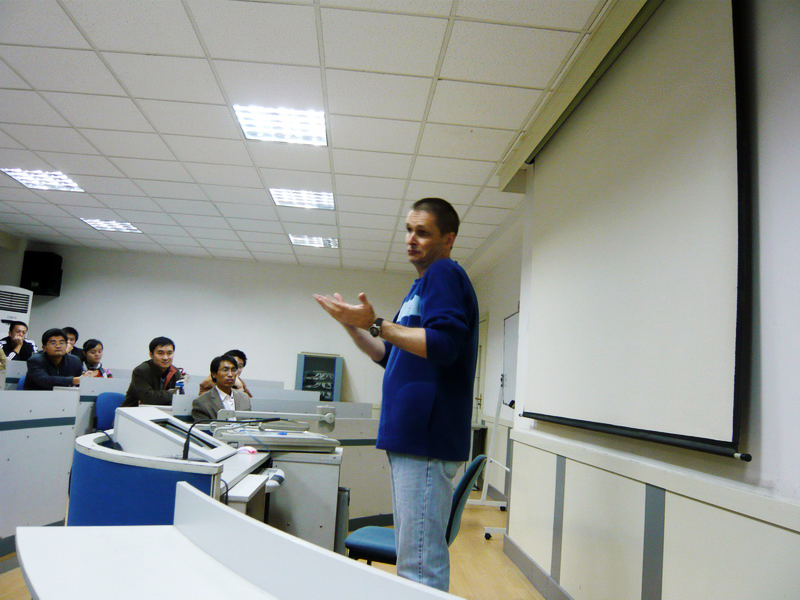
Didier talks to a class of MBA students in Jinan Didier talks to a class of MBA students in Jinan.

FCC adopts charity that helps asylum-seekers get their children into kindergarten

The FCC has adopted K3 as its charity for the next two years, helping refugees and asylum-seekers to get their children into kindergarten – and stay there. Joyce Lau reports.

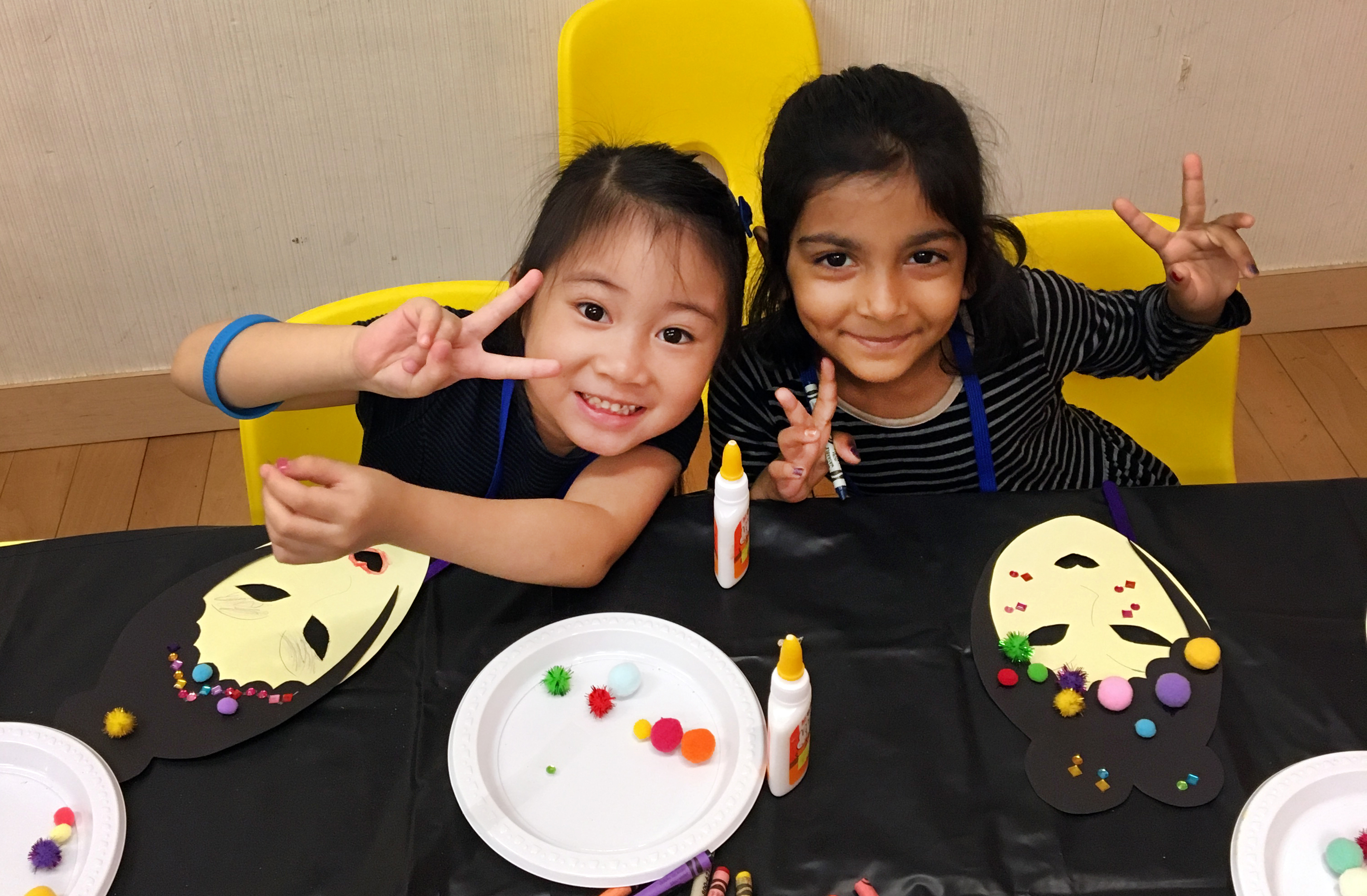
Best of friends. Best of friends.

Early education is tough in Hong Kong, where there are high expectations for children to start formal learning at age two or three, but where mandatory public schooling only begins in primary at around age six.

It is even more difficult for the approximately 13,000 refugees and asylum-seekers who live legally in the city but are barred from paid employment. Poverty, plus language and cultural barriers, keep many children out of kindergarten – depriving the city’s most vulnerable youngsters of essential learning opportunities and social interaction. By the time they start formal schooling, they could be years behind their peers in language and other skills.

K3 is the only sponsorship programme for refugee and asylum seeker children in Hong Kong. It started in 2014 by helping twin boys whose mother showed up holding a school acceptance letter, but no way to pay the fees. K3 helped 43 children in 2017, and currently 47 in 2018. It is an initiative of Branches of Hope (formerly The Vine Community Services Ltd), which has been serving marginalised communities since 2005.

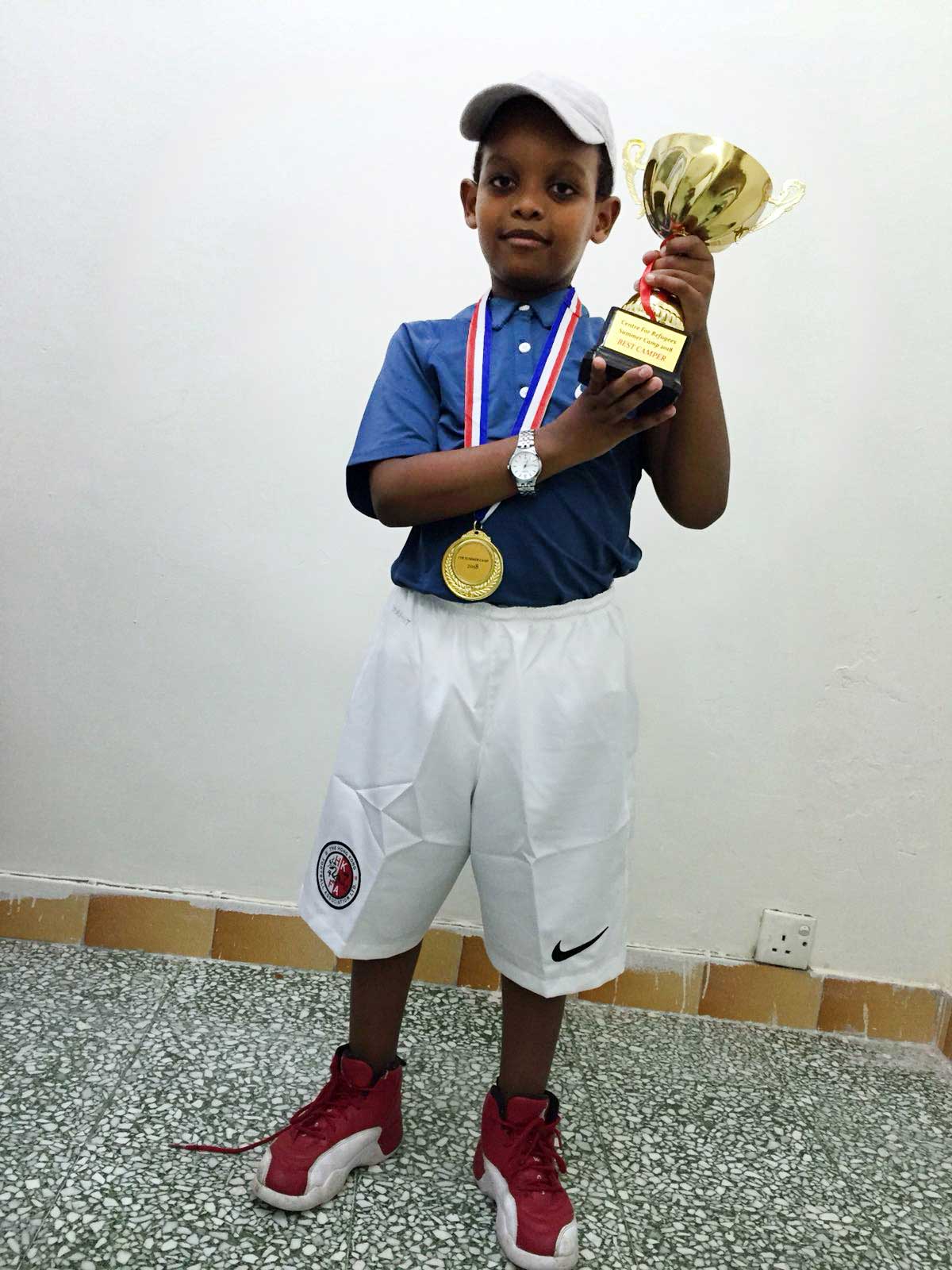
The best camper. The best camper.

Aline Ruzzon, a Brazil native and Branches of Hope’s education administrator, described some of the challenges she faces as she works closely with these families.

“A single mom came into the office crying because she thought she’d have to take her kids out of school,” Ruzzon said of a typical encounter. “There was a delay in a government payment to her, and she couldn’t afford tuition.”

“The first thing I do is calm the mother down. I sort out their paperwork. I figure out who is missing what. Sometimes they need a referral letter or a call to a government department. Sometimes it’s just good to have someone to talk problems with – someone who’s listening, someone who can calm them down. It’s holistic support for the whole family.”

As every Hong Kong parent knows, the kindergarten application process involves arduous paperwork, interviews, as well as advance fees for books, uniforms, activities and transportation.

Refugees in Hong Kong receive basic financial and educational support from the government, e.g. a rental subsidy of HK$1,500 per adult and HK$750 per child. It is not enough to offset the reality of being unemployed in a very expensive city. “They have no access to cash – the government pays the landlord directly and issues a food card,” Ruzzon explained. “I’ve heard of moms selling food cards to cover urgent bills to keep children in school.”

The charity pays HK$800 per child to cover extra educational costs. But K3 does more than hand out funds. Each month, Ruzzon meets personally with scores of families, checking on school attendance, academic performance and domestic situations. “There has been more than one child we’ve referred for special education. We follow them very closely. I know I can make their daily life in Hong Kong a little bit better.”

Asylum seekers come from all over the world, particularly from Africa, the Middle East, South Asia and Southeast Asia. Many are fleeing violence or persecution in their homelands, and seek temporary refuge in Hong Kong as they await resettlement in a third nation such as Canada. But this “temporary” situation can drag on for years. For young families, that may mean seeing an infant grow into a toddler, and then a schoolchild.

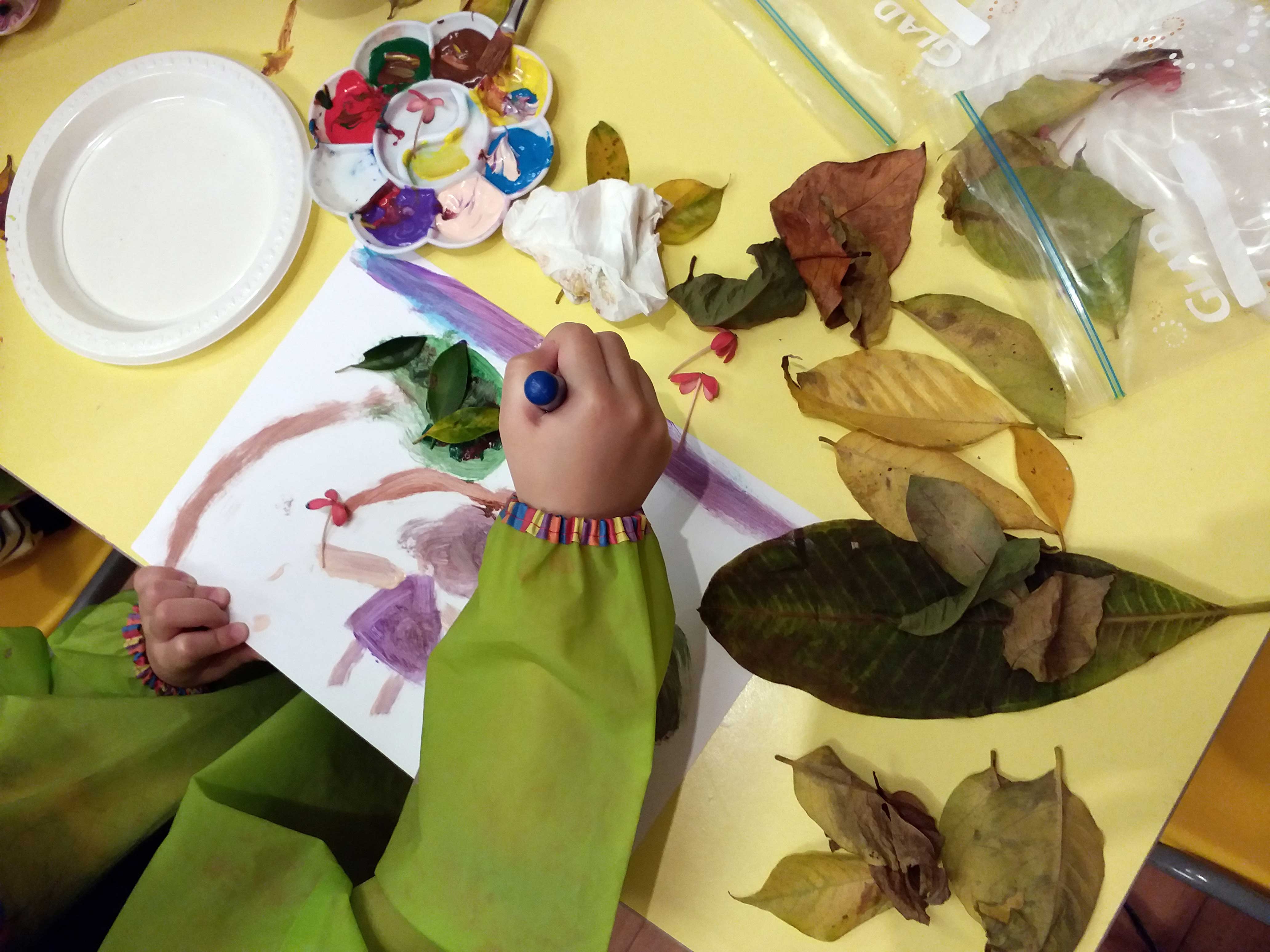
Angeline.

Ruzzon lights up when she talks about the transformation she has seen in K3 children. “Some kids might not be speaking very much when they arrive – and we may be concerned that they have special needs. But in fact, it turns out that it was simply a lack of school – a lack of interaction and social skills,” she said.

“Without a little funding, they would have no access to education, to Chinese- or English-language skills they need to get into primary.” But once they are in school, “they develop a lot”.

“It’s beautiful to see children who then turn around to teach their parents to speak or read Chinese or English,” Ruzzon said. “Some of the girls have won Chinese-speaking competitions. They have become completely integrated, but that would have been impossible without early education.”

How can you help?

Forms are available at the FCC Front Desk for those interested in helping a K3 child. A donation of HK$9,600 (HK$800 a month) will keep one student in kindergarten for one year; $28,800 will cover a child’s entire three-year kindergarten schooling. Donors will be given updates and photos of the children they are sponsoring.

For further information, go to: branchesofhope.org.hk

About the Charity Committee

The FCC Charity Committee, set up in 2016, sponsors one charity every two years. The chosen organisation must benefit the local community in at least one of three fields: Early education, special needs education or elderly support. The Committee aims to help smaller non-profits which may fall between the cracks in terms of funding.

The Committee’s first beneficiary was The China Coast Community, a home for the aged in Kowloon. Funds were raised during the Hong Kong Remembers party in March 2017. Events such as readings and visits continue to take place, including a planned tea at the FCC on Thursday, October 25. The next fundraising party, to benefit K3, is currently scheduled for March 2019.

Joyce Lau is a former New York Times writer and editor, now working at the University of Hong Kong. A long-time FCC member, she has served on the press freedom, communications and charity committees, and previously coordinated the Human Rights Press Awards. She is the mother of two girls, and writes book reviews in her spare time.

Journalists on trying to stay safe in dangerous places

However much support journalists are given in conflict zones, they are still the ones who come face-to-face with danger on a daily basis. A freelancer and a bureau chief tell The Correspondent how they live with risk.

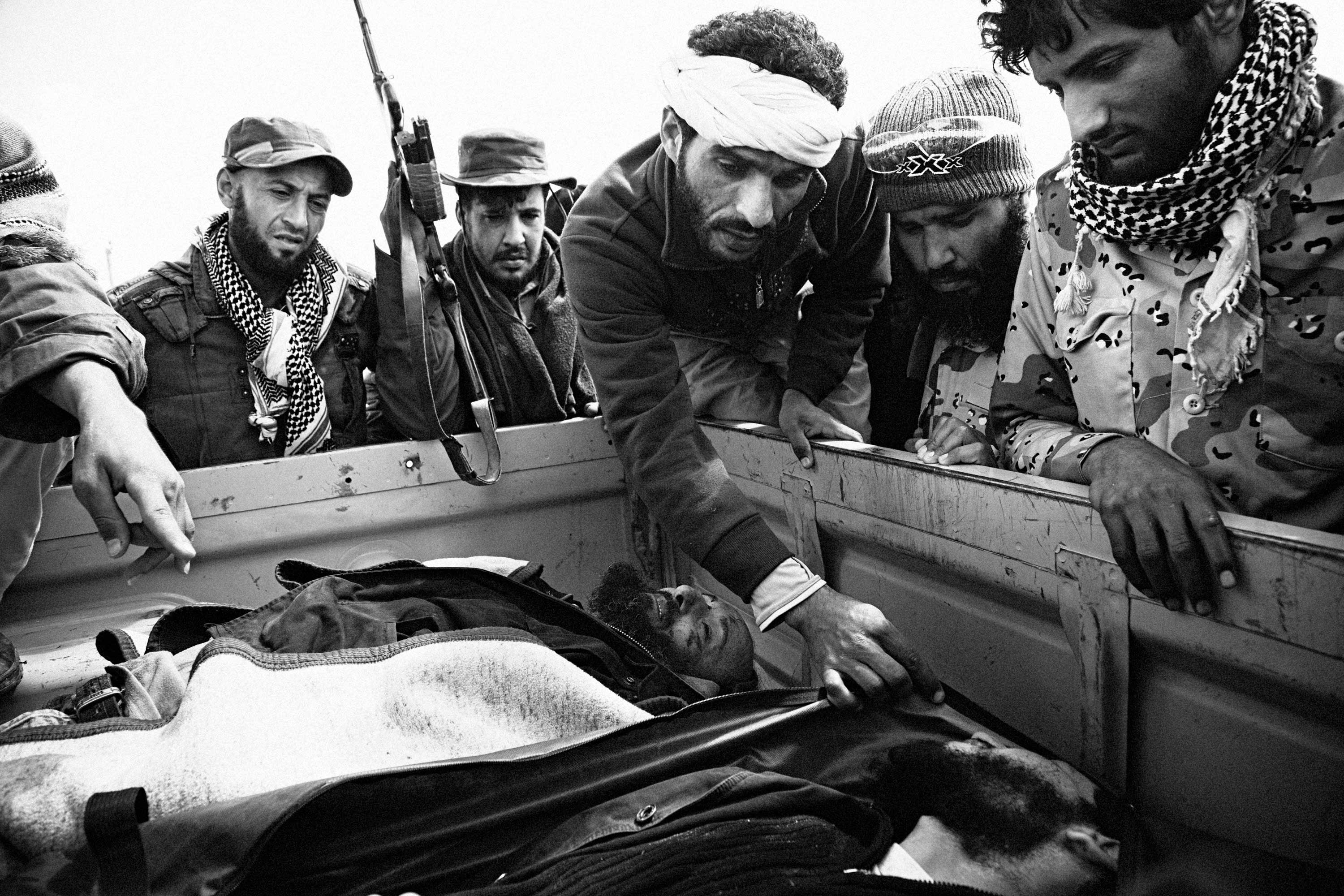
Rebel fighters attempt to identify the dead near the frontline between Ajdabiya and Marsa Brega, Libya, on April 1, 2011. Rebel fighters attempt to identify the dead near the frontline between Ajdabiya and Marsa Brega, Libya, on April 1, 2011.

If anybody has had first-hand experience of the risks involved in working in danger zones it is Hong Kong-born Nicole Tung, the recipient of this year’s James Foley Award for Conflict Reporting.

Her first experience of conflict reporting was during the 2011 Libyan revolution that overthrew President Muammar Gaddafi. “I just ran in with a camera and a pen, and I think that is what a lot of freelancers did,” she told The
Correspondent
.

She was in the Libyan town of Misrata when photographers Tim Hetherington and Chris Hondros were killed in a mortar strike and “it was from that that people realised we really needed to be better at training journalists with first aid”.

Nicole Tung is a freelance photojournalist born and raised in Hong Kong. Nicole Tung is a freelance photojournalist born and raised in Hong Kong.

The result was the creation of Reporters Instructed in Saving Colleagues, a non-profit that offers free medical training to freelance journalists.

After Libya, Tung focused on the civil war in Syria, where she went on around a dozen reporting missions with James Foley in 2012. She missed his last, fateful trip into Syria in November of that year because she stayed back to get her cameras repaired.

Foley went into Syria with British photographer James Cantlie and they were kidnapped on the road back to the Turkish border after filing from an internet café. Foley was murdered by ISIS two years later, and Cantlie’s fate is still not known.

Like so many things, safety comes down to money, and for Tung, their kidnapping could partly be blamed on a lack of resources.

“If they had had the appropriate financial means they would have had a trusted driver, you don’t know who the taxi driver is or if you can trust them.”

As a freelance, she said, “we are so at the mercy of these publications who don’t pay or pay late”.

She lists three essentials for freelancers in danger zones:

  • Insurance for accidental death or injury;
  • Advance payments for expenses – freelancers often get paid late and are out of pocket;
  • A security consultant who can check in with you at least once a day.

News organisations that use a particular freelance on a regular basis should provide gear and training, she said.

“Having a trusted and knowledgeable fixer/translator is one of the most key aspects of working safely,” Tung said.

“Secondary to that is having a good system of communication with people keeping an eye out for your whereabouts and ensuring you do check-ins regularly, and on time. I’ve also made sure that I have the essentials in order, including a flak jacket and helmet if needed, and first aid kit which I take on all assignments whether I expect violence or not.

“As a freelancer, the support system I have is certainly not comparable to those who work on staff with big organisations behind them, including security consultants and larger budgets. I create my own system of reporting back when I’m in the field, usually to fellow journalists who are going to be in one place with reliable communications for the duration of my trip and who I give all necessary contacts to.

“They also are connected with the editors for whom I’m working on the story in any given country. Most outlets do take work from freelancers, although some have decided to not take work at all from areas of high risk as they do not want to be held accountable in the event something goes wrong.

“I’ve had many different experiences that have all changed the way I work, not necessarily near misses (though yes, I have had too many of those, too). I’d say the increased targeting of journalists around the world makes this profession much more difficult, and I have either had to stop working in one place or go about it in a different way – Syria was one example of that.”

For details on free medical training for freelance journalists, go to https://risctraining.org/

Nicole Tung is a freelance photojournalist born and raised in Hong Kong. She graduated from New York University in 2009 and freelances for international publications and NGOs, primarily covering the Middle East. Her work often explores those most affected by conflict and war. She is based in Istanbul, Turkey.

‘If the threat level is high, staff are told to stay at home’

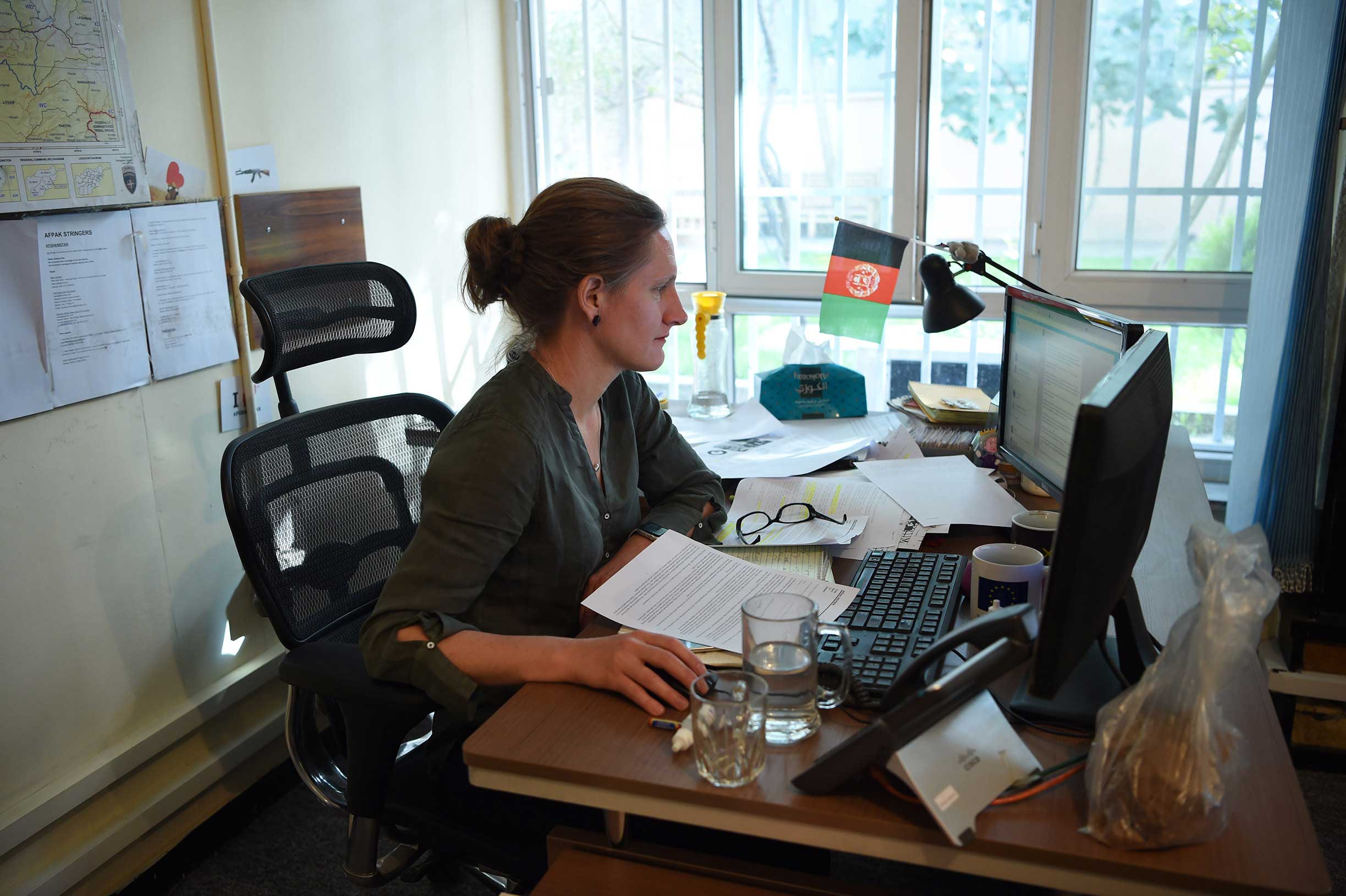
Allison Jackson is Afghanistan bureau chief for AFP. She lost her chief photographer and office driver in bomb blasts this year. Here she describes how her staff cope with the dangers of living in Kabul.

After our chief photographer Shah Marai and eight other journalists were killed in a twin bomb attack in Kabul on April 30 that appeared to deliberately target the media, AFP took the decision to stop sending photo and video journalists to the scenes of suicide bombings. For other types of security incidents, we make an assessment on a case-by-case basis.

AFP's Kabul Bureau Chief, Allison Jackson. AFP’s Kabul Bureau Chief, Allison Jackson.

While coordinated double-bomb attacks have not been a feature of the Afghan conflict, they do happen. We saw it again on September 5 when a suicide bomber blew himself up inside a wrestling club in Kabul. After journalists and first responders rushed to the scene, a car bomb exploded. A total of 26 people were killed in the twin blasts, including two Afghan journalists.

Kabul is a dangerous city and the constant challenge for us is to minimise the risks we face on a daily basis. We do that by taking precautions, such as not going out at certain times of the day; avoiding locations that are considered high risk; ensuring colleagues know exactly where we are going, who we are planning to see and what time we expect to be back at the office; not creating patterns in our movements; and staying in contact with colleagues on the office WhatsApp group.

If we believe the threat level in the city is particularly high, staff are told to stay home.

The deaths of Marai and Mohammad Akhtar, our office driver, have been devastating for the bureau. Fortunately, the team has managed to pull together and support one another. It is a sad fact that my Afghan colleagues have experienced painful loss many times in their lives and they have developed a resilience that enables them to carry on. Mental health professionals are scarce in Afghanistan and most people have never consulted one. While AFP has given everyone in the bureau the opportunity to talk to a psychologist, people here are more familiar with faith, family and friends to help them cope with loss.

Allison Jackson joined AFP in 2009 as economics correspondent in China. An Australian who speaks Mandarin, she spent nearly three years in Beijing then left the Agency in 2012 to spend time in Mexico. She rejoined AFP in 2016 as an editor in Hong Kong and became Kabul bureau chief in July 2017.

Introducing… FCC new members, October 2018

The latest group of members to join the FCC is, as always, an interesting bunch. The Membership Committee meets regularly to go through applications and is always impressed by the diversity of people who want to join the Club.

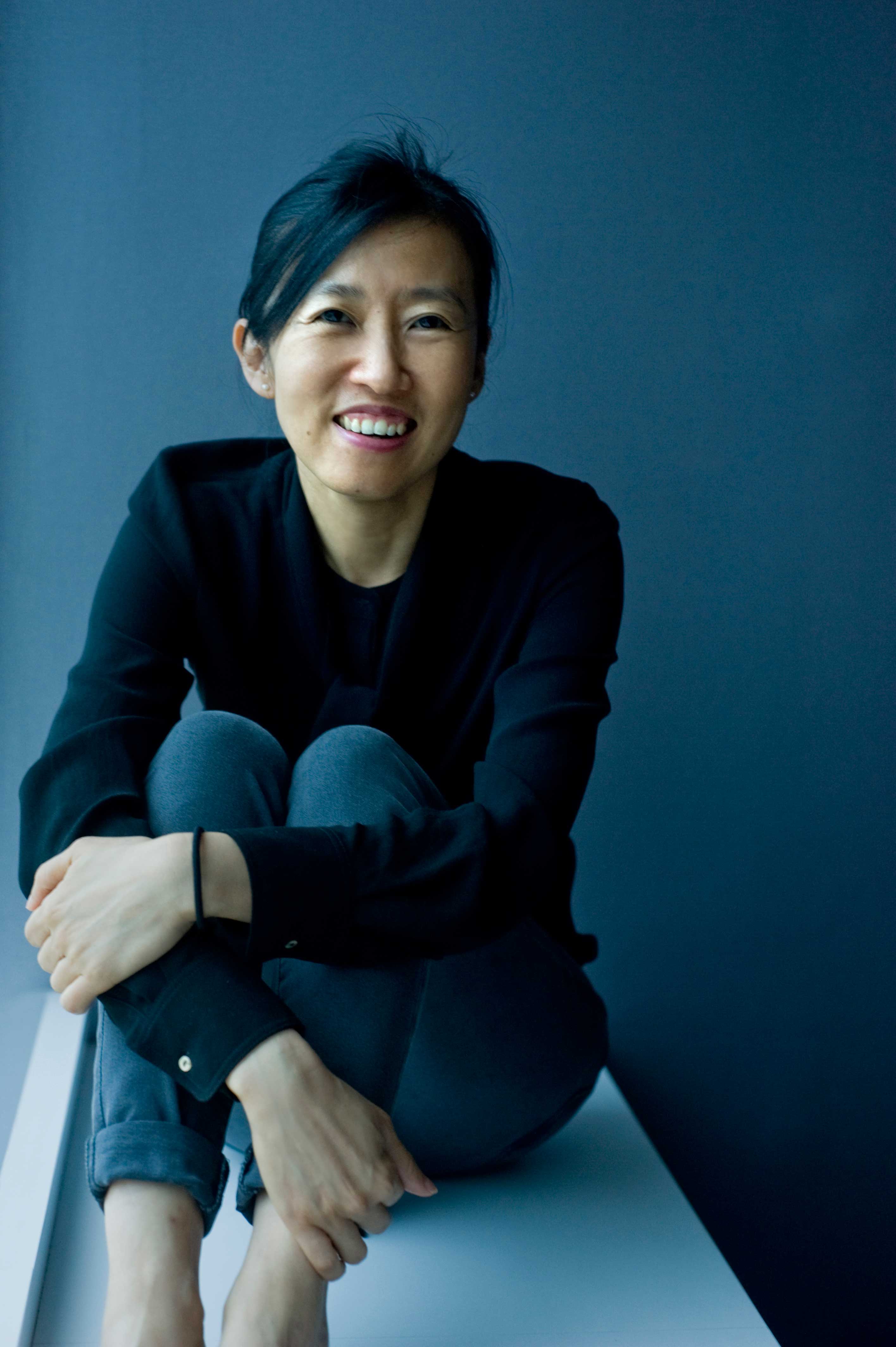
Vesa MakipaaVesa Makipaa

Unofficially nominated as the Indoor Air Quality Ambassador from Finland, I have lived in Hong Kong since 2009, where we have an office and warehouse for global online sales. To achieve good Indoor Air Quality is often hard and the topic is the passion of my life. My wife describes it as the most unsexy business in the world – maybe she is right, but anyway I’m the father of eight kids. I like fishing and social life, especially chats in bars and the FCC provides an excellent environment for meeting old and new friends.


Emma DaleEmma Dale

My name is Emma Macintosh but most people know me by my work name, Emma Dale. I am the co-founder of Prospect, a global recruitment business specialising in PR and Communications. Initially I set up Prospect in London. In 2009 I came to Hong Kong with my husband and two kids to set up Prospect’s Asia operation, here and in Singapore. I am also a certified coach and the founder of Transform Executive Coaching. I also love hiking in Big Wave Bay, practising yoga and drinking red wine or champagne.


Cassi ZarzykaCassi Zarzyka

I am a new Associate Member and writer/producer in my startup company, ChinaWest Films. After being an Asia specialist for my whole writing career, I am now a content creator for the China market. I started as an allrounder journalist/editor and Hong Kong correspondent in Tokyo working for newspapers and magazines, and also as a scriptwriter for NHK news. The script work always followed me as I grew up in Hollywood. Now as a full-time screenwriter and script developer, I am focused on telling the stories of China.


Olga BoltenkoOlga Boltenko

I am a disputes partner in the Hong Kong office of a Chinese law firm, Fangda Partners. I also teach a postgraduate degree in dispute resolution at the University of Hong Kong. By virtue of my profession and practice, I am presumed to be disputatious. I have it on record that a number of FCC members would describe me as polite, perhaps with a slight penchant for a friendly debate – especially on a Friday night at Bert’s after a few glasses of wine. I had my first article published when I was 24, about a bar fight in Bangkok. I have written about disputes since then.


John BerryJohn Berry

Born and schooled in Ballarat, Australia, I worked as a civil engineer in Melbourne before taking a year off travelling across Asia and Europe, then working in London and Abu Dhabi, and further travelling in and around South America. Work was resumed in Melbourne, only to be sent to Saudi Arabia. The latter experience clearly warranted another year off, mainly spent in sailing around the China Sea/West Philippine Sea. I first encountered FCC member Peter Miles on my boat, and he later introduced me to the Club. Hong Kong beckoned in 1982. I met and married Natalie, and HK is our home. We have two children, Tom and Lizzie.


Erin HaleErin Hale

I am the Hong Kong correspondent for Deutsche Presse-Agentur. Prior to moving to Hong Kong last year, for a second time, I was living in Cambodia for three years where I also worked for dpa and freelanced. During that time I learned how to drive a motorcycle through monsoon rain, communicate with Khmer spirits, and where to find the best barbecued rat meat. While I do miss the excitement of Cambodia and the (sometimes) strange efficiency of petty corruption, I now get my kicks from outdoor activities like hiking and running. I am also a well-known cat enthusiast and fan of all things satirical.


Ching Fang HuChing Fang Hu

My friends call me Lolita – a provocative name I picked up working in magazine media in my 20s. I am a Chinese-language writer. I was born in Taipei and have lived in Hong Kong, Tokyo, New York, Shanghai, Beijing and Paris. My writings fall into two categories: novels and essays. I was always told that, if you are a writer in Hong Kong, you should join the FCC – so here I am. My day job is head of Taiwan’s cultural office in Hong Kong, known as Kwang Hwa. We organise cultural events like concerts and art exhibitions. Taiwan has a flourishing arts community, which you are invited to share.


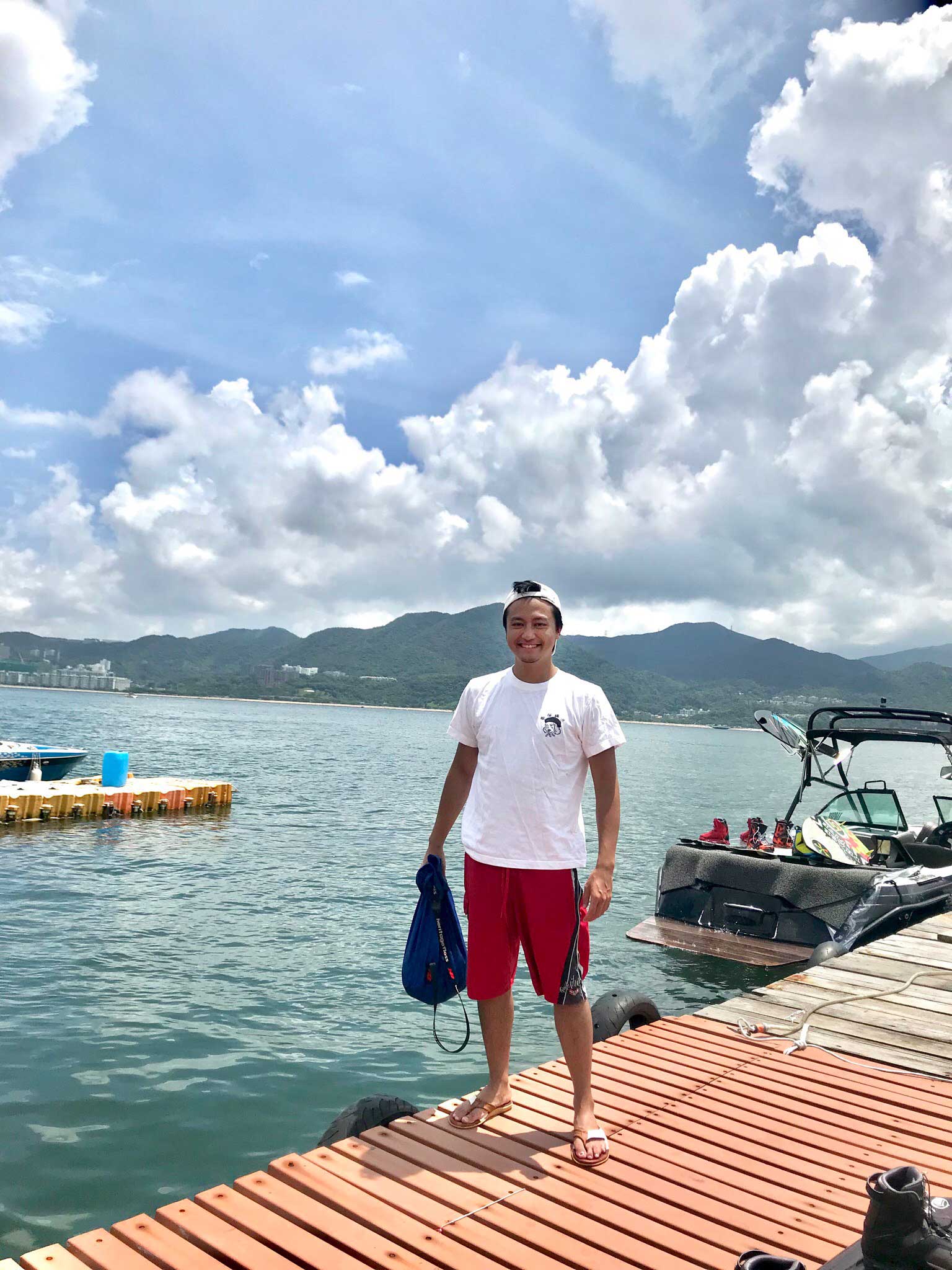
Kurt LinKurt Lin
Prior to reporting around Asia for Monocle, I was mostly keeping my eyes on stock tickers and the quarter end performance bonus, as most portfolio managers do. Those who have the habit of picking up some local press might have come across my commentary on the topics of affairs, travel stories and book reviews in Chinese — or even, once, my portrait on the cover of the city’s popular weekend tabloid. Wake boarding in the New Territories is the fun I miss most when I am abroad.


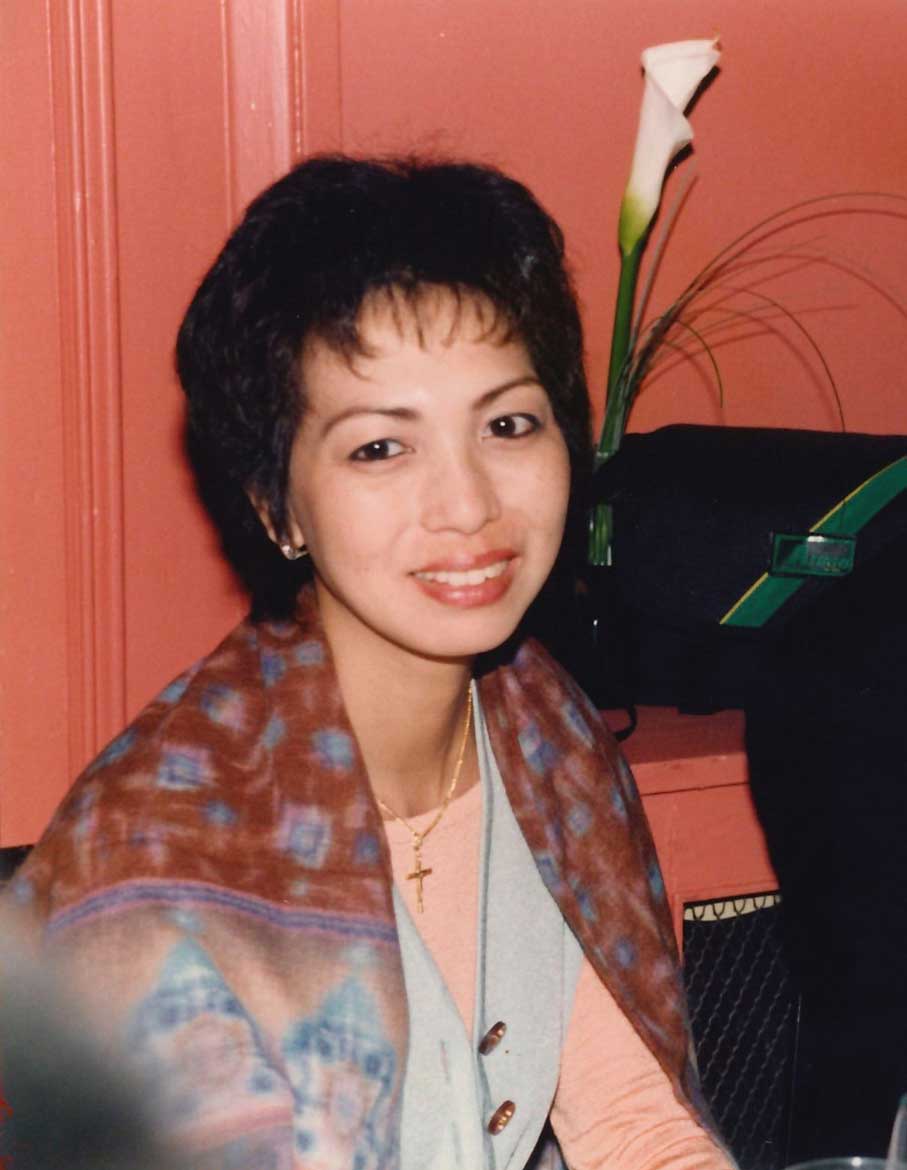
Josephine LiJosephine Li

I was born, raised and educated in Hong Kong. By chance, I joined the exclusive agent representing Carlsberg Beer as an intern when I left school. Little did I know back then this would lead to fulfilling my dream of a career in the commercial sector. A high point of my career was presenting a bouquet to the Queen of Denmark, Margrethe II, during the opening of our brewery in Tai Po. To complete my story, my husband Alex was the first European-trained Master Brewer who brewed the first batch of Carlsberg beer in Hong Kong. We are still serving the industry together up to this very day.


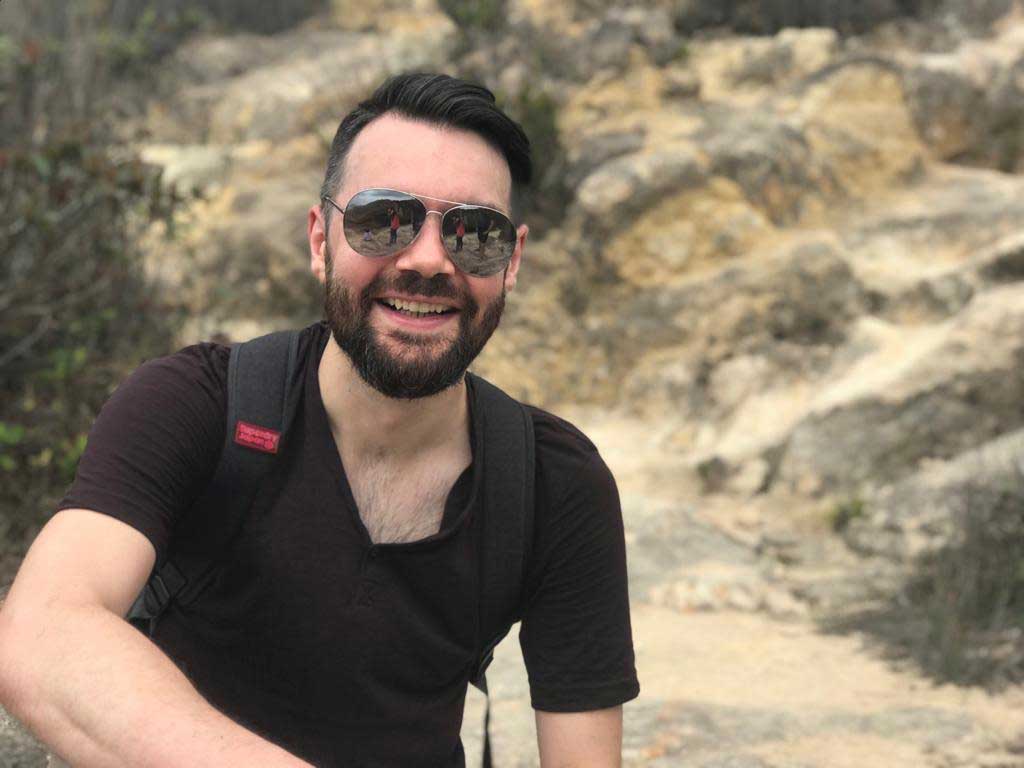
Jerome TaylorJerome Taylor

This is the second time I’ve been in Hong Kong. When my wife and I moved in 2014 for a posting in Thailand we both felt we were leaving the fragrant harbour too soon. I’ve been a journalist for 15 years, initially blundering my way around India as an enthusiastic but largely clueless post-graduate freelancer, before joining The Independent newspaper for seven years. I moved to Asia in 2012 for AFP, first on the Asia-Pacific desk, then three years as Southeast Asia correspondent in Bangkok, before returning once more to the regional editing hub late last year. I was a board member of the FCC Thailand for two years.


Jon Jensen

Jon Jensen

I’m a senior producer for CNN based in Hong Kong. I work mostly on long-form feature stories, covering everything from sports to arts and culture. This is my first stint in Asia. Before moving here, I spent over a decade in the Middle East, first in Cairo and then in Abu Dhabi. Before joining CNN, I covered the Arab uprisings from Tunisia to Libya to Tahrir Square. I was also a producer at National Geographic in Washington, D.C. I received a Master’s degree from the journalism school at the University of Florida. When I’m not on the road for work, my wife and I are either hiking or searching for the best roast goose restaurants in Hong Kong.


Vinod MahtaniVinod Mahtani

Born in Hong Kong, I am the third generation of an Indian family that arrived here in 1952. My wife’s family, also Indian, has roots in Canton dating back to 1929. Having left Hong Kong in 1968, I returned back to live here only in 2005. That is my excuse for no longer being totally fluent in Cantonese! Educated in the UK, I joined the family import and export business after having graduated at Manchester University. I set up my own arm of the trading business in 1985 and then spent nine years living in Nigeria, which was a true life lesson in street smart survival. I am currently an Honorary Consul for the Republic of Niger.


Scott HarrisonScott Harrison

I grew up in Sydney and qualified as an organisational psychologist before embarking on a career in recruitment. My first three years was a steep learning curve in a start-up before I moved overseas. I landed in Hong Kong just after SARS and managed to find a role recruiting lawyers. I developed a network across the city and, in time, the region. With the Lehman collapse, I felt it was the perfect time to begin a recruitment company and, with my business partner, formed Aquis Search 10 years ago. I married a fantastic Hong Kong lady, but I am still learning the language.


Finbarr BerminghamFinbarr Bermingham

I have been in Hong Kong for four years, after moving from London to become Asia Editor of Global Trade Review, a magazine about trade and trade finance. I come from Ireland and have previously lived in South Korea, where I somehow managed to hold down a slot on local radio, despite a strong Irish accent which shows no sign of diminishing. I’m currently training for marathon number five and turn out for the illustrious Hong Kong Dragons Gaelic football team (second string). I love exploring the Hong Kong trails with my fiancée Colleen, and trying out my questionable Cantonese in local restaurants.


Vega Hall-MartinVega Hall-Martin

I was fortunate to grow up in the famous Kruger National Park of South Africa, so my passion for wildlife conservation began at an early age. After attending university in Stellenbosch, I began a career in investment banking in London. After 12 fabulous years, I followed my soon-to-be husband to Hong Kong where we both began our careers anew. I now work for African Parks where my role is to raise the profile of African conservation in Asia while simultaneously tapping the region’s extraordinary wealth to help sustain the work we do in Africa. My Canadian husband and I have a lovely little boy.

Gary Liu SongnanGary Liu Songnan

I’m currently running an investment fund covering the Greater China area. The FCC is a place that provides different voices on all topics, so the two years waiting has been worth it for me to get membership. I travel a lot, and run marathons if there is one being hosted in the city that I visit; sometimes I visit because of the marathon. Japan and Italy are among my favourite countries so I have studied Japanese and a little Italian. Learning Italian helped my Italian cooking, as it’s my favourite food.


Tamsyn BurgmannTamsyn Burgmann

An experience isn’t an adventure until you don’t know that you’ll make it out alive. Since leaving Canada for Hong Kong, my journalistic pursuits across Asia have delivered roti snacks with rebel soldiers, shipwrecks to scuba dive and motorbike rides with Muay Thai fighters. In 2016, I departed The Canadian Press after ten years. I have since earned a master’s degree at HKU and joined the International Opinion desk of The New York Times. My survival skills are poised for whatever comes next.

Harry’s Rejects: Andy Chan, vaccine scandal

We measure site performance with cookies to improve performance.