Members Area Logout

Beyond just funding: How generous FCC members have helped the China Coast Community

The Charity Committee’s goal is to go beyond simply providing funds for the good causes the Club supports. Club members are encouraged to give voluntary time, and to become actively involved in the cause. To benefit our current charity, China Coast Community, an elderly care home, the FCC organised a series of author talks, plus a visit for residents to the Club for tea.

General Manager Michele McGregor with some of the China Coast Community residents. General Manager Michele McGregor with some of the China Coast Community residents.

In September, residents heard from columnist and author, Philip Bowring, a long-time Club member who has lived in and written about Asia for 40 years. He spoke on his book, Free Trade’s First Missionary: Sir John Bowring in Europe and Asia, which details the life of his distant relative, a former Hong Kong governor. Sir John had an illustrious career in Europe and Asia, though is probably not widely known for some of his far-reaching achievements. Residents of the home were interested to learn of his exploits and expeditions and to see some of the rare books of his original writings, which Philip had collected.

Then in October, Club member Rachel Cartland shared some of her personal story, which is detailed in her book, Paper Tigress. Arriving in Hong Kong in 1972 as a fresh Oxford graduate to be one of the very few female expat civil servants in the Hong Kong government, she retired 34 years later after a career that spanned many government departments during crucial times in Hong Kong’s history. She was full of colourful stories about times residents could remember and be nostalgic about.

Guest author Philip Bowring. Guest author Philip Bowring.

Also in October, the FCC hosted residents for tea in the Club’s Bunker. Long-term member, Sarah Monks, who is a wealth of knowledge on FCC history, spoke on the careers of some of the illustrious correspondents we have been fortunate enough to have had as members, including Clare Hollingworth, Richard Hughes and Anthony Lawrence.

In November, Vaudine England, another long-term FCC correspondent member and author of a book on the legendary Hong Kong character, Noel Croucher, shared with residents the history of his fascinating life.

“Many thanks go to those who have both spoken and donated their books to the China Coast Community,” said Charity Committee convener Elaine Pickering.

If you would be willing to give a talk to China Coast Community residents, who are always very grateful for interaction with FCC members, please let the Charity Committee know via Joanne in the Club’s Office.

Through the Club’s March fundraising Club-wide party, Hong Kong Remembers, more than HK$200,000 was raised to help replace the Home’s existing beds with surgical ones, as well as providing additional physiotherapy.

A hard choice for a good cause

For the first time, the FCC asked all Club members to be a part of the process to nominate the charity the Club would support during 2018. By the deadline in September, the Charity Committee had received 19 deserving submissions. Their range showed the depth of need across the city.

Several entries came with heart-felt, personal stories of how a particular charity had helped a Club member, or a child or relative.

All nominees had to address one of “the Three E’s”: namely elderly care, early learning or educational special needs. The committee was particularly looking to support a cause which concerned itself with those children and adults who may “fall through the cracks” in society, and one which may not be in receipt of large institutional funding.

An announcement will be made soon as to the recipient of FCC charitable support during 2018.

Pictures: Hong Kong seen through the lens of Miguel Marina Rodriguez

Miguel Marina Rodriguez, better known in photographic circles as Miguelitor, has lived in Hong Kong since 2010. Le Calle is his first exhibition in the city that features in all of his work. His candid and quirky style of street photography is “locally-grown” and has been inspired by Hong Kong’s street scenes and the people he found in them.

Photo: Miguelitor Photo: Miguelitor

“I was interested in photography before I came to Hong Kong,“ Miguel explains. “ But it wasn’t until I arrived here that I started to take my hobby more seriously.”

In 2013 he quit his job in PR to become a Spanish teacher to give him more time to spend prowling Hong Kong streets, camera in hand.

“Armed with a small compact camera I quickly discovered how much this city has to offer to anyone who is willing to stop for a while and observe the city,” Miguel said. “ Everything seemed worth photographing to me and my walks in between Spanish classes became longer and longer.

“In my photos I try to be spontaneous, candid, without any preparation other than attentively observing my surroundings, always on the lookout for an angle, a contrast, a short story to tell in one image.

“I dream of taking photos in which humour, geometry and that one split moment combine into a perfect composition, and I always have my camera with me, because I believe that the best photo is the one I will be making today.”

Photo: Miguelitor Photo: Miguelitor
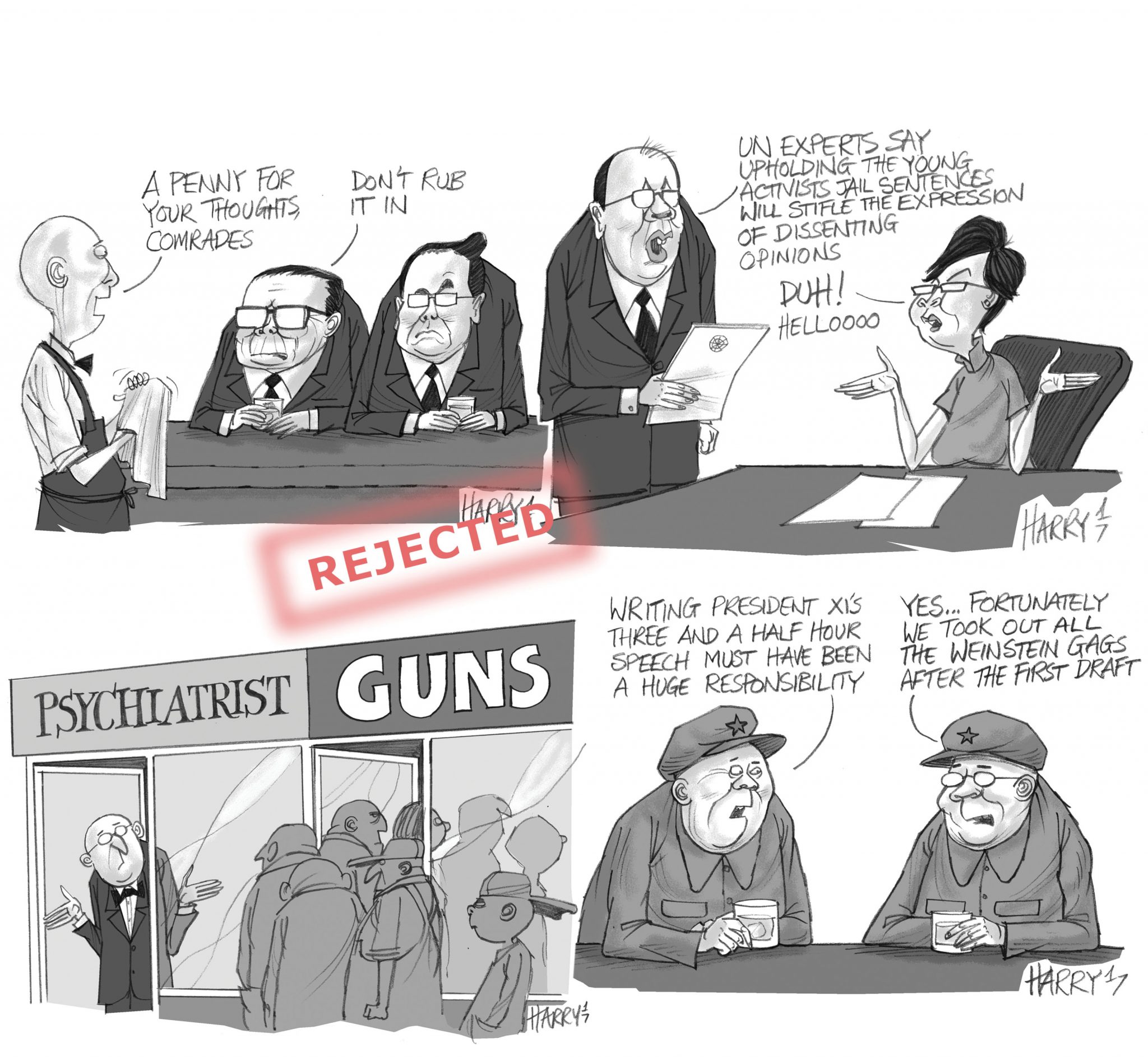
Harry’s rejects: President Xi’s speech minus the Harvey Weinstein gags

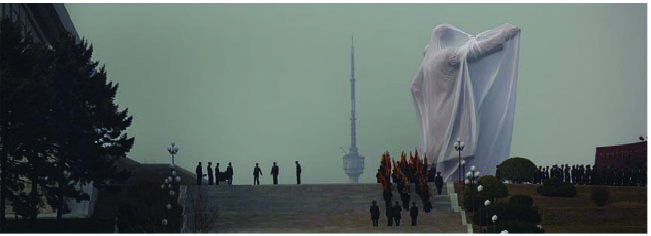
Pictures: North Korea – one party state machine

Vincent Yu was born and raised in Hong Kong, and has worked as a photojournalist for The Associated Press covering major news events across the Asia-Pacific region since 1989. He was first sent to North Korea on assignment in 1990 but didn’t visit again until 2011.

Photo: Vincent Yu/Associated Press Photo: Vincent Yu/Associated Press

“One day on that trip, I was sent to cover the biggest parade ever to mark the 65th anniversary of the country’s ruling Workers’ Party,” Vincent explains. “Kim Jong Il’s presence was nothing out of the unexpected but when he emerged on the stage with his grown-up son Kim Jong Un, I knew history was being made before us. Until then, the world had only seen black and white pictures of the young Kim when he was still a child.

“Since that time, I have visited Pyongyang a few more times. Its deepest impression to me was that everything was so neat and clinical; people’s movements were synchronised and I was always cautious with everything I did and said.”

Vincent’s work has been recognised with many honours, including the 2004 National Headliner Awards, 2010 World Press Photo Awards 3rd Prize “People in the News” singles category, 2013 Picture of the Year Awards, Award of Excellence “Photographer of the Year” and numerous Hong Kong Press Photographers Association Annual Awards. His works are collected by the Hong Kong Heritage Museum.

Arrow through our slide show below

[sliderpro id=”2″]

The Correspondent Nov/Dec 2017

Profile: Lynn Grebstad – the Peninsula PR woman who made Hollywood stars feel welcome in Hong Kong

Lynn Grebstad joined the FCC in around 1990, and says she probably would have signed up earlier, but was a “Kowloon wallah”. She spent her first decade in Hong Kong’s hospitality business working mostly in TST.

The GHC team (left to right): Paul Hicks, Kiri Sinclair, Lynn and Gary Kitching at the Business Traveller Awards 2016 in London. The GHC team (left to
right): Paul Hicks, Kiri Sinclair, Lynn and Gary Kitching at the Business Traveller Awards 2016 in London.

“My first visit was in the seventies,” she recalls. “My father was here, with my mother, working for British Intelligence in Little Sai Wan. I came out to visit them, and absolutely loved it.  It was bewitching, the intensity of it. I loved that bustling energy.”

After several years travelling the world as a flight attendant with British Airways Lynn decided she wanted to settle somewhere other than England, and decided to give Hong Kong a try. She arrived in January 1982.

Contacts from her BA days led to a job as Assistant PR Manager with Le Meridien. A high point of her time with them was the opening, on the same day, of two hotels, one at Kai Tak Airport and one in TST East.

“I was thrown in at the deep end and I loved every minute of it. I didn’t have any training in communications, but I was allowed to learn as I went along. That was what Hong Kong was like at the time. There were opportunities. ‘If you’re here, give it a go’.”

She and Karl got married in June 1982, and although she says she loved working for Le Meridien, an offer in 1983 to take over the PR Manager’s job at The Peninsula was too tempting to resist.

“It was mind blowing to be in that lovely old place – which was very run down at the time. The next three years were quite life-changing. I had the opportunity to meet some of the most unbelievable people – kings, queens, emperors, movie stars.”

She recalls meeting, among many others, Elizabeth Taylor, Gene Hackman, and David Soul who was making a TV series called Harry’s Hong Kong. Footage of the hotel in the 1980s turned out to be the production’s only saving grace.

Three years with The Pen led to another six across Salisbury Road at what was then The Regent – now the InterContinental – considered at the time by many to be the best luxury hotel in the world.

“There were a lot of journalists coming down from China, which was a hardship posting then. They couldn’t wait to get to the hotel for steaks and burgers. There was this whole family of journalists that used to come,” she says.

Having joined the club from The Regent, she remembers coming in much more frequently after returning to the Peninsula Group, this time in the corporate office in Central at around the time of the construction of the Peninsula Tower – a project on which she worked with fellow FCC member Sian Griffiths, who had her old job at the hotel.

Arrow through our slide show below

[sliderpro id=”1″]

“I did the topping out of the Peninsula Tower with three generations of Kadoories, and the opening was an extraordinary thing to do.  I was there during a period of expansion of the group, and then I went and started my own business. I was in my early 40s and I just thought ‘now’s the time’.”

Her friend, and, again, fellow FCC member Susan Field offered her some office space to start from.

“She did me a huge favour. I’ve never looked back. I’ve always loved being my own boss. It has been tough at times, but you have to have some hardship if you want your own company.”

After doing what she calls “the grunt work” of getting her own business off the ground, she decided to join forces with Paul Hicks, whose own company was at a similar stage of development. She recalls Stuart Wolfendale giving them a nudge on the road to partnership. FCC members all, and Grebstad Hicks Communications (GHC) is now one of Hong Kong’s leading communications agencies, with special expertise in the luxury hospitality business.

If I move on, one of the great things I’ll miss about Hong Kong is the Club. It’s the most comforting thing to walk in and feel that you know people.

“We were round the corner from the FCC so we used it a hell of a lot. There was hardly a day that went by when my friend KP wouldn’t call and say ‘Hi Lynn, fancy a sharpener at the FCC?’,”  Lynn says.

She served a stretch on the Board during Steve Vines’ presidency, and also served for several years on the Charity Ball Committees. The club remains a regular place to meet friends.

“If I move on, one of the great things I’ll miss about Hong Kong is the Club. It’s the most comforting thing to walk in and feel that you know people. The staff, the manager, some of the regulars. You feel ‘I belong in this place’ and it’s a beautiful feeling. That’s why people love it. It’s why a lot of people come back to Hong Kong. I think it does have a special significance. It’s a fantastic institution.”


Facebook still struggling against tide of fake news

Fake news continues to haunt social media sites. Facebook, for one, still struggles despite its well publicised steps to deal with it. 

Politifact

There has always been fake/distorted/ biased news — perhaps not on the scale of fake US election news — and it will continue as long as people want to believe it because they agree with it or it feeds their biases. Nevertheless, the efforts of social media, particularly Facebook, to get it under control have been somewhat successful, with some painful missteps.

Facebook’s recent high-profile fake news blunder involved the site’s “Safety Check” page which promoted a story that incorrectly identified the suspect of the recent Las Vegas mass shooting. The story got through Facebook’s fact-checking system, put in place in March this year.

An earlier story highlights the reverse psychology of some users: the fact-checking system labelled an article (on Irish slaves) as possible “fake news”, warning users against sharing it — the reverse happened when conservative groups decided that Facebook was trying to silence the story so spread the word – and traffic to the story skyrocketed.

When two or more fact-checkers debunk an article, it is supposed to get a “disputed” tag that warns users before they share the piece and is attached to the article in news feeds.

The spreading of this piece after it was debunked and branded “disputed” is one of many examples of the pitfalls of Facebook’s partnering with third-party fact-checkers and publicly flagging fake news. Articles formally debunked by Facebook’s fact-checking partners – including the Associated Press, Snopes, ABC News and PolitiFact – frequently remain on the site without the “disputed” tag warning users about the content. And when fake news stories do get branded as potentially false, the label often comes after the story has already gone viral and the damage has been done. Even in those cases, it’s unclear to what extent the flag actually limits the spread of propaganda.

Facebook’s efforts to curb fake news followed a widespread backlash about the site’s role in proliferating misinformation during the 2016 presidential election. The rocky rollout of Facebook fact-checking is as much a product of the enormity of the problem of Internet propaganda as it is a reflection of what critics say is a failure by the company to take this challenge seriously.

AP Fact check AP Fact check

Last year, Facebook faced growing criticisms that it allowed fake election news to outperform real news, and creating filter bubbles that facilitated the increasing polarisation of voters. In response, Facebook announced that it would work to stop misinformation in part by letting users report fake news articles, which independent fact-checking groups could then review.

When two or more fact-checkers debunk an article, it is supposed to get a “disputed” tag that warns users before they share the piece and is attached to the article in news feeds. While some of the fact-checking groups said the collaboration has been a productive step in the right direction, a review of content suggests that the labour going into the checks may have little consequence.

ABC News, for example, has a total of 12 stories on its site that its reporters have debunked, but with more than half of those stories, versions can still be shared on Facebook without the disputed tag, even though they were proven false.

There are a number of sites that promote fake news as a “joke” to see how gullible readers are and how far the stories spread. The fact-checking system catches these as well. One well-known fake news writer Paul Horner, said some of his websites have been blocked on Facebook, but that other articles have gone unchecked, including one famously saying Trump issued an order allowing bald eagles to be hunted and another about the president cancelling Saturday Night Live.

The next steps

In its latest effort to combat misinformation and fake news, Facebook is testing a feature that gives users additional information around articles shared in the News Feed. The feature, indicated by a letter “i” icon near the headline of an article, will provide users with contextual information like the publisher’s Facebook and Wikipedia pages, related articles on the topic, and information on how other users are sharing the article.

Wikipedia will likely become an increasingly important element of a publisher’s image. As Facebook more widely rolls out the new tool and more users begin to lean on Wikipedia to help them judge an article’s credibility, publishers will likely put more emphasis on ensuring their Wikipedia page accurately and favourably reflects them.

It was designed to assist users in identifying phoney publisher accounts. If a publisher doesn’t have a Facebook or Wikipedia page available, users will know to take the information with a grain of salt, and remain cautious of the publisher’s validity. Although this does not necessarily curb the amount of fake news being spread on the platform, users may be more likely to identify false information on Facebook in the first place.

Snopes

The announcement of this feature is timely, as user scepticism of the platform’s news, such as the Las Vegas massacre, may currently be particularly piqued.

Meanwhile, Wikipedia will likely become an increasingly important element of a publisher’s image. As Facebook more widely rolls out the new tool and more users begin to lean on Wikipedia to help them judge an article’s credibility, publishers will likely put more emphasis on ensuring their Wikipedia page accurately and favourably reflects them.

This may contribute to users becoming cautious of Wikipedia pages of publishers, as certain publishers may have an incentive to curate their Wikipedia profile. However, the website has over 130,000 accounts actively making edits, with over 10 edits being made per second.

Trust is timely. In an era in which fake news is trending, and brands are pulling advertising from large publishers because they don’t want their messaging associated with offensive content, trust is a critical factor that brands consider when re-evaluating digital ad strategies.


Social media trends 2018: forget Facebook, it’s all about messaging apps

How quickly technology moves on. Just when you think you have social media sussed, a new trend comes along that throws the proverbial curve ball.

In 2017, we saw Facebook lead the way as the world’s largest referrer of users to news websites, keeping the previous top spot holder, search engine giant Google, at bay. Similarly, Instagram, the Facebook-owned photo sharing site, saw staggering growth that put its total users at 600 million. Twitter’s fortunes, however, appeared to take a turn for the worse. The site’s number of total users flatlined in the last quarter of 2016, with the company reporting the same figure – 328 million – as it did in the first quarter.

With a growing number of news organisations pouring additional resources into delivering their content via the big social platforms, the likes of Facebook founder Mark Zuckerberg appear to hold all the cards.

So, what will 2018 hold for social media?

At the FCC’s Journalism Conference in April, keynote speaker and new South China Morning Post CEO Gary Liu predicted that messaging apps would overtake Facebook as the primary source of news content delivery.

Liu, previously CEO of aggregate news site Digg, outlined the struggles facing news organisations as advertising and print revenues decline and social media sites like Facebook become primary sources of news for so many.

“People are now going to fewer sources. Right now, Facebook is a leader in that,” he said. But he added: “The age of the app is moving on. People are going to messenger apps. We’re on the cusp of a new era.”

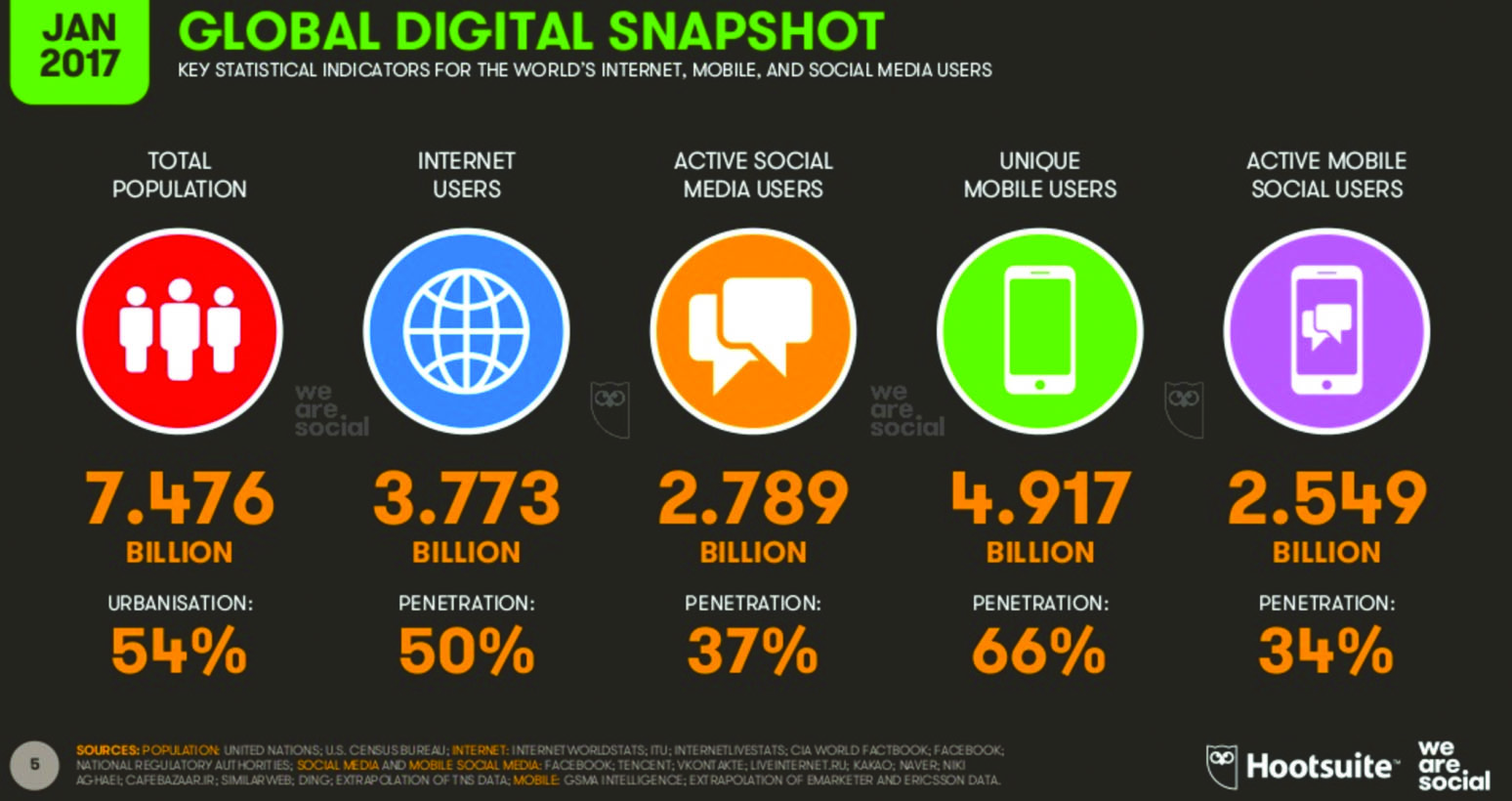
Liu was of course talking about the rise in use of messaging platforms such as WhatsApp, Facebook Messenger, WeChat and Snapchat, among others. These instant chat apps enable smaller groups of users to share photos, videos and links. And, according to the Reuters Institute for Journalism’s latest Digital News Report, users are increasingly looking to these messaging apps as a source of news. Indeed, the BBC and New York Times are just two big news providers experimenting with delivering content via instant messaging apps.

Geoffrey Colon, Senior Marketing Communications Designer at Microsoft, and author of Disruptive Marketing, echoed these sentiments when the FCC asked him for his 2018 social media trend predictions.

He said: “Number one – a mass move away from big platform posting to messaging apps. While Facebook and Twitter keep records of number of accounts, what they don’t disclose is how many times people use those accounts or how active they are.

“While the average user supposedly checks their accounts on average 16 times per day, the trend of the past few years towards small discussions on SMS, WeChat and WhatsApp are gaining steam. The reason is the need to be less filtered in these environments, more intimate and more authentic. The mass publishing to 2,000 “friends” in a one-way amplification loudspeaker manner is collapsing to platforms where only a select few can see what you’re communicating. The reason? Less distraction from ads and the ability to be less filtered.”

Colon’s second prediction is that we would see growth in Augmented Reality-driven (AR) mobile apps. He added: “Because iOS 11 contains ARKit, more of what we’ll see posted on social media may be coded for Augmented Reality. This has been driven the past few years via Snapchat but now will tip more mainstream due to the ability of anyone to code anything to be AR-enabled. We’ll see much more home advertising and art that is AR-enabled and much of this will be shared across social media. AR is to 2018 like YouTube video was to 2008.”

This is great news for social media marketers, who will likely see an increase in demand for their services as companies and publishers scramble to keep up with the latest technology in order to deliver monetisable content.

See Messaging App stats for 2020 here.

Obituary: Sir David Tang

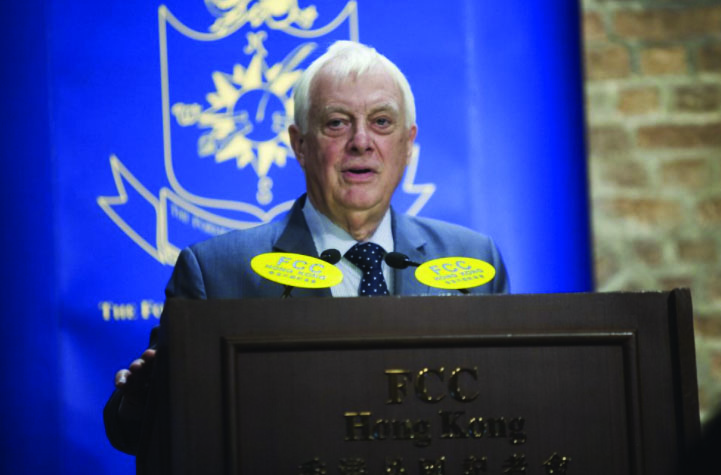
David Tang had a long connection with the FCC: as a speaker on four occasions from the early 90s; and as a friend to a number of members. Sadly, he is no longer with us to entertain and inform us with his wit, directness and sometimes penetrating insights… and he turned political incorrectness into an artform. He was also a shameless dropper of names, though quite often in an amusing context. And he did know all those names and they knew his.

Sir David Tang's last visit to the FCC was in February 2016. Photo: FCC Sir David Tang’s last visit to the FCC was in February 2016. Photo: FCC

His last visit to the FCC was in February 2016 when in an amusing, erudite and at times inspirational speech, he talked about what has happened in  Hong Kong and what needs to done. He was highly critical of CY Leung’s leadership — and slightly less so of his successor Carrie Lam — and his and the government’s handling of the Umbrella Movement, “perhaps the single most significant political event in Hong Kong since the riots in 1967”.

In this talk, which went viral on social media, he said CY didn’t “have the bottle to confront difficult issues” and often showed his “contempt… for the citizens of Hong Hong”.

When Tang established the China Club in Hong Kong in 1991 — with its wonderful art collection and library — he engaged two FCC photographers Bob Davis and Richard Dobson to do some shots. Both preferred a club membership in lieu of fees… and got them. Bob dined out on that story for years.

Another photographer Guy Nowell lived next door to Tang’s “country” house in Sai Kung. While he also did some well-paid photo shoots for Tang, he also became an occasional lunch guest. Guy remembers some great days of wonderful stories — and sometimes rants — told with great zest.

Although Tang was best known as an entrepreneur (Shanghai Tang, Island Tang and China Tang) and a philanthropist, he also dabbled in the journalistic arts as a columnist for the FT.

The FT’s House and Home section editor, Jane Owen, had her work cut out for her when she got Tang on board as columnist in 2010. He began as what was ostensibly an interior design agony uncle. Of course, it very quickly turned into a more general column full of name-dropping and anecdotes and what constitutes good manners. Some loved it, some hated it and some swore they would never read it… and then casually, without meaning to, got hooked on it.

Owen said one of his problems was with late delivery of the column with excuses “in a class of their own”. These included: “Its ancestral grave sweeping holiday today, I will be haunted if I work”; and “The Queen said I work too hard”. Tang rarely let facts get in the way of a good story, and his legendary political incorrectness kept the editors busy. When asked to be careful about the facts, Tang’s response: “Careful? Since when has progress of Man ever resulted from the insular approach to safety.”

In the early 90s author and journalist Simon Winchester was based in Hong Kong as a Guardian correspondent and freelancer. Following an interview with Tang, he was asked to curate the reference section for China Club library with, for the time, an extravagant budget. There was a lot of envy and gnashing of teeth around the FCC bar over such a plum job. In the course of that experience they became great friends as is Tang’s want. At this year’s Hong Kong Book Fair Tang hosted — apparently at times outrageously — Winchester as part of an author’s panel discussion. (It was just after Winchester left Hong Kong in 1997 that he penned his acclaimed bestseller “The Surgeon of Crowthorne”.)

There was no question that Tang was passionate about Hong Kong’s drive towards democracy and admired Chris Patten’s role in this. “You couldn’t have a greater champion than [Patten] in trying to install a system of government or politics that would maximise the possibility of Hong Kong people ruling Hong Kong,” Tang said.

Twitter to the rescue for American journalists detained in China

Two American correspondents who were detained in China got the word out via Twitter.

Canada’s Globe and Mail Asia correspondent Nathan VanderKlippe used Twitter to spread word of his detention. Canada’s Globe and Mail Asia correspondent Nathan VanderKlippe used Twitter to spread word of his detention.

The Asia correspondent for Canada’s Globe and Mail Nathan VanderKlippe and Voice of America reporter Ye Bing, who were detained in separate incidents by Chinese police in August managed to alert their employers — and followers — via Twitter about their predicament. While their detentions were brief, they are part of a pattern of harassment of foreign journalists by Chinese authorities.

Kashgar police detained VanderKlippe, the Beijing-based Globe and Mail journalist, for three hours, searched his bag and camera, and confiscated his laptop, the journalist said on Twitter. The journalist’s paper reported that police did not provide him with a reason for his detainment.

VanderKlippe was detained while interviewing residents in the township of Elishku about the security situation of the Uighur community, according to The Globe and Mail. Three police officers and several government officials approached the journalist and demanded that he follow them to a local government office, the report said.

VanderKlippe said on Twitter that after authorities gave him permission to leave, a car with two officers in it followed him. The reporter said that his computer was later returned to him along with a handwritten note, marked with an incorrect date, which read, “On July 24, 2017 at 1:35 Beijing time, [we] confiscated Nathan VanderKlippe’s Apple computer for operation purposes.”

Voice of America reporter Ye Bing's Twitter profile. Voice of America reporter Ye Bing’s Twitter profile.

The Xinjiang region has been a site of tension in recent years as Chinese authorities tighten controls in the area and criminalise religious activities of the Uighur population. Recently, residents of Elishku protested the arrests of 12 women for praying at a mosque and there were reports of allegations of illegal use of force and extra-judicial killings by Chinese security forces. Journalists covering the region have long been censored and jailed.

In the second incident, Chinese police Police obstructed and detained Voice of America (VOA) reporter Ye Bing while he was attempting to cover the closed trial of human rights activist Wu Gan from outside the Tianjin No.1 Intermediate People’s Court, according to VOA, a US government-funded broadcaster.

Ye tweeted that plainclothes police officers surrounded him and his assistant and held their arms for about 20 minutes to prevent the pair from taking photographs. Police then accused Ye of inciting violence outside the court and took him into custody where they forced the journalist to delete his photographs.

Ye’s phone, laptop, and other belongings were also confiscated, according to VOA. Ye said on Twitter that he and his assistant were released four hours after they were detained, and the journalists were returned their equipment.

The Tianjin police chief said there would be no criminal charges against the reporter and his assistant, according to a VOA article that quoted Ye.

The Committee to Protect Journalists has been on the case for both journalists. “People living inside and outside China have a right to know what is going on in the country, and there is no legal basis for harassing foreign correspondents who interview Chinese citizens,” said CPJ’s Asia programme coordinator Steven Butler. “China needs to stop trying to block coverage of sensitive stories and Chinese police need to stop harassing and blocking journalists who are merely doing their jobs.”

Conditions for the international press in China continue to deteriorate. The Foreign Correspondents Club of China 2016 survey of working conditions for international journalists found that more than half of respondents had been subjected to harassment, violence, or interference while attempting to report in China. Conditions for the local media are even worse, with journalists arrested, sentenced to years in prison, and subject to strict censorship requirements.

Social media curbs

As we know, life is much more difficult for Chinese journalists working within the social media sphere: jail rather than detention. In August journalist Lu Yuyu, who documented domestic protests in China on social media platforms under the moniker “Not News”, was sentenced to four years in prison on charges of “picking quarrels and stirring up trouble”.

Lu Yuyu: Jailed for documenting protests in China. Lu Yuyu: Jailed for documenting protests in China.

Police detained Lu and Li Dingyu, his personal and professional partner who worked with him documenting protests, in June last year. One of Lu’s lawyers, Wang Zongyue, in September told activists that prison officials had beaten the journalist in jail and that Lu had gone on hunger strike.

Li was released after an April trial on the same charge, although no verdict has been announced in that case, according to the website Chinese Human Rights Defenders.

Lu is a former migrant worker from Guizhou Province who began reporting and documenting protests around China in October 2012. Lu and Li documented protests against land expropriation, wage arrears, official corruption, and environmental pollution, verifying photos, videos, and textual accounts from social media, then republishing the information on a variety of social media platforms, including Twitter, Weibo, Blogspot, YouTube and Google Drive.

“Not News” collected a vast record of protests. In 2015 alone, Lu and Li documented more than 30,000 protests of various sorts, according to the Chinese-language website Bannedbook.org. The Chinese government stopped publishing statistics of these kinds of protests after 2007, when more than 100,000 incidents were recorded for that year alone, according to the site.

Closer to home

Macau’s Public Security Police Force at the end of August denied entry to four Hong Kong journalists, who were planning to report on the area’s recovery and rescue operations in the wake of Typhoon Hato. One journalist was from the South China Morning Post, one from the Chinese-language online publication HK01, and two were from the Apple Daily.

Macau immigration authorities briefly detained the reporters at the Outer Harbor border checkpoint with Hong Kong, and then asked the four to sign a notice stating they “posed a risk to the stability of internal security,” HK01 reported.

SCMP photographer Felix Wong was prevented from entering Macau. Photo: SCMP SCMP photographer Felix Wong was prevented from entering Macau. Photo: SCMP

The Macau Serviços de Polícia Unitários commissioner Ma Io Kun told reporters at a press conference the same day that the denial of entry had nothing to do with the four journalists’ profession, and that the government of Macau fully respects press freedom, according to media reports. When reporters at the press conference asked, Ma refused to explain how the journalists posed a threat to Macau’s security.

The Hong Kong Journalists’ Association (HKJA) and the Hong Kong Press Photographers’ Association (HKPPA) released a joint statement expressing regret over the obstruction. The Macau Portuguese and English Press Association, in a statement on Facebook, said local authorities’ explanation was “incomprehensible and unsatisfactory”.

SCMP photographer Felix Wong has previously been barred from entering Macau, according to Teledifusão de Macau, a local public broadcasting service.

Hong Kong residents are supposed to have free entry into Macau, however, the HKJA and other groups have documented past cases in which journalists have been denied entry for alleged security reasons.

Control widens

Instant-messaging apps, video streaming and other new content platforms in China will face closer scrutiny under new rules issued by the country’s internet regulators that will come into effect from December 1. The Cyberspace Administration of China said messaging apps and other new forms of information dissemination can be used to engage in illegal behaviour and that operators will soon be required to conduct extensive reviews to ensure they aren’t used to spread illegal content. The agency said the new technologies “can be used by criminals to spread illegal information and undertake criminal activity, harming the lawful interests of citizens, legal persons and other organisations”.

In a separate announcement, the regulator introduced new rules governing “internet content managers” – code for online censors – that require them to undergo 40 hours of government training over a period of three years to ensure that they are promoting socialist values.

We measure site performance with cookies to improve performance.