Patten goes scolds activists for diluting support for democracy
Almost 20 years after that rain and emotion-drenched night when Hong Kong returned to Chinese rule, the last colonial governor Chris Patten revisited his old haunts and proved as incisive, insightful – and newsworthy – as ever, as a sell-out FCC audience discovered. Jonathan Sharp reports.
 Hong Kong’s last British colonial governor Chris Patten gestures as he speaks at the Foreign Correspondents Club in Hong Kong on November 25, 2016.
/ AFP PHOTO / Anthony WALLACE
According to the billing for his appearance at the FCC, Patten was going to give his views on what the world was like, and could expect, following this year’s two seismic electoral shocks, the UK’s pro-Brexit referendum vote and Donald Trump’s victory in the US presidential election. But if any of those who packed into the Main Dining Room thought that Patten was going to stick to that script and not hold forth on the fraught political environment in his old bailiwick of Hong Kong, then they were in for another shock.
In fact it was his trenchant views on what he termed the oath-taking “antics” in the Legislative Council by activists favouring Hong Kong’s split from China that made headlines, not just locally but also back in the UK.
Patten, who during his 1992-97 governorship sought to quicken the pace of political reform and was excoriated by Beijing as a “sinner for 1,000 generations”, emphasised that he remained as devoted as ever to the cause of full democracy for Hong Kong. He also admired the Umbrella Movement that blocked some Hong Kong streets for 79 days in 2014.
“Two years ago many brave young people in Hong Kong established moral high ground about democracy and governance. It would be a tragedy if that high ground was lost because of a few antics about so-called independence for Hong Kong.”
The antics he spoke of were the actions of young elected lawmakers Sixtus Baggio Leung Chung-hang and Yau Wai-ching, who were banned from taking their seats in Legco after giving their own colourful versions of the oaths at the swearing-in ceremony. They declared allegiance to the “Hong Kong nation”, unfurled banners that said “Hong Kong is not China” and Yau gave allegiance to “the Hong Kong special administrative region of the People’s Refucking of Cheena”, the last word, among others, deemed derogatory. (The pair’s use of salty language is not confined to oath-taking ceremonies, as FCC stalwart Dr Feng Chi-shun reminded us in an opinion piece in the South China Morning Post. He also noted how, at a separate forum, an audience member got his own back at Leung Chung-hang by calling him “Lun Chung-hun” – Cantonese for “itching of private parts”.)
 Chris Patten arrives at the FCC with his wife, Lavender (left), and FCC President Tara Joseph (right).
Patten said such actions by pro-independence localists – some of whom were in diapers or not even born when he checked out of Hong Kong in 1997 aboard the Royal yacht Britannia — were diluting, not strengthening, the support for democracy. They were making a mockery of a serious political argument. Independence for Hong Kong is simply not going to happen, so why waste energy, time and popular support by saying that it could come about? It was “dishonest, dishonourable and reckless” to conflate the drive for greater democracy with the argument for independence. Adopting what he called his “headmasterly” manner, Patten, who has been a frequent oath-taker in his marathon career in political and public service and is now ennobled as Lord Patten of Barnes, said: “Taking an oath is a serious business… it isn’t something of a lark.” Patten also told Agence France-Presse: “There are lots of people who agreed with them on democracy who won’t touch this stuff about self-determination with a barge pole.”
Understandably, the localists did not take Patten’s stern admonishing lying down. Leung told the Guardian that he and his Youngspiration party “respectfully disagreed with Lord Patten’s comments about the so-called ‘moral position’” of the 2014 protests, adding that the past two years had proved that a strong moral position yielded nothing “when you are negotiating with the immoral and authoritarian Chinese communist party”.
He was further quoted as saying: “If there is no legitimate election and political discussion, how can we even start our discussion on governance and democracy as advised by the very learned Lord Patten?”
Who loses under Brexit and Trump?
 Lord Patten’s talk at the FCC made headlines both in Hong Kong and the UK.
Returning to the advertised theme of his FCC talk, Patten was asked by FCC President Tara Joseph what his verdict was on the year 2016, and his reply was: “Terrible”. Expanding on this terse judgement, Patten expressed his fears: “I think that, unfortunately, the people who are most likely to suffer from Trumpian protectionism, if it happens, are the people who voted for Mr Trump. Just as in Britain, the people who are most likely to suffer from the consequences of Brexit are people in some of the disadvantaged parts of the country who voted for it. I think that’s a real tragedy.”
The seemingly tireless 72-year-old Patten enlarged on this and many other themes at a succession of events during his Hong Kong visit. The day after his FCC appearance, he attended a Project Citizens Foundation forum entitled “Governance in Hong Kong: Are the Pillars Crumbling?” He said that during his career he had worked with several different bureaucracies – in the UK and Europe as well as Hong Kong.
“Without any question the most competent civil service that I worked with was that in Hong Kong in the 1990s. I hope it has not lost any of its vitality and morale since then.” The unequivocal response came from Anson Chan, the former Chief Secretary before and after Hong Kong’s handover to China, who told the forum in no uncertain terms that Hong Kong’s civil service had indeed gone downhill in many sad ways since she had been in charge.
Patten also said that his five years as Hong Kong governor were “the happiest years of my life”. And many Hong Kong people accord him a warm welcome whenever he comes back and gives us the benefit of his wisdom laced with dry wit. Which makes one wonder: how many other former governors of colonies, British or otherwise, are held in the same esteem in the territory they used to run as is Hong Kong’s last “colonial oppressor” – Patten’s joking term for himself?
Censorship, controversy, accolades: A year in the life of photographer Nic Gaunt
Earlier this year Nic Gaunt won a Gold prize for excellence in feature photography at the Asia Media Awards. Gaunt used the image of a girl surfing down the streets of Hong Kong in a Tatler feature in October 2015. This award, which goes usually to strictly hard-hitting stories, was given to a more fun take on life.
 The Tatler image of Mira Yeh, a well-known Hong Kong socialite and accomplished wake-boarder, surfing down the streets of Hong Kong won a Gold award in the Asia Media Awards. Photo: Nic Gaunt
“When I was introduced to the lovely Mira Yeh it was obvious she was not only a well-known Hong Kong socialite but an extremely accomplished wake-boarder,” Gaunt said. “I wanted to encapsulate her fun personality, her impact on Hong Kong and her sporty side within one image. She was great as she modelled for me trusting my description of the finished image that was only at that moment in my head.”
Gaunt’s provocative images, which regularly get censored by Hong Kong galleries and at the same time sell well in the US and Europe, are now gaining an underground following in the self-censored Hong Kong. While the galleries find that his work is too strong and explicit, the more unusual clubs of Hong Kong are asking to display his work on a regular basis.
His latest exhibition “Invisible Nudes” was on display at the Kee Club in December. It was supposed to move on to The Globe in January, but the Kee Club was reluctant to let them go. “The Globe also wants to mount images from my earlier exhibition “Obsession” in conjunction with “Invisible nudes” which will be fun,” Gaunt said.
In March 2015 the FCC put his “Obsession” exhibition in the Main Bar. While the images featuring fetishes disturbed some members eating lunch, some of those images are now on permanent display in the Burton Room.
For each “Invisible Nudes” image sold a donation will be given to Aids Concern, which recently auctioned a Gaunt image designed to raise awareness of Aids/HIV for HK$42,000. The image, called “Wish You Were Here” which pays homage to the music and imagery of Pink Floyd, was created as a “subtle diatribe” to “raise the awareness of Aids/HIV”, Gaunt said.
“I felt incredibly privileged to have been able to create and give a piece of art that was my own interpretation,” he said. “It was a personal take on the subject and I was delighted that other people were also able to see the feelings and emotions within the finished piece.”
Gaunt also produced the image for a poster about for the Black Box Theatre’s play “Crystal”, which shows lead actor Hong Kong drag queen La Chiquitta, aka Rye Bautista, through a broken window, in vaguely provocative images. However, it was all too much for the HKU campus where the play was to be shown – it was censored and an innocuous image of a pile of crystals in a broken-heart shape was used instead.
Journalists under attack: China news website editor arrested
News website founder arrested. Huang Qi, founder of the website 64 Tianwang, was arrested at his home in Chengdu in Sichuan for “disclosing state secrets” – a charge frequently used against political opponents and which can be worth many years in prison.
 Huang Qi, founder of the website 64 Tianwang, was arrested at his home in Chengdu in Sichuan.
“64 Tianwang is one of the few major online news sites in China,” says Virginie Dangles, editor of Reporters Without Borders. Twelve years after its founder Huang was rewarded with the RWB’s cyber-dissident award, 64 Tianwang and its citizen journalists continue to suffer the systematic repression by Chinese authorities.”
One of the site’s staff Pu Fei was also taken away by police soon after the arrest after he posted a tweet (since deleted) about the disappearance of Huang. He was released a few days later. Since the arrest, many volunteers from the Tianwang Human Rights Centre have also been arrested and interrogated.
China ranks 176th out of 180 countries in RWB’s World Ranking of Freedom of the Press 2016.
Myanmar reporter killed. Eleven Media reporter Soe Moe Tun, 35, was found dead with bruises and injuries to his face and head in Myanmar’s northwestern Sagaing region. Eleven Media Group, the owner and publisher of Daily Eleven, said on its website that Soe Moe Tun had been investigating a story on alleged illegal logging and wood smuggling. He had also reported on a recent seizure of narcotic stimulant tablets and a surge in new karaoke lounges in the region that allegedly operated as illegal brothels.
Nay Htun Naing, a Daily Eleven editor, said Soe Moe Tun’s reporting on sensitive subjects was the most likely motive for his murder.
Publisher shot in Philippines. Newspaper publisher Larry Que was shot in the head in December while entering an office building in Catanduanes province’s town of Virac. A gunman wearing a helmet and raincoat escaped on a motorcycle driven by an accomplice.
Que was publisher and columnist at Catanduanes News Now, a weekly community newspaper established in 2016. He was also the owner of a local insurance company and ran for mayor of Virac in an election he lost last May.
The number of journalists killed in the line of duty declined in 2016 from recent record levels as fewer journalists were targeted for murder, the Committee to Protect Journalists found in its annual analysis. Deaths in combat or crossfire ticked to their highest number since 2013 as conflicts in the Middle East dragged on.
At least 48 journalists were killed in relation to their work in 2016. CPJ is investigating the deaths of at least 27 more journalists during the year to determine whether they were work-related.
Historically, since 1992, about two-thirds of journalists killed are singled out for murder in retaliation for their work. This year, 18 journalists were targeted directly for murder, the lowest number since 2002. The reason for the decline is unclear, and could be a combination of factors including less risk-taking by the media, more efforts to bring global attention to the challenge of combatting impunity, and the use of other means to silence critical journalists.
The kids are alright: Working mothers on juggling juveniles and journalism
Joyce Lau talks to four working mothers in the demanding world of journalism.
My email exchange with BBC correspondent Juliana Liu was typical. I had wanted to sit down with her, preferably over a spot of tea, to talk about the pros and cons of being a working mother in the demanding field of journalism. But we were also both stuck in the hospital with sick children.
 Juliana Liu in full bloom.
My three-year-old Emilie woke up that morning with a bright-red, full-body rash at a time that Scarlet Fever, of all things, was making its rounds in local kindergartens. Thankfully, it turned out to be something else.
Liu was in another hospital with her son Philip, aged four, who had a frightening bacterial infection. She spent several nights in the children’s ward while her husband Marcel did the hospital “day shifts.” Their two other children – Laura, aged 2, and Matthias, an infant born in late July, 2016 – were cared for by nannies at home.
True to form, Liu replied to my interview request first thing the next morning – typing away at 7 a.m. before her kids were up.
Juliana Liu
Liu, a member of the FCC Board, is the BBC reporter famous (perhaps infamous) for running out with her big, pregnant belly to do live reports on hard-hitting Hong Kong news.
“The Lamma ferry disaster happened when I was hugely pregnant, and I started filing overnight, around the clock for several days,” she said of the 2012 maritime tragedy.
The Umbrella Movement started when I was 34 weeks along, and being tear-gassed was not at all fun,” she said. “The police, protesters and my colleagues were much more horrified than I was. My doctor said the chances of me going into early labour was extremely low, so I was able to keep working as usual
“The Umbrella Movement started when I was 34 weeks along, and being tear-gassed was not at all fun,” she said. “The police, protesters and my colleagues were much more horrified than I was. My doctor said the chances
of me going into early labour was extremely low, so I was able to keep working as usual.”
 Juliana Liu, right, with Angie Lau.
Liu has typically taken four to six months of maternity leave for each of her three children.
“Being pregnant means I was travelling less for work (but still travelling) and having kids meant I had to be much more efficient, too,” she said. “It’s definitely been challenging when it came to dealing with breaking news.”
Like many working parents here, Liu and I rely on foreign domestic workers who provide the affordable home childcare that allows Hong Kong parents to pursue their careers.
“I work with my husband and nannies as a team,” Liu said.
She brings her kids in on the weekends to be coddled by the FCC staff. “They love their Club aunties and uncles.”
Tara Joseph
Tara Joseph, who until recently was both a Reuters correspondent and FCC president, said she was “lucky” to have benefitted from a British maternity policy that gave her a full year off for each child.
But she was still honest about motherhood’s inevitable impact on job opportunities. “If I were not a parent I would have moved more frequently and regularly, taken up assignments in different countries,” she said. “I had to, and still have to, temper my expectations.”
Joseph said that becoming a mother “affected my whole being”.
If I were not a parent I would have moved more frequently and regularly, taken up assignments in different countries
“Being around young people has opened my eyes and mind to many ideas and thoughts,” she said. “Children are not just little things that keep you busy – they are creative beings and represent the future – so I really learn a lot from how they view the world.”
 Tara Joseph.
When Joseph debated running for re-election at the Club, she asked her two children, aged 10 and 14, for their opinions.
“They love the place and like to see me involved,” she said. “They will grow up with all sorts of memories of the Club: The Christmas gingerbread wall at reception, the staff at the Main Bar, the pictures on the wall in the bunker, and playing hangman over lunch on the yellow placemats at the weekend.”
Being a mother did not change her commitment as president; but it did affect how long she lingered at the Main Bar. “We think it’s important for us to sit together as a family as often as possible,” she said. “I usually go for a drink and a chat at the club in the evening and leave by 8, which is tough!”
Cammy Yiu
Cammy Yiu, editor-in-chief of CULTURE magazine, is a former FCC Board member who sits on several Club committees. Her two daughters, aged 14 and 23, are both products of the notoriously strict local school system, and fluently bilingual in Cantonese and English. “The local system is tough – but so are my girls,” she said.
When Yiu had her first daughter in the early ‘90s, she took the standard 10-week maternity leave. “It’s a real tragedy there isn’t better for Hong Kong working women,” she said. “It wasn’t enough. She was just a wee babe when I had to go back to work.”
For a decade she worked “crazy Hong Kong hours”. And when her older daughter was 6, Yiu enrolled in the top-ranked Kellogg-HKUST executive MBA programme.
 Cammy Yiu.Photo by: Ingrid Piper
“I juggled being a mom and a wife among all that. It wasn’t easy,” she said. “But my husband supported me 110%. He took over most of the ‘mum’ duties during the time.”
Yiu decided to change her life dramatically when she was pregnant with her second child; she quit her job and stayed home for a year-and-a-half. “I had the most wonderful time looking forward to the arrival of No. 2,” she said. “I stayed home to be with her.”
Like many working moms, Yiu is now self-employed. “I started my own company so I could have control over my professional and personal time,” she said.
She does not bring her children to the FCC very often. “No,” she joked. “The Club is where I get away from my kids!”
Angie Lau
Angie Lau is a star anchor at Bloomberg TV and president of the Asia chapter of the Asian American Journalists Association (AAJA). A former FCC Board member, she is still involved in the Club’s communications committee.
She is expecting her first child this January, and is planning on taking four or five months off after the birth. Like many expectant mothers, she deals with the awkwardness of answering questions by well-meaning if misguided outsiders about her post-baby plans.
“When a fellow [AAJA] member mentioned we should start thinking of succession plan for my role as president when I go on maternity, I was surprised,” she said. “But I chalk that up to good intentions.”
Meanwhile, Lau has just finished putting together the AAJA Christmas party and is now organising an AAJA conference for next May.
Joyce Lau
There’s a photo of me in The New York Times’ Hong Kong newsroom – sitting on a swiveling chair in front of two computer screens, smiling at a pudgy toddler on my knee.
For a while, I felt very proud of this photo. It made me feel like a member of Sheryl Sandberg’s “Lean-In” generation, a woman who balanced work and motherhood through sheer force of will.
After the birth of my first child, I had tried to “lean in” Sandberg-style – rushing home after work to get home before my baby fell asleep. I was exhausted. I leaned in so far, I fell over
But to be frank, the photo was somewhat staged. It was a cameo appearance by the kids at my workplace, and they were swiftly sent home in a taxi with their nanny. In all my years at the Times, I have never actually edited an article with a child on my lap.
After the birth of my first child, I had tried to “lean in” Sandberg-style – rushing home after work to get home before my baby fell asleep. I was exhausted. I leaned in so far, I fell over.
So after my second child, I left my job and became a part-time freelancer. Today, my “office” is the sunny spot at the Club Table, where I write my stories. But when I feel like going home, I can.
How Hong Kong’s democracy fight could help shape Donald Trump’s China policy
 Republican presidential candidates Donald Trump (L) and Marco Rubio (R) following the CBS News Republican Presidential Debate in Greenville, South Carolina, February 13, 2016. / AFP PHOTO / JIM WATSON
Hong Kong’s seven million-plus people are not political refugees and don’t want to be. They are nearly all Chinese but, unlike their Taiwan cousins, do not have a freely elected leader who can phone an incoming US president. America was once committed to protecting these people’s rights and democratic wishes as a matter of policy. What are the chances this might be policy again?
Hong Kong’s current distress offers Donald Trump an opportunity to reflect on his China policy and to showcase what it’s going to mean. The timing is opportune. The bipartisan US-Hong Kong Policy Act of 1992 committed America to support Hong Kong’s freedoms and democratic path. That law has expired. But Senators Marco Rubio and Tom Cotton, seeking to revive it, have recently reintroduced the Hong Kong Human Rights and Democracy Act. If passed, it would oblige the administration to hold China accountable for upholding its promises to Hong Kong.
Will Trump support it? He has pledged a tough line against China in economic areas. And he has accepted the controversial phone call from Taiwan’s president. With Hong Kong, he has a chance to show what, beyond pre-dawn tweeting, he is willing to countenance when it comes to dealing with China.
Hong Kong’s Chief Executive CY Leung, is using every available tool – including the courts – to crack down on dissenters known as localists, a few of whom have the audacity to imagine independence from China.
There is some sympathy for the localists, largely due to the unpopularity of the Leung government. In October, while a half-dozen localists won seats in Legco, others might have done so but were blocked from getting on the ballot. Beijing is now energetically involved in banning separatism from political discourse; CY says it shouldn’t even be discussed in schools.
The localists’ demands touch the Chinese Communist Party’s third rail. No one may dream of independence. Not the Buddhists of Tibet and Inner Mongolia, not the Moslems of Xinjiang, not the Taiwanese who democratically elected President Tsai Ing-wen, and certainly not the residents of Hong Kong, the former British colony.
Hong Kong’s current distress offers Donald Trump an opportunity to reflect on his China policy and to showcase what it’s going to mean
Like most people here, the localists want real democracy, but see little chance while under Beijing’s thumb. Some localists hedge, urging more autonomy somewhere down the road. A few insist on independence.
When the two pro-independence candidates won Legco seats and used their swearing-in ceremony for anti-China political theatre, it offended many Chinese, including pro-democracy parties. The Hong Kong government legally challenged the validity of their oaths and, while the matter was in the judge’s hands, China issued an interpretation of the Basic Law that effectively left the court no discretion.
Armed with the constitutional win, the administration has now targeted four more lawmakers on the same grounds. If successful, pro-government forces would have enough votes to ram through rule changes and legislation that pro-democracy lawmakers oppose.
The crackdown is timely for CY, who faces re-election in March from a 1,200-member body dominated by China’s choices. Though his popularity ratings are abysmal, his uncompromising stance against the Umbrella Movement protests two years ago, and his robust anti-localist campaign now, have endeared him among hardliners.
Meanwhile, China’s President Xi Jinping has launched an anti-corruption war that is a purge by any other name. Aiming at more than moral rectification, it is a broad effort to corral military, political and economic power that was allowed to disperse and develop at lower levels of government during the decentralisation of China’s economy. But what spurred China’s wealth boom also helped develop regional power centres that, unchecked, could threaten the central government.
Xi and his allies are fighting for re-centralisation of national power. They have taken to heart an old revolutionary song: “Without the Communist Party, there is no new China.”
By streamlining the party’s membership (88 million out of 1.3 billion people, the world’s largest political party), eliminating ideological rivals, reorganising the military along fighting lines instead of geographical units, and sidelining anybody in the way, Xi’s faction is condensing control. Keeping the party tight and the power centralised are keys to retaining control of China.
No surprise, then, that any mention of federalism is forbidden. The line is clear: China is a unitary state and all power flows from the centre and no power is retained by any lower entity. The message is hammered home: Any authority you enjoy flows from Beijing’s… and don’t assume it lasts. What the centre giveth, it also taketh away.
Hong Kong is sternly reminded regularly that the Basic Law’s freedoms and other guarantees – as a national law – are gifted by Beijing. Hong Kong people are warned daily that one cannot have liberties, greater than any enjoyed on the mainland, while rejecting China. The threat is explicit: you will not be allowed to live under a second system if you reject the one country.
Written by Francis Moriarty
Censorship and reporting in China: New survey reveals increased harassment and physical violence
 The Special Police Units (SPU) have an increased role in civil unrest and political demonstrations, often blocking journalist’s access. Photo: unit_1.bp.blogspot.com
The reporting environment for foreign journalists is proving hostile for yet another year in China – a situation that correspondents judge to be distant from basic international standards. Intimidation of sources and local staff, growing harassment and obstruction are major challenges for journalists conducting their work.
The annual Working Conditions survey conducted by the Foreign Correspondents´ Club of China finds an alarming new form of harassment against reporters, some of whom have been called into unspecified meetings by the State Security Bureau.
Harassment and physical violence. Most respondents (57%) said they had been subjected to some form of interference, harassment or violence while attempting to report in China. 8% of respondents experienced manhandling or use of physical force, an increase from last year, while 26% said they had been obstructed from reporting at least once by unknown persons. One person reported the breaking of news gathering equipment.
Several secret police showed up unannounced at my apartment after waiting for me to get home “for several hours”, according to my terrified doormen. They forced me to speak with them and they tried to get me to sign a document saying I would follow the rules of being a journalist in China. – US broadcaster
In what appears to be an added form of pressure applied on foreign correspondents, 27% of respondents said they had been asked to meet with the Ministry of State Security. Respondents said the tone of those conversations has been friendly, although the questions have in some instances been of concern.
I was asked to spy and report on colleagues, and I could refuse in the same friendly way. – European broadcaster
Harassment of news assistants. 33% of respondents said their news assistants had been harassed or pressured by government officials in some way, a slight increase from last year. Some correspondents reported news assistants quitting over a perceived negative reporting bias against China and the Communist Party.
Officials often target the Chinese staff. They often attempt to separate them from us, attempt to warn them that their perceived “support” of the foreign media is “un-Chinese” and sometimes threaten and verbally insult them. – Western news organisation
 State Security police: constant harassment of reporters. Photo: Pixabay.com
Harassment of sources. Official harassment of Chinese citizens who speak to foreign reporters is a violation of these sources’ constitutional rights. It also violates Chinese government regulations governing foreign journalists’ work, and Chinese officials’ public statements that sources will not be harassed. However, 26% of respondents say their sources were harassed, detained, questioned or punished at least once for speaking to them. In other cases, fear of harassment has led sources to decline interviews.
In the most extreme case, a woman who talked to us about losing money to a P2P lending website was detained by police for a number of days. – Newsagency correspondent
Limits on travel in minority areas. The Tibet Autonomous Region remains unreachable for foreign correspondents outside formally-organised trips by the Foreign Ministry. However, respondents have also encountered troubles reporting in other sensitive border or ethnic minority areas.
Of those who tried to report from Tibetan-inhabited areas, 60% reported encountering problems, while 44% had trouble in Xinjiang. Correspondents have also been told reporting was restricted or prohibited in other sensitive areas, such as the North Korea border, areas around the Tianjin explosion site, and coal mining locations where protests had taken place. Restrictions have extended to officially-sanctioned trips into areas normally open for reporting.
I would have liked to go to the Larung Gar, but was told from sources that this would not be possible. It is in Sichuan and not Tibet, so should be open to foreign reporters. But it is not. – FCCC member
Pressure outside China by Chinese authorities. 18% of respondents said they had seen signs of Chinese pressure on editors at their headquarters, a slight decrease from last year. Such visits have included complaints about sensitive stories, attempts to secure more “balanced” coverage and formal notes of complaint.
Visit by the head of the press department of the Chinese embassy to my editor who delivered a nearly two-hour lecture on my “biased”, “not objective”, “negative” reporting. But the main line was: “Your correspondent is questioning the system.” – German correspondent
Surveillance and censorship. Correspondents have long doubted the security of their communications and privacy where they live and work in China. This year, 85% said they worried about violations of privacy in phone calls and SMS messages, while 89% said they worried about their ability to communicate privately over the Internet, through email and Chinese social messaging applications (WeChat). Another 69% expressed concern over listening devices installed at home and at the office.
My laptop was hacked by someone, and a story I was writing (about the CPC) was prefaced in a new typeface by the remark: “The glorious CPC, with you always.” – Western correspondent.
Censorship of foreign media organisations continues, with authorities blocking Internet access in China to The Economist and Time following cover articles about Xi Jinping. Media outlets that continue to be blocked in China include Wall Street Journal, South China Morning Post, Bloomberg, Reuters and New York Times.
Some respondents provided concerning examples of electronic intrusions.
Journalists under attack across Asia
A round-up of the latest incidents involving media organisations around the region.
 A still from a video showing HKFP reporter Stanley Leung being surrounded by protesters.
Hong Kong journalist attacked by protesters. A journalist with Hong Kong Free Press website was attacked by protesters while covering a rally outside LegCo on October 26. The pro-Beijing protesters were upset about the two newly elected pro-democracy lawmakers, Yao Wai-ching and Sixtus Leung. When HKFP’s Stanley Leung started to take photos he was surrounded and jostled and his camera taken away. Two weeks earlier, during a swearing-in ceremony in the Legco, Yao and Leung modified their oaths and used a derogatory term for China, as a protest against Beijing’s encroachment on the city’s autonomy.
Filipino survives assassination attempt. Virgilio Maganes, a columnist with Watch newspaper and commentator on dwPR radio, was shot and wounded while riding a tricycle to work on November 8. The assailant, who was riding a motorcycle, fired at least four shots before speeding off. Apparently after the attacker sped off, a person picked up a piece of cardboard and placed it on the tricycle. It said “Pusher Ako Huwag Tularan”, in an attempt to disguise the murder attempt as part of President Duterte’s war on drugs.
 The Malaysiakini website is under investigation into its financing.
Malaysian news website threatened. Police have opened an investigation into the financing of independent news site Malaysiakini, under section 124C of the Penal Code which criminalises activities “detrimental to parliamentary democracy”. The investigation comes amid reports that the George Soros US-based Open Society Foundation provided funds to the site (a one-off grant for a documentary in 2011). A pro-government “red shirts” group threatened to “tear down” the website’s office building over the issue.
More Thai media controls. A new national media regulator has been proposed that will have discretionary powers to impose legally binding administrative penalties for breaches of a state-determined media code of conduct. The Thai Journalists’ Association, Thai Broadcast Journalists’ Association, National Press Council, News Broadcasting Council, Online News Providers Association, and the Cable TV Association – believe the council was designed to harass critical news outlets.
TV reporter killed in Afghanistan. Naimatullah Zaheer, a reporter with the Afghan private television station Ariana News, was killed by a roadside bomb in the southern province of Helmand.
Blogger detained in Vietnam. Saigon police arrested blogger Ho Van Hai, a medical doctor popularly known by his Facebook moniker “Ho Hai”, on November 2 for “spreading information and documents on the Internet that are against the government of the Social Republic of Vietnam.”
Malaysian cartoonist banned from travel. Award-winning cartoonist Zulkiflee Anwar Ulhaque, better known as Zunar, was stopped from leaving the country at the airport by passport control officer who said he was enforcing a June 24 police order imposed for unspecified “special reasons”.
Nov/Dec 2016
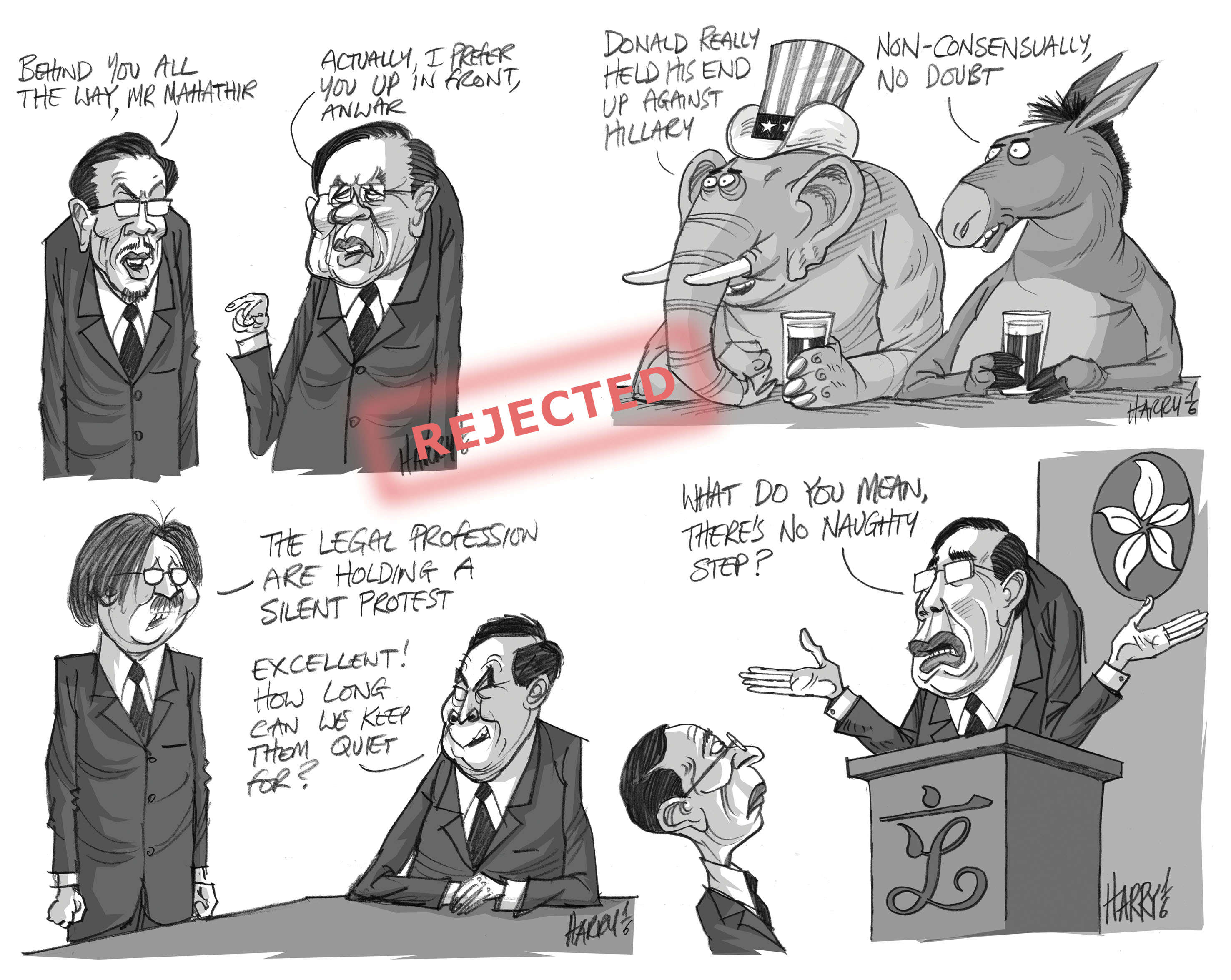
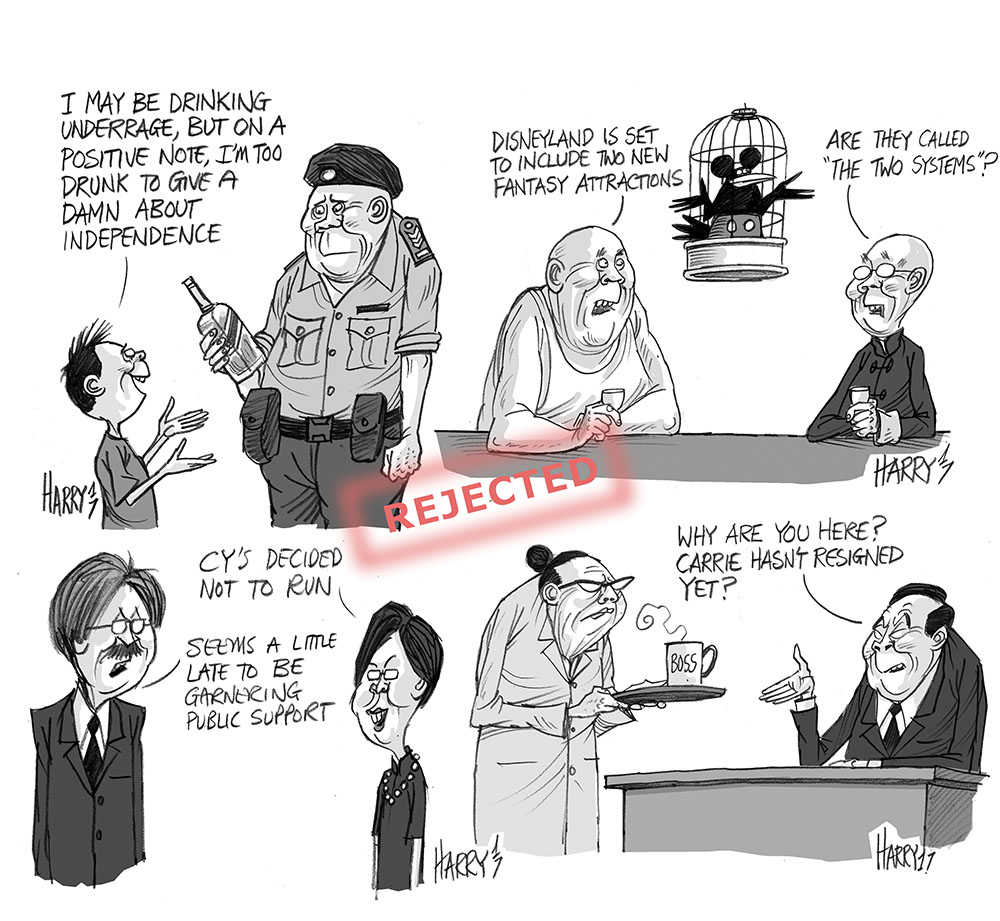
Nov-Dec 2016 Harry’s Rejects