Members Area Logout

Afghanistan: Between Hope And Fear

Paula Bronstein first visited Afghanistan in late 2001, right as the Taliban was being driven from power after the September 11 attacks. Afghanistan worked its magic on her, just as it does on many journalists. The country got under her skin. Harsh mountains, a wide sky, craggy faces, turbans and burqas— the country is so different from what we know, so foreign, that words can do it little justice. Photographs are almost the only way to prove the reality of life there.

She made the country a mission, returning frequently over the years and choosing to spend most of her time with Afghans rather than embedded with international troops. And while she has certainly documented how people die, she also shows how they live.

Bronstein’s photographs and their individual stories illustrate the larger narrative of Afghanistan and she has put together one of the richest portraits there is of modern Afghanistan—complicated, conflicted, and contradictory, but always compelling.

Buy Afghanistan: Between Hope And Fear

Slowly, slowly up Kilimanjaro

With the news that Pizza Hut just delivered a pie to the top of Mount Kilimanjaro, setting a new record for high-altitude PR stunts, Andrew Davison recalls his experiences in scaling Africa’s highest peak.

The 12-man team had some 50 guides, porters and cooks. The 12-man team had some 50 guides, porters and cooks.

In 2014 an old friend came up with the idea of climbing Mount Kilimanjaro in Tanzania. We’ve still no idea what possessed him to come up with this idea, nor what compelled seven more of us to join him. And if motivation were ever a key component to successfully scaling Kilimanjaro, then our group were in trouble right from the start. None of us really knew why were doing this. We had no lifelong ambitions or bucket lists. Once the idea was on the table, there simply seemed no reason not to.

And so we found ourselves on an Ethiopian Airways flight from Addis Ababa to Arusha, in Tanzania, with a view of Kilimanjaro poking its head out above the clouds. Kilimanjaro at 5,895m high is the highest free-standing mountain in the world. In trekking terminology it falls into the “extreme” category of above 5,400m.

The day before departure we were given the four golden rules of climbing “Kili”: have the right equipment, poli, poli (walk slowly), drink lots of water (5 litres per day), and maintain a positive mental attitude.

The following morning we’re driven to the Londorossi Gate for registration, and then on to the edge of the Shira Plateau at a height of 2,800m, from where we will start. We’re introduced to the army of around 50 guides, porters and cooks that are required to get the 12 of us up the hill and down again.

The ice crystals on the outside of the tent in the morning are testament to just how cold it is, but it is clear with a bright blue sky

Walking across the Shira Plateau is easy if unspectacularly flat. We were already in poli poli mode. Surprisingly it’s difficult to actually find the rhythm to walk that slowly. The porters, who have lagged behind to finish the packing, shortly come racing past.

After three or four hours of gentle plodding, we arrive at the first campsite, at 3,550m, where the porters have already set up our tents. We’re each given a bowl of hot water for washing and introduced to the mess tent, where we’ll eat all our meals, drink endless cups of tea and coffee.

The food is surprisingly good given the location, a combination of carb-heavy potatoes or pasta, with a meat or veg sauce and a breakfast of porridge – ideal for slow-release of energy needed for hiking.

The ice crystals on the outside of the tent in the morning are testament to just how cold it is, but it is clear with a bright blue sky. The second day’s walking takes us further across the plateau, before taking a diversion to the summit of Shira Cathedral, a huge buttress of rock surrounded by steep spires and pinnacles. The mist surrounding the rock creates a ghostly effect with the tree moss – old man’s beard – hanging like damp Halloween cobwebs off the trees. This extra climb is part of the acclimatisation process and has induced some altitude sickness among our group.

Day three is a steady but reasonably easy climb up from the moorland of Shira Plateau and onto the broad upland desert beneath the Lent Hills. We’re at the campsite at Moir Hut at 4,200m in time for lunch, then have another acclimatisation walk in the afternoon. The peak affords a spectacular view over the plateau, with the clouds on either side curling up over the edges, and creeping across the plain towards each other like two armies moving into battle.

Day three is a steady but reasonably easy climb up from the moorland of Shira Plateau and onto the broad upland desert beneath the Lent Hills

The following morning sees us ascend over numerous lava ridges across a dry, dusty moonscape, to the next camp at the volcanic plug that is Lava Tower (4,550m). Another acclimatisation walk takes us to Arrow Glacier, which seems to be in a rather sorry plight,. Our head guide, who has been climbing Kilimanjaro for 15 years, can recall a time when it was probably twice the length it is now. Research has indicated that the glaciers could have retreated entirely from Kilimanjaro by as early as 2020.

Some of the Kilimanjaro team struggled with the altitude. Some of the Kilimanjaro team struggled with the altitude.

Day five sees us descend from Lava Tower into the Great Barranco Valley and as the vegetation changes once again we find ourselves walking among large groundsel trees, their palm-like trunks topped with spiky leaf rosettes, and giant lobelia, a cactus-like flowering plant. In front of us now stands the Barranco Wall, a steep and exposed ascent of around 300m. The wall is near vertical, and while some of the porters will stroll up it barely using their hands, for most of us it represents the most physically challenging effort so far.

There is one more sharp descent to negotiate, and an equally sharp ascent, and then we’re at Karanga Valley campsite, at a height of 4,000m, which must make for our toughest day so far.

This is followed by a very short day; a short but steep climb out of Karanga Valley, onto a relatively easy path across a wide, shallow valley, gradually gaining altitude until we reach the Barafu Hut at 4,600m in time for lunch.

That night is to be our summit night – what this trek has been all about.

We’re in the mess tent for dinner at 4pm, prior to which we’re informed that one of the porters has succumbed to altitude sickness and needs to go down, despite having scaled the mountain countless times before. Unfortunately one of our own party has also decided he can go no further. He’s been struggling with fluid on the lungs for a few days but has now reached a point where the guides advise him not to continue. It’s a tough decision but undoubtedly the right one. Dinner this evening is a subdued affair.

We go to bed at 6pm. And wake at 11pm. And put all our clothes on, literally. And then we’re off.

As we leave camp there’s a steady procession of headlamps weaving their way up the mountain, like a line of fire-flies. And right from an early stage there are people being brought down, having succumbed to the altitude, the cold or simply exhaustion, including a member of our own team.

We walk in silence. At the very time you need some banter to sustain you, the well is dry as people struggle with the thin air, the cold and the relentless plodding. I’m fine for a few hours and even began to think that this Kilimanjaro lark is quite easy. However, at around 4am, as the tiredness and the altitude kick in, it suddenly goes from being a challenging but enjoyable experience to a brutal one. The last two hours or so to Stella Point are absolutely draining.

Stella Point comes into sight but I can’t summon the strength to make a final triumphant burst to the top and it remains the same slow plod for every last step.

Day five sees us descend from Lava Tower into the Great Barranco Valley and as the vegetation changes once again we find ourselves walking among large groundsel trees, their palm-like trunks topped with spiky leaf rosettes, and giant lobelia, a cactus-like flowering plant. In front of us now stands the Barranco Wall, a steep and exposed ascent of around 300m

It takes just a few moments to get our breath back, slow our heart rates down, and have a cup of tea. Then we are off again. To have reached Stella Point at 5,735m is to have climbed Kilimanjaro; the point at which you get a certificate. But there is another point, the highest point, Uhuru, at 5,895m, another 160m, and 45 minutes, up.

The team perfects the poli poli (walk slowly) rule on the way up. The team perfects the poli poli (walk slowly) rule on the way up.

Another of our team has been struggling all night, needing regular breaks, occasional vomits, and guide’s assistance. He’s ready to call it quits and go back down. But the guides think he can make it and push him on.

Finally, Uhuru Peak. Below us lies the 2.5km wide caldera, looking exactly as a volcanic crater should; the perfectly round inner Reusch crater like a valve just waiting to be released.

Then it’s time to go. After just ten minutes or so at the top it’s time to go all the way back down again. This time at least there is no poli poli. This time it is go as fast as you like.

Our descent takes a couple of hours, slipping, sliding, half running, half walking, down to Barafu Camp, where we’re allowed to sleep for a while until the last of our group completes their descent. Then we endure a further 2-3 hour descent to Millennium Bivouac, our final camp and final night on the mountain. The last day is then a long descent all the way back to Mweka at 1,650m, by which time most people can think only of a hot shower and a thirst-quenching beer.

And that was Kilimanjaro. Several days of gentle walking followed by one night of hell… and no pizza.


Obituary: Roy Rowan, Time magazine’s last Saigon bureau chief

By Anthony Paul, former FCC president and former editor-at-large Asia Pacific for Fortune magazine

Roy Rowan in Saigon in 1975. Roy Rowan in Saigon in 1975.

Wars are usually long periods of boredom punctuated by brief episodes of sheer terror. When the fighting ended in Saigon in April 1975, most of the overworked correspondents escaping from the North Vietnamese forces’ advance, myself included, wanted a respite – a return to home and family, perhaps a long cool drink or 10, and, most importantly, as much distance as possible from anything to do with the conflict.

But not Roy Rowan, Time magazine’s last Saigon bureau chief. A couple of weeks after Saigon fell, news reached Hong Kong of what would prove to be the last combat incident of the Indochina War: Khmer Rouge seizure of an American container vessel, SS Mayaguez. In the ensuing 3-day action, 38 Americans and an unknown number of Cambodians died.

“This story will soon be over,” Roy told me in Hong Kong, “but there’s a book in this.” He had been regretting that at age 55, after 28 years in journalism, he had never had time to write more than news reports. With six weeks’ vacation owed by Time, he was soon off on an intensive research swing interviewing Asia-based survivors and in Washington, President Gerald Ford and Secretary Henry Kissinger. His first book soon appeared, The Four Days of Mayaguez. Nine more books were to follow. As this record of his career will tell you, there were few colleagues able to match his energy.

Roy Rowan died September 13 in Greenwich, Connecticut, aged 96. His passing was no ordinary event. He was the last of what was once a large band of legendary American journalists who covered the Chinese civil war, by-lines that included such other members of the FCC in Hong Kong and Shanghai as Robert Shaplen (Newsweek and the The New Yorker), Tillman Durdin (New York Times), Teddy White  (Time-Life), Ernest Hauser (Reader’s Digest) and Henry Hartzenbusch (Associated Press).

Roy’s life spanned most of the major developments in East Asia in the century’s second half. China came first. He and Life photographer Jack Birns had stood on a rocky hill late in 1948 with General Li Mi of the Nationalist 13th Army Group watching the war’s climactic Battle of Huai-Hai unfold to a People’s Liberation Army victory and within a year the founding of the People’s Republic. In 1997 he returned to that same hill with his wife, Helen, a former Life picture editor, detouring from Fortune magazine’s coverage of the Hong Kong handover. There they watched quarry workers turn the hill into gravel to be used to build a forest of new skyscrapers in nearby booming Xuzhou. “I remember [a China of] men and women substituting for beasts of burden: pulling plows, pushing irrigation pumps, and struggling with heavy millstones to grind their wheat,” he would later write. “And I’m stunned at how most of that primitive, 4,000-year-old hand work gave way to modern production in just my lifetime.”

Roy Rowan interviewing President Ford in the White House. Roy Rowan interviewing President Ford in the White House.

Born in New York City in 1920, Roy graduated from Dartmouth in 1942, was immediately drafted into the army, rose to major, and spent two years in New Guinea and the Philippines. In search of continuing adventure, he joined the UN Relief and Rehabilitation Administration in China. While distributing food and clothing to peasants caught up in China’s civil war, he filed reports and photographs on spec to Stateside publications. A file “The Stadium of the Skulls” – photos of the remains of 5,000 Chinese massacred by the Japanese – led to his hiring by Life, then edited by founder Henry Luce. The pro-Nationalist son of an American missionary in China, Luce used his magazines to influence Washington’s China policies. Roy and Birns produced articles on what Roy described as “sham battles being fought by the Nationalists,” helping Luce face the war’s reality.

Shortly after Shanghai fell to the People’s Liberation Army in 1949, Roy moved Life’s Shanghai bureau to Hong Kong. His papers, held by Hartwick College of Oneonta, New York, record his eyewitness involvement in the next five industrious, tumultuous decades: the Malayan Emergency, Korean War, Japan’s resurgence, assignments in Italy, Germany and Chicago, then back to New York as one of Life’s assistant managing editors.

His editing team was just finishing the November 29, 1963 issue of Life when word came of President John F. Kennedy’s assassination. Within two hours, Roy had flown to the Chicago printing plants, where he remade the magazine using the now-famous Zapruder movie film, the only photo record of the president being shot.

In 1969, Roy began working on magazines he had suggested to Time Inc. On the Sound and On the Shore were dedicated to the region he loved so much, the waters around Long Island Sound and Chesapeake Bay. But when Time Inc.’s backing ultimately fell through, the publications eventually folded, and the company saved Roy from unemployment by retrieving their old warhorse. In November 1972 he returned to Hong Kong as Time’s bureau chief, based in Hong Kong but with responsibilities for all Time’s Asia-Pacific editions. The Indochina story loomed largest. Roy wrote more than 50 articles covering the war and was in Saigon for the hurried helicopter evacuation.

In 1977, Roy moved from Time to the Board of Editors as a senior writer at Fortune. Between then and his “retirement” in 1985 he wrote 65 major articles for the magazine. From 1998 to 2000, Roy served as president of the Overseas Press Club of America. When his term ended, the club established a Roy Rowan scholarship for aspiring young journalists. Meantime, he worked on a string of books. These included “The Intuitive Manager”, which drew on numerous interviews with American CEOs to explain how to turn a “hunch” into a well-calculated management step, and “First Dogs: American Presidents and Their Best Friends”, made into a Discovery Channel documentary. “Intuitive Manager” sold 350,000 copies, was translated into 10 languages and formed the basis of innumerable videos and tapes.

Roy Rowan in Hong Kong in 1949. Roy Rowan in Hong Kong in 1949.

Roy’s colleagues remember him as a no-nonsense editor. Once in Hong Kong he assigned a photographer-correspondent team to cover a story about an insurrection in the Philippines. Lacking a frontline pic, the photographer apparently talked the correspondent into dressing up as an armed guerrilla prowling through the jungle. Poring over the contacts, Roy detected the hoax. New York recalled both staffers, who were summarily dismissed.

One likes to think that current print publications, buffeted by the near-disastrous draining away of ad revenues by television and the Web, would handle the costs of this failed assignment in the same way. Though the fact in no way detracts from their accomplishments, Roy and his colleagues were fortunate to be print journalists whose careers coincided with a quite remarkable flowering of wildly successful US publications after the First World War, e.g. Reader’s Digest (1922), Time (1923), The New Yorker (1925)  and Newsweek (1933). Though I’d like to think otherwise, It’s unlikely that we’ll see again such an abundance of well-rewarded opportunity for foreign correspondents.

Despite Roy’s travels and home-base disruptions, Roy and Helen raised a notably successful, loving family of four sons. Photographers Robin Moyer and David Burnett of the FCC, who joined Roy on several assignments, recall his camaraderie and his tolerance, even for journalists born long after Roy had begun his climb and the events he covered were all but ancient history.

PEN writers’ group reforms in Hong Kong to promote freedom of expression

Hong Kong is once more home to a local branch of the international PEN organisation for writers, writes Vaudine England.

Some of the founding members of PEN Hong Kong in September 2016. Photo: PEN Some of the founding members of PEN Hong Kong in September 2016. Photo: PEN

Few writers may be aware of the role of Marilyn Monroe in the fight for freedom of creative expression, or indeed her connection with the opening of a new flank in that fight in Hong Kong.

Such was the allure of Monroe that her fame had spread far and wide. It even spread to Nigeria’s head of state, General Yakubu Gowon, during the civil war over Biafran secession back in the late 1960s.

This matters because the general had decided a local playwright, the then unknown Wole Soyinka, should be executed.

The international group for poets, authors, essayists, editors (and even journalists), PEN, was then led by another playwright, the somewhat better-known Arthur Miller. As PEN president, Miller wrote a letter to Gowon which a friendly businessman delivered directly.

The general’s key question was: is this the Arthur Miller who married Marilyn Monroe? On being assured that indeed he was, Gowon did as suggested by Marilyn’s man, and let his prisoner go.

Wole Soyinka went on to become one of the world’s most eminent poets and playwrights, winning the Nobel Prize for Literature in 1986.

Now whether this was all due to Marilyn remains moot. The point is that PEN, an international writers’ group in existence since 1921, acts to celebrate, promote and extend freedom of expression.

It also campaigns directly on behalf of writers endangered by governments, statelessness, imprisonment and other hazards.

As we now know in Hong Kong, those hazards include kidnapping, detention and interrogation without charge across the border, and concerted efforts to destroy livelihoods, ideas, and independent thought.

It was FCC member Fred Armentrout who was the leading light of the English-speaking PEN, along with Saul Lockhart and others.

How apt, then, that the Hong Kong branch of PEN has just been revived after more than a decade of somnolence. The new, bilingual Hong Kong branch of PEN was launched at the FCC on November 13, as part of this year’s Hong Kong International Literary Festival.

To be historically accurate, the previous PEN group was called ‘English-speaking PEN’ in Hong Kong. There was also a ‘Chinese PEN’ here which was often bogged down in exactly which China they meant.

“The English-speaking PEN reached its zenith during the period of forced repatriation of Vietnamese boat people. There were writers in the camp and we were very active in getting about a half-dozen of them refugee status, as was the FCC in at least one case (Saul Lockhart led the charge there),” wrote Fred Armentrout, when we asked for his sage advice.

It was FCC member Fred Armentrout who was the leading light of the English-speaking PEN, along with Saul Lockhart and others. Now chaired by Jason Ng, several more FCC members have helped to found the new group — Steve Vines, Vaudine England, Ilaria Maria Sala, Kate Whitehead, Cathy Holcombe… the list of names continues.

However, as the Marilyn story shows, this is not just another press freedom group. PEN focuses on a broader definition of freedom of expression; it has UN recognition, and a roll-call of past presidents from Vaclav Havel to Margaret Attwood. People PEN has tried to help include writers as varied as Salman Rushdie, Ken Saro-Wiwa, Anna Politkovskaya and Hrant Dink. PEN originally stood for Poets, Essayists and Novelists, and then grew to include playwrights, editors, publishers, academics and, importantly for us, translators.

Our new Hong Kong group includes all of the above. It is multi-racial and bilingual, Hong Kong-based, but of course alert to how the politics around us affect freedom of creative expression here. It’s hard not to be increasingly alarmed by this environment in which self-censorship has become the norm and newspaper editors are chopped by machetes. It is now acceptable in some circles to submit to career-defining constrictions on our intellectual life.

“The Chinese government has for many years perceived Hong Kong independent publishing as ‘politically harmful’. It has strategically targeted Hong Kong publications and implemented ‘strike campaigns’, renewed annually. The Causeway Bay Book Store incident was just one highly visible episode in the ongoing campaign,” notes PEN Hong Kong founding member, Bao Pu, of the independent publishers, New Century.

“This long-running campaign has demonstrated its effectiveness after so many years. The sales of books about mainland politics has dropped, and the case of the Causeway Bay Book Store has sufficiently deterred not only mainland buyers and Hong Kong book stores, but even many in Hong Kong’s printing industry from books on politically sensitive topics on mainland China or Hong Kong,” he said.

It is the politics around us that now stops some publishers from publishing, some book shops from selling, some printers from printing, and thus all of us from reading a full range of literature. This cuts directly at our ability to have fun with new ideas – and yes, we have a sub-group in our new PEN which is firmly focused on rediscovering that sense of fun.

Marilyn Monroe, then PEN leader Arthur Miller’s wife, had a role to play in saving the life of a future Nobel Prize for Literature winner. Marilyn Monroe, then PEN leader Arthur Miller’s wife, had a role to play in saving the life of a future Nobel Prize for Literature winner.

So it was with PEN when it was founded in London in 1921. It had begun as a dining club for poets and authors who felt discombobulated after World War One. The Charter of PEN which stands firm to this day, was then forged in the dark atmosphere of threats, persecution and mass murder of World War Two. By 1939, PEN member centres included Argentina, Australia, Bolivia, Brazil, Canada, Chile, Colombia, Egypt, India, Iraq, Japan, Mexico, New Zealand, Palestine, Uruguay, the US and others. All the Scandinavian countries were accounted for in the membership, as well as several countries in Eastern Europe. Basque, Catalan and Yiddish centres were represented, too. Today the vast majority of PEN International’s 145 centres are outside Europe.

For PEN, freedom of expression and literature are inseparable. Indeed, it’s an idea present at the centre of the many cultures of the world, not simply the West. PEN has long been unique in bringing writers together regardless of culture, language or political opinion. Initially, it saw itself as “above” politics. It was the Nazi repression of writers — and the dissent within PEN of such great names as Bertolt Brecht, Alfred Döblin and Robert Musil – that engendered a more nuanced approach.

The British novelist HG Wells, who became PEN’s president in 1933 following John Galsworthy’s death, led a campaign against the burning of books by the Nazis in Germany. When the German branch of PEN failed to protest at the book-burning and even tried to stop a Jewish writer from speaking at the PEN Congress, it had to be expelled.

It was out of events like these that parts of the PEN charter were written: “Literature knows no frontiers and must remain common currency among people in spite of political or international upheavals. In all circumstances, and particularly in time of war, works of art, the patrimony of humanity at large, should be left untouched by national or political passion..

There are lines in the sand for all of us, no doubt differing from person to person around the bar.

In the revived PEN of Hong Kong, we aim to touch up that line with neon lights, with book-readings, literary celebrations and even, yes, the odd campaign. We aim to keep that line shining bright, and you are very welcome to join us.

Visit the PEN Hong Kong website here


Anson Chan: Hongkongers face systematic undermining of values and freedoms

Anson Chan knows of what she speaks as one of the very few people who have served as both an Official and Unofficial Legco member.

Chan, who has been a regular speaker at the Club since the 90s when she was Chief Secretary before and after the handover, spoke about what to do with the troubled Legco and the importance of the Legco elections.

“In the four years since the last Legislative Council elections, our way of life, supposedly protected under the mantra of ‘One country, Two systems’, has faced unprecedented challenges in the form of a systematic undermining of our core values and freedoms.”

Chan then listed incidents to illustrate what she calls “the assault on freedom of the press,” including outspoken political commentators being sacked, journalists attacked on the streets, and the case of the missing booksellers – which she said was “in flagrant breach of the Basic Law”. Chan also mentioned a threat to academic freedom at HKU and the ban on independence debate in schools.

“The really scary thing is that these developments are now coming so thick and fast, they no longer even seem to cause surprise,” she said. She warned Hongkongers not to be “accustomed to a new normal” when it came to the dishonesty and lack of accountability of government officials.

Chan said the legal basis for banning pro-independence candidates from standing for election was “dubious at best and likely to be the subject of a legal challenge”. She called the process “arbitrary and politically biased”.

She also said what fuelled the localist and pro-independence movements was a feeling of powerlessness that arose from “the absence of full universal suffrage and the ability to vote out officials”, warning that such sentiments will only grow as the government attempts to stamp them out.

“The frustration on the part of young people… they don’t want mainland culture and values to creep into Hong Kong,” Chan said. She also said that the government should have allowed for an open discussion about the topic, rather than “using a sledgehammer”.

In the four years since the last Legislative Council elections, our way of life, supposedly protected under the mantra of ‘One country, Two systems’, has faced unprecedented challenges in the form of a systematic undermining of our core values and freedoms

“I think there are very few people in Hong Kong who are actually pressing for independence. It almost leads me to believe that the Chief Executive has a hidden agenda… to create such havoc in Hong Kong that he has more reason to persuade Beijing that a strong pair of hands is needed to keep Hong Kong in control,” she said.

She added there was a need to “find a pathway to a more mature party political system” which could work with a democratically elected Chief Executive. Chan called for a more effective relationship between the Legislative Council and Executive Council.

Ahead of the elections, Chan said it was crucial for the pro-democracy camp to maintain its veto power, or the pro-government lobby will be able to push forward “unwelcome constitutional changes” such as last year’s political reform package, or “introduce self-serving amendments to LegCo Standing Orders.”

Chan then urged everyone to vote to ensure the legislature will contain “as many men and women as possible who are of high moral principle, who embrace the values and freedoms that we cherish and who, above all, are prepared to stand up and defend them.”

When Chan, who retired from the Civil Service in 2001 after 39 years, announced she was standing for the Hong Kong Island constituency in 2007, the FCC was one of the first places she spoke at… and where she first aired her increasingly “radical” positions about the future of Hong Kong.

Hong Kong’s copyright law reform hits a wall

Hong Kong’s efforts to reform copyright law towards the US-based “fair-use” treatment of copyright versus the “fair-dealing” approach stall, writes Jonathan Hopfner.

Hong Kong’s efforts to reform copyright law have stalled Hong Kong’s efforts to reform copyright law have stalled

Hong Kong might be one of the most wired cities on the planet, but its copyright legislation remains a product of the pre-Internet era – a situation that has ramifications for businesses, consumers of web content and an increasingly digitalised media alike.

The failure to update the city’s Copyright Ordinance certainly isn’t for lack of trying. First enacted in 1997, the Ordinance has been subject to successive amendments that attempted to clarify matters such as the type of work that can result in criminal liabilities if copyright is infringed, to the number of copies of a publication that can be made or distributed without constituting an offence.

But the most recent attempt to update the law, which began in 2013, sparked massive controversy and was ultimately abandoned by the government earlier this year. Whether this can be viewed as a victory or setback for freedom of expression (and consequently the press) in Hong Kong is still a matter of considerable debate.

In essence, the Copyright (Amendment) Bill 2014 was an attempt to make the Ordinance more technologically neutral, and to balance the need to protect the interests of copyright owners with the right to free speech. It extends the rights copyright owners have over their work to the digital realm and also establishes a “safe harbour” for Internet providers that limits their liability for copyright violations occurring on their networks, provided they take reasonable precautions – changes that are broadly in line with international practice.

More controversial was an attempt to safeguard free speech by extending the right to use copyrighted material without fear of criminal or civil liability if it is for the purposes of – significantly for journalists – reporting or commenting on current events; quotation; and/or “parody, satire, caricature and pastiche”.

In the eyes of the administration and much of the business and legal community, this was a relatively generous set of conditions that, in the words of a Hong Kong-based former intellectual property counsel to the US Senate, Stacy Baird, likely constituted “the broadest free speech exception in copyright law anywhere in the world.” Critics, however, including “netizen” groups and most of the city’s democratic-leaning lawmakers, argued the exceptions were ambiguous and did not go far enough.

Among the key demands of the bill’s opponents were a broader exception for user-generated content (UGC), which includes mash-ups of copyrighted images or video footage, or fan versions of music videos or songs disseminated on social media. Critics also called for measures to prevent companies from overwriting these exceptions in business contracts.

Fair use v fair dealing

More broadly, the bill’s detractors have argued that by limiting “legal” copyright infringement to a few specific categories like parody and reporting, the government is trying to confine the scope and format of debate. In essence this is a push for Hong Kong to move towards the US-based “fair-use” treatment of copyright versus the “fair-dealing” approach generally adopted here, in Commonwealth countries such as Australia, Canada and the UK, and much of Europe.

Protesting against Hong Kong’s proposed copyright law, which some Netizens claim is the Article 23 of the Internet. Protesting against Hong Kong’s proposed copyright law, which some Netizens claim is the Article 23 of the Internet.

While the basic principle of both approaches is the same – that people should be free to use copyrighted material in certain circumstances – fair dealing is generally viewed as more restrictive, since it limits permissible copyright infringements to specific categories stated in relevant legislation. Under fair use, on the other hand, broader principles or factors are used to judge whether the use of copyrighted material is indeed “fair”.

In the US context, these factors include whether the copyrighted material is used for commercial purposes, the amount or portion of copyrighted work used, and how the use may impact a copyrighted work’s market value. This approach obviously gives the courts more leeway in deciding what constitutes acceptable infringement.

The Hong Kong government has claimed that shifting to fair use would constitute a far more ambitious overhaul of the territory’s intellectual property regime than was envisioned in the last set of amendments to the Ordinance. It was also reluctant to apply a general exception for UGC, noting the definition of such content is ambiguous and that few jurisdictions have adopted exclusions of this kind. In the current political climate these debates proved impossible to resolve and in March the bill was moved to the bottom of the legislative agenda, effectively suspending it indefinitely.

Incidents like the recent bookseller disappearances, Hong Kong’s declining ranking in press freedom indexes and a series of high-profile attacks on journalists show there is every reason to be concerned about the right to free speech in the city, and wary of government attempts to subvert it.

But there are also indications that the opposition to the Copyright (Amendment) Bill may have overshot the mark.

First, it must be remembered that any attempt to challenge an individual or organisation’s rights to use copyrighted material under the exceptions outlined in the bill would ultimately end up before the city’s courts, where, given the city’s own laws and international precedent, it would face significant scrutiny. As Baird has pointed out, no lawsuit of this kind has been brought against an individual in Hong Kong’s history – presumably for the reason that such a case would prove very difficult to win.

Also, one need only look at the US for proof the fair use stance is far from immune to legal challenges or debate. A long-running case brought by Universal Music Group against a mother who uploaded a video to YouTube of her toddler dancing to a (Universal-owned) Prince song resulted recently in a landmark decision from the 9th Circuit Court of Appeals, which firmly established the obligation of copyright owners to consider the fair use concept before ordering content creators or distributors (like YouTube) to remove unauthorised work.

The decision was hailed by free speech advocates, but agencies such as the Reporters Committee for the Freedom of the Press noted it should be seen as a double-edged sword for journalists. It affirms their rights to use copyrighted content in the course of their activities, and makes it more difficult for companies to use takedown notices as a means to target negative press. However, it also sets a higher bar for journalists (and publications) seeking to protect their own work when it is reproduced or used in an unauthorised way.

Similarly, it is hard to see the current situation in Hong Kong as a victory for either side of the copyright battle – or for reporters. The collapse of the copyright bill had more to do with a general lack of trust in the current administration, and the city’s polarised legislature, than any serious flaws in the updated legislation.

The end result is that the regime governing the replication and dissemination of copyrighted information, particularly via online and social media channels, is incomplete and ambiguous. This may make it easier for journalists to use this information in the course of their duties without fear of repercussions. At the same time journalists and their employers may have little in the way of recourse when their intellectual property is reproduced online without due credit or citation; or manipulated in a way that may damage their reputation.

A new, less fractious and (hopefully) more credible administration may yet resurrect the bill in some form and bring copyright legislation in line with technological realities and the highest international standards. In the meantime, reporters, bloggers and media companies alike will have to labour in an uneasy state of limbo.

Prince defended his copyright

In spite of the 9th Circuit Court of Appeals ruling that copyright owners should “consider the fair-use concept before ordering content creators or distributors to remove unauthorised work, Prince earlier this year would have none of it.

During Prince’s last tour, he continued his staunch opposition toward fan recordings of his performances. Virtually all footage from the tour’s concerts, including brief 15-second Instagram clips, have been taken down.

Fans were not happy, particularly those who fail to secure tickets to shows that typically sell out within seconds.

However, Prince eventually responded to fans in a series of since-deleted tweets. One fan wanted to know why there was no video of his concerts on YouTube? His answer: “Since YouTube doesn’t pay equitable licensing fees, isn’t that a nonsensical question?” And further: “Shouldn’t your concerns be directed at YouTube and not here?”

In a landmark copyright decision, the US Court of Appeals for the Ninth Circuit affirmed in 2015 the 2008 ruling of the US District Court for the Northern District of California, holding that copyright holders must consider fair use in good faith before issuing a takedown notice for content posted on the Internet.

Stephanie Lenz posted on YouTube a home video of her children dancing to Prince’s song “Let’s Go Crazy”. Universal Music Corporation (Universal) sent YouTube a takedown notice pursuant to the Digital Millennium Copyright Act (DMCA) claiming that Lenz’s video violated their copyright in the “Let’s Go Crazy” song. Lenz claimed fair use of the copyrighted material and sued Universal for misrepresentation of a DMCA claim. In a decision rejecting a motion to dismiss the claim, the district court held that Universal must consider fair use when filing a takedown notice, but noted that to prevail a plaintiff would need to show bad faith by a rights holder.

Don’t tell the King: The increasing danger of reporting in Thailand

The book The King Never Smiles, by Paul Handley, was banned in Thailand. The book The King Never Smiles, by Paul Handley, was banned in Thailand.

One unforgettable wire photo from 1985 shows the leaders of an attempted military coup on their knees before the late King Bhumibol Adulyadej who was symbolically brokering an end to unrest sparked by the coup. There was only one death in the coup attempt: cameraman Neil Davis who filmed the soldier who shot him.

Many FCC members have from time to time been based in Bangkok covering the turbulent political events played out on Bangkok streets since the 1980s. Whether coups (10 before 1980 and 10 since) or Red and yellow-shirt protests. The most recent coup in 2014 has led to an unprecedented crackdown on journalists, TV and Internet news programmes as well as a strict application of the lese majeste laws against social media.

Foreign correspondents have always trod warily around lese majeste, though some of their publications got into strife when they inadvertently did not place a photo of the King at the top of a page, or had someone else’s photo on top of his.

The former Hong Kong-based Far Eastern Economic Review, well known for treading on toes throughout Asia, was very careful in its coverage of one of the King’s periodic walkabout tours of the Thai countryside in the mid-80s by the then editor (and former FCC president) Derek Davies. This celebrated cover story was about the King visiting carefully selected villages to listen to problems and hand out purples (Baht500 notes).

However, many of the Review’s Bangkok-based correspondents skirted the law on a number of occasions particularly when speculating about the unpopular heir-apparent Crown Prince Vajiralongkorn. One of those correspondents was Paul Handley (1987-1994) who later wrote the book The King Never Smiles, released in 2006 – which was banned in Thailand even before it was published. The book asserted that the King, widely seen as beneficent, apolitical and a living Buddha, was “deeply political, autocratic, and even brutal” and linked to big business and the Thai military.

Thai officials blocked access to the book’s page on the publisher Yale University Press’ website and at Amazon.com as the “contents could affect national security and the good morality of the people”.

Later two state-run university bookshops removed books that referenced Handley’s book. In October 2011, Thai-born American Joe Gordon was sentenced to two and a half years in prison for defaming the royal family by translating sections of the book into Thai and posting them online. He was pardoned eight months later.

Some of the most recent arrests for lese majeste have been made over posts on social media sites: A man faces 15 years in jail for posting images on Facebook of the King’s favourite dog in a way that mocked the king, according to the prosecutor; a cleaning lady is being charged for posting the words “I see” in an exchange on Facebook between her and a political activist that police say had defamatory comments; in May Patnaree Chankij, a mother of a prominent pro-democracy activist was charged for failing to criticise or take action on Facebook messages that were sent to her account by her son’s friend; and even hitting the “like” button on Facebook on a post that is deemed offensive to the king has led to people being charged under Article 112.

Earlier, Jonathan Head, BBC correspondent and FCC Thailand vice-president, in May 2008 was  accused of lese majeste three times: for writing articles about the alleged support for the People’s Alliance for Democracy by members of the royal family; writing that the Crown Prince might find it difficult to “fill his father’s shoes”; and allowing a picture of a politician to be placed above a picture of the King on a BBC web page.

Social activist and former magazine editor Somyot Prueksakasemsuk was jailed in 2013 for 10 years over two articles deemed offensive to the royal family.

AFP beachhead in North Korea

Hughes MD-500 helicopters perform a fly-by during the first Wonsan Friendship Air Festival in Wonsan on September 24, 2016. Hughes MD-500 helicopters perform a fly-by during the first Wonsan Friendship Air Festival in Wonsan on September 24, 2016. AFP PHOTO / Ed Jones

Agence France-Presse’s new bureau in Pyongyang, which opened in September, is already churning out the stories.

The bureau, which was officially opened by Emmanuel Hoog, the group’s chief executive and chairman, so far has been focusing on producing video and photographic content.

It was able to open following an agreement made earlier in the year between AFP and the Korean Central News Agency (KCNA), following “about 10 rounds of negotiations that began in 2012”, said Philippe Massonnet, AFP’s Asia-Pacific regional director.

“Not that there was any resistance by the authorities, but it was only a matter of time as we were not only dealing with KCNA, but other government departments as well.”

The Pyongyang bureau will be staffed by a locally hired videographer and a photographer, who will work in conjunction with visiting foreign correspondents, which mirrors what other international news bureaux, including the Associated Press, Xinhua, Ria Novosti and Japan’s Kyodo News. AP opened the first foreign bureau in 2012.

As a big international newsagency “we have to be wherever we can”, Massonnet said. “For us, it is normal and natural to open an office in North Korea, as we open offices everywhere in the world – in some we cannot employ locals, in others it’s foreigners.”

With North Korea’s total media censorship and control it must be a struggle for the locally hired staff to function properly for foreign media – even with training.  “We brought the North Korean staff to Hong Kong in August for training sessions about how AFP works as well as going on shoots to take care of the practical aspects,” Massonnet said. “The two were competent and open and enthusiastic about the training and even though they were accompanied by an KCNA official the training was unsupervised.

The AFP team check out the work of local artists in a Pyongyang park. Photo: AFP The AFP team check out the work of local artists in a Pyongyang park. Photo: AFP

“We had worked with the same official before during the negotiations and got on well, so we took the opportunity to show him how we deal with photo and video stories from other countries – which he found interesting even though he acknowledged that many of those types of stories would not be done by KCNA.”

AFP’s Seoul bureau chief will run the bureau while teams from South Korea, Hong Kong or China will be sent every two months or so as part of the deal. “So far, we sent a team in July, again in September and another is planned for November,” he said. “There are no visa problems and now the visas are issued in Hong Kong rather than having to go via Beijing.”

The November mission we will try to get, among others, the August flood aftermath story, but it is difficult – or at least time consuming – to get approval. “Typically, we submit a list of say 20 potential stories in the hope of getting five or six to run with.”

So far the Pyongyang team has been involved in stock footage shoots of the capital as well as getting on the streets and train stations and the like; or reacting when someone noteworthy visits Pyongyang. “We did cover the 15th Pyongyang International Film festival [brainchild of the cinema-obsessed “Dear Leader” Kim Jong-ll in September.

“It’s really a way of showing as much as we can about what’s happening in Pyongyang. Many of our clients – particularly in South Korea and Japan – want as many images as they can get from the country.”

In this picture taken on September 29, 2016 commuters wait for a bus during the morning rush hour in Pyongyang. / AFP PHOTO / Ed Jones In this picture taken on September 29, 2016 commuters wait for a bus during the morning rush hour in Pyongyang. / AFP PHOTO / Ed Jones

One of the ways the AFP team gets around in North Korea is to work with NGOs, “often going to places that are normally difficult for journalists to get to”. A case in point is that they were able to cover the floods in North Hamgyong province, where some 140 people were killed and 35,000 homes destroyed, by being part of an NGO team. “It enabled us to get some great footage,” he said.

Everything produced by AFP in North Korea will be edited by AFP people, mainly at the  regional headquarters in Hong Kong. “There is no difference from anywhere else in the region where we have people taking photos or videos or writing stories. They send their material to Hong Kong, and it will be exactly the same for North Korean stories.”

As in other countries where AFP operates there is official monitoring. “But monitoring is not a problem. It would be a problem if we were censored. The big issue for us is to go there and to report or shoot what we see… and this job won’t be much different than the one we do in
other countries where it is difficult to work.”

Once a story is finished and on the “wires” that might be another story. “So far we have had no negative feedback from government officials,” Massonnet said. “We will see where the limits are of what is possible to do and what is not. If we think it is worth doing and reporting about, then we will do it. It may be difficult sometimes, but that doesn’t prevent us from working and getting good material.”

Apart from a few big occasions such as mass rallies and big celebrations, foreign media don’t report from North Korea very often. “So we have a very rare opportunity to be there every month and to deliver content to our Asian clients who have big expectations about our North Korea coverage.”

Portraits of former North Korean leaders Kim Il-Sung and Kim Jong-Il are displayed on buildings of the Pyongyang skyline on July 27, 2013. North Korea mounted its largest ever military parade to mark the 60th anniversary of the armistice that ended fighting in the Korean War, displaying its long-range missiles at a ceremony presided over by leader Kim Jong-Un. AFP PHOTO / Ed Jones / AFP PHOTO / Ed Jones Portraits of former North Korean leaders Kim Il-Sung and Kim Jong-Il are displayed on buildings of the Pyongyang skyline on July 27, 2013.  AFP PHOTO / Ed Jones / AFP PHOTO / Ed Jones

Massonnet likened the Pyongyang experience with Beijing in the 70s and 80s when correspondents had no official contacts or news sources and had to rely on what they saw in the streets as reporting beyond the city was all but impossible. However, when the big story came – China opening up – the resident bureaux could move fast.

“It makes sense to be in Pyongyang, not only because we don’t have much competition from the few journalists who go there, but also there are some opportunities to make connections so that you are ready when the big story breaks,” he said.

Massonnet said that even today in China, how many sources are there within the Chinese Communist Party to cover real political stories? You are left with the economic stories and speculation.

“The opening of an AFP bureau in Pyongyang will further strengthen the agency’s international network,” said the AFP chief executive, Emmanuel Hoog at the opening ceremony. “AFP’s role is to be present everywhere in the world in order to fulfil its news mission as completely as possible, in particular through images.”

AFP – which is a public company but governed by a board of representatives from French news organisations and the government – has 200 bureaux across 150 countries.

Dying in the pursuit of news

PanelJournalists as targets in conflict zones is a relatively new thing as militias and some governments around the world seek to control the message by killing the messenger. The FCC’s Journalism Conference heard from those who have been there.

The FCC’s Roll of Honour lists those killed in Indochina and Korea while on the job: a case of wrong place, wrong time. However, a new name was added in 2014, Sky News cameraman and former member Mick Deane. In late 2013 he was filming in the Rabaa al-Adawiya protest camp in Egypt when he was shot and killed by a sniper.

“In the old days, a press card was like a protection, but now more and more journalists have been targeted and killed,” said Eric Wishart, a member of AFP’s global news management, who led a panel discussion on the increasingly dangerous world for journalists.

“The game and the stakes have changed tremendously,” according to Marc Lavine, AFP’s editor-in-chief for Asia. ”In the mid-90s when I went to Afghanistan as a war correspondent, I had very little training and was equipped with just a pen and notebook.

“There was always the danger of being hurt or killed if you happened to be in the wrong place at the wrong time, but you were not targeted so you weren’t always looking over your shoulder expecting to have someone come out at you.”

In the past 15 years we have seen a complete move away from that, with militants targeting journalists in a propaganda game. “Film of executions in Syria illustrate that incredibly well as killing a journalist stops the message and sends its own brutal message across the world,” he said.

“In Pakistan we saw protesting journalists attacked by police with live rounds and baton charges. While, closer to home journalists were targeted in the Mongkok riots earlier this year.”

The figures speak for themselves: the Committee to Protect Journalists said that 970 journalists have been killed in the past 20 years – two-thirds in the past 10 years alone. Of the 72 killed last year, two-thirds of them were targeted.

“One of my big fears is the kidnapping of journalists,” said Roger Clark, CNN’s vice-president for Asia and Hong Kong bureau chief. “If ISIS kidnapped a Western journalist from a big news organisation it would use that to maximum effect across social media – that scares the hell out of me.”

No press here

Always in the past journalists would identify themselves as journalists – not such a good idea
these days.

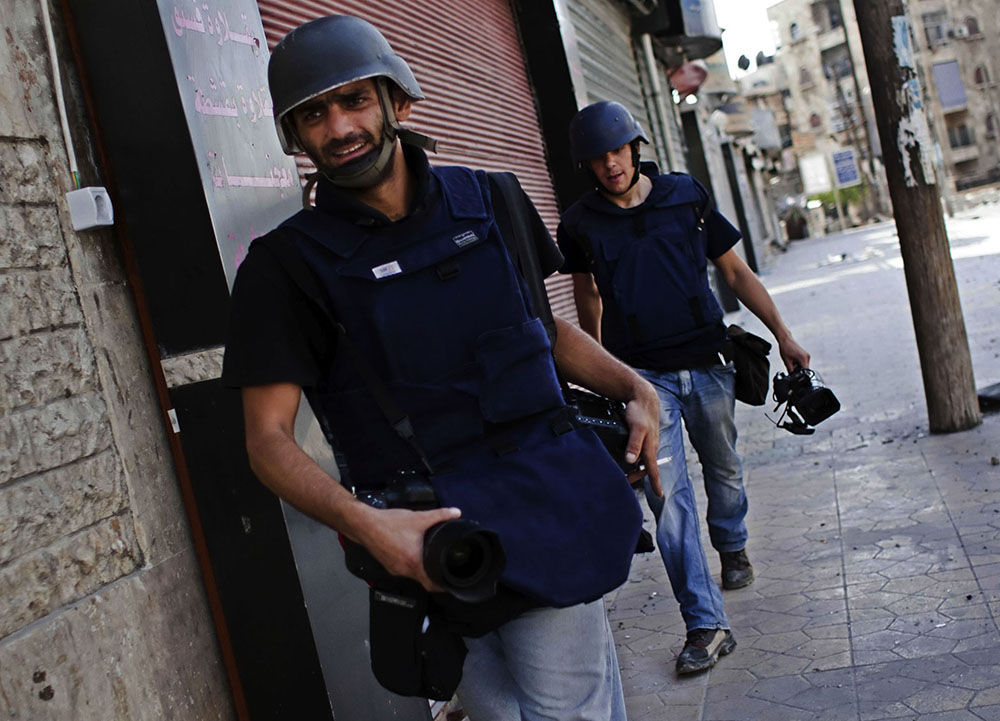
For AFP, Lavine said, “we have taken identification from our cars and some of our offices, although we mostly still have PRESS tags on our flak jackets. However, in some sensitive areas it’s more a liability than a protection.”

For Roger Clark there are some situations “where you do want to be identified as PRESS on your car, or on your flak jacket, but for other situations like when we recently sent one of our correspondents to Syria where she kept the lowest of the low profile and tried to blend in.

“When you talk to our security specialists the phrase they use all the time is ‘blend in’, which, thankfully, is easier these days with the cameras being very small. Unlike when we were in Iraq where we had to keep a low profile by using old cars to get around – we were constantly re-spraying them.”

CNN’s senior international correspondent Ivan Watson says the precautions journalists should take depend on the conflict. “If you are dealing with conventional armies then you do identify yourself as the military usually represents the government, and has a chain of command and responsibility.

“But when you are dealing with militias it’s all about blending in,” he said. “During the US occupation of Iraq we used to hide in the back of crappy old taxis – basically our best defence at that point.

“It is a very strange development that we think that the violence against journalists – most of it directed against local journalists – has grown even though the number of cellphones and distribution systems for pictures and information now in use has magnified.

“It kills me that some governments will go after me and my professional TV crew, yet all those people running around with cellphones taking pictures – and uploading them to Facebook – don’t appear to be targeted.”

Clark spoke about recent threats to major news organisations by the Taliban in Afghanistan for not properly presenting the Taliban’s views. “However, the people who take the brunt of these threats are not the guys who parachute in for a story, it’s the guys who have to stay behind in those worlds – and very often the least protected.”

Covering disasters and surviving
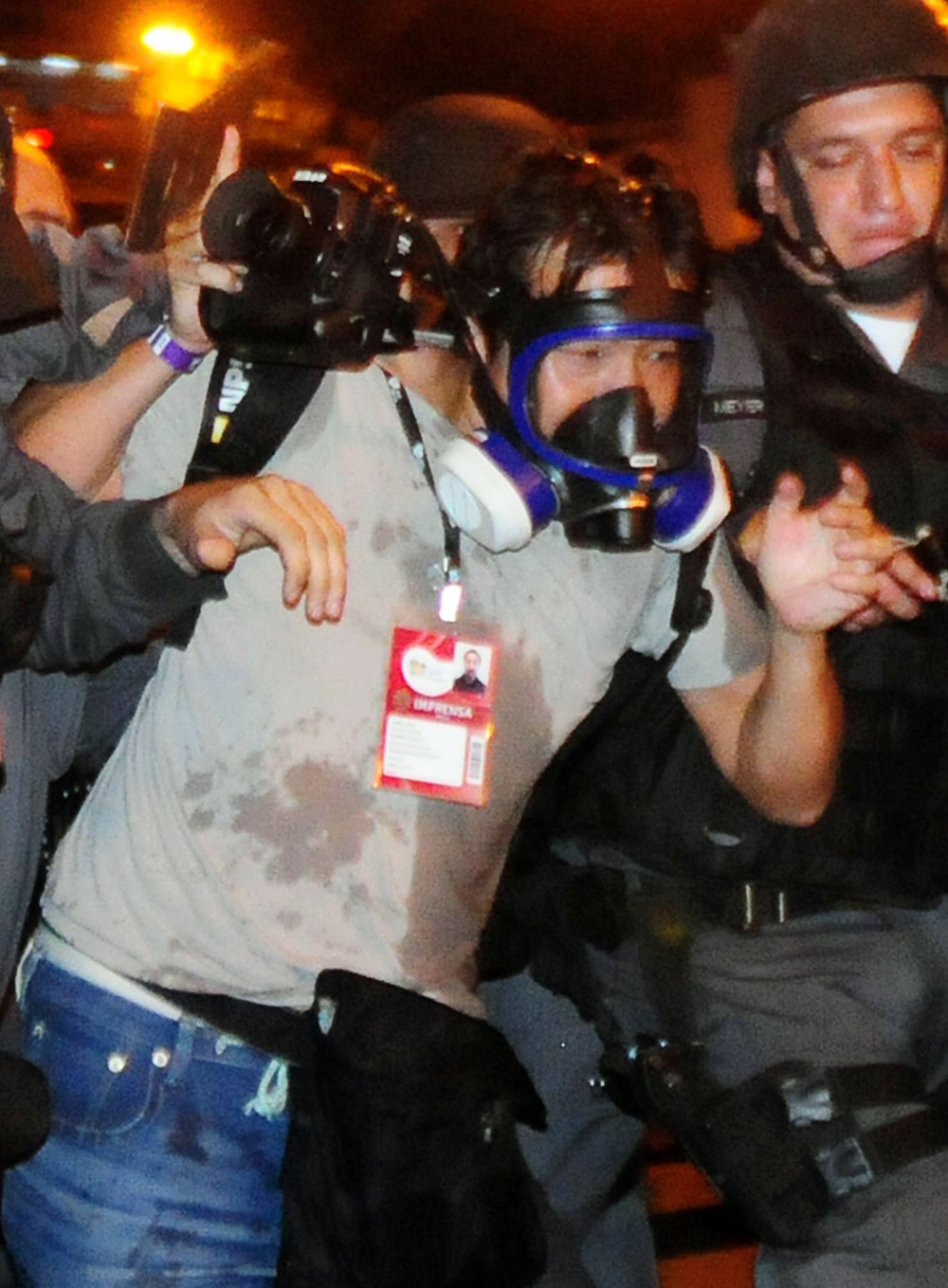
Photo: AFP

The CNN team led by Andrew Stevens was on Tacloban in the Philippines and faced the full force of Typhoon Haiyan in November 2013 as it devastated the island. Dramatic – and award-winning – footage was shown of the typhoon which killed more than 10,000 people.

“They were there before the storm hit,” Clark said. “With our good contacts in the country we got our reporters there very quickly.”

At the time Clark was director of international coverage in Atlanta and, like they always do with big stories, sat down and did a review.

“We knew we had let the front-line team down badly because we could not supply them with the support they needed,” he said. “Normally we pride ourselves in making sure our correspondents and producers can eat, sleep in reasonable conditions and drink clean water. Now, we had supplies but they were stuck on another island.”

Out of this experience CNN now has a different deployment procedure. “When we deploy – whether on disaster or high-security stories – someone has to hit the pause button and take stock.”

CNN has now put together what they call “grab bags” that are in every bureau designed to support a team of three for three to four days – everything from toothpaste to tampons, including first aid kits, tents, sleeping bags, floor liners, mosquito nets, water-purification tablets, matches, sun cream, walkie-talkies, satellite phones, batteries and even instant noodles.

“It’s a great asset and you don’t have to think about logistics as you race off to do a story,” Clark said. “You also need to ensure that your team is not bigger than the resources you have.”

Sometimes what they need to bring doesn’t fit into the grab bag. “Sometimes we need to bring a generator – and find fuel – to a disaster zone as part of the philosophy that we have to create all our own infrastructure to operate,” Watson said. “It means you don’t have a cameraman falling down from dehydration because he is carrying heavy equipment around.”

Having sufficient cash is another issue. “Keep in mind that ATMs often don’t work in disasters,” he said. “We have had to bail out other journalists many times.

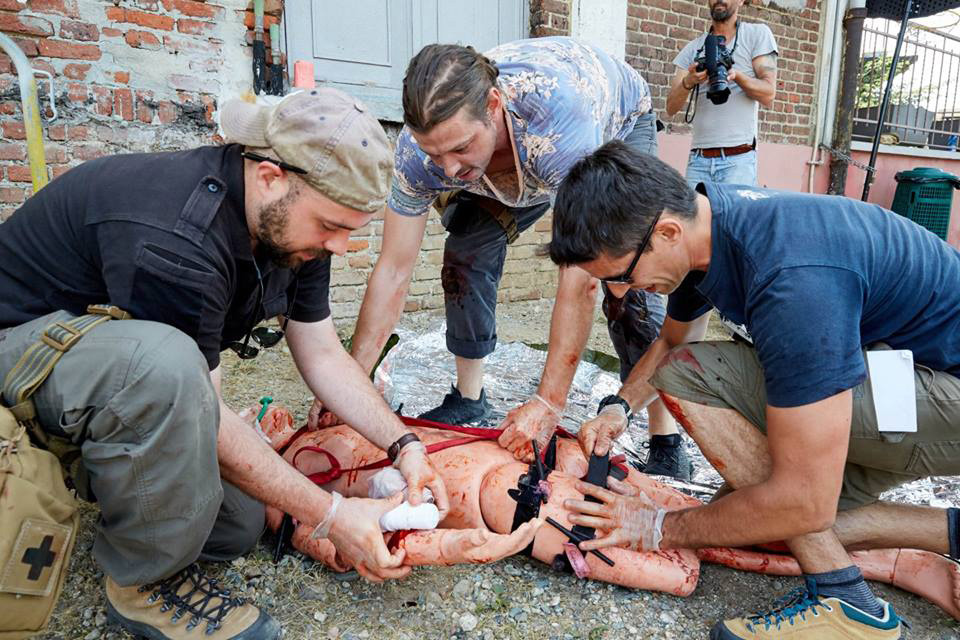
“It’s all in the preparation: you may need body armour, gas masks or long underwear, but it’s the grab-bag idea that ensures survival.”

Watson, reflecting on his experiences in Afghanistan and Iraq, said it’s absolutely essential to do specific hostile environment training. “And it’s not for just surviving war, conflict or disaster, you need to able to know how to begin surviving when the whole structure of the society has been ripped apart.”

Local riots

Marc Lavine’s advice to Hong Kong-based journalists thinking of diving into the next riot: don’t rush in when you don’t know the score.“All it takes is a big rock hitting your head, or finding yourself between the police and the rioters.”

“We are always trying to get to the scene to see what’s happening,” says Ivan Watson, “but at some point you have to assess what’s going on around you – the worst place you can be is between two groups shaping up for a fight.”

He suggests that you need to try and figure out which side you are safe on… “or the side with the better guns”.

“It’s also important to remember that the riot or conflict always evolves or degenerates during the course of the conflict. When I first started going into Syria from Turkey the government didn’t welcome us and we would need to hide among the rebels. However, in the course of a year, the rebels started kidnapping journalists so they became a bigger threat. We finished up going in with the same military which had horrified us before.”

Roger Clark says it is down to training. “We need to be trained well enough to know just what our limits are before it is too late to turn back.”

Lavine agrees and adds that “we need to look at the kind of training we are delivering to journalists these days.

“Some 10 to 15 years ago in the time of Afghanistan and Iraq, war-type training was needed,” he said. “Often these days it’s training around public order – riots and the like. The chances of you getting killed in a riot in Hong Kong or wherever is fairly small, but with the huge amount of stones and bottles flying around, serious injuries are likely.”

While body armour is useful, it appears reinforced glasses and hard hats are more the thing for riots.

“When you are in a country that is going through destructive changes or conflict, you need exceptional planning for your teams – with the expectation that nothing works according to plan,” Watson said.

A dramatic video was shown of an incident in Iraq in 2014 when Watson joined an Iraq air force relief helicopter to take aid to a religious group besieged on the top of a mountain by ISIS forces. In the end the helicopter crew had to fire machine guns to protect the craft coming and going. Besides dropping relief goods, they also picked as many terrified people people as they could. Inevitably families were split up with the ensuing emotional chaos.

Watson said “there was little advance warning of what we were getting into”.

“This sort of stuff isn’t a game and it messes you up for a while. After some of these types of incidents I have gone into counselling – it’s essential to do this and playing at being a tough guy is not on.”

Trauma and PTSD can also occur well away from the field. Clark said that on the CNN international desk they have Arabic speakers vetting all this horrific footage pouring in relentlessly from the Middle East – sometimes the footage is worse than what you see in the field.

“So as managers we have to keep a close eye on these people,” he said. “At CNN we are pretty good in making sure that people know what to do if they are struggling to cope. It is only in recent times that it has been recognised that PTSD affects journalists in the field and back in the newsroom.”
AFP_JHET#1C_web Photos: AFP

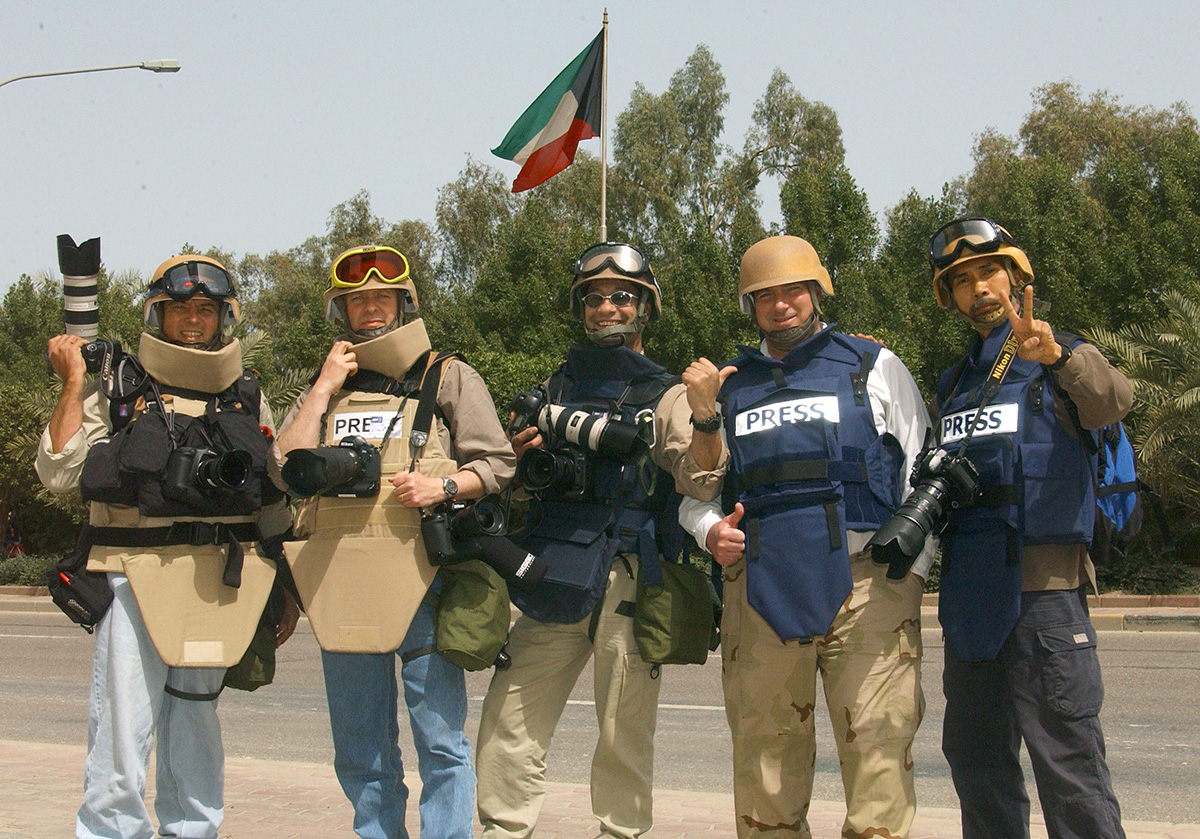
 RISC XII>Day 4_Final simulations_web From L to R: AFP's Cris Bouroncle, Peruvian based in Santiago, Chile, Eric Feferberg and Jack Guez both French based in Paris, US news reporter Charles Hoskinson from the English Desk in Washington DC and Romeo Gacad from the Phillipines based in Manila, part of the AFP staff in Kuwait to cover the US-led attack in Iraq. AFP PHOTO / AFP PHOTO

Sept/Oct 2016

We measure site performance with cookies to improve performance.