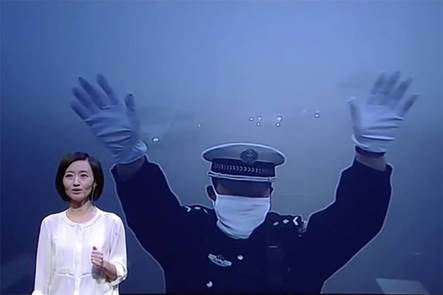
 The viral Chinese pollution documentary ‘Under the Dome’ has disappeared behind a wall of, no not smog – censorship. Created by former CCTV anchor and newswoman Chai Jing this documentary has been compared to Al Gore’s ‘An Inconvenient Truth.
Greening of Asia
Asia, particularly China, is an environmental disaster. Mark Clifford in his book “The Greening of Asia” – and at a FCC lunch – argues that there is a way out through a combination of business, government and civil society strategies.
[dropcap]A[/dropcap]s we all know, Asia has a lot of environmental problems. Mark Clifford, executive director of the Asia Business Council and formerly editor of the South China Morning Post and The Standard, a senior editor for BusinessWeek and the Far Eastern Economic Review, said he was staggered by the research into this book that showed just how bad it is.
“I originally thought of calling the book ‘The East is Black’, first coined by Time correspondent Sandy Burton [of the FCC’s Burton Room] more than 10 years ago, which the Chinese authorities didn’t take kindly to,” he said.
“I don’t want to sugar-coat the problems, however the book is unabashedly a glass-half-full kind of book: we have got a disaster, but I think there is a way out.”
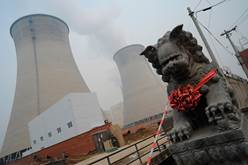 Chai Jing coal towers – China burns more coal than any other country in the world – about half the total every year – and is responsible for more than a third of the greenhouse gases that impact global warming. AFP
Chai Jing coal towers – China burns more coal than any other country in the world – about half the total every year – and is responsible for more than a third of the greenhouse gases that impact global warming. AFP
While Clifford’s book looks at all of Asia, his talk focused on China, arguably the most important country that needs to clean up.
Coal is at the heart of global environmental and energy problems. China burns more coal than any other country in the world – about half the total every year – and is responsible for more than a third of the greenhouse gases that impact global warming.
So, coal is bad on many counts: about 1.2 million people every year die from outdoor air pollution alone mainly through sulphur dioxide, 90% of which comes from coal emissions; 70% of China’s carbon emissions are from coal; and although carbon dioxide is not a pollutant, it is a significant greenhouse gas.
“In my book I focus on business and what business is doing because I think business day in and day out solves problems and takes challenges and makes opportunities out of them,” he said. “However, business does not operate in a vacuum, but as part of a three-legged stool of government, business and civil society.”
Civil society in China, despite the enormous pressure it’s under, is increasingly important. “You see a lot of localised protest against chemical and other highly polluting industries – though most of these are what I call not-in-my-backyard protests.
“However, all of us saw the reactions to Chai Jing’s quite stunning documentary ‘Under the Dome’, which was downloaded more than 300 million times in that first two-week period. It had an enormous impact. So much so, the government removed it from the Web.
“This shows the importance of civil society, even in the Chinese context,” he said. “I think China is now moving towards taking action.”
Clifford said that since 2007 the top leadership in China has made increasingly bold and assertive comments regarding climate change and air pollution. Like last November when Xi Jinping announced that China’s carbon emissions would peak by around 2030. “This is the first time China has a committed to a date, or even talked about it,” he said. “Although our research shows that it could be earlier than that, what is it going to take to get there?”
Toward clean energy
Clearly the climate wars are going to be won or lost on what China and the US – by far the two largest producers of energy – are going to do.
“If coal use has to peak by the mid-2020s, we will probably need some sort of carbon tax to speed the transition away from fossil fuels.
“As part of that transition towards 2030, clean energy will need to take up some 20% of the total – coal now is about 70%, so clean energy has to take some of that.
“China is going to need 800-1,000GW of clean energy,” says Clifford. “If China, which now has about 200GW of clean energy, mainly hydro and some solar, builds the 1,000GW it needs, it’s more than any other country other than the US. It’s an enormous amount of power to build.
“While I am focusing on solar and wind, I don’t want to ignore that clean tech for China includes hydro and nuclear energy.”
In fact, China has the most ambitious nuclear energy programme in the world, though it will be a drop in the bucket given that by 2020 it is expecting to add 57-58GW from nuclear power – almost as much as France. So nuclear doesn’t really move the needle for China.
“Solar and wind are increasingly important,” Clifford said. “Already China is the world’s largest solar panel manufacturer. It didn’t actually use the solar panels domestically but exported most to Europe and the US until a series of what I would call protectionist moves made it much more difficult to sell into those markets.”
In a way, that turned out to be a blessing in disguise, Clifford said, because it put a floor under the pricing for China’s solar manufacturers and saved some from bankruptcy, although it has not been a profitable industry.
“I say in my book that Suntech, which had been the world’s largest solar manufacturer, went bust because it expanded too quickly. Suntech and other individual companies’ loss in terms of profitability, has really been to the rest of the world’s gain because we have seen solar prices fall by more than 80% because of China’s manufacturing capability in the past decade,” he said.
As the international markets have become more difficult, China has turned to the home market. “In the first quarter this year alone, it has installed 5GW of new solar capacity, which given the fact that Germany is the largest solar producer in the world with 38GW, it’s almost unbelievable.”
China is the world’s largest producer of solar panels and installed over 5GW of new solar capacity domestically in the first quarter of this year. Chin leads the world in wind turbine capacity at 15GW of output. AFP
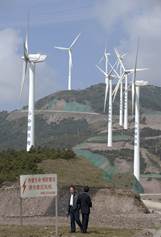 China is the world’s largest producer of solar panels and installed over 5GW of new solar capacity domestically in the first quarter of this year. Chin leads the world in wind turbine capacity at 15GW of output. AFP
Wind could be it
At the end of 2014, China had, by far, the most wind capacity in the world at 150GW. “Although wind is extremely cost-effective – the second most cost-effective after coal – China has some problems here because even though it has all this capacity, the US produces more electric power from the wind because it actually hooks the turbines up to the grid,” Clifford said.
“A lot of the problems we see in other parts of the Chinese economy are writ large in the electricity grid sector. It’s something that China has to do something about if it wants to reap the benefits of its investment in clean tech.”
So, on a theoretical basis at least, the wind potential is almost limitless in China. Some US and Chinese researchers estimate that wind could meet all of China’s electricity needs by 2030.
“Of course, this is highly theoretical, but the point is the wind is there, it’s cost-effective, and at this point it’s a matter of getting the grid and the policies right to make sure that these assets generate electricity.”
Ten years ago China had almost no wind capacity domestically and didn’t export wind turbines very much – a very different picture from solar. “However, China went through a really aggressive localisation programme where foreign manufacturers’ share of the wind-turbine market went from about 78% to about 14% in under a decade as China did everything it could to create a domestic wind-turbine industry.
“It’s important to remember that though there are a lot of problems – profitability for individual companies and linking turbines to the grid – this is real and not just smoke and mirrors: China spent US$89 billion last year on clean tech (US in the low 50s).”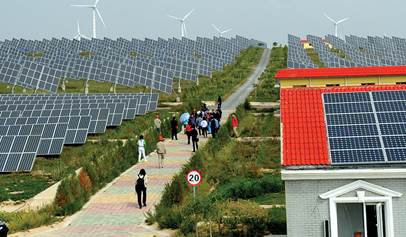
Clifford said that what is also impressive is how the region – Asia ex-China – performed with spending more than US$60 billion on clean tech last year, about the same as the EU. Asia is playing catch-up, but it is putting in the money and resources; and it’s not only government initiatives and policies but a lot of corporate work as well.
“What works best is when government, business and civil society work together; and that we are using prices as much as possible to drive change as opposed to super-detailed regulations.
“And businesses are really giving the lead and direction to do what they do best, which is to solve this kind of problem,” he said.
How green was my
Special Administrative Region
By Gavin Coates
[dropcap]M[/dropcap]ay 6 1982: My first morning in Hong Kong. Desperate to brush my teeth after a night out at the Bull and Bear and Disco Disco, I staggered to the bathroom, turned on the tap and waited in vain. Outside was torrential rain the like of which I had never seen before, but like a latter-day, urban Ancient Mariner I had not a drop to drink.
I mention water rationing, because this partly explains why so much of Hong Kong Island and the New Territories was not developed. Not only is it difficult to create construction terraces on mountains, but before Hong Kong could buy water from the Mainland, the water catchment areas and reservoirs were of critical importance and had to be kept free of development. It’s no coincidence that the Country Parks largely overlap with these catchment areas. Like many, I was astonished at the beauty and extent of the Country Parks only fairly recently established thanks to the governor, Sir Murray MacLehose. They and the other undeveloped hillsides, islands and beaches alone, endow Hong Kong with exceptional green credentials in terms of the proportion of protected land area.
The New Town Development Programme was instigated in parallel with the establishment of the Country Parks and this really kicked things off for the landscape architecture profession here, with a lot of help from former FCC member Michael Kirkbride. Entirely new cities like Shatin rose from nothing, starting in the mid-1970s, followed by Tai Po, Fanling, Tuen Mun, Sheung Shui and Yuen Long. The Hong Kong new town programme was to some extent a transplant from the British new town programme, requiring landscape architects to design the open spaces, parks, housing estate landscapes, as well as the greening of the road and land formation infrastructure.
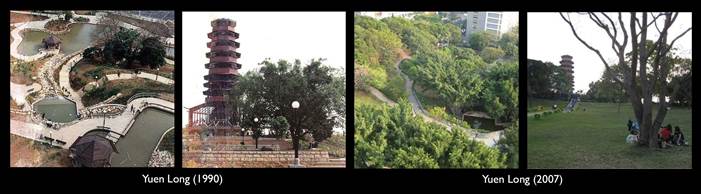
Green times
From 1982 I worked mainly on Tseung Kwan O New Town (formerly Junk Bay) and various housing estates. I’m particularly proud of having been involved in the design of Yuen Long Town Park, completed in 1991. Unlike most other Hong Kong parks, which are terribly regimented, it is much freer; people sit on the grass, have picnics, play Frisbee, and relax, like in a real park.
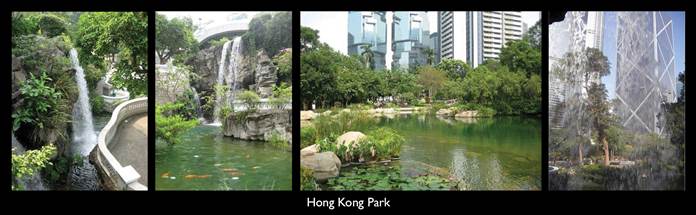
In the late 1980s I was involved with the preservation of the big banyan tree at Pacific Place between the Conrad and Island Shangri-la hotels. Around the corner, the waterfall and lake area of Hong Kong Park turned out really well; the main waterfall must feature in countless wedding photographs. Try knocking on the stone face and you’ll find it’s hollow – all artificial but very professionally so.
At that time, I also started doing illustration and cartoon work, which became my main line of work until 2004. From 2000 to 2008 I drew the daily editorial cartoon for The Standard newspaper and a weekly cartoon for Hong Kong ComputerWorld from 1987 until 2004.
For the past 11 years I’ve worked on a series of Greening Master Plans (GMPs) commissioned by the Civil Engineering and Development Department of the Hong Kong government. Although the scope of the GMPs was mainly restricted to the streets and roadsides, more than 20,000 trees have been planted so far, scattered all over the urban areas of Hong Kong and Kowloon.
It really is quite exciting to be able to go around the city and check up on how they’re doing.
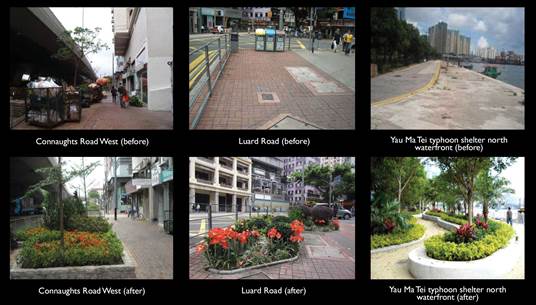
The GMPs were great as far as they went, but did not change the layout of the city. They did not address circulation or land use issues. If you wanted to green Queen’s Road East, for example, the vehicular lanes would have to be drastically reduced in order to plant trees down the street. Then you are up against entrenched attitudes. When it comes to this topic our policymakers seem to be stuck in the 1950s. The rest of the world is moving on, and urban design is increasingly about pedestrianising, reducing traffic speeds, widening footpaths, and putting in bicycle lanes. In Hong Kong the streets are exactly the same as they were when I first saw them in 1982. There has been little positive progress, and it is a bit frustrating.
Another area I would love to get my hands on is the ‘urban fringe’, that is the areas between the Country Parks up on the hillsides and the urban areas themselves. Many of these areas are former squatter areas which are now fenced off. They have tremendous potential to be developed as informal parks and woodlands, easily accessible to the urban population and dramatically improving accessibility – the slopes below Tai Hang Road, for example.
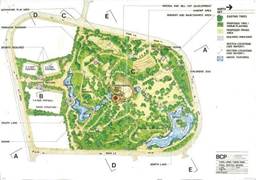
Good and bad
Much has been achieved over the years and there is still progress, albeit painfully slow. The opening up of the Central Waterfront Promenade is a huge step in the right direction – after waiting 150 years people will finally be able to walk along the seafront from Central to Wan Chai.
By the way, that whole waterfront is zoned as a park, let’s just hope we don’t have to wait another 20 years or more for it to be built.
The West Kowloon Park should finally appear in a few years, two decades after the land reclamation was carried out. Progress in urban planting is of course only one component of being green, and is frankly reduced to window dressing if the government persists with endless highway construction and massive, highly destructive projects like the rubbish incinerator proposed on Shek Kwu Chau island off Lantau.
When you go back to your old projects and see people enjoying the environment, you see the trees you planted now mature, that is very exciting. Now, I am teaching landscape architecture at HKU. I hope to encourage students to be bold in their thinking, to develop a passion for plants, design, and to make a positive difference. All we need now is a CE with a green rather than reinforced concrete mindset.
Photos by Gavin Coates
Green story books
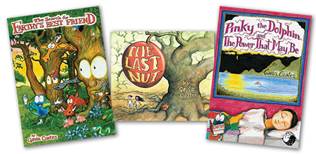
[dropcap]I[/dropcap]n the grounds of the Eastern and Oriental Hotel in Penang stands, or at least stood, a truly magnificent tree. One that I could not identify, which for someone with an interest in trees, is always frustrating. I showed its impressive fruit to various people to no avail until the Tamil doorman proudly announced it was aptly called a ‘horseball tree’. The herbarium at Singapore later told me it was a Sterculia but somehow the first name was more evocative.
The image of the tree and its potential progeny remained with me and when I was confronted with responsibility for my own progeny in the form of my newborn son, a story began to germinate. The result was my first illustrated book “The Last Nut”, dedicated to all children under the age of 125, which I bet includes you. I’ll let you discover the story yourself, and say only that it involves a nut that becomes a mighty tree and that the most important character can be seen in the mirror at the end of the story.
The best way to distribute the book turned out to be by visiting schools, reading the story, and asking the schools to send out order forms afterwards. I quickly learned that the majority of children are way ahead of most adults when it comes to curiosity and concern about our environment.
A second book “Pinky the Dolphin and The Power That May Be” followed, a story about the plight of the pink dolphins that live off Lantau, again ending with the mirror.
This was followed by ‘The Search for Earthy’s Best Friend’ featuring a characterisation of our planet, with guess-who at the end of the story.
These three books suit the 5 – 10 age group, other titles “Earthy Love” and “Earthy is Nuts About Trees” cater for younger readers or listeners.
Other titles include “My Life My Chopstick”, which explores the futility of life as a single, megalomaniac chopstick, but ends with a happy pair.
I have read these books to thousands of children and am always amazed by their incisive questions.
I wrote and illustrated all the books and if you would like to find out more, please have a look at http://www.earthypublications.com/. FCC members are welcome to order from me directly.
Gavin Coates