
Members Area Logout

Maria Ressa and Caoilfhionn Gallagher express ‘shock’ at Hong Kong national security law

Rappler CEO Maria Ressa and international human rights lawyer, Caoilfhionn Gallagher, have expressed shock at new national security legislation imposed on Hong Kong.
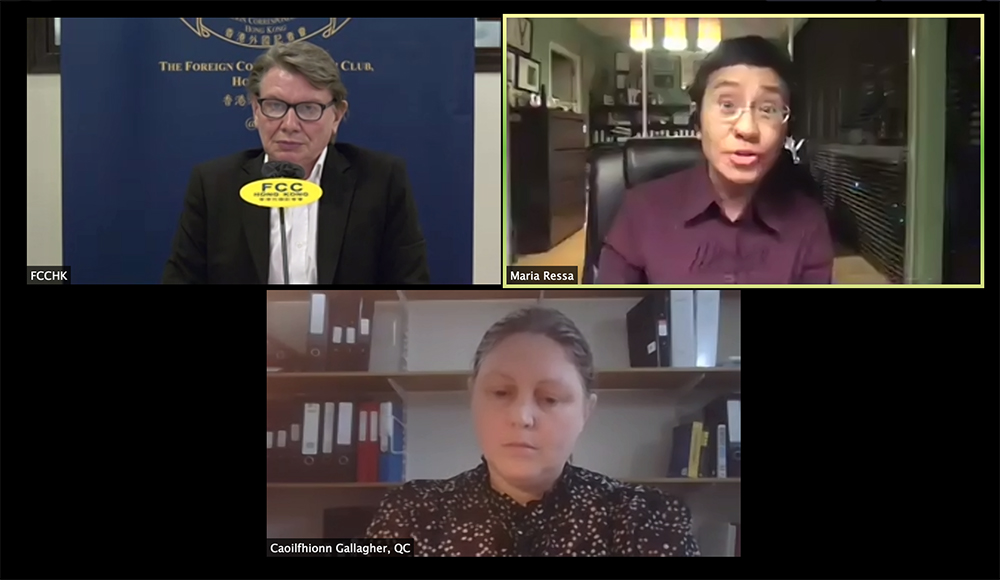
FCC First Vice President, Eric Wishart, interviews Maria Ressa and Caoilfhionn Gallagher on July 9. FCC First Vice President, Eric Wishart, interviews Maria Ressa and Caoilfhionn Gallagher on July 9.

Joining an FCC webinar on her fight against her recent conviction in the Philippines on cyber libel charges, Ressa was unequivocal when asked what was her reaction to the introduction of the law: “Shock”.

“When we were looking at the protests and this surge for press freedom… I understood why and we all were trying to understand, why is that not happening here? What’s the difference?

“What we’re seeing is really a geopolitical power shift and COVID-19 is helping that. But this is also where I feel Hong Kong is punching above its weight, what you guys do will impact the rest of us. And the Philippines is also punching above its weight in terms of a geopolitical power balance because President Duterte’s shift from the US to China and Russia. That is shifting the power balance in the South China Sea.”

Gallagher, a renowned lawyer who leads Ressa’s international defence team alongside Amal Clooney, expressed “shock and concern”. She was also deeply concerned by Carrie Lam’s July 7 comments in which the Hong Kong Chief Executive said she would give guarantees about press freedom to the Foreign Correspondents’ Club and journalists if they also give “a 100% guarantee that they will not commit any offences under this piece of national legislation”.

“That is a promise that’s not worth the paper it’s not written on, if I can put it that way, when you then look at the law, which is breathtakingly broad. I read with some horror the description of the crime of subversion, undermining the power and authority of central government. So the crimes themselves are exceptionally broad.”

She added: “I’m very concerned by the provisions relating to regulation and surveillance. The part that someone suspected of breaking this breathtakingly broad law can be wiretapped and put under surveillance is of serious concern to journalists.”

On her legal fight against her June conviction and sentence of six years in prison, Ressa said she was “geared up for battle”.

The executive editor of news website Rappler.com was arrested last year over an allegedly defamatory article published in 2012 which linked a businessman to trafficking and drug smuggling. She denied charges of cyber libel, calling them “baseless”. The move came several months after a warrant was issued for her arrest on seven charges of tax fraud — a case she called “politically motivated”. Rappler has been a frequent critic of President Rodrigo Duterte and his administration.

On June 29, Ressa and co-defendant Reynaldo Santos Jr filed a motion for partial reconsideration, appealing to Manila Judge Rainelda Estacio-Montesa to reconsider her decision.

The FCC issued a statement deploring the conviction, saying it set a precedent and could have a “chilling effect on the press in the Philippines and across the region”.

Club president Jodi Schneider said: “Press freedom, already endangered in the Philippines, is now further undermined with this high-profile verdict.”

FCC Seeks Clarification on How National Security Law Affects Media

The Foreign Correspondents’ Club, Hong Kong on July 7 noted the statement by Chief Executive Carrie Lam at a press conference before the Executive Council meeting in which she answered questions about the new National Security Law.

In answer to a question regarding letters from the FCC seeking a guarantee that journalists would be allowed to continue reporting on any topic under the law, the Chief Executive replied: “If the Foreign Correspondents’ Club or all reporters in Hong Kong can give me a 100 percent guarantee that they will not commit any offences under this piece of national legislation, then I can do the same.” The Chief Executive added that the new law “clearly defined” the four types of actions that are now unlawful.

The FCC stresses that it respects the laws of the Special Administrative Region. At the same time, the FCC has written to the Chief Executive seeking clarity on specific areas where the new law is vague and where terms are undefined, particularly regarding the press and freedom of speech. So far, our detailed questions remain unanswered.

For example, the FCC in its letter asked whether any specific topics are off limits for news reporting. Also, will journalists face legal risks for quoting government critics or critical voices? Will journalists face legal risk for their social media posts? Can journalists be held liable for activities or events, like attending conferences, outside of China or Hong Kong where critical views might be expressed?

As we have not received a detailed response to our specific and pertinent questions, we would again urge the Chief Executive to provide a more complete and comprehensive response to the concerns raised in our letter. We further would like to reissue our open invitation for the Chief Executive to give a luncheon address at the FCC and answer questions in an open forum, as a way to address journalists’ concerns created by the vagaries of the new law.

To operate within the new law, the media needs to know precisely what is permissible. We look forward to receiving clarification from the Chief Executive, as well as having her come to the FCC to speak.

The national security law: Hong Kong journalists should be more serious about protecting sources and information

Journalists in Hong Kong must be a lot more serious about protecting their sources and data if they are to navigate the new national security law.

That was the opinion of three panelists discussing the impact of the new legislation on press freedom in the city. The event on July 7 came a week after China’s top legislature enacted the law which criminalises any act of secession, subversion, terrorism, and collusion with foreign or external forces.

Keith Richburg, director of the Journalism and Media Studies Centre at the University of Hong Kong and a former Washington Post Beijing bureau chief, said he potentially foresees visa restrictions for journalists in Hong Kong who cross the so-called ‘red line’ in their reporting. However, he added that the details of the ‘red line’ have been deliberately vague to allow authorities to be flexible in how the legislation is interpreted.

The key for journalists, Richburg said, was “to figure out how to operate within the law and where the red lines are – coming as close as you can without crossing them”.

Joining Richburg on the panel was Sharron Fast, a legal expert from the Journalism and Media Studies Centre, and author Antony Dapiran. Fast observed that the law is difficult to interpret as two streams had been created – authority, and the Hong Kong judiciary. She highlighted some of the articles that could threaten press freedom in the city, such as Article 41, “one of the  many provisions that waters down the right of a fair trial”, she said. No media is permitted in the courts where the offence is deemed to be state secret, yet there is no definition of state secret.

Dapiran, also a corporate lawyer, raised the issue of protection of information and data in relation to the city’s police being given new powers to search without a warrant obtained through the courts. He advised journalists to be very vigilant about the way they store information and data.

You can watch the entire event here

An Open Letter to the Hon. Carrie Lam Cheng Yuet-ngor on the National Security Law

On 24 June, the FCC wrote an open letter to the Chief Executive of Hong Kong, the Hon Carrie Lam Cheng Yuet-ngor, urgently seeking clarification of the potential impact of the pending national security law on the city’s media including foreign correspondents and the broader implications for press freedom. We expressed our concern that the new law will curtail the ability of journalists to report freely about Hong Kong and mainland China, as is our right under Article 27 of the Basic Law. We received a reply from the Chief Executive’s Office, which did not answer any of our specific concerns. We are publishing that letter below, along with second letter requesting an urgent response, especially now that the national security law has taken effect.


An Open Letter to Chief Executive Carrie Lam Cheng Yuet-ngor Seeking Clarification on National Security Law

On June 24, representatives from the Foreign Correspondents’ Club, Hong Kong, delivered an open letter to the Chief Executive of Hong Kong Special Administrative Region, the Hon Carrie Lam Cheng Yuet-ngor, seeking clarification of the potential impact of the pending national security law on the city’s media including foreign correspondents, and on the broader implications for press freedom.

Survey: Journalists in Hong Kong fear for personal safety as China pushes national security law through

A new survey conducted by the Hong Kong Journalists Association (HKJA) and released on June 19 showed that an overwhelming majority of journalists in Hong Kong worry about their personal safety if the new national security law is enacted. The legislation, approved by the National People’s Congress in Beijing, would criminalize any act of secession, subversion, terrorism, foreign intervention, and allows Chinese security forces to operate in the city.

Read the CPJ report on the survey here.

So much at stake if Rappler’s Maria Ressa is jailed, says leading press freedom advocate

The conviction of journalist and Rappler founder, Maria Ressa, is a “Waterloo moment” for press freedom, says a leading advocate for the protection of journalists.

FCC First Vice President, Eric Wishart, interviews Joel Simon and Amelia Brace. FCC First Vice President, Eric Wishart, interviews Joel Simon and Amelia Brace.

Joel Simon, executive director of the Committee to Protect Journalists (CPJ), told an FCC webinar that the full force of the press freedom movement was being deployed to protect Ressa, who was sentenced to six years in prison by a Philippines court on June 15 for cyber libel. Ressa and Rappler’s reporting has been critical of President Rodrigo Duterte’s government.

Simon, a friend of Ressa, said her conviction would have far-reaching consequences and that it was crucial to prevent her being jailed.

“We have to win because if we do not win, if we cannot keep Maria Ressa out of prison, then every tyrant and every repressive government will feel that they can act against journalists without consequence. So much is at stake. It’s an absolute Waterloo moment for the press freedom movement,” he said.

Joining Simon on the June 18 webinar on the growing threats to journalists during the recent Black Lives Matter protests in the United States was Australian journalist Amelia Brace. The US correspondent for Australia’s Seven Network was attacked along with her TV crew by police just yards from the White House as the area was cleared to make way for a presidential photo opportunity. Footage shows how cameraman Tim Myers was injured when a police officer in riot gear hit him with a shield before punching the camera. Brace was struck several times across the back with a baton and hit by pepper balls ahead of President Donald Trump’s walk from the White House to nearby St. John’s Church.

The video of the attack has been watched on the network’s video channel more than 8 million times. Australian Prime Minister Scott Morrison described the incident as ‘troubling’ and called for an investigation.

“It was a terrifying moment and quite a violent moment as a journalist,” Brace admitted. “The heavy-handed approach by police was completely disproportionate.”

Simon added that the CPJ’s U.S. Press Freedom Tracker had documented more than 400 attacks on journalists by police in the United States since the protests began. He said he believed that the militarisation of the police force was the dynamic that accounted for the significant rise in attacks on credentialized reporters covering the nationwide demonstrations.

“This is how the police in the United States are trained,” he said.

Watch the webinar

Reminder of minimum-spend

Reminder of Minimum-spend
       

Dear Members:

Please note this further reminder that members must meet their minimum-spend requirement of HK $1,800 for the six months to June 30 or they will be charged after that date.

We encourage you to use your outstanding minimum spend at the club before then. You can use it in any of the outlets, for take-away food and wine, or to purchase souvenir items.

Additionally, we have added vouchers — in denominations of HK$50, $100 and $500 — that can be purchased at reception by June 30 to be used in the club through Nov. 30, 2020. (Certain conditions apply including not being eligible for wine home delivery or to offset future minimum spend, and are not transferable.)

We appreciate your support and look forward to assisting you. For enquiries please call 2521 1708 or email [email protected]

19 June 2020


Check us out on:             


FCC Hong Kong deplores guilty verdict against Maria Ressa, Reynaldo Santos

The Foreign Correspondents’ Club Hong Kong deplores the guilty verdict against Rappler CEO and executive editor Maria Ressa and its former researcher-writer Reynaldo Santos on cyber libel charges.

Maria Ressa at the May 17 FCC club lunch. Photo: Sarah Graham/FCC Maria Ressa at the May 17 FCC club lunch. Photo: Sarah Graham/FCC

A court in Manila sentenced them to up to six years in jail but they can appeal the verdict.

“The FCC is gravely concerned about the precedent this sets and the possible chilling effect on the press in the Philippines and across the region,” said FCC president Jodi Schneider. “Press freedom, already endangered in the Philippines, is now further undermined with this high-profile verdict.”

Ressa, executive editor of news website Rappler.com, was arrested last year over an allegedly defamatory article published in 2012 which linked a businessman to trafficking and drug smuggling. She denied charges of cyber libel, calling them “baseless”. The move came several months after a warrant was issued for her arrest on seven charges of tax fraud — a case she called “politically motivated”. Rappler has been a frequent critic of President Rodrigo Duterte and his administration.

Ressa co-founded Rappler in 2012 and turned it into one of the region’s most influential media outlets, even as the Philippines government arrested her and made efforts in the courts to silence her and the publication.

With a career in journalism spanning more than 30 years in Asia, she has won multiple awards for her work, including the 2018 Gwen Ifill Press Freedom Award from the Committee to Protect Journalists. In December 2018, Ressa was named a Time Person of the Year, and most recently was chosen as among Time’s 100 most influential people of 2019.

She has been a regular speaker on press freedom at FCC Hong Kong events.

The conviction of Ressa under the Philippines’ 2012 cyber libel law confirms widespread fears it would be used against online journalists and would harm the freedom of the press in the country. The law allows for up to 12 years in prison for a conviction of cyber libel, and cases can be brought as many as 12 years after an article or post, posing grave risks to journalists who wish to report and write critically on those in power.

Freelance journalist Laurel Chor recognised for Hong Kong protests coverage

Laurel Chor, a freelancer and FCC member, has been given an honourable mention in the International Women’s Media Foundation’s (IWMF) annual Anja Niedringhaus Courage in Photojournalism Award for her coverage of the Hong Kong protests and showing the region’s struggle for democracy, freedom and human rights.

Laurel Chor. Laurel Chor.

Named after German AP photojournalist Anja Niedringhaus, who was killed in 2014, the award recognises gripping, nuanced photojournalism that inspires action. This year’s awardee was Masrat Zahra (Kashmir), and an additional honourable mention was awarded to Nahira Montcourt (Puerto Rico).

Chor is an award-winning freelance photojournalist from Hong Kong. In 2019, she worked with the New York Times, National Geographic, Getty, AFP, Reuters, EPA, the Los Angeles Times, the Wall Street Journal, NBC News, the Telegraph, the South China Morning Post, Hong Kong Free Press, the New Humanitarian, the Spectator, the Nikkei Asian Review, the Guardian, the Washington Post and Quartz.

Currently, Chor is covering the Hong Kong protests. Previously, she was the Asia reporter and producer for VICE News Tonight on HBO, covering news, culture and politics across the region: from the Rohingya refugee crisis to the Chinese social credit system, from the assassination of Kim Jong Un’s half-brother to Chinese “boy” bands and from the earthquake in Palu, Indonesia to the war on drugs in Bangladesh.

Prior to that, Chor was the managing editor for Coconuts Hong Kong. In 2013, Jane Goodall appointed her to be the ambassador for the Jane Goodall Institute in Hong Kong.

Commenting on Chor’s portfolio, the jury noted that her portfolio demonstrated, “unique framing, complex commentary on community and great skill with the sequencing of the narrative.”

We measure site performance with cookies to improve performance.