
The FCC Journalism Conference returns — Saturday 14 April, 2018
 |
 |
|
From Rocket Man to the Rohingya
Saturday 14 April 2018
Save the date for the Foreign Correspondents’ Club Hong Kong’s third annual journalism conference. In a turbulent period for the news industry the conference will feature workshops and discussions led by panels of the region’s leading editors and reporters. Topics will include investigative reporting, women in the newsroom, fake news, challenges to press freedom, how to shoot video, get a book published, deal with traumatic assignments and avoid the pitfalls of stereotype reporting. Speakers include reporters and editors from major news organisations such as BuzzFeed, HK01, Agence France-Presse, Associated Press, The New York Times, CNN, The Wall Street Journal, Bloomberg, Reuters, the Financial Times, Le Monde, Quartz and representatives from Google and Facebook. Details will be sent out along with booking forms in mid-March. |
Considering an investment in Bitcoin? Expert Bobby Lee gives this advice
Don’t be indecisive over investing in Bitcoin – and buy as much as you can, says an expert in the high-value digital cryptocurrency.
 Bobby Lee, Co-Founder and CEO, BTCC, gives his tips for investing in Bitcoin. Photo: Sarah Graham/FCC
Bobby Lee revealed four common mistakes when buying the currency when he spoke to a packed first floor at the FCC on January 3. Lee, owner of cryptocurrency exchange BTCC, pointed out that the longer procrastinators hesitated in buying Bitcoin, the more it increased in value. He cited his own experience, when in 2011 he heard about Bitcoin but decided against investing until a few years later, by which time its value had massively increased.
Another common mistake when investing in Bitcoin was selling the moment it made a small gain – and by small Lee was talking about up to 300%, which, when looked at in the context of the currency’s performance in the last year alone is a drop in the ocean. Long-term gain is worth waiting for, he said.
Lee also advised buyers not to sell during a panic crash. Such a young currency is prone to volatility, he said, so hanging on to it through thick and thin will produce yields.
Despite the mountain of publicity around the cryptocurrency in recent months, during which its value soared to almost US$20,000 then settled back down just over US$15,000 at the time of writing, there remains uncertainty over whether it can actually be used to make everyday purchases. Although a small number of businesses are beginning to accept the digital currency, it still cannot be used, for example, to buy a cup of coffee or groceries due to its exceptionally high value.
Lee explained that the cryptocurrency – so called because it is encrypted when units of it are transacted or “mined” – has introduced three new concepts to the world and society, the first being that it is the only currency to have a limited supply. Its secretive founder, Satoshi Nakamoto – probably a pseudonym – imposed a limit that means only 21 million bitcoins will ever be mined.
It was also unique in that for the first time the world has a currency that is “not organised or controlled by any single entity, individual or government”. This means owners of bitcoins can move it around as they please.
Thirdly, it’s an asset that is untraceable to the owner. Whereas purchasing a house or car requires ownership under identity, obtaining Bitcoin does not due to its encryption.
While the currency is now being embraced globally, some countries, including China, have cracked down on it by closing Bitcoin exchanges. Lee’s company, BTC China, was the first Bitcoin trading platform in China. In September 2017, China cracked down on cryptocurrencies after the People’s Bank of China said trading could pose major financial risks to the country.
“What do Chinese regulators think of Bitcoin? For them it’s very challenging,” explained Lee, adding that authorities were reluctant to regulate the currency because they considered it not real money, and because it violated foreign currency controls. They also believed it to be a security risk open to hacking, he said. Since the crackdown, its value has increased by five times, Lee added.
Other Asian countries such as South Korea are following suit, although Japan has responded positively, allowing the opening of exchanges.
Pictures: The FCC’s New Year’s Eve party 2017
FCC members and guests packed the club on December 31 to welcome the new year.
With a little help from DJ Keith, members danced the night away and, as is tradition at the club, they all raised a glass as a piper played at midnight.
See our rogues’ gallery below.
 Photo: FCC
 Photo: FCC
 Photo: FCC
 Photo: FCC
 Photo: FCC
 Photo: FCC
 Photo: FCC
 Photo: FCC
 Photo: FCC

 Photo: FCC
 Photo: FCC
 Photo: FCC
 Photo: FCC
 Photo: FCC
 Photo: FCC
 Photo: FCC
 Photo: FCC
 Photo: FCC
 Photo: FCC
 Photo: FCC
 Photo: FCC
 Photo: FCC
 Photo: FCC
 Photo: FCC
 Photo: FCC
 Photo: FCC
 Photo: FCC
22nd Human Rights Press Awards open for entries from January 1, 2018
Asia’s most prestigious honours recognising outstanding human rights reporting will be open for entries from 1 January 2018 to 9 February 2018.
 Last year’s winner of the Photography Feature was Agence France-Presse’s Noel Celis for his pictures of Quezon City jail. Photo: Noel Celis/AFP
The Human Rights Press Awards, now in their 22nd year, are organised by the Foreign Correspondents’ Club, Hong Kong, Amnesty International and the Hong Kong Journalists Association. The awards aim to increase respect for people’s basic rights and to focus attention on threats to those freedoms.
Submissions must have been reported from the Asia region and been published or broadcast during the past calendar year between 1 January and 31 December 2017. Entries must be in either English or Chinese. Categories include Spot News, Features, Multimedia, Television/Video, Radio and Photography.
Each entry must cite the specific article of the Universal Declaration of Human Rights that the work seeks to address. This landmark document, which marks its 70th anniversary next year, set out the alienable rights to which every human being is entitled. The full text is available here: www.un.org/Overview/rights.html
Please mark your calendars and be ready to submit your work!
The online entry form will be open on 1 January 2018 at:
https://humanrightspress.awardsplatform.com/
For further information, please visit:
http://humanrightspressawards.org
Stay up to date with the latest news – follow us on Twitter and Facebook
For queries, please contact the awards administrator:
Cintia Huen
The Chinese University of Hong Kong
School of Journalism and Communication
Email: [email protected]
Tel: (852) 3943 8705
Chinese New Year 2018 Opening Hours

Festival Season Opening Hours

Income Statement – November 2017
November 18, 2017 Board minutes
FCC Hong Kong calls for immediate release of Reuters journalists held in Myanmar
The Foreign Correspondents’ Club of Hong Kong calls for the immediate release of Wa Lone, 31, and Kyaw Soe Oo, 27, two Myanmar journalists with the Reuters news agency who were arrested on Wednesday.
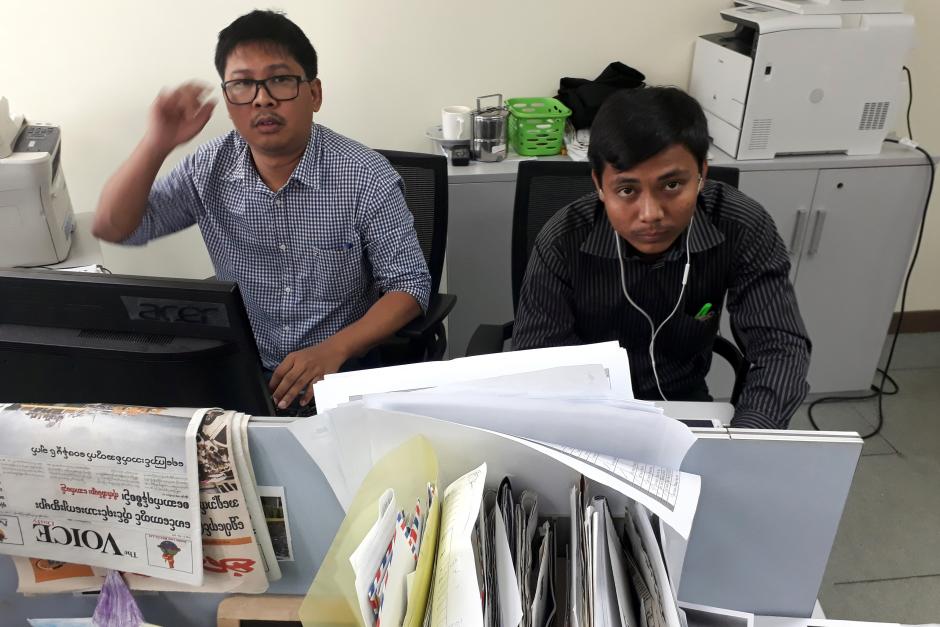 Reuters journalists Wa Lone (L) and Kyaw Soe Oo, who are based in Myanmar, pose for a picture at the Reuters office in Yangon, Myanmar December 11, 2017. Picture taken December 11, 2017. REUTERS/Antoni Slodkowski
The pair have been charged under a section of the Official Secrets Act that carries a maximum sentence of 14 years in prison. The government has released a photograph of them wearing handcuffs with documents displayed before them.
Reuters has expressed its outrage over the arrest and accused Myanmar authorities of an attack on press freedom.
The US State Department has also voiced concern for the “safety and security of international reporters who are simply just trying to do their jobs”.
Wa Lone and Kyaw Soe Oo have both recently reported on the refugee crisis in Myanmar’s Rakhine state, where a deadly military “clearance operation” has resulted in more than 600,000 ethnic Rohingya Muslims fleeing into Bangladesh.
Their arrest is part of a deepening crackdown on freedom of expression in Myanmar, which is facing severe criticism from the international community for its handling of the Rohingya crisis.
Journalists have been banned from travelling independently to northern Rakhine to investigate the circumstances of the crackdown, and verify refugees’ accounts of murder, mass rape and burning of villages by security forces.
In November, two foreign journalists along with their interpreter and driver were sentenced to two months imprisonment for filming with a drone without official permission. And in June three journalists were detained in war-torn northern Shan state and spent two months in custody.
As Myanmar undertakes its transition to democracy, it is vital that the country respects the beneficial role of a free and independent media and ensures that journalists are able to do their work without threat of retaliation.
The arrest of these two Myanmar journalists under the Official Secrets Act is unacceptable and counterproductive in a country aiming to take its place in the international community after decades of military rule.