Members Area Logout

Electric cars, driverless vehicles, and subscriptions: How Volvo plans to stay ahead of the curve

The future of automobiles is electric – and driverless – according to Volvo Cars president Håkan Samuelsson, whose company recently signed a contract to supply 24,000 ‘robotaxis’ to Uber.

Håkan Samuelsson, Volvo Cars CEO, discussed the company's success under Chinese ownership. Photo: Sarah Graham/FCC Håkan Samuelsson, Volvo Cars CEO, discussed the company’s success under Chinese ownership. Photo: Sarah Graham/FCC

And from 2019, the Swedish car maker, which was bought by Chinese firm Geely Holdings in 2010 after suffering losses as a result of the financial crisis two years before, will only produce hybrid and electric cars, ditching the combustion-propelled vehicles it has made since it was founded in 1927.

FCC members and guests were given a glimpse of the future as Samuelsson outlined the company’s ambitious plans during the January 23 club lunch, made possible since it was bought by Geely, a move that gave Volvo record sales last year.

“We have a very motivated workforce right now,” Samuelsson said, giving his thoughts on what has driven the company’s record sales. “A big part of the growth is coming from China, which it should as it’s the largest car market in the world.”

Indeed, five years ago, according to Samuelsson, Volvo sold under a thousand cars in China. Last year, 114,000 were sold – manufactured at its Chengdu factory. But China is not the only foreign soil to be producing the world’s safest car: it is set to open “the most sustainable automotive plant in the United States” in Charleston, South Carolina, this year. Pre-production of the new Volvo S60 will start in the first half of 2018 and serial production in the third quarter.

However, when asked why Geely had recently bought a major stake in truck manufacturer AB Volvo, and what the long term plan was for that arm of the company, Samuelsson declined to answer.

The company has also introduced a subscription car service, allowing motorists to get a new vehicle for a flat monthly fee which includes insurance, maintenance and service. “With our subscription, you have one flat price in the whole country,” he said.

Samuelsson, who joined the company seven years ago, was in Hong Kong attending the around-the-world Volvo Ocean Race as it made its first ever stop in the city. However, the event has been overshadowed by tragedy following the death of a fisherman in Hong Kong waters after a fishing vessel collided with a boat taking part in the race. When Samuelsson was asked about the tragedy, he said: “Of course we have to find out how this happened, but it’s really tragic. I feel a lot for these people being out, trying to make their living fishing. We will of course try to learn from it and see it should never happen again.”

Income Statement – December 2017

December 9, 2017 Board minutes

We’re keeping an eye on it: Macau journalists’ association on its fight to safeguard press freedom

Journalists in Macau still enjoy a level of press freedom despite incidents such as the barring of Hong Kong reporters into the enclave following Typhoon Hato in 2016, says the president of the Macau Portuguese and English Press Association (AIPIM).

José Carlos Matias spoke about press freedom in Macau on January 18, 2018. Photo: Sarah Graham/FCC José Carlos Matias spoke about press freedom in Macau on January 18, 2018. Photo: Sarah Graham/FCC

And while publications in the Special Administrative Region receive government subsidies, this has not affected the integrity of the Portuguese or English language newspapers, said AIPIM president José Carlos Matias, emphasising that this was his opinion. He added that he was unable to comment on Chinese language publications.

The 30 square kilometre former Portuguese colony, has the highest concentration of media in the world, with a staggering 18 daily newspapers (in Chinese, Portuguese and English) to serve the 648,000 population. Additionally it has 19 weeklies, two TV and radio stations.

In recent years, Macau has been the focus of fears over press freedom. In August 2016, four journalists – one from HK01, one from South China Morning Post and two from Apple Daily – were denied entry to Macau in the wake of the devastating Typhoon Hato. The government cited that they ‘posed a threat to the stability of the territory’s internal security’.

“The explanation by the authorities we found particularly hard to understand to say the least,” Matias told FCC guests. “We have to keep an eye on this problem that is becoming relatively common.”

In a separate incident, Portuguese-language weekly, Plataforma, was ordered by the Electoral Affairs Commission for the Legislative Assembly Election (CAEAL) to remove from its online edition an interview with a candidate of the Legislative Assembly elections. Matias explained that in Macau there is a period between publication of candidate lists and the start of the campaign during which electoral propaganda is banned. However, AIPIM issued a statement at the time that said: “AIPIM deplores this situation, stressing that it is perplexing that news content, such as an interview, can be considered electoral propaganda.”

Soon after, AIPIM conducted a survey among around half of its journalist members that highlighted a growing trend among authorities to limit access to information to reporters. Matias said that part of the issue was the shortage of bilingual translators working in the judiciary and government departments, where the predominant language is Chinese.

The survey, analysed by an independent third party committee of experts, also found that 80% of journalists believed there was press freedom in Macau; 70% didn’t face violation of press freedom rights; and 76% dealt with different types of restraint.

Matias said that future aims of the AIPIM include conducting new surveys to go deeper into the challenges faced by journalists; and to deepen ties with Chinese journalists’ associations to promote press freedom and access to information.

The Correspondent Magazine is looking for an editor

We are looking for an editor for the club’s magazine, The Correspondent.

We are confident that we will find an excellent editor from among the ranks of the club’s freelance journalists.

If you are a freelance editor with solid editorial experience then we are interested in hearing from you.

The Editor will be responsible for:

  • Coming up with ideas for stories
  • Commissioning freelance writers
  • Producing fresh content
  • Editing stories
  • Sourcing images
  • Liaising with the club’s social media editor
  • Working with the production editor
  • Managing a budget

If this is something that interests you and you have a strong editorial background please send a cover letter with your resume to [email protected] or leave it at the front desk to the attention of the Communications Committee.

Please note that beginning with the next issue the magazine will switch from being published every two months to quarterly.

FCC appalled at decision to close down Philippines news website, Rappler

The Foreign Correspondents’ Club, Hong Kong, is appalled at the move to close Rappler, a news organisation which has proved to be a brave and independent voice in the very challenging context of the Philippines since the election of President Rodrigo Duterte.

The Securities and Exchange Commission said on Monday that it had revoked Rappler’s operating licence because it violated the country’s restrictions on foreign ownership of domestic media.

Rappler has defied Duterte’s threats and intimidation to expose corruption within the police force, which has led the deadly crackdown against drugs, as well as in government ranks.

Rappler has rejected the ruling which it describes as “pure and simple harassment, the seeming coup de grace to the relentless and malicious attacks against us since 2016″. It will file an appeal within the next two weeks.

The order for Rappler to be shut down is part of a broader trend by Duterte to silence his critics. Duterte laid the foundations for his campaign of intimidation against the media shortly after he was elected in 2016 when he told reporters that some could be legitimately killed.

“Just because you’re a journalist you are not exempted from assassination, if you’re a son of a bitch,” he said at the time.

The Rappler shutdown marks a dark day for press freedom and democracy in the Philippines. We call on the authorities to reverse the decision and allow Rappler and other media outlets to operate freely and safely.

The FCC stands with Philippine media groups, including the National Union of Journalists and the Foreign Correspondents Association of the Philippines, which have denounced the Rappler ruling.

And it salutes the journalists who work in extremely difficult conditions to cover the threats to democracy and press freedom in their country.

Harassment of journalists in China: reporters covering Xinjiang prevented from conducting interviews

Here are the latest reports of harassment against journalists covering events in China, courtesy of our colleagues at the FCC China.

Axel Dorloff, ARD German Radio. Photo: Twitter Axel Dorloff, ARD German Radio. Photo: Twitter

INCIDENT REPORT – submitted December 2017

By Axel Dorloff, ARD German Radio.

We went to Xinjian Cun on Monday, December 11. After about 20 minutes of interviews and talking to different people and migrant workers (who all were very open and willing to talk) a group of about 15 to 20 “Te Qin” security guys approached us and asked us to leave. We would have no sufficient permission to do those interviews. We insisted that in this case we wouldn’t need that and tried to go on with our work. But they repeatedly asked us to stop our interviews and wouldn’t leave us alone until we did that. We finally went to the car and headed to the neighbouring village to go on there.


INCIDENT REPORT – submitted December 2017

By Macarena Vidal, El País.

When we went to Daxin, we had no problem at the beginning and the police would only look on while we worked. But after a few interviews, another policeman arrived and told us to go with him to the station “to receive a briefing”. Needless to say, we never received such briefing. At least we did not have to stay there for very long. After about 15-20 minutes a girl arrived, said that a press conference “may be arranged in the future”, told us to contact the Beijing city information office and drove us to where our car was waiting, making clear that we should leave. They took copies of our press cards, but so far we have not been told off or summoned by anyone.

INCIDENT REPORT – submitted December 2017

By a correspondent with an American news organisation.

Two of us were detained back in early November in Xinjiang, lasting from approx. 6pm to 5am. We were told the typical line: reporting in the area required prior permission according to law. We pointed out that there exists no such Chinese law, and for the past decade or so foreign journalists have been free to travel unannounced outside the TAR. They basically retorted that that’s not applicable in Xinjiang or in their local jurisdiction due to the security situation.

We had booked train tickets out of town that night at 11pm but they refused to let us go. They requested to see our photos and we refused but after some negotiation they backed down and we didn’t hand them over. We called the foreign ministry several times starting at around midnight, and for a few hours they seemed to try their best to negotiate with the local public security and propaganda officials on our behalf. We were moved from the public security department to a local hotel lobby at 1am, where interrogation and a lot of waiting continued. We were released at 5am after they interrogated us about the sequence of events for the fourth time and took a written record which both parties signed as per common procedure. They refused to let us take a picture of it but we recorded a reporter reading it over the phone to the bureau chief in Beijing.

We boarded a train at around 5:30am. Later that day after we landed in a different city we were met with (and in my case physically grabbed by) propaganda officials outside an airport. We were closely followed for a day and that night, we were told that every hotel that could take foreigners were booked even though we saw multiple people check into empty rooms. The local entry-exit bureau also refused to make an exception for us to stay at a lower-grade hotel, leading us to wonder if it was a coordinated attempt to deny us lodging. Local officials insisted it was not. We were not permitted to fall asleep by a security guard but caught a few winks on two couches in a hotel lobby while local and prefectural propaganda officials took turns watching us from a third couch. One of the officials, who is Uighur, noted that “sometimes I am denied a hotel room when I’m traveling because I’m Uighur, but that’s how it is and I don’t complain.” We left before dawn for a sleeper train and roused from our sleep by train staff who were instructed to monitor us, which they did via walkie talkies whenever we moved through train cars or prepared to disembark.

We were detained several more times the rest of the trip; I was at one point pursued by three officials on foot. I’ve previously been followed, pursued and interrogated for even longer in China, but this Xinjiang trip was by far the worst experience. The authorities were relentless in pursuing us and obstructing our work.

INCIDENT REPORT – submitted December 2017

By a correspondent from a western media outlet.

A correspondent from a western media outlet was called into the Foreign Ministry to discuss the reporter’s coverage of the evictions issue. They were told that while it was preferred that no more stories were done on this subject if there were to be any more they should be balanced and include the government’s perspective. The correspondent told them that repeated attempts to interview a Beijing government representative were declined by the government. The reporter was warned to guard against “Chinese public opinion” hardening against their stories however the meeting was friendly. The same correspondent (along with a Chinese staff member) were also called into the Exit Entry Police to discuss their coverage of the evictions issue. The police interviewed the two separately and recorded the interviews on video camera. The reporter was told they’d done nothing wrong but asked many questions about the basis for this coverage. It was a lengthy, polite discussion. The tone was friendly and the police said they merely wanted to better understand the situation. At one stage the officers asked if the reporter had sought the permission of local village officials to enter the eviction areas, in the same way that the managers of a danwei should approve an employee being interviewed. The journalist said that as this was a public space such permission did not seem necessary. The police at no stage specifically insisted that such permission was required under Chinese law.

What makes an MMA world champion? Resilience, determination… and 5,000 calories per day

As a child Alain Ngalani was bullied at school. As an adult he’s a Mixed Martial Arts world champion, his journey to the top triggered by the abuse suffered at the hands of older, bigger children.

MMA world champion Alain Ngalani revealed his gruelling daily regime during his talk to the FCC. Photo: Sarah Graham/FCC MMA world champion Alain Ngalani revealed his gruelling daily regime during his talk to the FCC. Photo: Sarah Graham/FCC

A mix of resilience, determination and passion for the sport has won Ngalani, known as The Panther, world titles in Jiu Jitsu, Karate and Muay Thai. He is also the owner of Impakt Gym in Hong Kong.

His daily routine sees him rising at 4.30am to meditate before beginning his high-intensity circuit training. “By eight o’clock in the morning, when everybody else is coming out, I’m gone,” he said – and that’s just the first training of the day. So what does he do with the rest of his time? “I eat every two-and-a-half hours,” Ngalani said, adding that he consumes 5,000 calories per day to maintain his 105kg physique.

The 42-year-old was guest speaker at the FCC on January 11 where he discussed his rise to the top. Hailing from Cameroon, he recalled the advice his mother gave him when he fell victim to the bullies: “Stand up for yourself.”

Ngalani, who knocked out opponent Hideki “Shrek” Sekine last September in a record 11 seconds, said the bullying motivated him to take up martial arts, adding that he’s now grateful to those who picked on him: “If they were sitting here today I would say you know, I forgive you,” he said. “What you did made me what I am today because it gave me the drive, passion and resilience. That incident woke something in me.”

Despite his early success at Judo, then Karate, his mother wanted him to become a doctor. Ngalani said his mother struck a deal with him: he could continue to train as long as he excelled at his studies. The moment his grades suffered, his training had to stop.

“I studied (sciences) until I went to university but it was not my passion, I felt I had to do it,” he said.

After his mother became ill and unable to pay the tuition fees, Ngalani decided to switch to sports science and pursue his dream of becoming a world champion. “I feel like I am a doctor myself because I’m still helping people. I have clients I meet every day to help them maintain a better lifestyle throughout their training,” he added.

So would Ngalani want to be a doctor if he weren’t a world champion MMA fighter? No, he said – dancing is his other passion: “I love dancing. As soon as I finish fighting I will be a dancer,” he said.

One sport he won’t take up is golf. When asked by a guest whether he had sustained any injuries in such a “dangerous” profession, Ngalani joked: “I don’t see it the way you see it. You say it’s a very dangerous sport but for me it’s a safe sport. Perhaps I am lucky, but when I watch other sports like rugby or golf… I saw someone twisting their hip!”

FCC Hong Kong and FCC Thailand call for the immediate release of Reuters journalists held in Myanmar

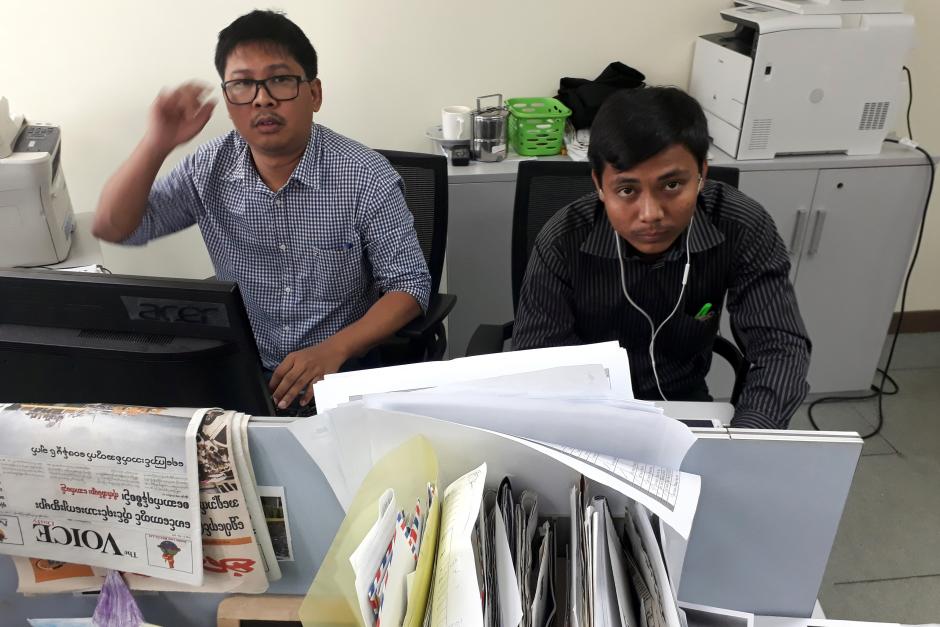
The Foreign Correspondents’ Club of Hong Kong and the Foreign Correspondents’ Club of Thailand demand the immediate release of Wa Lone, 31, and Kyaw Soe Oo, 27, two Myanmar journalists with the Reuters news agency who were arrested on December 21, 2017.

Reuters journalists Wa Lone (L) and Kyaw Soe Oo, who are based in Myanmar, pose for a picture at the Reuters office in Yangon, Myanmar December 11, 2017. Picture taken December 11, 2017. REUTERS/Antoni Slodkowski Reuters journalists Wa Lone (L) and Kyaw Soe Oo, who are based in Myanmar, pose for a picture at the Reuters office in Yangon, Myanmar December 11, 2017. Picture taken December 11, 2017. REUTERS/Antoni Slodkowski

The pair were formally charged in court on Wednesday for allegedly breaching the draconian Official Secrets Act, which carries a maximum sentence of 14 years in prison.

The FCC Hong Kong and FCC Thailand do not consider it to be a crime to be handed documents from sources – in this case from police officers who had invited the pair to a meeting. The two journalists were engaged in normal reporting activities, and had not committed any wrongdoing. All charges against them should be dropped.

“They arrested us and took action against us because we were trying to reveal the truth,” Wa Lone told reporters as he and Kyaw Soe Oo were led out of the court and back to Yangon’s Insein prison after the 30-minute hearing.

Reuters has expressed its outrage over the arrest and accused Myanmar authorities of an attack on press freedom. A number of senior officials from countries including the UK, US and Canada have appealed to Myanmar authorities to immediately release the journalists. The US State Department has voiced concern for the “safety and security of international reporters who are simply just trying to do their jobs”.

Wa Lone and Kyaw Soe Oo have both recently reported on the refugee crisis in Myanmar’s Rakhine state, where a deadly military “clearance operation” has resulted in more than 650,000 ethnic Rohingya Muslims fleeing into Bangladesh.

Their arrest is part of a deepening crackdown on freedom of expression in Myanmar, which is facing severe criticism from the international community for its handling of the Rohingya crisis.

Journalists have been banned from travelling independently to northern Rakhine to investigate the circumstances of the crackdown, and verify refugees’ accounts of murder, mass rape and burning of villages by security forces.

The arrest of these two Myanmar journalists under the Official Secrets Act is unacceptable and counterproductive in a country aiming to take its place in the international community after decades of military rule.

We call on Aung San Suu Kyi and her civilian government to act to defend press freedom which is under serious assault as the country undertakes its transition to democracy. It is vital that Myanmar respects the beneficial role of a free and independent media and ensures that journalists are able to do their work without threat of retaliation.

Hong Kong Media Moves: January 2018

Find out who’s moving where in Hong Kong’s busy media landscape, in association with Telum Media. Also, see job listings for the region.

Gerry Doyle now with Reuters in Singapore

Having relocated from Hong Kong to Singapore, Gerry Doyle is now a Top News Editor for Asia at Reuters, where he will work on the region’s biggest and most globally relevant stories in a variety of subject areas, but with a particular interest in security and defence. He brings 20 years of experience having worked in the United States, the Middle East and Hong Kong, and was most recently the Deputy Business Editor for Asia at The New York Times.

BBC Chinese welcomes Heather Yang

Heather Yang is now with BBC Chinese in Hong Kong as Social Media Reporter, where she works on Chinese-language stories across various channels. She was the Social Media Editor for Initium Media and previously covered news across Greater China for Ming Pao.

Ming Pao welcomes Grace Lam

Grace Lam joined Ming Pao this week as a Senior Reporter with a heavy focus on innovation and technology. She previously worked at unwire.hk as a Reporter.

Navin G. Ahuja joins Hong Kong Lawyer

Having recently joined Reuters as the Lead Editor for Hong Kong Lawyer, Navin G. Ahuja now oversees the content of the company’s monthly magazine which provides the Hong Kong legal community with news and insights to keep abreast of the latest legal trends and developments. He was previously with Asian Dispute Review. He completed his Master of Laws and is currently pursuing his Doctorate in Law at City University of Hong Kong.

To notify Telum about your move, or to sign up for Telum’s free alerts, please visit www.telummedia.com


CHINA JOBS

British Medical Journal – Freelance writers
 
We are looking for writers who are based in, or travel regularly to, China who would like to write short features (1000-2000 words) for The BMJ on a freelance basis to delight and educate our global readership of practising doctors with stories from the country. We have a broad readership and are looking for pieces as you might find in a serious newspaper or magazine like The Economist: fact based, authoritative, and written in plain English.  Ultimately, we want great stories that keep the medical audience in mind and refer back to the evidence. I’d be happy to consider pitches. Please get in touch via email: [email protected]
 
Variety – China correspondent
Variety, Hollywood’s oldest industry trade magazine, is seeking an experienced, versatile, reporter to cover the film, TV, and media sectors in China. The position is full-time, based in China, and comes with a J-visa. The mission is to break news and develop enterprising features for Variety’s website and weekly magazine (in English). Proficiency in Chinese strongly preferred; knowledge of the entertainment industry preferred but not imperative. Applicants should send CV and clips/links to Variety International Editor Henry Chu ([email protected]) and Asia Bureau Chief Patrick Frater ([email protected])

The Economist – News Assistant

The Economist seeks to hire a full-time Chinese news assistant in the Beijing bureau. The basic requirements and responsibilities are: fluent English; research skills; extensive reading about current events, academic research, high politics and social trends; pitching story ideas; identifying interview candidates and arranging reporting trips; translation during interviews; some office management.

Competency and enthusiasm in all the above areas is necessary for the job, but not sufficient. We’d like to see how you think about stories in China: what sorts of stories should we be doing, and why? We are not asking you for a list of ideas–you can tell us what you’ve read that you like or don’t like about coverage of China, and what you feel has been neglected. To that end, in addition to a one-page CV, your application should consist of a cover letter, in English, of no more than 500 words.

Interested applicants please send a CV and a cover letter to [email protected] by the end of business on January 12th.

Belgian/Dutch correspondent – News Assistant

As China correspondent for the Dutch newspaper Trouw (忠诚报) and some Belgian and Dutch weeklies, I am looking for a full-time news assistant in Beijing. Your main job will be to follow up on news in the Chinese media, contact sources, arrange interviews and reporting trips, conduct research and translate/interpret interviews.

Qualifications:

– Native speaker of Mandarin, good level of English (or Dutch)

– Good communication skills, an understanding of European media

– Journalistic values: a critical sense, curious nature and outstanding integrity

– Flexibility / stress resistant / quick problem solving skills / willing to go the extra mile for a good story

– Bachelor’s degree, preferably in journalism or media studies, is a plus

– Former experience in (foreign) media, with references, is a plus (junior position)

I have over thirteen years experience in journalism and can offer you an interesting job experience with lots of travelling in China and opportunities for learning on the job. If you’re interested, send your curriculum vitae and a motivation letter to Leen Vervaeke, [email protected], with ‘news assistant’ in the subject line.

S&P – Reporters 

S&P Global Market Intelligence’s real-time, subscription-based news service is looking to add two journalists to its Hong Kong bureau. The dynamic newsroom is looking for: a senior reporter to cover financial institutions in China (more information here); and an associate editor/reporter to cover Asian media, entertainment, communications and technology sector (more information here). Interested candidates please email their CV to [email protected] and indicate in subject header the role of interest; or they can apply online via the links above.

Women’s Wear Daily – News Assistant

Women’s Wear Daily (WWD) is looking for a part-time news assistant for its newly-set up Beijing bureau. The assistant will be responsible for scanning daily headlines, monitoring social media, transcribing and light admin work, and can be done remotely. WWD is the global leader covering the business of fashion and beauty. Coverage scope includes retail trends, fashion shows, ceo and influencer profiles, textiles, sourcing and manufacturing. For more background please see: https://pmc.com/our-brands/wwd/. Email Tiffany Ap at [email protected] to get in touch.

We measure site performance with cookies to improve performance.