The Foreign Correspondents’ Club of Thailand expresses fears over press freedom and journalists’ safety
The Foreign Correspondents’ Club of Thailand (FCCT) has expressed concerns over the “new risks” to journalists covering the unrest in Thailand and called on the authorities to “respect the role and responsibilities” of all media. Below are the FCCT’s statements in full.
The FCCT released the following statement on October 18, 2020.
As protests continue in Thailand, the FCCT is concerned about the safety and security of all involved, including members of the media – both foreign and Thai. In particular provisions of the new emergency decree place vaguely defined criteria for news coverage that could see journalists arrested for simply doing their job. The arrest, albeit temporary, of a Thai journalist on Friday night highlights the new risks for media in covering events. The FCCT urges the authorities to respect the role and responsibilities of all media in Thailand.
The FCCT released the following statement on October 19, 2020.
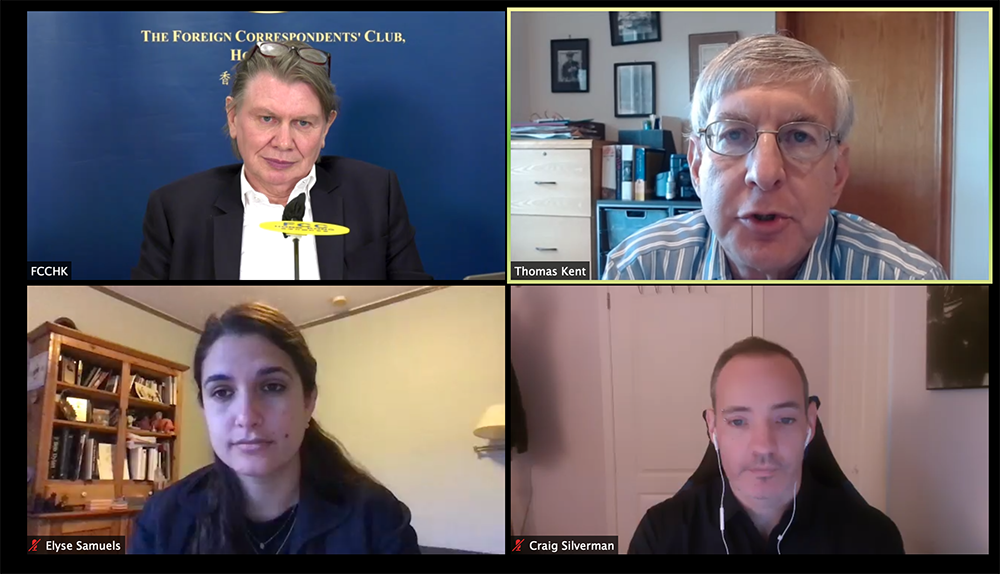
U.S. election disinformation worse than ever – Craig Silverman
The spread of disinformation and fake news is far worse than four years ago and is fuelling a deluge of lies in the run-up to the U.S. election, Buzzfeed media editor Craig Silverman said in an FCC panel discussion.
Eric Wishart (left) interviews (clockwise) Thomas Kent, Craig Silverman, and Elyse Samuels.
He said that conspiracy theories and an alternate reality ecosystem had flourished on the internet since the last election. In 2016, social media platforms were criticised for disseminating fake news ahead of the election of President Donald Trump.
“What’s incredible to me is thinking about what I was seeing in 2016 in the U.S. and how that just felt like an incredible high watermark for conspiratorial thinking infecting the mainstream, for viral falsehoods, gathering a huge amount of attention and interactions… And all of that seemed like ‘how could it get worse?’, and here we are,” Silverman said.
He criticised social media platforms for not doing enough to curb the continued rise of disinformation and fake news on their sites.
Twitter and Facebook were late to act against the spread of fake news due to a sense of American “free speech”. He said the firms were led by people “very much in favour of leaving up rather than taking down”.
Silverman acknowledged that platforms were beginning to crack down on disinformation. However, highlighting Facebook’s recent commitment not to accept political ads after the U.S. election polls close on November 3, he added: “It’s fair to point out a lot of this stuff is coming very close to the election. They’ve had four years and while they’re banking massive profits they have not really invested as much as they could have.”
Samuels discussed the rise in deep fakes – manipulated videos or photos – with the most common form being clips used out of context. As an example, she spoke of the recent controversy surrounding a Donald Trump campaign video in which White House coronavirus advisor Dr. Anthony Fauci appears to praise the president’s response to the COVID-19 pandemic. Dr. Fauci subsequently issued a statement saying his quote was taken out of context.
“It just shows how easy it is to take something out of context and change the narrative,” Samuels said.
She conceded that once a video clip had gone viral it was “harder to put the genie back into the bottle” but added that she hoped articles that debunked misinformation were having a positive effect.
Samuels said both the Trump and Biden campaigns were guilty of spreading disinformation, although she said there were more instances of the Trump campaign using this strategy.
Kent discussed interference in elections by Russia. Although the Kremlin was widely believed to have helped elect Trump in 2016, Kent argued that Russia is also “on the other side too”. He cited Russian-created content that was both critical and supportive of the Black Lives Matter movement.
“You can look at this in two ways: the classical explanation of this would be that the Russians are trying to hedge their bets, to have some allies on both sides depending on who wins the election,” he said. “However, the general thrust of Russian information operations in the United States has not been aimed particularly at making allies for Russia anywhere. Instead, it’s been aimed at sewing disruption in general in U.S. society.”
Kent suggested one solution to the divisive spread of disinformation was to change the way people think about politics and democratic values.
“The problem is we are too defensive; we spend all our time saying don’t believe this don’t believe that… If you want to affect the way people think about politics you need to present a positive message as well as a negative message,” he said.
Watch the video
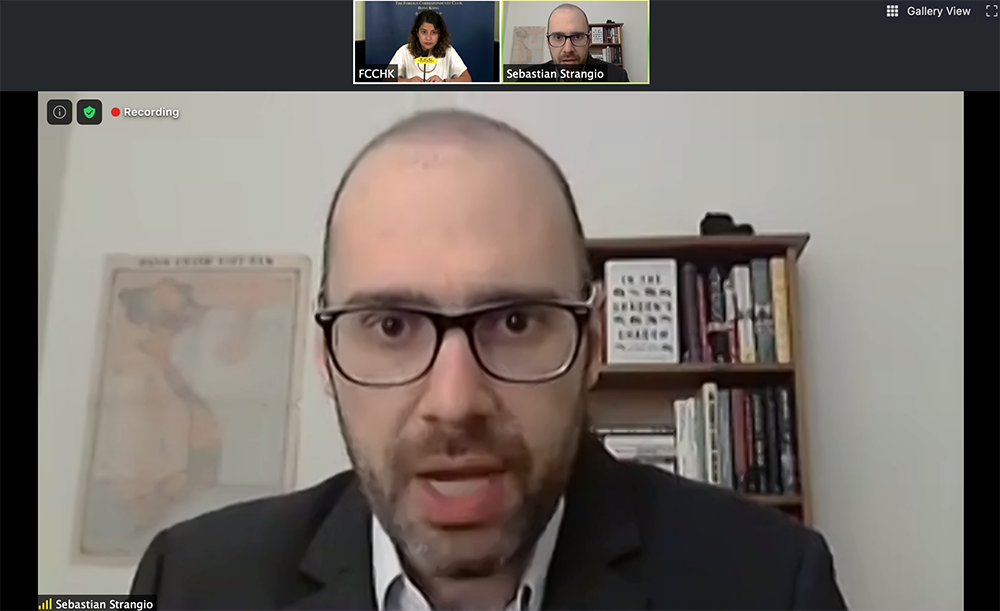
Why COVID-19 has hurt China’s standing in Southeast Asia – Sebastian Strangio
China’s dominance in Southeast Asia has been hit by its response to the COVID-19 pandemic, according to author Sebastian Strangio.
Sebastian Strangio talks to Shibani Mahtani on October 12.
The Southeast Asia editor of The Diplomat told an October 12 FCC webinar that the onslaught of the coronavirus had furthered a trend that was already underway in the region which was that the “image of both the United States and China are suffering in Southeast Asia”.
This trend was borne out before the pandemic in the surveys conducted by the ISEAS-Yusof Ishak Institute in Singapore that showed amongst elites and opinion leaders in the 10 nations of ASEAN “a pretty significant souring on both of these powers for different reasons”, Strangio said.
“What we see is a lot of Southeast Asia nations concerned about China’s initial response to the pandemic.. allowing it to get out in the first place. Concerns about the region’s over-reliance on China in terms of when the pandemic arose there – the first cases outside China arose in Thailand I think … Also the fact that China took the opportunity to assert its maritime sovereign claims in the South China Sea. I think in the affected nations that was seen with a great deal of negativity,” he added.
However, Strangio said he believed the pandemic would not ameliorate China’s main advantage in the region – its geographic proximity which, he said, is a “structural underpinning of Southeast Asian relations with China”. As COVID-19 and itseconomic after-effects continue to ravage the region, he added, “China is looking more and more like an unavoidable economic partner”.
Strangio, author of In the Dragon’s Shadow: Southeast Asia in the Chinese Century, said China is currently reaffirming its commitment to Southeast Asia, assuring ASEAN partners that it will help the region recover from the virus physically (via its signing of vaccine access agreements), economically, and politically.
China, he said, has a basic security dilemma in that it has “formidable rivals” on every side: nuclear powers India and Russia, and “a string of U.S. treaty allies – Japan, South Korea, the Philippines, and Taiwan”. Southeast Asia is the one region in China’s neighbourhood that does not have an incumbent great power constricting the power of Chinese influence, Strangio said. This made it a region “relatively amenable to the extension of Chinese influence”. The Chinese economy relies heavily on the vital sea lanes of the South China Sea and wants to protect them, he said.
“China views itself as a dominant power in the region once again, it is reclaiming a mantle that it lost 150 years ago with the rise of western empires and I think what we can glean from its behaviour occasionally from the comments of its officials is that China wants the region to be deferential, it wants the region to acknowledge China’s size and prominence through deference to Chinese aims.”
On China’s relationship with the United States, Strangio said a Biden presidency would not bring any significant shift in America’s policy towards China, adding: “I think a corner has been turned that will not be reversed.”
Watch the video
“Wolf warrior” diplomacy ‘has hurt China’s global reputation’
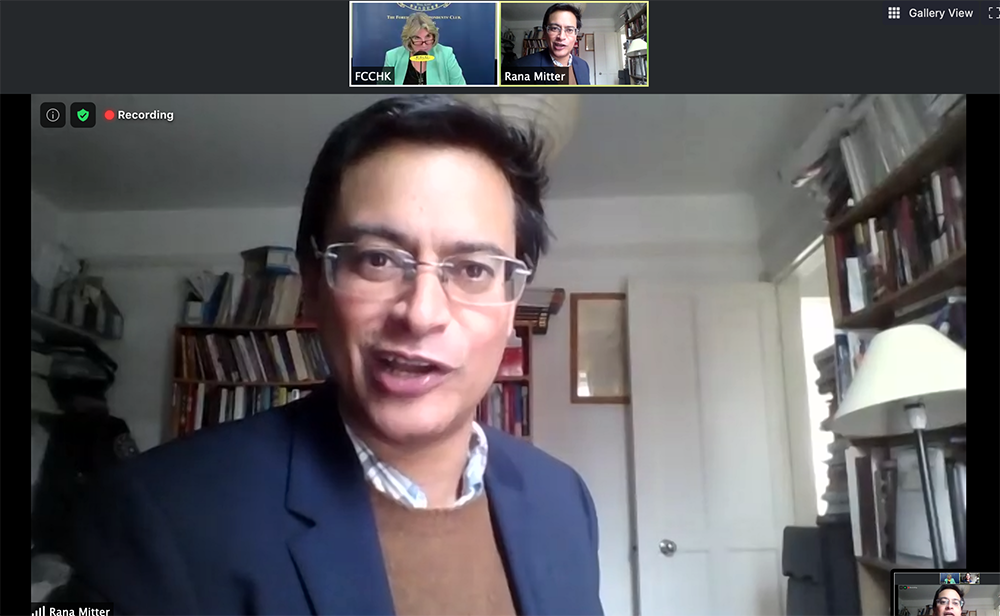
China’s “wolf warrior” diplomacy has contributed towards its damaged global reputation, according to author and China scholar, Professor Rana Mitter.
Professor Rana Mitter talks to FCC president, Jodi Schneider.
Speaking in the week that new research showed unfavourable views of China has reached record highs, Mitter told an October 7 FCC webinar that the country’s often aggressive style of diplomacy could have influenced the United Kingdom ’s decision to drop Huawei as a provider of 5G.
The report from Pew Research Center found that sentiment towards China had grown more negative in recent years across many advanced economies, and in particular unfavourable option had soared in the past year.
Mitter, Director of the China Centre at the University of Oxford, noted that an escalation of “wolf warrior” diplomacy had appeared to occur at the peak of the COVID-19 pandemic. He added that there was a sense within the Chinese Communist Party that such an approach had “been really damaging to China’s reputation”.
“Anyone who thinks it’s been part of some great wider thought-through propaganda effort I think needs to look at the results of it,” he said, citing Huawei’s failed 5G bids. He added: “It seems to me if you were actually sitting in Beijing plotting and planning you would not do the things that have happened which, as we say in Britain, tends to suggest cock-up rather than conspiracy.”
While the research found China had firm support at home over its handling of the pandemic, “it’s got a very bad reputation in the global north and it will need to start from there in terms of thinking where are they going now”.
Addressing relations between the United States and China, Mitter said he believed a Joe Biden administration would lead to better diplomatic relations between the two countries.
President Donald Trump’s “aggressive rhetoric” and China’s “wolf warrior” mode response has led to a deterioration in relations between the world’s two largest economies. Mitter said he believed a change of government in the United States would reset the relationship.
“My sense is if we have a Trump administration I think we’re going to go further down the route we are now which is with a huge amount of very confrontational rhetoric on both sides. People talk about Trump’s aggressive rhetoric – I think that’s true – China has been responding a lot in the ‘wolf warrior’ mode. Both of these things have to be acknowledged,” he said.
Mitter added that Democratic hopeful Biden would find a new way of addressing “the problems that involve dealing with a large, growing authoritarian powerful economy in the shape of China”. He acknowledged that “many people in western Europe” were concerned about China’s growth, its expanding military and its stance on Hong Kong.
The United States, he said, had abandoned alliances and “respect” for the post-1945 world order which was also problematic for Europe.
“The Biden administration, if there is one, would be able I think to pick up the phone to the EU, it would be able to talk to London … talk to Japan, talk to South Korea – all the people who for 75 years have been part of that wider ecosystem of shared norms and liberal norms… and actually say ‘let’s talk about how we do this together’,” Mitter said.
On the topic of Hong Kong, Mitter said it was important that authorities outline their vision for the city in the context of the new national security law, which was imposed on July 1. He said it was not clear from the outside what the various interest groups involved want to happen.
“And this is as true, I think, for those protesting as it is for those upholding what they would portray as being the current status quo,” he added.
Mitter discussed his latest book, China’s Good War: How World War II is Shaping a New Nationalism, which explores how influential World War Two is on today’s China. From this summer’s wartime blockbuster, The Eight Hundred, to the successful TV series, Autumn Cicada, the Second World War is “an historical obsession” in China.
He explained that U.S. participation in World War Two was ‘good’ in that it created a “narrative of moral purpose, of how America had stood up and fought against dark forces”. China, he said, has turned back to its World War Two experience, when over 10 million died, and 100 million people became refugees.
“All of this has gone to construct a narrative today and over the last 20-30 years in which China seeks to portray itself to the world as also having taken part in a ‘good’ war in the sense of a World War Two that helped make the world safe for decent forces rather than the forces of the axis power,” Mitter added.
Watch the video
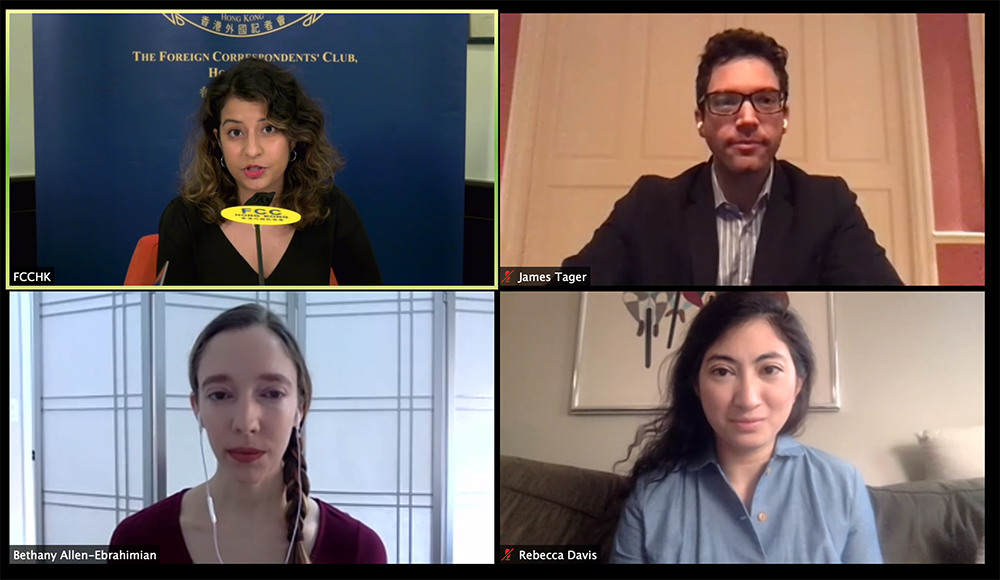
How the Mulan controversy highlights Hollywood’s ‘greed’
China’s Communist Party has ‘weaponised’ the greed of America’s film industry, resulting in increasing self-censorship by Hollywood in its bid to reach Chinese audiences.
James Tager, Bethany Allen-Ebrahimian and Rebecca Davis are interviewed by the FCC’s Shibani Mahtani.
That was the consensus of a panel of experts discussing China’s influence over Hollywood during a webinar on October 5.
James Tager, Bethany Allen-Ebrahimian and Rebecca Davis were appearing just weeks after the release of Disney’s Mulan, a big-budget Hollywood retelling of the Chinese folklore, The Ballad of Mulan, which flopped at the Chinese Box Office. The movie, the most expensive ever directed by a female, was beset by controversy surrounding director, Niki Caro’s choice to film in Xinjiang. The region is home to Uighur Muslims who are oppressed the Chinese government, which has been accused of detaining hundreds of thousands in mass internment camps in what Allen-Ebrahimian described as “cultural and demographic genocide”. In the film’s credits, Disney thanks several government departments of Xinjiang, prompting an international backlash against the movie.
“It was just shocking”, said Allen-Ebrahimian, China reporter at Axios. “It would have been bad no matter what but it landed in the midst of this controversy which is basically more or less about how powerful rich Americans and a powerful American corporation have sold out any semblance of values to the Chinese Communist Party.”
She speculated that either Disney had been “asked to put it in there to make Xinjiang look better and whitewash Xinjiang”, or that “whoever was in charge of this was so removed from all these debates and issues about human rights in China that they didn’t even realise what it would do”.
Either way, she said, Disney had failed to show “democratic morality”.
“Let’s be clear: this isn’t Chinese cultural pressure, this is Chinese government pressure. They’ve weaponised the greed of Americans,” Allen-Ebrahimian added.
Tager, deputy director of free expression research and policy at PEN America, discussed the organisation’s recent report on the topic. Titled Made in Hollywood, Censored in Beijing, it revealed how Hollywood’s most influential professionals are increasingly making decisions about their films in an effort to avoid antagonising Chinese officials who control whether their films gain access to the world’s second largest movie market.
He gave 2013’s Brad Pitt movie, World War Z, as an example of how Hollywood was pandering to Beijing’s desire to promote narratives of which it approves. In the original novel by Max Brooks, the virus that led to the zombie outbreak originated in China. Yet in the film, that storyline was dropped.
“Chinese regulators offer a carrot and stick to Hollywood studios determining their stance on cooperation with Chinese governmental censorship. The carrot is ‘well if we really like your movie we can offer better release dates, we can offer more preferential marketing buys… essentially we can create a morefavourable regulatory climate for your movie to succeed. We can remove barriers out of your way’. And the stick of course is ‘ultimately if we don’t like your movie we won’t show it within China’. They (CCP) are the sole gatekeeper to what is becoming the most important Box Office in the world.“
Only 34 foreign films per year are permitted for release in China, and the four big studios – Disney (which now owns 20th Century Fox), Paramount Pictures, Warner Bros., and Metro-Goldwyn-Mayer – dominate those slots. Scripts are checked by the Chinese government before permission is granted to shoot in the country. The origins of China’s censorship, said Allen-Ebrahimian, stem from the first Cold War and Hollywood’s subsequent depictions of Russians as ‘evil’ and ‘incompetent’, Allen-Ebrahimian said.
Tager and Davis agreed that Hollywood had come a long way in recent years in terms of diverse representation, with an increasing number of Asian and Asian American actors winning top roles.
Davis, China bureau chief for Variety, said that while Hollywood would continue in its bid to appeal to Asian audiences, there would be no Chinese/American co-productions in the near future.
She said a “total disengagement” and cinematic “decoupling” from China on Hollywood’s part would be “a tragedy” and that “we should still keep trying”.
Watch the video
Invite to join the FCC’s Disciplinary Panel
FCC Minimum Spend Period Extended
FCC Minimum Spend Period Extended
While the FCC has remained open during the restrictions imposed in Hong Kong as a result of the coronavirus, the Board of Governors is aware that it has been more difficult than usual for some members to enjoy the club’s facilities. The board has therefore decided that the minimum spend due on members’ September accounts will be rolled over for another three months. This means that no minimum spend charge will appear on members’ September bills and the minimum spend will be HK$ 1,800 for the six-month period from 1 July, to appear on December bills.
Once again, the club will offer the opportunity to purchase vouchers for any minimum spend not used by 31 December. We would also like to remind members who purchased vouchers to cover the minimum spend for the first six months of this year that those vouchers expire 30 November.
Thank you for your continued support of the FCC.
22 September 2020
FCC Restrictions Further Relaxed
FCC Restrictions Further Relaxed
Dear Members:
The Hong Kong government starting Friday October 30 will further ease anti-virus restrictions. The club will comply with the new measures as follows:
•
Operating hours for all restaurants and bars will revert to their previous hours (see timetable below). Last orders for food can be made by 10:50 p.m. while last orders for drinks can be made 30 minutes before closing.
Venue
Monday – Saturday
Sunday
Public Holidays
Bert’s
Mon –Thu/Sat: 12:00–24:00
Fri: 12:00–01:00
closed
closed
Main Bar
Mon–Wed: 10:00–24:00
Thu–Sat: 10:00–02:00
10:00–24:00
Sun–Wed: 10:00–24:00
Thu–Sat: 10:00–02:00
Lounge
Mon–Wed: 07:30–24:00
Thu–Sat: 07:30–01:00
10:00–24:00
Sun–Wed: 10:00–24:00
Thu–Sat: 10:00–01:00
Dining Room,
Verandah &
Chinese Restaurant
Luncheon: 12:00–14:30
Dinner: 18:30–24:00
12:00–21:00
(Dining Room)
closed
•
The takeaway menu is available from 11 a.m. to 10 p.m., though last orders must be made by 9:00 p.m. The menu can be downloaded from our website at fcchk.org. Please place orders with the FCC Restaurant at 2844 2806 or [email protected]. Orders will be confirmed by a phone call.
•
Up to six people will be allowed at tables in all outlets and the number of guests per member will be extended to three.
•
All outlets will be extended to 75% capacity.
•
Live performances will resume in Bert’s on Friday nights.
•
In-person events can resume, though in keeping with all required measures such as mask wearing while not eating or drinking. We will soon plan speaker events, as well as food and beverage events.
•
Banqueting can resume as well. Please contact the banquet team at 2844 2838 or [email protected] to book.
•
The gym is open yet the sauna and steam room remain closed. No more than four people are allowed at a time. Wearing a mask while exercising is no longer required in the gym. Please pre-register with the gym attendant at 2844 2849.
•
The workroom will be open from 8 a.m. to 11 p.m. Wearing a mask is required.
In keeping with government requirements and best practices, all members, guests and staff must wear face masks except when eating or drinking. Hand sanitizer must be used. The FCC will continue the check-in, temperature-taking and declaration measures upon entry to the club, as well as the frequent cleaning protocols throughout the building.
Thank you for your continued support of the FCC.
28 October 2020
FCC Continues Anti-Virus Restrictions
FCC Continues Anti-Virus Restrictions
Dear Members:
The Hong Kong government is again tightening its anti-virus restrictions; a few changes affect the FCC. The club will comply with the measures as follows:
•
All restaurants will close at 11:59 p.m. every day. Last orders for food will be 10:50 p.m. while last orders for drinks will be 11:30 p.m.
•
The takeaway menu is available from 11 a.m. to 10 p.m., though last orders must be made by 9:00 p.m. The menu can be downloaded from our website at fcchk.org. Please place orders with the FCC Restaurant at 2844 2806 or [email protected]. Orders will be confirmed by a phone call.
•
Up to four people are allowed at tables in all outlets and the number of guests per member remains at three.
•
All outlets are restricted to 50% capacity. Please book ahead.
•
Live performances are suspended.
•
In-person events will continue, though four-per-table limits, a limit to 40 in the room, distancing and mask-wearing requirements are strictly enforced.
•
Banqueting has resumed except for cocktail parties, and distancing and mask-wearing while not eating or drinking are being enforced. The number of participants per event is limited to 40. Please contact the banquet team at 2844 2838 or [email protected] to book.
•
The gym is open yet the sauna and steam room remain closed. No more than four people are allowed at a time. Wearing a mask while exercising is not required in the gym. Please pre-register with the gym attendant at 2844 2849.
•
The workroom is open from 8 a.m. to 11 p.m. Wearing a mask is required.
•
As of Dec 2, it will be mandatory for the FCC to register a “LeaveHomeSafe” venue QR code from the government and display the QR code at the entrance of the club to facilitate check in by members and guests and keep a record of visits with their mobile phones.
In keeping with government requirements and best practices, all members, guests and staff must wear face masks except when eating or drinking. Hand sanitizer must be used. The FCC will continue the temperature-taking and declaration measures upon entry to the club, as well as the frequent cleaning protocols throughout the building.
People who have travelled overseas in the past 14 days are not allowed to visit the club, even once the “travel bubble” with Singapore begins.
Thank you for your continued support of the FCC.
25 November 2020
Response From Chinese Foreign Ministry to FCC Statement on New Police Accreditation Policy
Commissioner’s Office urges FCC Hong Kong to immediately stop meddling with Hong Kong affairs
The spokesperson of the Commissioner’s Office expressed strong disapproval of and firm opposition against the unwarranted remarks FCC Hong Kong made about the Hong Kong police force’s amendment of the definition of “media representatives” under the Police General Orders, and urged the organization to immediately stop meddling with Hong Kong affairs on the pretext of press freedom.
The spokesperson pointed out that some anti-China troublemakers in Hong Kong who proclaimed themselves as journalists deliberately obstructed the police from enforcing the law and even assaulted police officers during the anti-amendment protests last year, hampering the interviewing and reporting work of other journalists and seriously undermining law and order. The truth is not to be distorted. By anxiously whitewashing the fake journalists, FCC Hong Kong is attempting to endorse the rioters and condone their “burn with us” violence, thus sowing more trouble in the city.
The spokesperson emphasized that there is no such thing as absolute press freedom above the law. Hong Kong is part of China, and any media practitioner in the HKSAR shall strictly and voluntarily abide by national laws applied to Hong Kong and local laws. No organization or individual shall seek privileges above the law, impede the HKSAR Government’s law-based governance, or endanger China’s national security and Hong Kong’s prosperity and stability on the pretext of press freedom.
The spokesperson said that it is only right and proper for the relevant HKSAR authorities to strengthen the management of and services for the media, and amend the policy to address prevalent maladies and set things right, so as to better safeguard the legitimate rights of recognized media outlets and journalists and protect press freedom in Hong Kong. We urge FCC Hong Kong to observe national and local laws and regulations, stop provoking trouble on purpose, and refrain from meddling with Hong Kong affairs under any pretext.