Members Area Logout

Leave so you can fight another day – Kasparov’s message to Hong Kong’s democracy activists

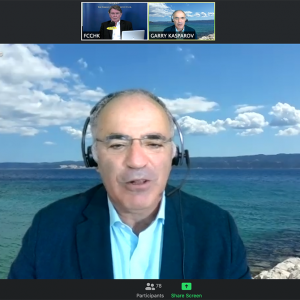
Leaving Hong Kong would be a “wise choice” for the city’s prominent pro-democracy activists rather than face prison or worse, says former chess world champion turned democracy campaigner Garry Kasparov.

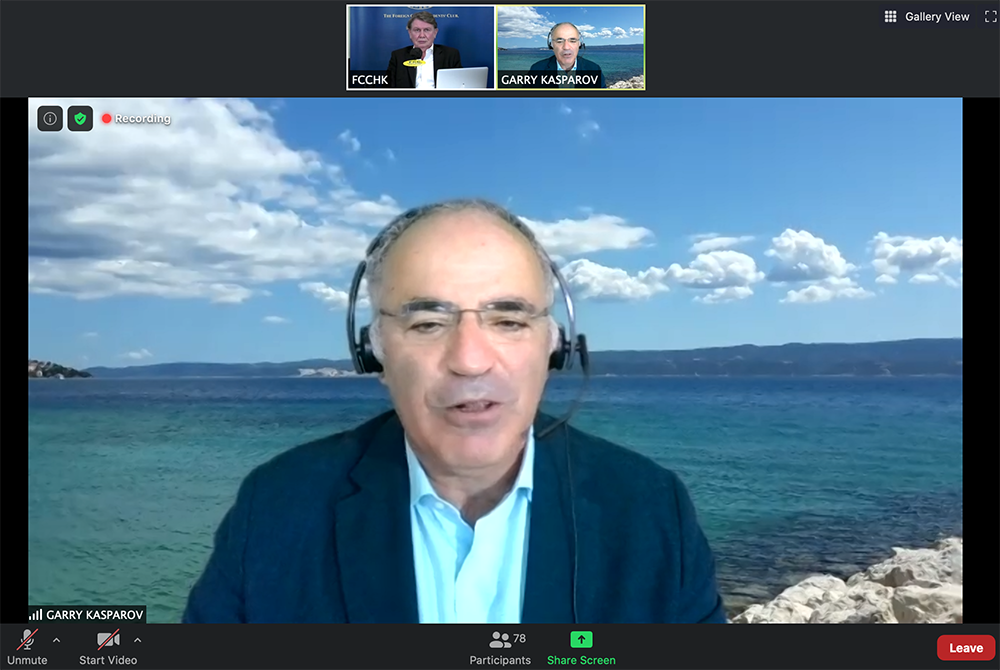
Garry Kasparov talks to FCC first-vice president, Eric Wishart. Garry Kasparov talks to FCC first-vice president, Eric Wishart.

Speaking at an FCC webinar on August 27, Kasparov – himself exiled from his home country of Russia – said he hoped that a new wave of democracy movements around the world would make it safe for activists to return and rebuild Hong Kong.

Kasparov, who at the age of 22 became the world’s youngest ever chess champion, is a vocal human rights activist and was one of the first prominent Soviets to call for democratic reform. He was an early supporter of Boris Yeltsin’s push to break up the Soviet Union.

A fierce critic of Russian President Vladimir Putin, Kasparov left his home in Moscow to live in New York following a crackdown on dissidents in Russia.

He was speaking in a week that saw two Democratic Party lawmakers – Lam Cheuk-ting and Ted Hui – arrested in connection with last year’s pro-democracy demonstrations.

Kasparov, chairman of the Renew Democracy Initiative, said he hoped to see a “new wave of democracy movements” that would bring dictatorships to an end. This, he said, could herald a new era for Hong Kong.

When asked whether pro-democracy activists should seek exile, Kasparov said when he “recognised it would be jail or worse”, he left Russia.

He added: “The prominent people who believe they can play a role in rebuilding Hong Kong, I would say probably it’s a wise choice (to leave). China’s regime is not at the stage where they care about creating martyrs. You stay there, you fight, you’ll be in jail – you mentioned mainland China – maybe you will die.

“So I think it’s important that the core of this group is preserved because there will be a moment – maybe sooner than we think because as we can see in Belarus, these regimes are not stable and Putin now is experiencing great problems. Hopefully now … you see this the trend is going back to the eighties like a pendulum of history when we have a new wave of democracy movements around the world and when we’ll see these dictatorships are losing the momentum that unfortunately they gained on the geopolitical stage. Then I wish there will be enough people in Hong Kong to come back.”

Describing himself as “an incorrigible optimist by nature”, Kasparov said he believed “that China will also be free”.

Kasparov spoke about his desire to see President Donald Trump lose the November election. He discussed Trump’s close relationship with Putin – “please don’t call him president – he is what he is: a dictator” – comparing it to a KGB handler and his asset. He said he suspected that Trump’s connections to Russia “started much earlier than 2008/2009 when Russian money saved his crumbling empire from collapse”.

However, he was adamant that he would not visit Hong Kong in the future.

“I think that Hong Kong might not be on my travel list… I doubt very much in the foreseeable future I’ll be able to set my foot on Chinese soil or the soil controlled by the Chinese Communist Party,” he said.

Watch the video here

Australia has a long way to go to before getting an indigenous prime minister – Stan Grant

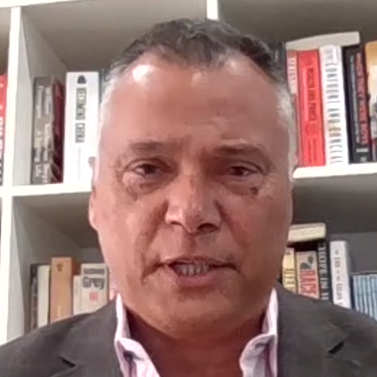
The prospect of an indigenous Australian becoming prime minister or “anywhere near” is a long way off, according to award-winning journalist and author, Stan Grant.

Discussing the recent announcement of US Senator Kamala Harris as presidential hopeful Joe Biden’s running mate, the broadcaster said that while there were similarities between America’s struggle with racism and that of his own country, the chances of an Aborigine taking high office were remote.

“It has taken over 100 years for an indigenous person to make a federal government minister. There are now a few more indigenous represented at state and federal level, but we’re a long way from getting to the point where an indigenous politician would get anywhere near becoming prime minister in Australia,” he said, adding: “It’s something I can’t even envisage at the moment.”

Talking to CNN anchor, Kristie Lu Stout, he said the appointment of Harris, the daughter of African-American and Asian immigrants, was an “extraordinary achievement” and “a reflection, I think, of America’s journey”.

Grant, who recently became the first indigenous host in the 59-year history of the ABC Four Corners documentary program, shared his experiences of racism growing up and discussed what the Black Lives Matters movement means to indigenous Australians.

He said Americans and Australians share a history of institutionalised and structural racism that limits opportunities in life and places first nation people on the margins of society. The killing of George Floyd during his arrest in Minnesota sparked a global outrage that kicked off protests in several countries. For Grant, who has been at the forefront of the fight for the rights of indigenous Australians for decades, it was a pivotal moment.

“That experience of George Floyd and Black Lives Matter spoke to me very personally. It spoke to our shared history,” he said.

Grant told of his own experiences of racism growing up in Australia, where, as part of a group of Aboriginal school children, he was told by his headmaster that he’d never amount to anything. After relocating to Canberra, he and his siblings found themselves “in a world that was overwhelmingly white”.

And those in power in Australia are still overwhelmingly white, Grant said, pointing to institutions from government to media. Yet he said even today, to discuss racism in Australia was “a difficult conversation”.

“It’s a country where people come to escape history, not to confront history,” he said. “Yet if we don’t do that as a nation then we are forever diminished. You cannot keep people in chains forever and not think that at some point it isn’t going to come to the surface, and that’s what we’re seeing in the United States.”

Watch the video here

A Biden Win Could Stabilise Sino-American Relations – Experts

A win by Democrats Joe Biden and Kamala D. Harris in November would likely not change America’s tough line toward China, but the tone would soften and the U.S. would seek more allies against Beijing, according a panel of experts at an FCC webinar.

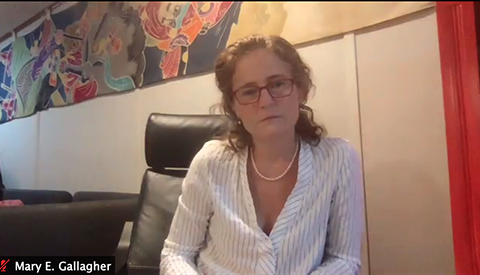
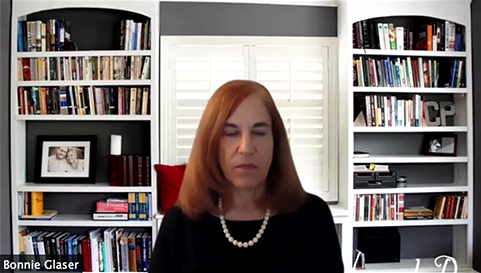
The three August 12 panelists – political scientist Mary E. Gallagher, journalist Lingling Wei and Asia expert Bonnie Glaser – all agreed that although presidential hopeful Biden was unlikely to dramatically change some policies if he were elected, his administration could move to stabilise the frail relationship.

The three were speaking the day after Biden announced Senator Kamala D. Harris as his running mate. She is the first Black woman and the first Asian American to appear on a major-party presidential ticket.

Relations between the United States and China have soured since President Donald Trump took office, resulting in a trade war, tit-for-tat expulsions of journalists, and more recently, sanctions over the new national security law in Hong Kong.

Wei, an award-winning correspondent for the Wall Street Journal who herself became a casualty of the deteriorating relations when she was expelled from China earlier this year along with colleagues, warned that Trump’s final days in office posed a major threat to relations with China.

“I think Beijing welcomes a Biden administration. The next 90 days… are going to be the most dangerous time for China,” said Wei, the co-author of a book on Sino-U.S. relations, Superpower Showdown. “The South China Morning Post story about Xi Jinping instructing the Chinese military not to fire the first shot, I think that’s really a sign of how nervous the leadership is about this whole relationship completely getting out of control. They’re trying very hard to show restraint.”

Gallagher, a professor at The University of Michigan, has been director of the Lieberthal-Rogel Center for Chinese Studies since 2008, said: “I think it’s a super exciting ticket and I love that a black Jamaican Asian child of immigrants is the safe choice for Joe Biden. One thing that will be different and I would certainly advise is to stop thinking about China as the Soviet Union. It is nothing like the Soviet Union, it is not going to disappear. When we talk about the Cold War, it ended when the Soviet Union disappeared. China is not going to disappear.”

She added that she would advise the Biden administration to “stand up to China on human rights issues and freedom of expression and freedom of speech”.

Biden would not be seen “on a daily basis hammering China” in the way that Trump has, said Glaser, adding that a sustained dialogue mechanism would likely be restructured under Biden in an “effort to resurrect some cooperation with China”.

Echoing Wei’s warning over the run-up to the November election, Glaser said that U.S. pressure on China would increase now that Trump has declared he no longer has a good relationship with Chinese President Xi Jinping.

“Now he’s really taken the gloves off, and this has enabled other people in the administration to do things, for example, regarding Xinjiang and Hong Kong that the president was not on board with when the trade negotiations were going on. In that period, we’re going to see a lot more ramping up of pressure,” she predicted.

You can watch the video here

‘Huge mistake’ if China tries to eradicate Hong Kong’s identity, warns Asia scholar

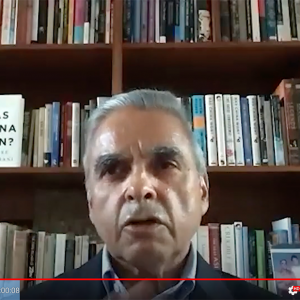
Hong Kong has become a political football between China and the West, according to author and Asia scholar, Kishore Mahbubani.

It would be a “huge mistake” for China to try to eradicate what makes Hong Kong so special, he told an August 10 FCC webinar, and China must act with restraint as the West weighs in on the row over the national security law.

“Hong Kong has become a political football … when players play football they get a lot of fun kicking the ball but after a while the ball breaks down. It’s important for Hong Kong to steer itself out of being a political football as soon as possible,” he said.

Prof Mahbubani, a distinguished fellow at the Asia Research Institute, National University of Singapore, said that although Hong Kong was a “piece of treasure” to China, the people of the city “should not force the leaders to choose between the interests of 1.4 billion people in China and 7 million people in Hong Kong”.

When asked if he thought China was trying to eradicate Hong Kong’s culture and identity, Prof Mahbubani warned it would be a “huge mistake” on China’s part.

“Even though the Chinese have tried very hard to get Shanghai to grow as a financial centre, you can see that Shanghai just cannot keep doing what Hong Kong is doing. Hong Kong is really at the end of the day a piece of treasure for China and it will be huge mistake for China to destroy that culture, that separateness.

“For the same reason, I think it’s also a huge mistake in the West – the United States and U.K., and all – to continue using Hong Kong as a political football. It’s in the global interest for Hong Kong to be one step in, one step out as part of the One Country, Two Systems framework. We should globally recognise that it’s good for China, good for the West and good for the rest of the world,” he said.

Prof Mahbubani’s latest book, Has China Won? analyses the tensions between the United States and the world’s second largest economy. In it, he argues that the real question – “one that never surfaces in America” – is whether the United States can lose.

“America has got so used to winning the idea of losing doesn’t come up,” he said, adding that 100 years of growth into the world’s largest economy had made the country complacent. His book, which he said he hoped the Trump and subsequent Administration would read, would help them to “at least think about the possibility of being number two”.

Watch the video

New Cold War between U.S. and China is a ‘disaster for the world’ – Noam Chomsky

Deteriorating relations between the United States and China have potentially disastrous consequences for the world when global cooperation is needed to fight threats such as COVID-19 and global warming, renowned intellectual Noam Chomsky said Friday in an FCC webinar.

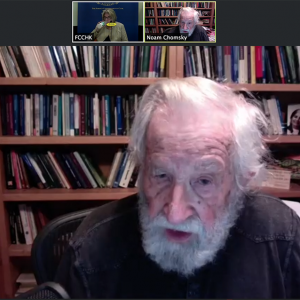
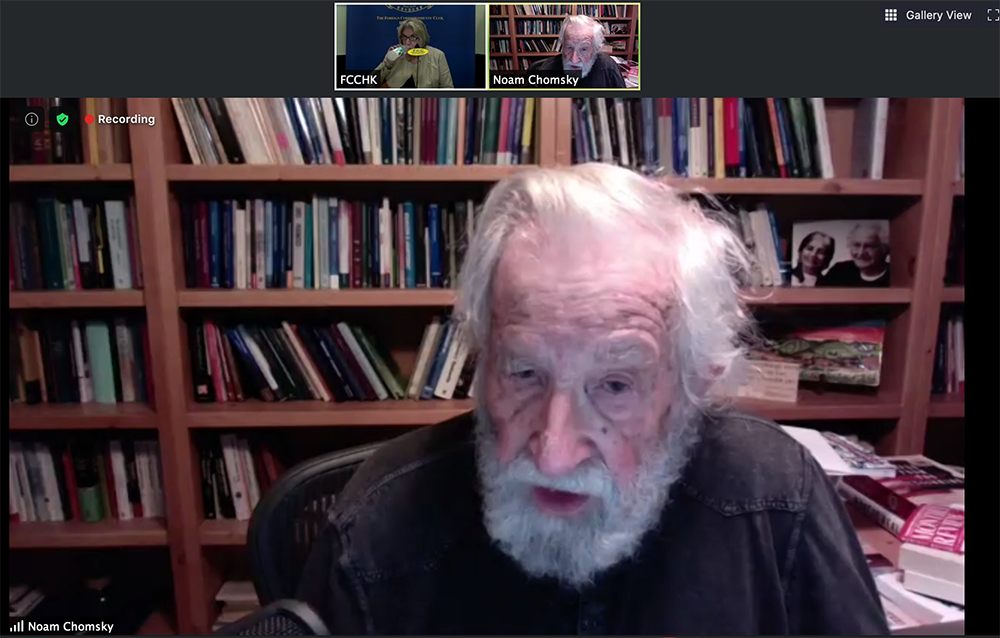
Noam Chomsky talks to Club President Jodi Schneider on August 7, 2020. Noam Chomsky talks to Club President Jodi Schneider on August 7, 2020.

The attempts by the United States to prevent China from developing were cruel and pointless, he said.

“If China develops, we all benefit,” Chomsky said. “If we’re going back to a Cold War between China and the United States, that’s a disaster for the world. This is a moment, more than ever, where we have to have international cooperation. The crises that we face are all international.”

Relations between China and the United States have deteriorated since U.S. President Donald Trump – whom he called “the most dangerous political leader in history” – took office, resulting in a trade war and retaliatory actions against journalists in both countries.

Chomsky, one of the most influential public intellectuals in the world, said China was “trying to reassert its traditional role as the dominant force in Asia”, and the United States “won’t tolerate it”. He then likened the situation to the Mafia.

“The fact is the world is being run very similar to the Mafia.. the Don doesn’t tolerate any interference from states that challenge it, or even states that get out of line,” Chomsky said.

Discussing a range of topics, the author of more than 100 books including Requiem for the American Dream: The 10 Principles of Concentration of Wealth & Power, addressed the political unrest that gripped Hong Kong in 2019 and said the only way to ease the pressure on Hong Kong to “undermine its democratic procedures, practices and opportunities” was a “reduction of international tensions” between China and the United States.

“It’s always worth remembering the old saying that when the elephants fight, the grass gets trampled. Hong Kong is the grass. If the elephants start fighting, Hong Kong is lost.”

“The Hong Kong protests were a major sign of optimism. They didn’t totally succeed but laid the seeds for future progress,” Chomsky added.

The webinar opened with Chomsky’s thoughts on the COVID-19 pandemic and the Trump Administration’s handling of it.

“The United States is basically a wreck,” he said, citing Trump’s dismantling of former President Barack Obama’s preparations against a global health emergency which he said left America “unprepared when the pandemic struck”.

Chomsky went on to warn of future coronavirus pandemics that, intensified by the impact of global warming and habitat destruction, would be even more lethal.

“It could be something like the Black Death,” he said.

Arizona, the state where Chomsky resides and where he is laureate professor in the Department of Linguistics at the University of Arizona, was “now vying for the international record for the highest number of cases per capita”, he said. He accused Trump of “flailing around desperately to find some scapegoat to cover up for the fact that he’s responsible for killing over a hundred thousand Americans”.

Referring to misinformation around the pandemic, he took aim at media organisations such as Fox News for “peddling” misleading messages playing down the seriousness of COVID-19. But Chomsky also lamented the Trump Administration’s rhetoric towards the media as enemies of the people.

“With the media now it’s very scary. When half of Republicans think the government should have the right to close down media it doesn’t like, then that’s dangerous,” he said.

You can watch the entire talk here.

We’re in a moment of global retreat for democracy and freedom – Suzanne Nossel

The removal of pro-democracy books from Hong Kong libraries following the implementation of the national security law was alarming, says the author of a new book on free speech.

Suzanne Nossel told an FCC webinar that PEN America – a non-profit organisation that defends free expression and of which she is CEO – had been documenting events in the city in recent years and that she was saddened to see Hong Kong’s “vibrant intellectual life… steadily shut down”.

The author of Dare to Speak: Defending Free Speech for All, noted that we are in “a moment of global retreat for democracy and freedom”, naming other countries, including the Philippines where freedom of speech and press freedom under threat. Maria Ressa, a regular FCC speaker and founder of the news website Rappler, is currently appealing a conviction for cyber libel there.

The effect of the ongoing encroachment on free expression in Hong Kong would inevitably make it difficult to sustain any space for open dialogue in the city, she added.

In her book, Nossel addresses call outs, cancel culture, cultural appropriation, online content moderation, how to address hateful speech, and why we need to do more to amplify lesser heard voices. She outlines principles for how curb hate speech while protecting freedom of speech. One example is how to apologise having published or spoken a controversial opinion that has offended others.

“A genuine apology can go a long way and it should count for a lot,” she said, touching on the current trend of cancel culture that has resulted in the resignations of several high-profile media figures responsible for publishing controversial op-eds.

Nossel, who served in the Obama and Clinton administrations, criticised President Donald Trump for his inflammatory rhetoric around race and women, and addressed the “catalytic sea change” among Americans, sparked by the death of George Floyd.

You can watch the video here

Daughter of COVID-19 victim speaks out about spread of misinformation

For Kristin Urquiza, misinformation about COVID-19 amounted to a death sentence for her father and drove her to launch her MarkedbyCovid campaign to try to stop people suffering the same fate.

During a July 30 FCC online panel discussion, Urquiza recounted how her father Mark, an otherwise healthy 65-year-old, died of the disease on June 30. He contracted COVID-19 after Arizona reopened and the governor encouraged people to resume their normal activities. She said she had understood as early as January that the virus was serious and, concerned by the apparent downplaying of the illness by authorities, had devised a strategy to keep her parents safe. Yet, as Arizona lifted its state-wide lockdown in May, citizens began returning to their normal activities. Urquiza said the downplaying of the potential risks of contracting the virus affected her father.

“My dad took this message to heart and it ended up being a death sentience for him. Two weeks later dad woke up with a cough and exhaustion. My dad ended up passing away on June 30, alone in his room in the ICU with a stranger holding his hand and he did not deserve that ending,” she said.

After his death, Urquiza said she looked through her father’s social media news feed and found ‘overwhelming’ misinformation from unverifiable news sources “which, to my trained eye, I could tell was fake news”. She is now campaigning for safer public health policies.

Appearing alongside Urquiza on the panel was Alice Budisatrijo, who heads Facebook’s misinformation policy work in Asia-Pacific. She said that Facebook had several policies in place to prevent the spread of misinformation and provide users with verified news and public information sources. She said as soon as the platform, which also owns Instagram and WhatsApp, started hearing about the global health crisis ‘we realised we had a responsibility to help people, to provide reliable information and stop the spread of disinformation’.

Among the measures in place to prevent the spread of misinformation, she said were chatbots on messenger apps that allow users to help find the latest information on the disease, and fact checkers in some countries via WhatsApp. On Instagram, when users search the most common keywords associated with coronavirus, the first results they see are links to the CDC in the U.S. or the World Health Organization.

“We can’t get to every piece of content,” said Budisatrijo, explaining that content that violates Facebook’s various policies is detected by automation and through reporting from users.

Claire Wardle, director of First Draft, a nonprofit coalition fighting the spread of harmful misinformation by providing “tools needed to outsmart false and misleading information”, said skepticism was needed when consuming news shared on social media. She warned that ‘seductive messaging’ in palpably false social media posts shared by presidents and celebrities alike posed a dangerous threat to us all and would only get worse if not addressed.

“We are in a much worse situation than I’ve seen in the last four years,” Wardle said.

You can watch the video here

U.S./China relations: The world is at stake, warns top economist and global thinker

Improved relations between the United States and China is vital to global stability, according to economist and author, Professor Jeffrey Sachs.

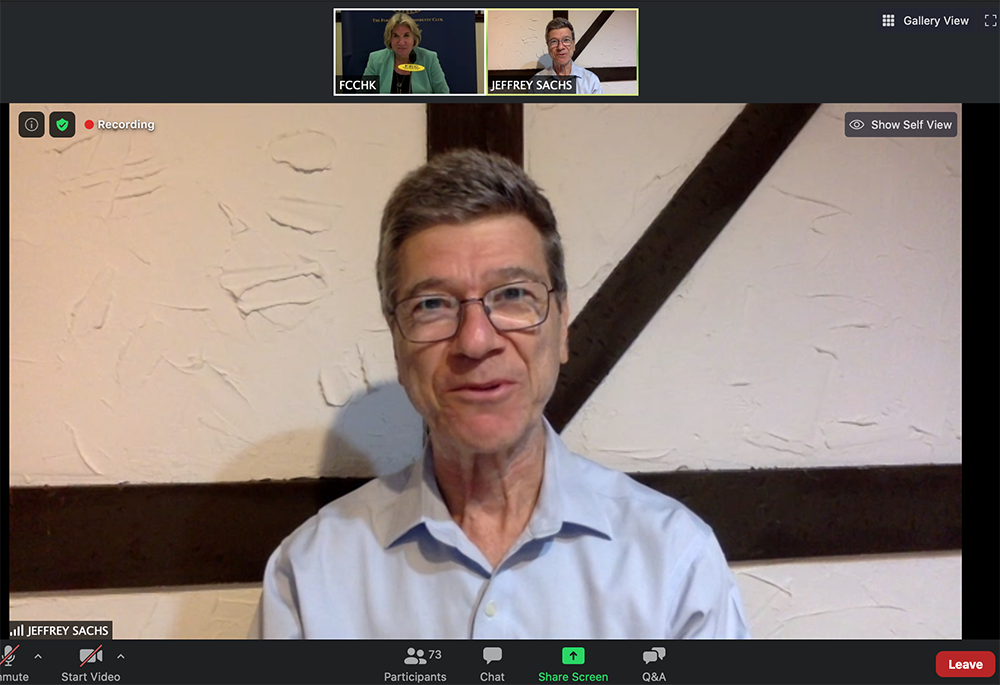
Professor Jeffrey Sachs is interviewed by Club President, Jodi Schneider. Professor Jeffrey Sachs is interviewed by Club President, Jodi Schneider.

Speaking during a July 20 FCC webinar on how global cooperation is needed to solve some of the challenges currently facing us, Prof. Sachs said that if former Vice President, Joe Biden, were to win November’s election, he would advise him to work on relations between the world’s two largest economies.

“I think the U.S./China relations are so vital for the world that it’s extremely important to set in place a thorough and high-level, extensive and serious interaction between the two countries,” Prof Sachs said. “Between the U.S. and China, the world is at stake.”

Prof. Sachs, director of the Center for Sustainable Development at Columbia University in New York, opened the discussion with the assertion that if President Donald Trump were reelected, the world would likely spiral out of control. Referring to the president on several occasions as ‘mentally ill’, Prof. Sachs said Trump’s ‘dangerous view of the world’ had spilled into global politics, leading to polarisation instead of the cooperation needed to face into current issues including the coronavirus pandemic.

“We cannot have [global] cooperation with Trump as president,” he said, adding that America’s ‘unilateral attacks’ on China meant ‘there can be no deal-making’.

Trump had shown ‘zero restraint’ in governance over the last three years, relying on executive orders and emergency decrees as he frequently bypassed the Senate, Prof. Sachs said. When asked whether he had considered any ‘nightmare scenarios’ of what Trump might do in his final days in office should he accept defeat at the election, Prof. Sachs answered: “Given his psychopathology, he is capable of lashing out in a serious way.” He speculated that this could be in the form of sparking a diplomatic crisis or making an international declaration of war.

Prof. Sachs, a best-selling author and former adviser to three United Nations Secretaries-General, attacked Trump for his Administration’s slow and chaotic response to the COVID-19 outbreak, which at the time of writing was responsible for the deaths of more than 140,000 American citizens.

“Our country was completely incapable of addressing the epidemic,” he said, adding: “Trump, because he is a mentally ill man, he is truly incompetent because everything is viewed through the lens of ‘how does this look on the daily news?’”.

Watch the full video here

US still supports Hong Kong, should open door to its people: Bolton

Former U.S. National Security Advisor John Bolton told an FCC webinar that Hong Kong still enjoys broad support in the United States even as the city’s freedoms are being eroded, and that the Trump administration should follow the lead of other Western countries and open the doors to Hongkongers wishing to leave, writes Keith Richburg.

Former U.S. National Security Adviser John Bolton appears in a July 15 FCC webinar. Former U.S. National Security Adviser John Bolton appears in an FCC webinar on July 15, 2020.

Bolton spoke the day after President Donald Trump signed an executive order ending Hong Kong’s preferential trade treatment, and a sanctions bill aimed at individuals and banks, leading some analysts to suggest Washington and Beijing were headed for a “decoupling” of their relationship if not a new Cold War.

Bolton said decoupling is “not only possible, but is happening,” although he said the likelihood of a military conflict remained remote.

Calling the new China-imposed national security law “deplorable,” Bolton said: “It must be very discouraging for the people in Hong Kong. They fought so long. They thought they had another 25-plus years before this.”

“Don’t think that anybody’s giving up on you,” Bolton added: “I favour greatly immigration and I think what Britain, Canada and others have done in terms of potential political asylum for Hong Kong is something the United States should do, too, so I favour more immigration.”

Bolton, who left the Trump administration in September 2019, described its China policy as “incoherent” and “utterly without strategy”.

While Trump understood the Hong Kong protests of 2019 to be “significant in size,” he was “resolute in not wanting to do anything about it or to get involved in it”, fearing it might disrupt prospects for a trade deal.

The July 15 discussion between Bolton and FCC board of governors member Keith Richburg focused largely on U.S. relations, which have become increasingly strained over trade, territorial disputes in the South China Sea, and the coronavirus pandemic.

Bolton also touched on Republican Party politics, saying he would not vote for either Trump or former vice-president Joe Biden, the presumptive Democratic nominee, in November, instead choosing to write in a conservative candidate.  Bolton said he wants to spend time after the election working to rebuild the Republican Party for the post-Trump era.

His recent book, The Room Where It Happened: A White House Memoir, details his 453 days in the Trump Administration.

You can watch the video here

Hong Kong’s businesses ‘must seize COVID-19 opportunities’

Hong Kong’s retailers must seize the opportunities brought about by COVID-19, according to two of the city’s best known business people.

Syed Asim Hussain, co-founder of Black Sheep Restaurants; and Goods of Desire founder, Douglas Young, both agreed the so-called new normal was here to stay as the city played a “cat-and-mouse game” with the lifting and reimposing of restrictions to combat the coronavirus.

The two were speaking alongside Asia economist Alicia García Herrero during a panel discussion on July 14 – the day before tighter social restrictions come into force – exploring how the city’s economy could survive without tourism dollars in the wake of the Hong Kong protests and COVID-19.

Hussain, who in 2018 became the world’s youngest restaurateur to hold two Michelin stars, predicted that by this autumn one in three restaurants in the city will have gone out of business. Young conceded that the Hong Kong protests had hit his lifestyle retail business hard, but that the face mask “is going to be my company’s saviour” since his outlets began selling fashionable and washable masks.

The outlook isn’t all bleak, however. Herrero said the good news for retailers was that rents would decrease in the city as the vacancy rate increased due to businesses closing down or moving to cheaper premises.

You can watch the event here

We measure site performance with cookies to improve performance.