Members Area Logout

It’s a dangerous place out there for journalists, says veteran Washington Post editor

The mainstream media needs to be fair and give people the chance to make up their own minds in order to survive the current climate that has seen an erosion of trust in the press, according to veteran journalist David Ignatius.

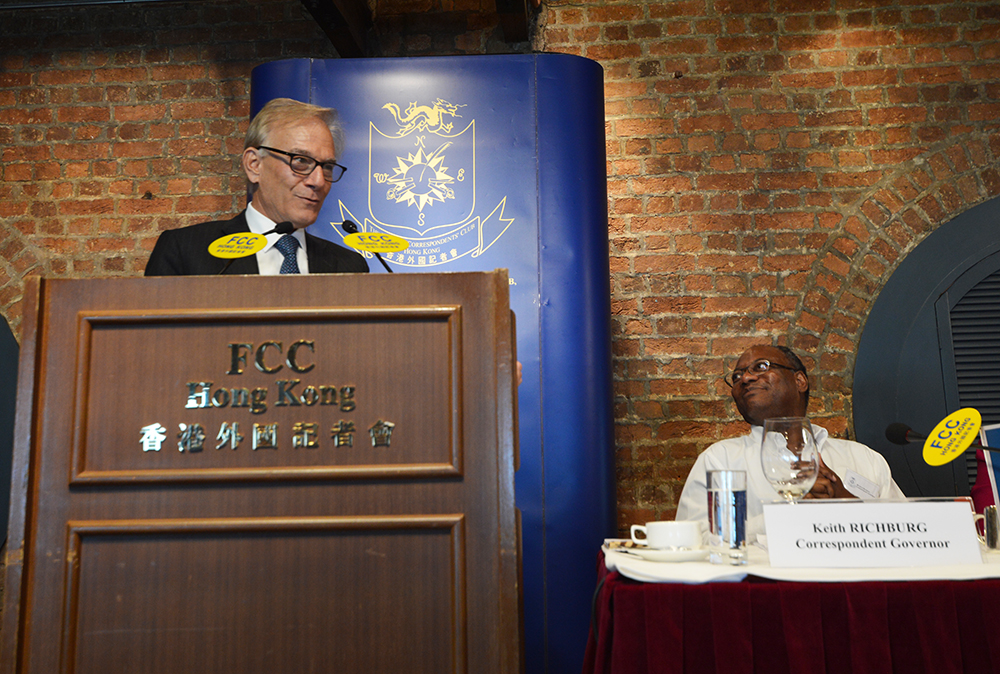
Washington Post Associate Editor, David Ignatius, spoke of his fears for global press freedom at the FCC. Photo: Sarah Graham/FCC Washington Post Associate Editor, David Ignatius, spoke of his fears for global press freedom at the FCC. Photo: Sarah Graham/FCC

Speaking about his fears for press freedom against the backdrop of increasing global hostility towards the media, fueled in part by US President Donald Trump and his ‘enemies of the people’ rhetoric, Ignatius said news organisations need to remain objective in their reporting to win back support.

The Associate Editor of The Washington Post said it was a dangerous time to be a journalist, citing figures on the reporters currently imprisoned around the world, and urged journalists to “cover the story progressively, we don’t want you to take risks that would lead to death or serious injury”, adding that for editors the hardest thing was to say no to a reporter who wanted to put their safety at risk to get the scoop.

Ignatius also talked movingly of his friend and colleague, journalist Jamal Khashoggi, who was murdered a year ago at the Saudi consulate in Istanbul. The CIA concluded Saudi Crown Prince Mohammed bin Salman ordered the assassination.

“He was a complicated person… he had very extreme views as a young man. Over time he decided the way in which the world would be purified of deep corruption was journalism,” Ignatius said.

Watch the video

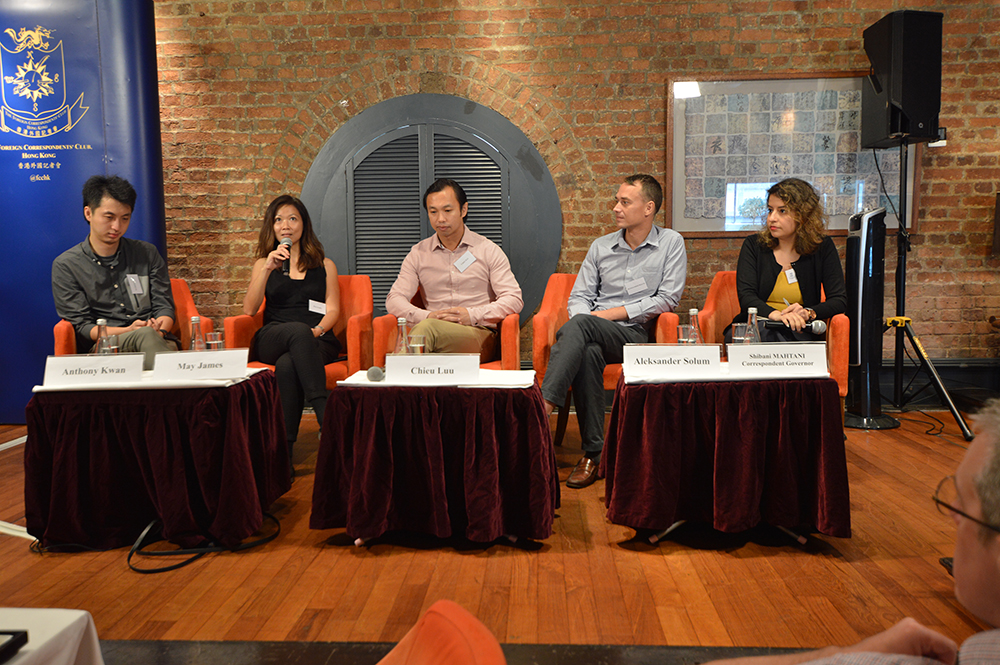
How fake news is shaping the Hong Kong protests

The phenomenon of fake news and the spreading of disinformation have increased sharply since the Hong Kong protests began, with conspiracy theories in particular taking off in recent months.

These were the observations offered by three experts who have been covering the protests since June. They were taking part in the September 12 panel on the topic.

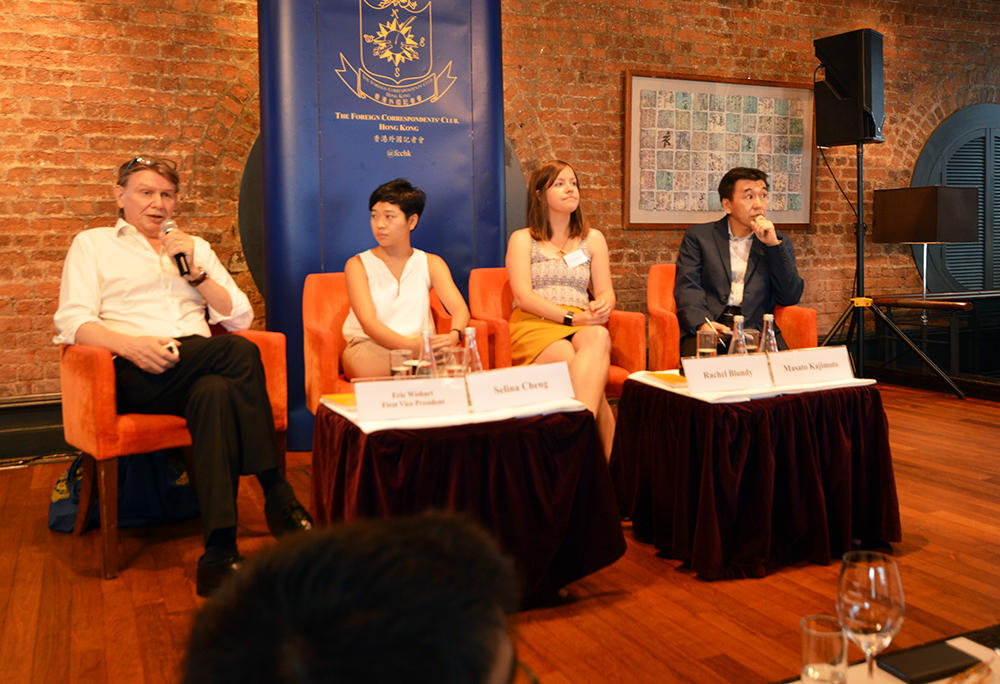
L-R: Host Eric Wishart, Selina Cheng, Rachel Blundy, and Masato Kajimoto. Photo: Sarah Graham/FCC L-R: Host Eric Wishart, Selina Cheng, Rachel Blundy, and Masato Kajimoto. Photo: Sarah Graham/FCC

Rachel Blundy, a fact-checker for Agence France-Presse, revealed how her team analyses claims being made on social media and investigates them to debunk fake news. Joining her on the panel was HK01’s Selina Cheng, who gave examples of fake news stories and how they quickly spread. “If the story sounds too good to be true, it probably is,” she said.

Masato Kajimoto, an assistant professor of practice at the Journalism and Media Studies Centre (JMSC), the University of Hong Kong, discussed China’s propaganda war and its attempts to smear the pro-democracy camp through the spread of fake news. He added that the more polarising the topic is, the easier it is for people to believe misinformation.

The discussion was the latest in the FCC’s series of workshops for journalists covering the ongoing Hong Kong protests. You can find the rest of the series here.

Watch the video

The Hong Kong Protests: An FCC Workshop Series for Journalists

Since June 2019, journalists in Hong Kong have been on the front lines covering what began as anti-extradition bill protests, often dodging tear gas and rubber bullets in the course of their work.

This FCC series of workshops brings together a wide range of experts, from journalists to tech specialists to health professionals, all of whom offer valuable advice for any media covering the protests.

Presentation slides:

Hong Kong Red Cross introduction (PDF)

Hong Kong Red Cross presentation (PDF)

Professor Paul Yip presentation (Slideshare)

Lokman Tsui (PDF)

Fake news panel (PDF)

You can download the Centre of Suicide Research and Prevention’s recommendations on suicide and mental health reporting here.

The Hong Kong Samaritans website can be found here, and the 24/7 hotline number is 2896 0000.

Watch the video series

The Hong Kong Protests: What Next for Hong Kong?

Stevo Stephen: A Workshop on Journalists’ Safety

Sharron Fast: A Workshop on the Legal Risks for Journalists

The Hong Kong Protests and Press Freedom

Lokman Tsui, Assistant Professor: A Workshop on Digital Security

Paul Yip: The Hong Kong Protests – Covering Mental Health and Suicide

Brian Wong: First-Aid and Health Safety

Information Wars – How Fake News and Disinformation Have Been Weaponized in the Hong Kong Protests

From Water Cannons to the Face Mask Ban: Increased Risks in Covering the Hong Kong Protests

Essential First Aid tips for journalists covering the Hong Kong protests

How to treat the effects of tear gas and other protest-related injuries was shared by a member of Hong Kong’s Red Cross at a workshop for journalists.

Brian Wong, senior staff officer for the Hong Kong Red Cross’s First Aid Service Coordination Team, Youth and Volunteer Department, also advised potential first aiders on the treatment of heat exhaustion, cardiac arrest, and bleeding.

He was speaking on September 3 at the latest in the FCC’s series of workshops aimed at journalists covering the ongoing Hong Kong protests.

Due to some technical issues, the talk is in two parts. 

Watch the videos


Ireland prepared to listen to backstop alternatives to avoid no-deal Brexit, says finance minister

Ireland’s finance minister says his government is prepared to listen to any alternative solutions the United Kingdom may have to the question of the backstop, but stressed that so far Prime Minister Boris Johnson had failed to put any forward despite the fast-approaching deadline for Britain to leave the European Union.

Minister of State at Ireland’s Department of Finance, Michael D’Arcy, at the FCC on September 2. Photo: Sarah Graham/FCC Minister of State at Ireland’s Department of Finance, Michael D’Arcy, at the FCC on September 2. Photo: Sarah Graham/FCC

Speaking at the September 2 club lunch, Michael D’Arcy reiterated that the withdrawal agreement thrashed out between the European Union and former British prime minister Theresa May was now non-negotiable but said he personally felt a deal on the issue of the border between the Republic of Ireland and Northern Ireland could be done after the October 31 deadline passes. He said Ireland was committed to exploring alternative agreements with the EU to avoid the return of a hard border which he said put the island’s prosperity at risk. D’Arcy added that avoiding a hard border was not just about economics, but about protecting the Good Friday Peace Agreement.

Referring to his controversial tweet last week in which he compared Prime Minister Johnson’s “anti-democratic” move to prorogue UK Parliament to Oliver Cromwell’s establishment of the Protectorate government, D’Arcy conceded he “shouldn’t interfere with UK Parliament” but added that he felt the current direction of discourse in politics internationally was “disappointing”.

Watch the video

Is the Sino-British Joint Declaration dead? Two experts give their views

The question of whether the Sino-British Joint Declaration was dead was the topic of debate at a sold-out club lunch on August 29.

Left: Alan Hoo, Chairman of The Basic Law Institute, and, right lecturer at CUHK’s Centre for China Studies, Tim Summers. Photo: Sarah Graham/FCC Left: Alan Hoo, Chairman of The Basic Law Institute, and, right lecturer at CUHK’s Centre for China Studies, Tim Summers. Photo: Sarah Graham/FCC

Guest speakers Alan Hoo, Chairman of The Basic Law Institute, and lecturer at CUHK’s Centre for China Studies, Tim Summers, gave their views on the relevance of the document, drawn up between Britain and China as part of an agreement to hand sovereignty back to China.

Both speakers also gave their take on the current protests gripping Hong Kong, and what they determined to be the next steps to resolving the crisis.

Watch the video

Essential tips for Hong Kong journalists reporting suicide and mental health issues

The media’s role and its responsibilities in reporting suicide and mental health issues were outlined in a workshop for journalists, part of an FCC series focused on the Hong Kong protests.

Professor Paul Yip, Director of the Centre of Suicide Research and Prevention at HKU, gives reporting tips to journalists. Photo: Sarah Graham/FCC Professor Paul Yip, Director of the Centre of Suicide Research and Prevention at HKU, gives reporting tips to journalists. Photo: Sarah Graham/FCC

Following rumours and speculation about a number of suicides that were directly linked by some Hong Kong media to the ongoing protests in the city–and giving details of how they were carried out–Professor Paul Yip, Director of the Centre of Suicide Research and Prevention at the University of Hong Kong, issued advice to journalists covering the topic at a breakfast briefing on August 27.

Prof Yip encouraged media professionals to provide more information around suicide prevention to help raise awareness of the support available to those experiencing mental health issues. He also advised journalists covering the Hong Kong protests to take rest for the sake of their own physical and mental health.

An audience member and representative of the Hong Kong Samaritans revealed that the nature of calls to the organisation’s hotline had recently changed, with many callers worried about the protests.

You can download the Centre of Suicide Research and Prevention’s recommendations on suicide and mental health reporting here.

The Hong Kong Samaritans website can be found here, and the 24/7 hotline number is 2896 0000.

Watch the breakfast briefing

Essential tips for journalists on digital security while covering Hong Kong protests

Digital security expert Lokman Tsui gave tips and insights into how journalists can take precautions to protect themselves, their work and their sources’ digital communications while covering politically sensitive events. 

What apps and email providers to use, how to adjust your phone settings to protect hackers and police interference, and what news organisations can do to better protect their reporters were topics that were covered during the August 13 briefing by the Assistant Professor at the School of Journalism and Communication, the Chinese University of Hong Kong.

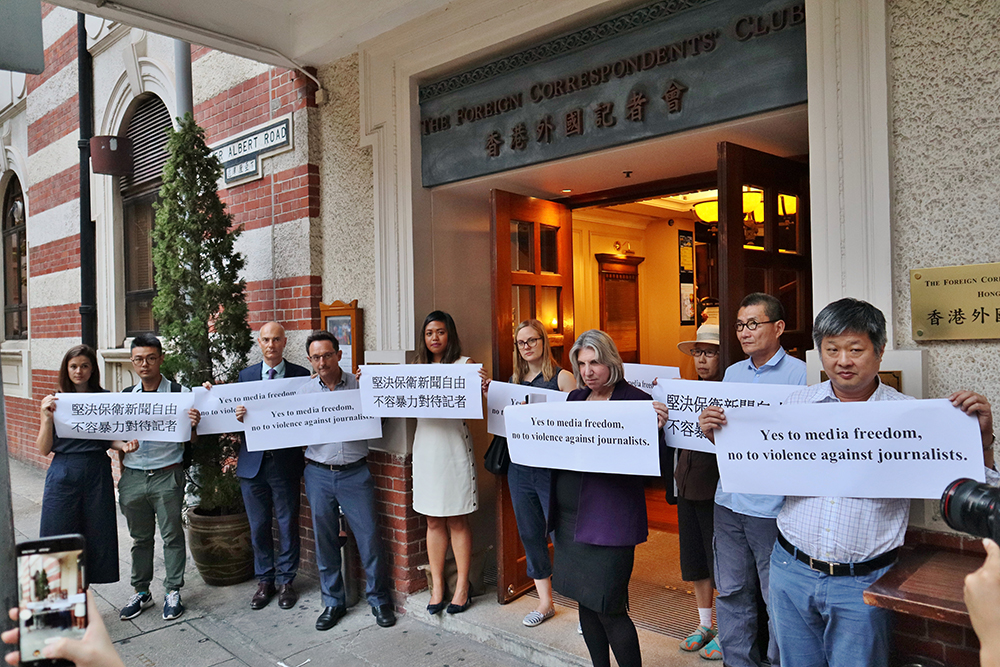
The event took place the day after the club sent an open letter to Hong Kong Police Commissioner Stephen Lo outlining concerns over the deterioration in relations between the police and the media covering the Hong Kong protests. 

Watch the video here

Inside the Hong Kong protests, as told by the reporters and photographers on the ground

The challenges facing journalists and photographers covering the Hong Kong protests were discussed by members of the media who have been on the ground since the demonstrations began in June.

Jennifer Creery, senior reporter for Hong Kong Free Press; Damon Pang, multimedia journalist for Radio Television Hong Kong (RTHK); AFP photographer Anthony Wallace, freelance journalist Eric Cheung, and Chris Yeung, chairperson of the Hong Kong Journalists Association, revealed their thoughts on the protests during the August 8 club lunch.

From covering the demonstrations as part of a small team to dodging tear gas, the panel detailed the ups and downs on reporting on the frontline.

Watch the video here.

How the U.S.-China trade war is impacting Asia

The effect of the U.S-China trade war on South East Asia was the topic of discussion at a breakfast briefing featuring a leading economic expert.

Ernest Bower, founder and CEO of BowerGroupAsia Inc. and founder and chairman of AkarAsia Inc. which is pioneering the field of digital advocacy and the use of artificial intelligence as a policy and business tool across Asia, gave his insights into how the dispute has affected China’s inbound and outbound investment.

Having arrived in Hong Kong from Washington on Monday, during the city-wide strike, Bower also commented on the ongoing protests as well as giving the view from Washington.

Watch the full talk here.

We measure site performance with cookies to improve performance.