
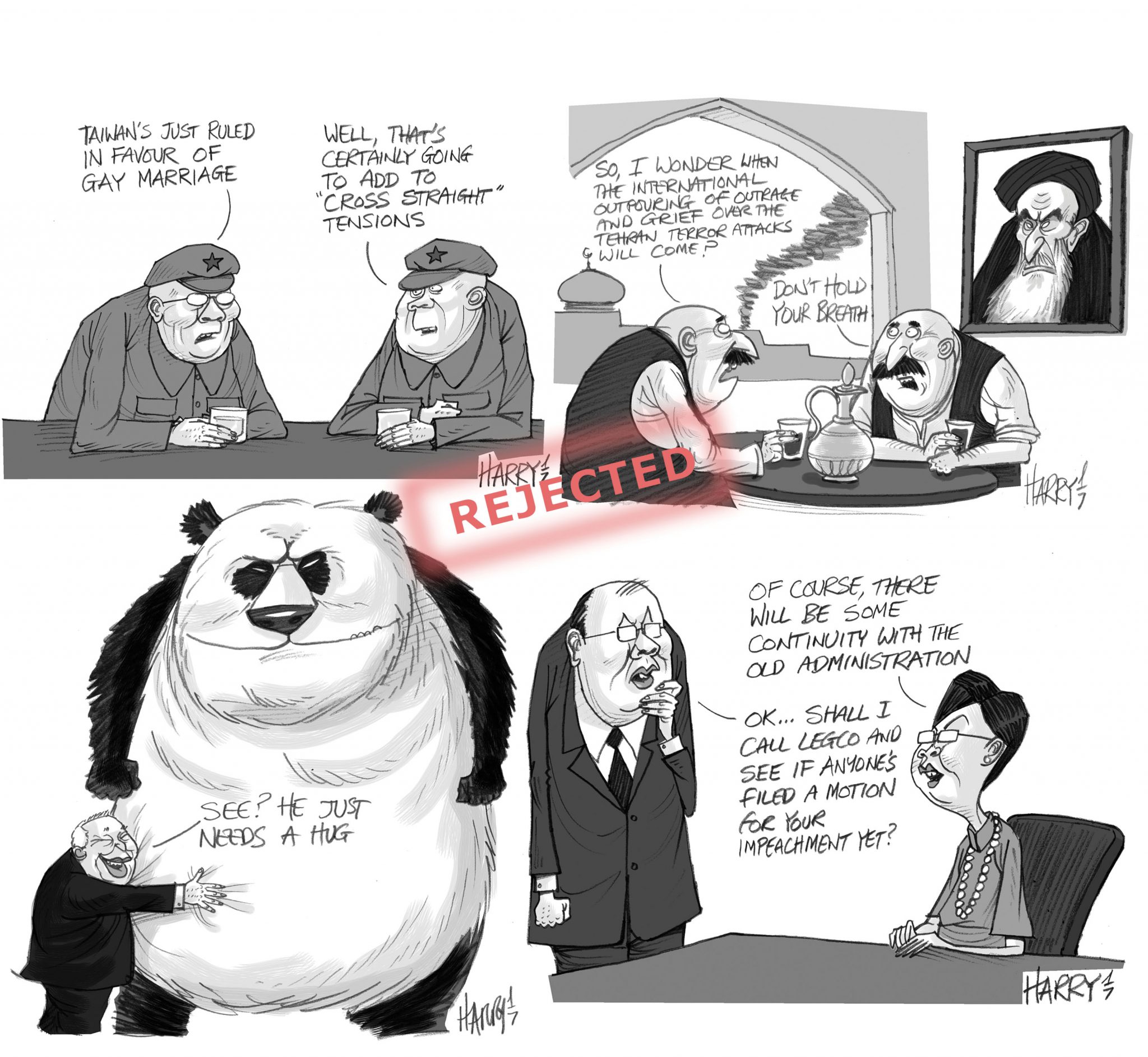
Harry’s rejects: Taiwan’s new gay marriage legislation
Introducing… FCC new members, July/August 2017
 Clockwise from top left: Bhavan Jaipragas, Malcolm Johnston, Ernest Chi, Silver Kung, Michael Connelly, Alex Williams, Marian Liu, Jean-Charles Viens.
The latest group of members to join the FCC is, as always, an interesting bunch. The membership committee meets regularly to go through the applications and are always impressed by the diversity of the prospective members. As you would expect there’s a healthy mix of Correspondents and Journalists as well as Diplomats and Associates – and all have interesting tales to tell – so if you see a new face at the bar, please make them feel welcome. Below are profiles of just some of the latest ‘intake’.
Jean-Charles Viens: At 25 I established my first company in Hong Kong and for the past 20 years I have witnessed, first as an entrepreneur in import and export and now as an expert in wine communications, the unprecedented growth of the wine industry in Asia. I am deeply passionate about wine and other pleasures of the table and am always looking for quirky and unusual wines. I regularly travel to various wine regions around the world to learn the stories behind the labels. I am a Vinitaly Academy Italian Wine Ambassador and creator of a popular 30-part wine workshop series “How to Taste like a Pro”. When not talking about wine, I am writing about it. As Deputy Editor of Spirito di Vino Asia, a bi-monthly magazine I am dedicated to promoting a Culture & Quality “Wine-Style”. The magazine is widely distributed across Asia.
Ernest Chi: I graduated with a BA degree from the University of Winnipeg, Canada and began my career in journalism when I joined the Hong Kong Economic Journal in 1995 as a financial reporter. In 1999, I moved to Ming Pao, where I was promoted to finance news editor in 2003 before joining its general news desk in 2007.
In April 2011, I formed an investigative news team and soon after, we broke a story on the rigged purchase of Henderson Land’s luxurious residential 39 Conduit Road. Other investigations followed – notably one on voter rigging in 2011 and the following year two ‘illegal basement’ stories. The first led to the leading Chief Executive contender Henry Tang losing the 2012 election while the second report a few months later found an illegal structure in the Peak home of the newly-elected CE, CY Leung. I have often wondered whether the Chief Executive would be a different person if we had broken both stories at the same time.
I left Ming Pao in 2013 and joined HK01 as Executive Chief Editor in charge of the News. The publication was launched with a mission to drive social change, restructure social values and drive media reform. And that’s what I’m trying to do.
Michael Connelly: I have lived in Chicago, Beijing, and New York City before relocating to Hong Kong in May 2016 to assume the role of Editor in Chief at digital magazine Lifestyle Asia. My past experience includes colourful stints roaming the globe as online editor at Fodor’s Travel, reporting on the arts for New York magazine, and interning for the fiction editor of Playboy magazine. A speaker of Mandarin and Spanish, my passions include languages, cooking, 35mm photography, gardening and gin.
Bhavan Jaipragas: I’m the not-so-new Asia Correspondent for the South China Morning Post. I came on board last September, after spending a year at the LSE pursuing a postgraduate degree in politics and communication. I was previously a correspondent for Agence France-Presse in Singapore, my home country. At the Post, I work mainly with the newspaper’s This Week in Asia team and write about the politics, economy and foreign policy of the 10 ASEAN countries. I’m a wannabe polyglot and am ever endeavouring to polish my command of Tamil, my mother tongue, and Malay, my national language. I speak and understand (very) basic Mandarin.
Malcolm Johnston: Originally from Northern Ireland, I arrived in Hong Kong in 1992 for a two-year contract and decided to stay. I am a Chartered Surveyor, specialising in major transport infrastructure projects, and have worked on projects in the UK, China, Hong Kong and the Middle East. I am head of quantity surveying with Arcadis Hong Kong / Macau. Married with two teenage daughters, I am a keen hill walker, whisky taster and novice beer brewer.
Silver Kung, Ph.D: I consider myself a poetic traveller exploring life through space and time. I am a constant and enthusiastic student of world history and hope to travel to every corner of the world. I have an academic background encompassing engineering, finance and economics and have been working on cross-border and cross-fields projects for the past decade. I am an active environmentalist doing my best to preserve our planet to help make it a better place for our children. I was born in Taiwan but have lived in the US and Italy, I am currently based in Hong Kong and active in the Greater China region.
Marian Liu: On a whim, I quit my job with American newspapers to take up my first overseas post with CNN in Hong Kong. As a Chinese American, I hope to bridge the gap between countries and cultures. I cover Asian entertainment with stories about K-pop, J-pop, Canto and Mando pop and Bollywood. I manage the sites and social media for CNNMoney International, Media, Tech, Travel and Entertainment. I will also be teaching multimedia journalism at the Journalism and Media Studies Centre at The University of Hong Kong. Previously, I covered entertainment as an editor, critic and writer for the Sun Sentinel, The Seattle Times, San Jose Mercury News and Source Magazine. I have an Executive MBA from the University of Washington and a Bachelor of Arts in Integrative Biology and Mass Communications from the University of California, Berkeley.
Carlos Tejada: Nora and Carlos Tejada may have downed a few drinks at the FCC before. We are returning members after a smoggy five-year detour through Beijing, where our children learned Chinese and discovered that the line between pets and food can get blurry fast. We have also lived in Kansas, Dallas and New York. Nora, a freelance photographer, is from Towanda, Kansas. Carlos, the Asia business editor for The New York Times, is from southern Arizona. Like so many country people, we prefer life in the big city. We are both graduates of the University of Kansas.
Alex Williams: Now 38, I have spent most of my adult life working in Asia – firstly in Beijing and Shanghai and now more recently living the dream in Wanchai. My early career penning bar and restaurants listings and selling advertising at That’s Beijing transitioned seamlessly into that of a commodities trader. I currently focus on trading large quantities of specialised sand around the world; life’s a beach! As a Brit with an American wife and a couple of ankle biters, we holiday in England and New England, or make the most of short breaks to Japan, Cambodia or Vietnam.
The one piece of the jig-saw that still needs to fall in place is setting up an AC/DC cover band here and thrashing out some foot-stomping tunes!
Weiboscope: Tracking censorship of China’s most popular social media platform
 The instant-messenger app Sina Weibo has been redefined by media as a bellwether of popular opinion. Martin Choi looks at its influence with a study of a University of Hong Kong project that tracks the censorship of microblogging posts.
With the proliferation of Internet access in China, authorities are increasingly hard-pressed to prevent the spread of sensitive content before it gets blocked or removed.
One of the largest Internet-based platforms for sharing ideas publicly in China is the microblogging service Sina Weibo. It is the country’s answer to Twitter, which is officially blocked in the Mainland.
Weibo is so widely used in China that journalists, experts and China observers look to the platform as a gauge of the pervading public sentiment. By looking at what type of information is censored on Weibo, insight may be gained into the limits of free expression.
The Weiboscope project at the Journalism and Media Studies Centre at the University of Hong Kong, tracks and produces annual and quarterly reports on the most important censored Weibo posts of the year.
Looking at the first quarter of 2017, the most recent at press time, the top five posts relating to current affairs were selected in descending order of the reposts generated per “survival time”, or the time between which they were posted and taken down. Each post has been translated into English and includes relevant background information to provide context and insight into China’s online media environment.
By looking into the content and circumstances surrounding the censored posts, we hope that some light may be shed on the nature of discussing sensitive issues on China’s most popular microblog.
TOP FIVE CENSORED POSTS
1) Parodying the CCTV New Year’s Gala
Posted on 2017-01-27 at 12:00:47
Generated at least 40,346 reposts in 3 hours and 35 minutes.
Original: #春晚# 大家好,这是今年的春晚节目单吐槽・[bed凌乱]
Translation: #SpringFestivalEvening# Hello everybody, here are the rantings about this year’s Spring Festival Gala rundown … [bed messy]
 Parodying CCTV New Year’s Gala
The Spring Festival Gala, also known as the CCTV New Year’s Gala, is a highly publicised official event in celebration of Chinese New Year. Broadcast annually by China Central Television (CCTV), the event always generates criticism and is the butt of jokes on the Internet community in China for its unsubtle dissemination of Communist Party values and propaganda themes such as national unity and prosperity.
In this censored post, the whole rundown of the CCTV New Year’s Gala was parodied. For each event, netizens made a crude drawing, poking fun of the performance.
In the screenshot above, the song and dance performance of “Beautiful Chinese Year” was parodied. The drawing for the performance featured the silhouettes of numerous people and words in brackets that specifically said there were “many people”. Without having seen the event itself, it’s not too hard to envision a performance with a lot of performers.
In the image below, netizens made fun of the recital of the song “Happy Night”, sung by Phoenix Legend with a crude drawing of a pole-dancing panda saying “Come on, be happy” and “It’s New Year’s Eve, no need to do homework” in mockery of the officially joyous nature of the occasion.
 This post may have been censored for making fun of the CCTV New Year’s Gala, a highly publicised event that the government takes pride in.
2) Recruiting wives for the PLA
Posted on 2017-02-06 at 17:32:20
Generated at least 52,871 reposts in 6 hours and 32 minutes
Original: 说起开放代孕这件事,不知道现在的大家知不知道八千湘女上天山灯。
50年代初,为了让驻疆二十万官兵垦荒屯田,从湖南征招了一大批平均年龄只有十八岁的少女送去,给当兵的一人发一个老婆灯。那些入伍的少女,多是有文化、读过书、满腔爱国热情的女学生,响应的是保卫边疆,建设边疆的崇高号召,以…全文: http://m.weibo.cn/1717321192/4072208135147041
Translation: Speaking of surrogate pregnancy, not sure if you have heard of “The Eight Thousand Girls from Hunan who went to Tianshan”.
 In the early 1950s, in order for two hundred thousand troops to reclaim and cultivate the barren land in Xinjiang, a large number of Hunan girls aged 18 were recruited so that each soldier could “each have one wife”. Many of the recruited girls were cultured, educated and full of patriotic enthusiasm, and they responded to the lofty call to protect and construct the borders…
To put this censored post into context, in 1950, Chairman Mao Zedong ordered the 200,000 People’s Liberation Army soldiers stationed in Xinjiang after the 1949 occupation to settle down and cultivate land there to secure China’s borders.
Many of the PLA soldiers were unmarried, so Wang Zhen (1908-1993), who commanded the forces in Xinjiang, requested Mao to send female soldiers from Hunan.
Wang (who would later become vice-president of China and is known as one of the ‘Eight Elders of the Communist Party of China,’ told Mao: “Without a wife you cannot be at ease, without a son you cannot take root.” This quote can be found at the bottom of the image in the Weibo post. Over the next three years, around 8,000 young women from Hunan were sent to Xinjiang to be married to the soldiers.
History is a sensitive issue in China, especially anything to do with the image of the party or its propaganda. In March, the National People’s Congress made amendments to the Civil Code, notably that “encroaching upon the name, portrait, reputation and honour of heroes and martyrs harms the public interest, and should bear civil liability”, according to a Reuters report.
This is a significant amendment in that it restricts discussion of history that the Communist party deems sensitive. Yet this Weibo post not only brings to light history that is sensitive to the party, it also attacks the image of the PLA, which is sacred in the eyes of the Chinese government.
3) Pork or beef for the New Year?
Posted on 2017-01-29 at 13:56:50
Generated at least 13,309 reposts in 7 hours and 27 minutes.
Original: “腊月二十六,杀猪割年肉,怎么在中国中央电视台就成了粕二十六,炖牛肉?难道春节也清真了?为了灯民族团结,随意放弃自己几千年民族传统,我相信得到的只能是轻蔑和鄙视,因为你们太无耻太自贱!“ “
Translation: The folk saying is that on the 26th day of the 12th month in the Lunar Calendar, you butcher a pig to prepare for the New Year’s feast, but how come CCTV has changed this tradition to braising beef on the 26th? Has the Chinese New Year become a Muslim tradition? Freely giving up traditions spanning thousands of years for the sake of “national unity”, I believe the only thing you will end up with is contempt, for you are shameless and cheap!”
 In other words, this post criticised the Chinese government for sacrificing traditions for ethnic and national unity. Ethnic minority relations are a highly sensitive topic in China, as the Communist Party has been trying to secure harmonious relations between communities. Therefore, it’s not surprising this post was censored for touching on Muslim and ethnic concerns, one of the red line issues for the Chinese government.
4) Protesting against criticism of Mao
Posted on 2017-01-08 at 11:40:14
Generated at least 2,526 reposts in 3 hours and 15 minutes.
Original:【意味深长】济南,那些人打出的标语大书打倒邓贼灯,后面用很小的字写相超灯 。
Translation: [Meaningful] In Jinan, those people held up banners with the words “Down with Deng thief” written on it, then in smaller words “Xiangqiao” was written behind it.
 In this Weibo post, a banner is erected in Jinan, with supporters of Mao Zedong condemning criticism of Mao.
Tang Xiangqiao, a professor at Shandong University of Architecture and Engineering, wrote posts on Weibo insulting Mao. As his posts gained more traction and the protest in the Weibo post became publicised, he was dismissed from his teaching position by the Shandong provincial government.
There may be two levels of sensitivity in this post. The first issue is Tang’s criticism of Mao, which could be unwelcome itself. Another issue may be the depiction of collective action, and anything on social media about collective action tends to be censored in China.
A study about censorship in China headed by Gary King, professor of government at Harvard University, claimed that China’s “censorship programme is aimed at curtailing collective action by silencing comments that represent, reinforce, or spur social mobilisation, regardless of content.”
The study further concludes that collective action may be a stronger reason for censorship than criticism of the government. Therefore, the idea that people are standing on the streets holding banners may be the most sensitive issue at stake for the Chinese government in this post, even if they are in support of Mao.
5) Muslims take to the streets of Shanghai in worship
Posted on: 2017-02-19 12:04:39
Generated at least 2,900 reposts in 5 hours and 9 minutes.
Original:【上海穆斯林占街朝拜 官方默许】上海回教徒信仰中心的沪西清真寺,一到周五「主麻日」(相当基督教的主日崇拜),就有上千人潮蜂拥占据整条马路。连上海特警、公安都要开道让教徒跪地祈祷,特别的是,这现象周周上演。
从来严禁聚众上街集会,更不鼓励宗教活动的大陆,「默许」回教徒占据上海街头,…全文: http://m.weibo.cn/6030678530/4076836713597066
Translation: [Shanghai Muslims occupy the streets in worship. Authorities acquiesce] Every Friday during “jummah day” (equivalent to Christians’ Sunday worship), more than a thousand Muslims gather outside the Shanghai Huxi Mosque. Even the Shanghai police forces have to clear the way to allow them to pray in the middle of the road, and the most astonishing thing is that this happens every week.
 Mainland China forbids assembly, nor does it encourage religious activities, yet it acquiesces to Muslims in Shanghai occupying the road during Friday prayer every week.
This Weibo post criticises Muslims for being able to assemble on the streets of Shanghai during the noon Friday prayer. This takes place outside the Huxi Mosque, a historic building in Shanghai’s Putuo District that was built in 1922. It was the first mosque in Shanghai to be allowed to resume worship after the establishment of the People’s Republic of China.
As in the post about Tang Xiangqiao, this post may be sensitive on two levels. First, the post brings up and generates criticism of ethnic minorities – Muslims in Shanghai in this case. In addition, the Muslims assembling on the streets of Shanghai, although behaving peaceably, appear to violate unlawful assembly and demonstration laws. As noted in the title of the post, the authorities appear to “acquiesce” and don’t stop them from gathering on the streets.
The nature of posts like these triggered sensitive issues that send signals of alarm to the party. While the posts shown here depict many issues that worry the party – ethnic minority issues, collective action, historical narrative or even defamation of party officials these are in no way a definitive or exhaustive explanation of online censorship. Much remains to be seen regarding China’s censorship decisions over its expanding online community.
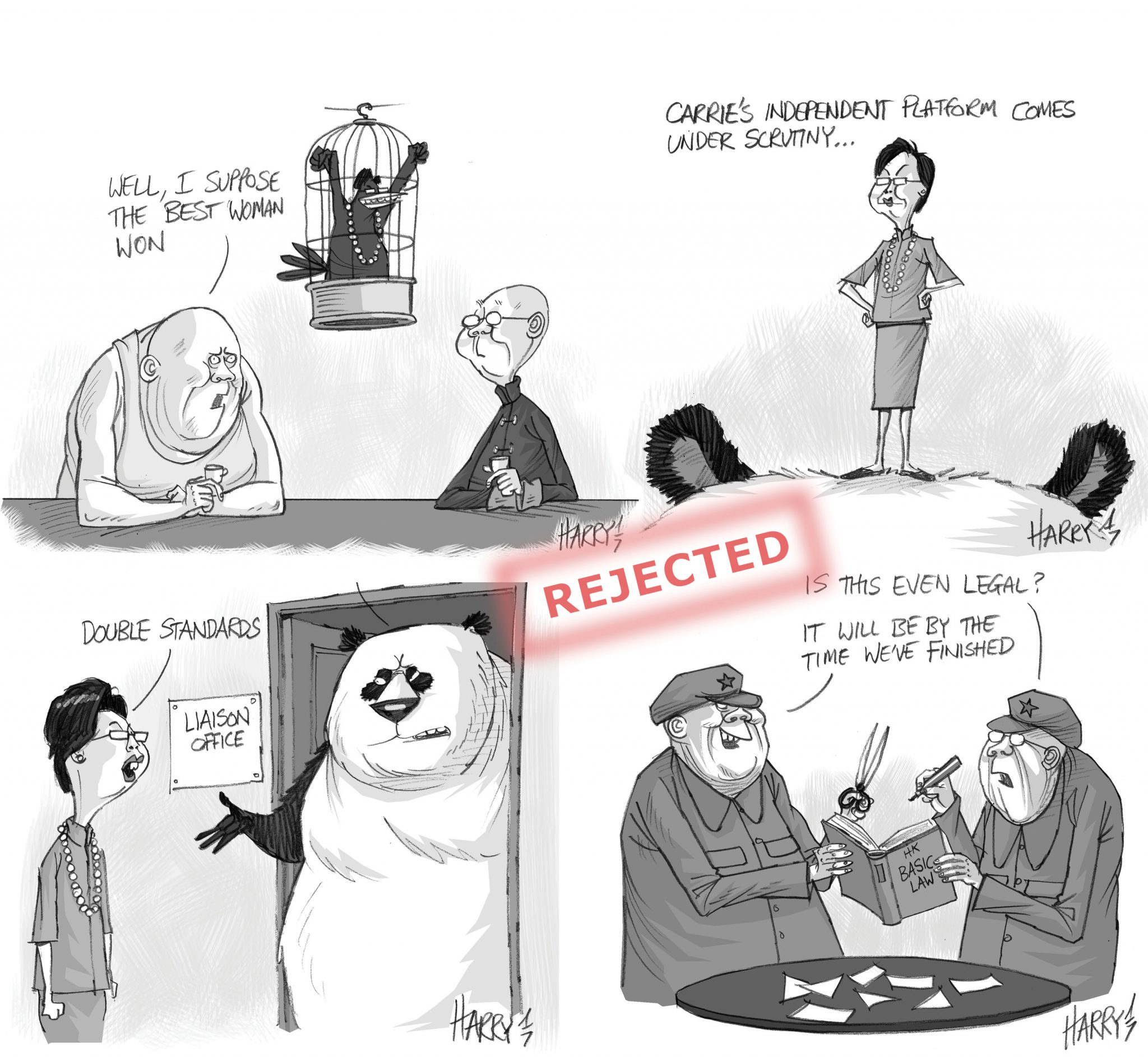
Harry’s rejects: Carrie Lam in the spotlight
Book review: Free Speech, Ten Principles for a Connected World
 Timothy Garton Ash delivering the 2017 Central European University’s President’s Lecture_WikiCommons_© 2017 Daniel Vegel
The Internet and unlimited free speech are part and parcel of the modern world. Regulation on a global scale is neither possible nor desirable but should we perhaps adhere to some basic principles? Vaudine England looks at some of the arguments put forward by Timothy Garton Ash in his latest book, Free Speech, Ten Principles for a Connected World
Do we really need yet another well-meaning essay about how free speech is a nice thing and we should all have it?
Ever since I had to fold the church newsletter for pocket money I’ve had rather an aversion to the whole idea of preaching to the converted. And surely now that at least half the world’s population has access to the internet, we are all free to share ideas and marvels across boundaries, fuelling change through social media, right? Yes and no.
Several recent chroniclers of our times have pointed out that with every new freedom of the internet comes a new responsibility or fear. A recent review of several such books referred back to the philosopher Jeremy Bentham’s idea of the panopticon, a circular prison with an inspection chamber stuck in the middle. It meant that every prisoner could be watched at any time, but you would never know when the jailer was looking. (See the Weekend FT, 11 March 2017, for John Gapper’s review of new books by Donna Freitas, Adam Alter and Robin Boast.)
It is this landscape that the Oxford academic Timothy Garton Ash has chosen to chart in his latest book, Free Speech, Ten Principles for a Connected World. Professor Ash did his post-graduate fieldwork in East Berlin, back before the Wall came down and an earlier book, The File, is a brilliant evocation of that time, and of layers of perception. This is relevant now, as Professor Ash told a Hong Kong audience in early March 2017, that what is now available about each of us (our File, as it were) on the internet would be a Stasi detective’s wet dream.
As he discusses in his book Free Speech (on page 284), surveillance is, in fact, the business model of the internet. He quotes a security expert as explaining how private empires such as Google and Facebook build systems that spy on people in exchange for services which are described as free. ‘Corporations call it marketing’, says the expert.
This is the new world that Ash, over the course of a decade of another set of layers of perception — academic research, interviews in Silicon Valley, and the vast global website project called freespeechdebate.com — has set out to consider. Happily, Ash has the knack of the best public intellectuals of taking vast, complex, scary subjects and putting them into words we can relate to.
Most importantly, he has taken the debate into new territory by engaging directly with people far beyond a western liberal’s usual comfort zone. He has sat with and learned from intellectuals and internet practitioners from Iran to Brazil, from China to India, from Turkey to South Africa.
He makes the point that the vital other half of speech is listening and it’s clear he has listened intently in his quest to find new, workable definitions of free speech that cross cultural boundaries. This is a deeply thoughtful and informed look at how ancient, diverse cultures and peoples have tackled this fundamental issue of existence and how these various ideas work now.
He talks of the year 1989 as one of the most profound in recent history. In that year, the Berlin Wall was broken down heralding the end of the Cold War division of Europe; Iran’s Ayatollah Khomeini issued a fatwa against the author Salman Rushdie (in one of many illuminating asides we are told that Rushdie’s American publisher had naively asked, what’s a fatwa?), the Chinese Communist Party reasserted its claim to survival via Tiananmen Square, and the World Wide Web was invented.
As a result, ‘We are all neighbours now. There are more phones than there are human beings and close to half of humankind has access to the internet… Never in human history was there such a chance for freedom of expression as this. And never have the evils of unlimited free expression — death threats, paedophile images, sewage-tides of abuse — flowed so easily across frontiers.’ (Ash, p1)
It is this consciousness of the here and now, and how dramatically different it is to the very recent past, that makes Ash’s book so important. He is illuminating on virtually every page. Some points seem blindingly obvious. But after a chapter going more deeply into what, for example, it means that ‘were each user of Facebook to be counted as an inhabitant, Facebook would have a larger population than China’, one is left in no doubt that some corporations have more power than most states.
That can be frightening, until Ash also points out that without users — and that is each of us — those uber-states are nothing. So it matters, deeply, what we do with our power. He calls the most powerful states (still led by the U.S.) ‘Big Dogs’, and the commercial superpowers ‘Big Cats’. Yes, we are the mice, but without us, the big animals die.
Ash knows all about the constraints on the internet, and the legal guarantees of freedom of speech, plus where these work and where, as in China, they patently fail. Ash takes things a large step further however.
He realised he needed to engage the monster he was talking about, and so the vast web-based project, Free Speech Debate, began. At one level, this is a website, most of it now in 13 languages, where all and any issue relating to free speech are debated, translated, discussed, disagreed with and published. In detail, it is a fascinating exploration of multiple cultures, ideas, histories and personalities.
Real stories, and accounts of actual, vigorous debate, of basic values is something we’re often all too scared to bother with these days — for fear of being labelled politically incorrect in some places, or being locked up or shot in others.
 At the end of the web-based Free Speech Debate, ten points emerged as a kind of shorthand for how to live in this newly interconnected cosmopolis that everyone online in the world is now a part of.
Lifeblood
— We, all human beings, must be free and able to express ourselves and to seek, receive and impart information and ideas, regardless of frontiers.
Violence — We neither make threats of violence nor accept violent intimidation.
Knowledge — We allow no taboos against and seize every chance for the spread of knowledge.
Journalism — We require uncensored, diverse, trustworthy media so we can make well-informed decisions and participate fully in political life.
Diversity — We express ourselves openly and with robust civility about all kinds of human difference.
Religion — We respect the believer but not necessarily the content of the belief.
Privacy — We must be able to protect our privacy and to counter slurs on our reputations, but not prevent scrutiny that is in the public interest.
Secrecy — We must be empowered to challenge all limits to freedom of information justified on such grounds as national security.
Icebergs
— We defend the internet and other systems of communication against illegitimate encroachments by both public and private powers.
Courage — We decide for ourselves and face the consequences.
Asia journalism news round-up: BBC correspondent faces Thai charges
International fact-checking day. News organisations, journalism schools and more celebrated International Fact-Checking Day on April 4 to raise awareness of fact-checking efforts and techniques. Poynter’s International Fact-Checking Network led the effort, partnering with organisations like Argentina’s Chequeado, Google News Lab and the American Press Institute. Local fact-checking activities and discussions took place across five continents. The initiative’s website features several resources for journalists and journalism educators, including a lesson plan for high school teachers and six “how-to” guides.

BBC correspondent faces Thai charges. The criminal defamation and Computer Crimes Act case in Thailand against Jonathan Head, the BBC’s Southeast Asia correspondent, is emblematic of the state of press freedom in Thailand, the FCC said in a statement of support. The charges, initiated by a private citizen over Head’s reporting on foreign retirees who were scammed in Phuket, carry a possible five-year prison sentence. Head had to surrender his passport, seriously impeding his ability to report across Asia. The FCC called on those responsible to throw out the case against Head. Moreover, Thailand’s leaders should undertake long overdue reform of laws regarding criminal defamation, computer crimes and lese-majeste.
Hong Kong’s press freedom ‘slightly’ better. Despite a slight improvement in the perception of press freedom in Hong Kong for 2016 after two consecutive years of decline, the Hong Kong Journalists Association, which conducted the latest survey in January and February, says the situation continues to be “worrying”. The annual Press Freedom Index for journalists rose 1.2 points to 39.4 out of 100, while the index for the general public increased slightly by 0.6 points to 48. The index measures a group’s perception of media freedom in their society.
The positive development, however, came despite 72% of the media workers surveyed saying that they felt overall press freedom in Hong Kong had worsened in the past year. “But it is still hard to set our minds at ease as the press freedom index for both groups – 39.4 for journalists and 48 for members of the public – is still way below the passing mark of 50 points,” said HKJA chairwoman Sham Yee-lan.
Indonesia’s journalist blacklist. The expulsion of French journalists Franck Escudie and Basile Longchamp on visa violations from West Papua, highlighted the failed election promise of Indonesian President Joko Widodo to allow local and international journalists to operate in West Papua without obstruction, Reporters Without Borders said. Repeated refusals to issue press visas and the growing number of journalists on its blacklist, shows it falls far short of qualifying as a country that supports freedom of expression and media freedom.
Terrorism handbook. Unesco has launched a new handbook, “Terrorism and the Media”, designed to help journalists navigate the challenges of covering violent extremism. The primer states that terrorism and the fight against it “have become major elements of domestic and international politics, with the media firmly on the front lines, especially when attacks target civilian populations”. The 110-page manual is not just for those who specialise in national security, given that any journalist at any time can be thrust into reporting on a terrorist act. It can be downloaded online here.
Introducing… FCC new members, May/June 2017
The latest group of members to join the FCC are, as always, an interesting bunch. The membership committee meets regularly to go through the applications and are always impressed by the diversity of the prospective members. As you would expect there’s a healthy mix of Correspondents and Journalists as well as Diplomats and Associates – and all have interesting tales to tell – so if you see a new face at the bar, please make them feel welcome. Below are profiles of just some of the latest ‘intake’.
 FCC new members
Bill Cox is a British Chartered Engineer and has spent 40 years as a management consultant working with manufacturing companies to improve performance. Consultancy projects took him from the UK, across Europe, Southern Africa, the Middle East, India and Pakistan, then into the Asia Pacific region working from Hong Kong. Bill also spent 10 years in China working on major industrial development projects sponsored by the World Bank and UK DFID.
In 2011 Bill started working for the Epoch Times, a New York based media group, dedicated to reporting uncensored news with emphasis on China. He is based in Hong Kong as a Senior Reporter, Photographer and Sports Editor
A native New Yorker, Sunshine Farzan is an accomplished business leader who has held senior positions at MetLife, American Express, and Harte Hanks. She has lived and worked in New York, Mexico City, Sydney and Hong Kong. She currently serves as Head of Marketing and Communications for MetLife Hong Kong.
Sunshine is a graduate of Rutgers University and has an MBA from the University of Michigan. She has been recognized as one of the top “40 under 40” marketers and a “Woman to Watch” in Asia.
Find out how to become a member here
Bernd Hanemann was born and raised in the south of Germany near to the borders of Switzerland and France. Bernd moved to Hong Kong in 1985 and is the CEO of the Global Sourcing Office of the German Retail and Wholesale Group Metro. Bernd is also a member of the Royal Hong Kong Yacht Club and is a keen sailor and motorcyclist.
Born in Liverpool, UK, James Legge is a copy editor working at the South China Morning Post. James spent 18 months freelancing as a reporter in Hong Kong for The Independent, Vice News, DPA and the Evening Standard, before joining The Post. James previously worked in London on staff at The Independent. James is also the presenter of the Hong Kong Football Podcast.
Jeff Nankivell took up the post of Consul General of Canada in HK and Macau in August, 2016. In his 28 years in Canada’s foreign service, he has served once before in Hong Kong and three times in Beijing, most recently as Deputy Head of Mission, 2008-2011. From 2011 to 2016 he was Director General responsible for Canada’s official development assistance in the Asia Pacific region.
His wife Alison Nankivell is Vice-President for Funds and Co-Investment with BDC Capital, part of the Business Development Bank of Canada, a Government-owned bank for small business.
They are both fluent Mandarin speakers.
Corliss Ruggles arrived in Hong Kong in May1994, just a few weeks after graduating from university in Canada. Looking for work in financial communications, Corliss worked hard to build a career which has kept her busy and rooted in Hong Kong for the past 23 years. It was here she met her husband, had two children and gave a home to four rescue dogs. Corliss enjoys her life in Hong Kong, “you meet people and make friends from all over the world,” she says. “There’s nowhere else like it.”
Former Consul General of Canada to Hong Kong, and High Commissioner to Singapore, Doreen Steidle is HSBC’s Regional Head for Government Affairs in Asia-Pacific. Before taking up her position with HSBC, Doreen served on several Boards including Invest Ottawa and was on Canada’s delegation to observe elections in the Ukraine. She is the mother of four adult children, a PADI-certified Rescue Diver and most recently completed a 100 km trek across the Gobi Desert in winter in support of Water Aid. She is now on the Board of Governors of the Canadian Chamber of Commerce and the FCC’s Charity Committee.
Lisa Yuriko Thomas recently relocated from San Francisco for her second stint at living in Hong Kong. She loves all things digital so is delighted to be working as senior producer and Asia Editor for AJ+, Al Jazeera’s digital only Channel. She is always on the lookout for great stories and new forms of video storytelling and social engagement. Swimming and yoga take up most of Lisa’s spare time.
Hong Kong Remembers: An unforgettable night for a good cause
The FCC Charity Committee went into overdrive to plan and execute the first of many events aimed at benefitting smaller, lesser-known charities which can all too easily fall between the cracks in Hong Kong.
 Hong Kong Remembers
A lot of people came up and said ‘You should do this at least twice a year’,” said FCC Second Vice President Tim Huxley a few days after the Hong Kong Remembers party. “Obviously they were people who weren’t on the Charity Committee.”
Indeed not. A lot of hard work went into the fun. The Charity Committee, of which Tim and Elaine Pickering are co-convenors, had only about two and a half months to put together, as it was billed, “An Evening of Music, Nostalgia & Entertainment in Aid of The China Coast Community”.
It required a transformation in the appearance of all the F&B venues and function rooms, as well as laying on three separate buffets and an evening long entertainment programme running concurrently on all three levels.
The evening was an important event for the club. It brought members back together after a few difficult weeks during which the Main Bar had been closed for renovation. It also marked a resumption of active involvement in charity fundraising, following the decision of the organizers of the former FCC Charity Ball to make a change of address to the Hong Kong Rugby Union.
This however, Tim stressed, was something different and intended to mark the first step towards establishing a programme of community outreach initiatives in support of a raft of causes.
“There was a desire to have something not based so much on an individual event, but to develop a longer term sustainable approach to our role in the community and utilise all the talents that exist in the FCC,” he said.
“We were particularly keen to focus on areas where people risk falling between the cracks, and geriatric care is one of those – particularly for people who are not native Cantonese speakers, but who are going to be here long term. And that’s an increasing number of people. We went and looked at the China Coast Community when we were looking at how to start our initial fundraising for this year. Later on we’d like to expand this into other areas.”
As a first step though, rather than simply write a cheque to the charity, it was determined that an achievable target should be identified. This was to replace the home’s existing beds with surgical ones – a significant and tangible improvement in quality of life for both the residents and their care givers – and to provide occupational therapy services.
Scroll down for our photo gallery from the night
The way the second objective has been achieved, Tim said, is a model of the way the Charity Committee would like future FCC community outreach to work. Through a member of the committee’s connections, arrangements are being made for Hong Kong Polytechnic University final year Occupational Therapy students to take up placements with the China Coast Community.
“We were able to cover that one through connections of the club. Absolutely brilliant and absolutely what we wanted to do,” said Tim.
To raise money for the beds, the party was organised, in short order by, in Tim’s words, “that force of nature, Elaine Pickering”.
“It was all volunteers. She managed that committee with military precision, deciding who was delegated to do what, and they all went out and did it. Everybody was very enthusiastic about the cause and the event. There was a great team of people on the committee, and the staff were really behind it.”
To help establish a suitably nostalgic atmosphere Huxley recommended designer – and former FCC member, time you reapplied – Colin Tillyer, who set to work recreating iconic signs, logos and other paraphernalia of yesteryear.
Almost exactly 20 years after The Godown closed, the night’s jazzier performers recreated the atmosphere of its heyday. The Main Bar, with a Disco theme, became the 1970s Peninsula nightclub, The Scene, and the Verandah got a dai pai dong makeover as a hawker food area – although not all elements of decoration for that were Colin’s idea.
“The rubber mice and cockroaches that you saw in Hawker Street were Chef George’s idea. He turned up at a charity meeting with a plastic bag full of rubber mice and we thought ‘Yeah, that’s different’,” Tim recalls.
Members and the companies and organisations they work for or run were more than generous in donating goods and services, including all the prizes in the raffle – for which all the tickets were sold – and lots for the silent auction. There isn’t space to name them all here, but you can find all 89 listed in the back of the programme and on page 32 of this magazine.
The musicians who perform regularly at the club also rallied round, and there were fine performances from The FCC All Stars, Miriam Ma & Hippogroove, Crimes Against Pop, and The Red Stripes, all in suitably nostalgic mode, not to mention a pipa recital and very popular impromptu lessons in swing dancing. The dancers have also volunteered to perform at the China Coast Community, very much in the spirit of the evening.
There was some more poignant nostalgia as well. A screen in the Hughes Room – sorry, Luk Kwok Hotel – was playing a digital image gallery of photographs of FCC members accumulated by The Correspondent, and curated at Elaine’s suggestion by Terry Duckham. Quite a few of us watching that were reminded not only of past times, other parties and of our younger selves, but of many absent friends gone too soon – to reconvene, let us hope, at a celestial Main Bar.
Much of the success of the nostalgia theme can be attributed to so many members getting so much into the spirit of the evening in putting together their costumes.
We had rival air crews from Cathay Pacific and Pan Am, cheongsams and safari suits, hawkers and sampan ladies, all manner of colonial era headgear, and any number of ludicrous wigs.
The results? Apart from the enjoyment of the entertainment, the company and some great food from the kitchen, the evening raised more than HK$200,000. But that was not, as Tim – or for that night CX Captain Huxley – points out, the only important achievement.
“We threw open the club to a lot of members who maybe don’t come here that often, and to a lot of guests who came here and said ’Wow!’ At the same time we achieved our target of getting most of those beds sorted out, and the occupational therapy, and raising awareness. So it was a celebration of Hong Kong, and of the FCC, and of doing a bit of good. You can’t ask for more.”