
The life and legend of Melville Jacoby
By Hugo Novales
“This belonged to your cousin, the war correspondent.”
That’s what Bill Lascher’s grandmother told him as she handed him an old typewriter that belonged to Melville Jacoby — the famed WWII foreign correspondent who worked as a radio broadcaster, United Press stringer and photographer for Time Magazine and LIFE.
Jacoby was also the first cousin of Lascher’s grandmother, who spent the next few years telling Lascher about his distant, famous relative. Lascher then set out to research as much as possible about Jacoby’s life before, during, and after his time living in wartime China, which led him to publish A Danger Shared: A Journalist’s Glimpse of a Continent at War (2024).
Featuring never-before-seen images depicting war-torn Chongqing (then Chungking), as well as the origins of the FCC at the aptly named Press Hostel, extracts from A Danger Shared also made it onto the FCC’s Van Es Wall in April.
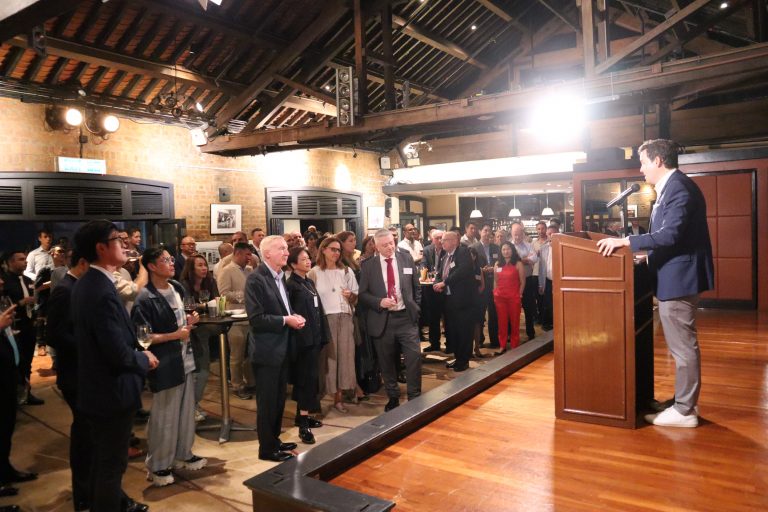
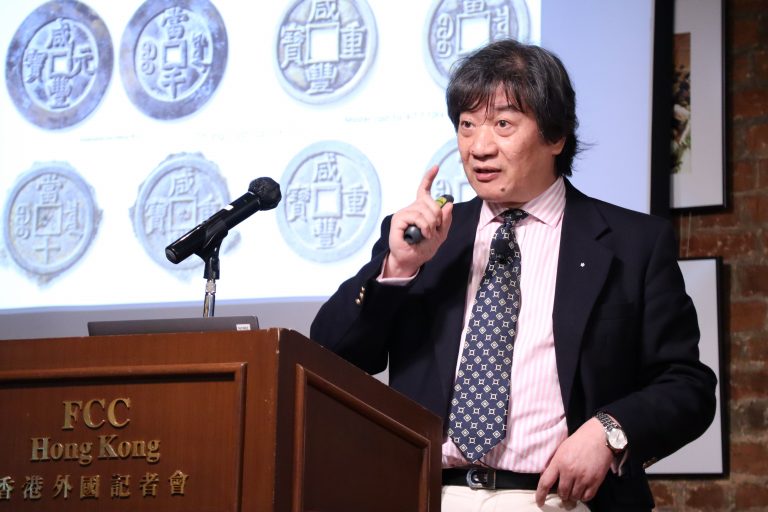
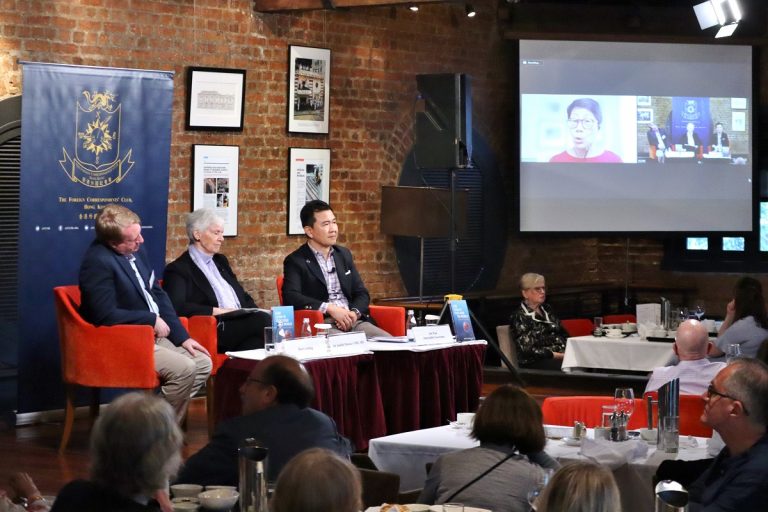
To learn more about Jacoby’s life and how he and his fellow journalists collaborated to form what would later become the FCC, Lascher had an in-depth conversation with then-President Lee Williamson at a Club Lunch in early April. He began by first describing what early-1940s Chungking was like.
“It was a place that was hectic, and lively, and hopeful, and painful, and tragic, and energetic, and broken. It was a place of contrasts, a place of extremes. Most importantly though, it was the new capital of wartime China — at least ‘free China’,” he said, referencing the Kuomintang (KMT) and the Chinese Communist Party (CCP), who were fighting for control over the mainland while simultaneously battling the invading Japanese Empire.

Jacoby, along with many other journalists covering the war from Chungking, found himself at odds with the KMT’s influence over his reporting, particularly how the police and military changed facts and screened reports before they were broadcast. Jacoby worried how these conditions might affect his journalistic reputation.
“How can I be seen as an independent journalist while I’m putting across a certain message?” was how Lascher interpreted Jacoby’s mindset during that time.
After finally having enough, Jacoby joined forces with other journalists at the Press Hostel and, on 18 May 1943, the group issued a memorandum that voiced their concerns to the authorities in Chungking.
“…as correspondents who are personally sympathetic for China in a struggle against aggression, we strongly object to the constant surveillance to which we are subjected in the course of our activities in Chungking,” said a key part of the memorandum, which can be read in full on pages 12-15 of the July issue of The Correspondent.
This memorandum became the foundation upon which the FCC was later built, with many of the sentiments expressed in it still echoing in modern initiatives by the Club, especially the camaraderie between members with shared goals and a vision.

“That community was everything to him and to many of these reporters,” Lascher said, adding that, “It’d be great to find the original bylaws.”
Jacoby only lived for 25 years. After his birthday on 11 September 1941, he reached two significant milestones in his professional and personal life.
First, he met Annalee Whitmore Faidman, who he quickly proposed to and married. The couple then made plans to relocate from Chungking to The Philippines, where Jacoby would be taking on a new role as Time’s Far East Bureau Chief in Manila. Jacoby left first, with Annalee leaving for Manila on the same day that Japan set off to attack Pearl Harbor, thus beginning the United States’ involvement in the Second World War.
The newlywed Jacobys couldn’t stay long in Manila. Japan soon began their invasion of the island nation, with the couple escaping via blockade runners until they made it to Australia, where they were finally safe.
Continuing his job as a reporter, Jacoby found himself in northern Australia alongside General Harold H. George, an American military officer he became acquainted with during his time in Chungking. Jacoby and General George were standing on Batchetor Airfield when a collision between two aircraft caused a runaway propeller to strike them. Jacoby was killed instantly while General George died in a nearby hospital the following day.

Jacoby’s death was a shock to his wife, his family, and to his network of journalists across the world, who often described him as a “soldier of the press.”
“He dies having accomplished something by 25 years old that many of us can’t claim to accomplish in our entire lives,” said Lascher when summarising the short, impactful life of Melville Jacoby.
To watch the full discussion, please visit the FCC’s YouTube channel: