
Understanding Southeast Asia’s scam farms with two on-the-ground experts
By Hugo Novales
On January 3rd of this year, Chinese actor Wang Xing went missing after taking a trip to Bangkok, Thailand, for what he thought would be a casting call for a new film.
He was first picked up at the airport and driven approximately 500 kilometers away to Mae Sot, a city located on Thailand’s border with Myanmar. That’s where he lost contact with his girlfriend back in China, who on January 5th notified both the authorities and the public about Wang’s disappearance.
In a joint operation between Chinese and Thai law enforcement, Wang was rescued just two days later. He was found in Mywaddy, a small border town in Myanmar that’s become synonymous with the notorious “scam farms” that have spread across Southeast Asia.
These scam farms aren’t new, but they are growing, and regular citizens from all walks of life are their targets.
“It’s open season on us, not just here in this room or in Hong Kong, but really globally and around the world. We are literally living in an epidemic of scams,” said Cezary Podkul.

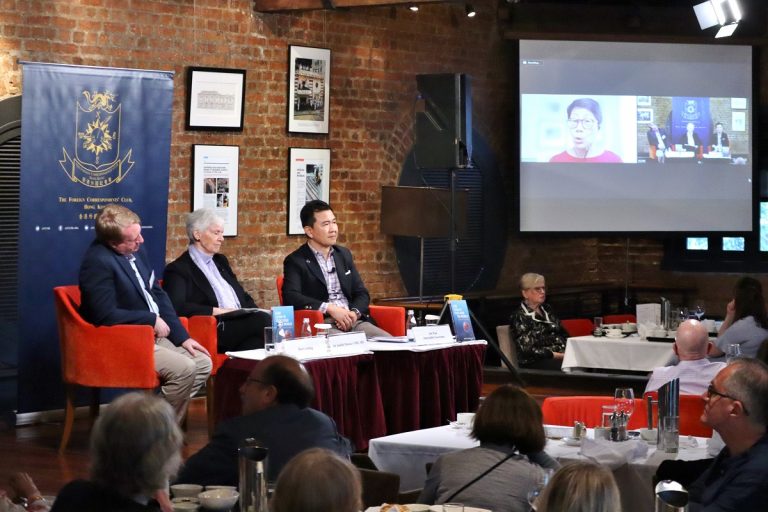
Podkul, an experienced investigative reporter and author of the upcoming book The Big Trace, organized and moderated an FCC Club Lunch to discuss why Southeast Asia has become a hotbed for the scam industry with two on-the-ground experts: Ling Li and Ivan Franceschini.
Li and Franceschini, along with researcher Mark Bo, have recently published SCAM: Inside Southeast Asia’s Cybercrime Compounds, a summary of their decades researching the networks, history, and criminology fueling the online scam underworld.
The expert pair began the discussion by sharing their first encounters with scam farms.
While on a research trip in Phnom Penh with the University of Liverpool, a 21-year-old Li first learned about Cambodia’s massive scam compounds from the Chinese scholars and business professionals living there. She was initially examining the country’s efforts to combat the slavery of women, but became more intrigued by this new cybercrime industry that she never knew existed. From there, she began not only researching, but getting directly involved with rescuing victims from the prison-like scam compounds.
“I’m a researcher, but I’m also a practitioner. Can I do something?” she said when explaining her motivation behind being more than just an expert on this type of crime.
When asked about why she continues to be an activist, Li answered that it was the victims’ stories that kept her going. She mentioned her experience with a 16-year-old girl who was tricked into traveling to Cambodia for work and became trapped in a scam compound. The girl ended up becoming pregnant while in the compound, and when Li rescued her, Cambodian authorities detained the young mother and her newborn baby for months due to lack of identification. Experiences like this are what remind Li that her work is life-saving.

“It’s just inhuman for me to see this. I just feel like we have to do something, even if it’s very heartbreaking every time to hear their stories,” she said, adding that, “There’s many times that I want to give up, that’s for sure, but then we do have a team to support me.”
For Franceschini, he remembered his 2019 visit to the Cambodian coastal town Sinoukville. He had been there years before and noted how the small town that was once ideal for backpackers searching for a quieter side of Cambodia had transformed drastically.
The Cambodian government’s 2017 plan to turn Sinoukville into a “new Macau” was overturned in August 2019 due to a rise in crime and illicit foreign investment, mostly from Mainland China. Franceschini called this move “completely unexpected” and explained that since the city’s gambling industry was now gone, it left behind the necessary infrastructure for online scams centers to take over.
When Franceschini first saw one of Sinouville’s scam compounds — a massive building repurposed from the city’s casino days — that was enough to make him interested in learning more about what was inside.
So how do these scam farms operate, and how do they differ from other types of scams?
Franceschini and Li first explained the details of two more common types of scams: investment scams — when a fraudster claims to have a good investment deal; and romance scams — when a fake dating profile gains the trust of a victim before asking for money to deal with an unexpected emergency.
The cybercrime compounds across Southeast Asia utilize a unique hybrid of both types of these scams in that they gain the victim’s trust from a variety of angles before claiming to have a good job, investment, or other financial deal in a new location where the victim is eventually kidnapped and moved to a scam farm. The victims then become a part of the system, forced to scam new victims online using technology, and even AI.
“The scammers are really creative. They’re really good at getting your trust… it’s nothing to be ashamed of, I mean, it’s terrifying how good they are,” said Franceschini.

Li emphasized that scammers target literally everyone and have specific procedures to fool people regardless of job, gender, age, or social status.
“Everyone sitting here, you can be a target,” she said.
The panel then touched upon the misconceptions of how the Chinese government combats scam farms and why such misconceptions exist.
The Chinese government has faced criticism for its softer approach to fighting the “scamdemic” (as described by the United Nations Office on Drugs and Crime) given that most of this crime happens in neighboring countries and not within its own borders. This has led some American NGOs to infer that China only wants to get involved for its own benefit, whether it be politically or financially.
“This idea of China being the mastermind behind the compounds to gain influence or undermine the West or whatever, we find it — I find it — quite unconvincing,” said Franceschini, who added that the central reason why these scams have migrated to Southeast Asia is because of China’s heavy crackdown on organized crime.
“China is an important factor. It’s controversial. It’s complicated, but if we point the fingers only at China, we miss the real point here,” he concluded.
To watch the full discussion, please visit the FCC’s YouTube channel: