
Obituary: Author Dr Feng Chi-shun, a ‘truly talented and diversely accomplished man’
Paul Murray pays tribute to his friend, Dr Feng Chi-shun.
Chi passed peacefully early afternoon on Friday, March 8 after a particularly debilitating illness which robbed him of his considerable communicative powers.
Originally from Wuhan, he came to Hong Kong, as so many did, as a result of the Mainland Civil War.
His insightful novel, Diamond Hill, describes his early years and school days growing up with his family in a tough squatter settlement at a time when Hong Kong’s population was rapidly expanding.
A clever man, he was no isolated ‘bookworm’. He enjoyed sport and socialising, keenly and astutely observing the world around him.
Chi did his Medical Degree at the University of Hong Kong, moving to the USA to train as a pathologist initially in New York, then Philadelphia.
Chi married and had three children in the USA before returning to Hong Kong to work and settle.
He remarried in Hong Kong in 1997. His wife, Cathy Hillborn, loyal and loving, was with him daily throughout his last dark journey.
Not only was Chi a well-respected pathologist but in his later years became a prize-winning and best-selling novelist. His most recent work Three Wishes in Bardo, perhaps his best, takes us from Hong Kong to New York, California, Texas, back to New York and, ultimately, to Hong Kong. An adventurous, powerful and spiritual journey encapsulating the triumph of human qualities over malice and….. Tibetan Bardo – a state after death when the conscious mind actively persists on leaving the physical state.
Chi, a popular, elegant and witty friend. A fixture and feature at the Foreign Correspondents’ Club. It’s hard to believe we won’t see you and enjoy your company there anymore.
A truly talented and diversely accomplished man.
Profoundly missed by your loving wife, your sisters, children, and many friends.
At peace now, Chi – your muse at peace too.
Watch Dr Chi at the launch of his book, Hong Kong Noir
Why Russia is no longer a superpower
Russia is an increasingly weak state under President Vladimir Putin, with the country’s elites abandoning it amid a feeling that there is no hope for the future, according to a leading European scholar on Russia and Ukraine.
 Dr. Marie Mendras appeared at the FCC on March 13, 2019. Photo: Sarah Graham/FCC
Thirty years ago, under President Mikhail Gorbachev – the last leader of the Soviet Union – the country was a superpower following his democratisation measures and the end of the Cold War. But today’s Russia sees elites emigrating, a shrinking middle class, and a stagnant economy. Putin’s standing on the world stage has also suffered since Russia’s military intervention in Ukraine after it voted for independence.
“If you look back 20 years, the new president of Russia had many partners. He had strong partners in the European Union. And after 9/11 he had a strong partner in George W Bush,” said Dr. Marie Mendras, currently a visiting scholar at HK Baptist University.
Watch the video to hear Dr. Mendras on Vladimir Putin and Russia.
Nominees for the Election of The Board of Governors 2019-2020
Here are the nominations for the FCC Board of Governors 2019-2020. Below are links to each nominee’s bio and policy statement. Please read them before voting.
| Note: | |||
| a. | Please indicate your vote by putting a “✓” in the appropriate bracket. Any mark other than a “✓” shall invalidate this Ballot paper. | ||
| b. | If vote(s) casted exceed(s) the number allowed in respective capacity, this Ballot paper shall be invalid. | ||
| c. | Bio & policy statements of the candidates are available at the FCC website <www.fcchk.org>. | ||
| d. | The completed Ballot paper must be received by the Club, either by mail or in the Ballot box, not later than 3pm on Wednesday, 22 May 2019. |
|
|
||
|
Candidate |
||
|
|
||
AGM Notice

China ‘on the wrong side of history’ in its religious persecution, says U.S. ambassador
China is not solving the terrorism problem by detaining Uighurs in internment camps in Xinjiang, it’s creating it, says the U.S. Ambassador at Large for International Religious Freedom.
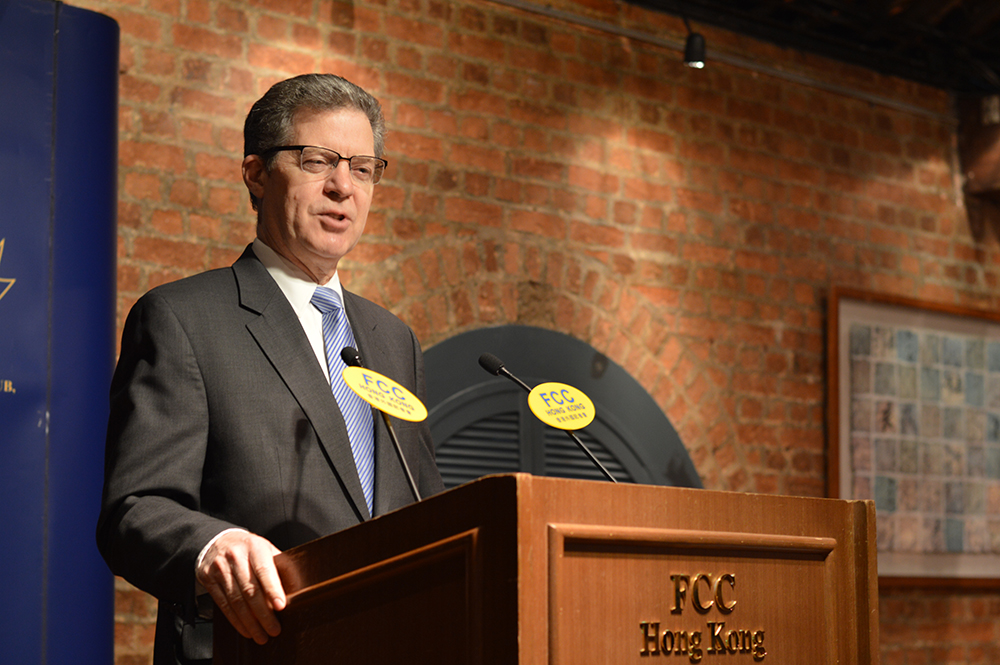 Sam Brownback, U.S. Ambassador at Large for International Religious Freedom speaking at the FCC on March 8, 2018. Photo: Sarah Graham/FCC
Sam Brownback said he has received hundreds of communications from the families of detained Uighurs desperate to find out what was happening to their loved ones. The Muslim minority group has suffered persecution in China for decades, but recently the government intensified its oppression with the introduction of what it calls re-education camps. Kazakhs, Christians and other minority faiths are also held in the camps.
The Chinese government has also cracked down on Christianity in the country by closing unregistered churches and destroying Bibles.
Brownback asked: “Why is the Chinese government afraid of the Bible? Why does the Chinese Communist Party not trust the Chinese people to choose their own path with their own soul?”
He added: “China is at war with faith. It is a war they will not win.”
Despite the events of recent years, Brownback said he believed the Chinese people would soon enjoy religious freedom because China was ”on the wrong side of history” and a general shift around the world towards freedom. He pointed to Hong Kong as an example of somewhere that enjoyed religious freedom. Speaking at the March 8 Club Breakfast, he called on China to immediately release all religious prisoners.
Kansas Republican governor Brownback was sworn in as Ambassador at Large for International Religious Freedom on February 1, 2018, with the remit to monitor persecution and discrimination on a global scale through the Office of International Religious Freedom (IRF).
Watch the full talk here
Weijian Shan: From hard labour in China to the halls of America’s most prestigious universities
Today’s young people should cherish the opportunities they are given, says a top financier who was one of the so-called “lost generation” who missed out on education during China’s Cultural Revolution.
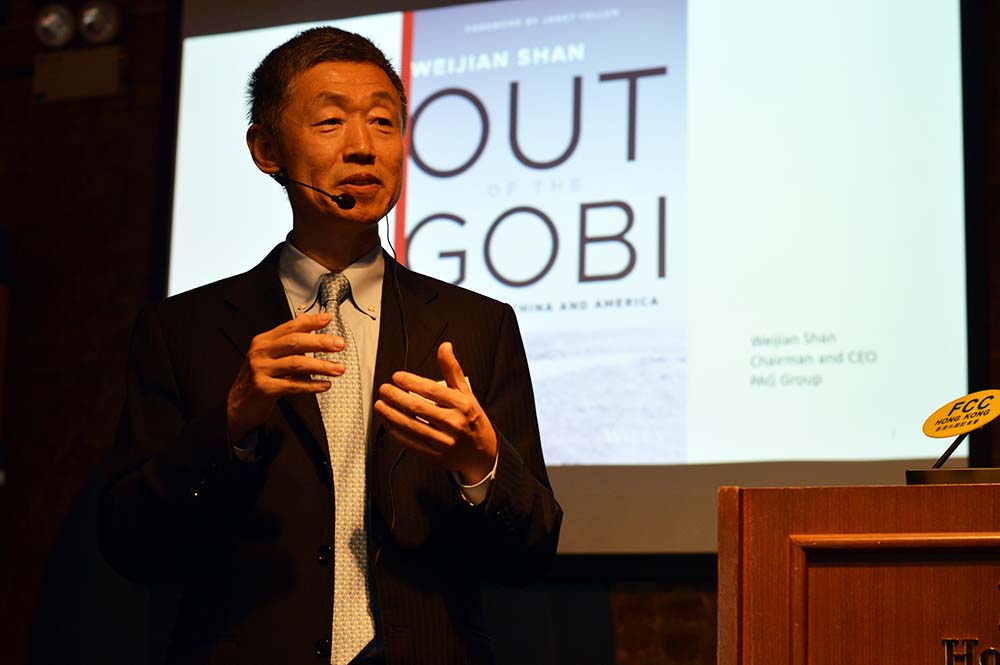 Weijian Shan speaking at the FCC on March 5, 2019. Photo: Sarah Graham/FCC
Weijian Shan is Chairman and CEO of PAG, one of Asia’s largest private equity firms. But growing up in China during the 1960s he found himself at the beginning of a decade of turmoil in China’s history, kicked off by Mao Zedong’s bid to take control of the Communist Party, a move which eventually led to the death of tens of millions through starvation.
Education was abandoned as schools and universities closed amid chaos, with gangs of young ‘Red Guards’ rampaged through city streets after Mao urged them to destroy China’s old culture and custom. During the first chaotic years of the revolution, Shan said, he witnessed teachers being beaten to death.
Shan told how, after Mao sent young urban dwellers out into the countryside for re-education, he was sent to work in the Gobi Desert to try to turn it into fertile land to grow crops for the country. Food was sparse, the winters were freezing cold, and the summers hot.
Showing photos of himself during that time which appear in his book, Out of the Gobi: My Story of China and America, Shan said: “When I look at this picture I realise how stupid I was at that age. At the time, I thought I knew everything.”
After the Cultural Revolution ended with the death of Mao, a new economic relationship formed between the U.S. and China which resulted in an open door policy. Shan was selected by a Congressional-sponsored foundation to go to America as a visiting scholar. He eventually became a professor at the Wharton School of the University of Pennsylvania before embarking on a career in finance.
He recalled how, on a visit to a kindergarten funded by his company, he broke down in tears at the freely available books and learning tools for the children. Shan said youth today should treasure their opportunities.
Watch the video to learn more about Shan’s journey.
2019 Human Rights Press Awards
 |
|
2019 HUMAN RIGHTS PRESS AWARDS
Now Open for Entries
(Scroll down for Chinese version)
|
| We are delighted to announce that The Human Rights Press Awards, Asia’s most prestigious honours that recognise outstanding human rights reporting, have returned for the 23rd year and are now open for entries. The deadline is 12 February 2019.
The Human Rights Press Awards are organised by the Foreign Correspondents’ Club Hong Kong, Amnesty International and the Hong Kong Journalists Association. Showcasing this work has become more important than ever as governments around the region step up threats to basic freedoms — locking up journalists, carrying out arbitrary detentions and silencing political opponents. Submissions must have been reported from the Asia region and been published or broadcast during the 2018 calendar year. Entries must be in either English or Chinese. Categories include Breaking News, Features, Multimedia, Video, Audio and Photography. This year we have split the Features category into two awards – Investigative Feature Writing and Explanatory Feature Writing. In addition the video category now features two awards – Short Video for compelling and shareable video reporting, and Documentary Video for more in-depth work. Please go to the website for more details. Each entry must cite the article of the Universal Declaration of Human Rights that the work seeks to address. This landmark document is viewable here: www.un.org/Overview/rights.html Entry registration at: For further information of the Awards, please visit: And follow us on: For queries, please contact the awards administrator: |
|
|
|
|
|
二零一九年人權新聞獎
現正接受報名
|
| 亞洲矚目的新聞界盛事、二零一九年人權新聞獎現正接受報名,誠邀新聞工作者踴躍參與,截止日期為2019年2月12日。
人權新聞獎由香港外國記者會、國際特赦組織香港分會及香港記者協會合辦,以表彰亞洲區的卓越人權新聞報道,今年已是第二十三屆。獎項旨在增加公眾對人類基本權利尊重,並令大眾關注任何對這些權利之威脅。 近年區內多個政府對基本人權自由之侵害變本加厲,扣留記者、任意拘捕、打壓政治異己等新聞時有所聞,令舉辦此獎項以表揚人權新聞,更形重要。 參選作品必須為亞洲區的人權議題採訪報道,並於二零一八年內刊出或公開播放。參賽作品須以中文或英文提交,今屆參賽類別包括:突發新聞、特寫、評論、多媒體、錄像、電台廣播和錄音及攝影。其中特寫類別分拆為調查專題及解釋性特寫,錄像類別分拆為短片及紀錄片,詳情請瀏覽新聞獎官方網站。 參加者必須註明參選作品與《世界人權宣言》中哪一條人權宣言相關。 網上報名平台網址: 有關比賽詳情請瀏覽新聞獎官方網站: 亦可追蹤我們的社交平台以獲得最新資訊: 如有查詢,請聯絡新聞獎秘書處: |
FCC Anti-Harassment Policy
Dear Members,
Part of what makes the FCC so wonderfully vibrant is the diversity of its membership, and it is important that every member be able to fully enjoy everything the Club has to offer. To that end, below please find a new anti-harassment policy outlining what kind of behaviour is considered harassment and the procedure for filing complaints. The Board of Governors will investigate all harassment complaints and take disciplinary action if warranted.
We appreciate your cooperation in treating all members, guests and staff with dignity and respect, including calling out unacceptable behaviour when you see it. It is up to all of us to ensure that the FCC is a place where everyone feels comfortable and safe.
If you have any questions, comments or concerns, we welcome your feedback at [email protected].
Sincerely,
Florence de Changy,
President, FCC
The Foreign Correspondents’ Club of Hong Kong is committed to providing an environment in which employees, members and their guests are free from harassment and are treated with dignity and respect.
As stated in the By-Laws, 21(b), “Members are required at all times to conduct themselves with decorum and to consider the comfort and quiet enjoyment of other users of the premises.”
The Board takes complaints of harassment seriously, and any member found to be in breach of this policy is subject to disciplinary measures, up to and including termination of membership. Sexual harassment may also entail civil and criminal liabilities.
All complaints shall be investigated fairly and promptly in accordance with the Articles of Association and with respect for the confidentiality of those involved. Disciplinary action will be taken against anyone who interferes with the conduct of an investigation or retaliates against a complainant.
This policy aims to explain and prevent the types of unacceptable behaviour that could amount to harassment. It applies to all members of the Club and their guests, and all members are responsible for complying with this policy and discouraging behaviour that goes against it regardless of whether a complaint is made.
This policy does not impose any contractual obligations on the Club. It is subject to periodic review and updates.
Definition and Examples of Harassment
Harassment is defined as any unwelcome conduct, comment or display that is known or ought
reasonably be known to offend, intimidate or humiliate the recipient on the basis of
appearance, gender, race, ethnicity, religious beliefs, sexual orientation, disability, physical size
or weight, age, marital/family status, nationality, language, ancestry or place of origin.
Harassment does not have to be intentional. It may occur between persons of the same sex or opposite sex, and a single incident may be sufficient to constitute harassment. It may include, but is not limited to:
• Sexual or physical assault, stalking and indecent exposure
• Inappropriate touching or brushing
• Sexually suggestive remarks
• Persistent unwelcome invitations or requests
• Sexual propositions; promises or threats in return for sexual favors
• Inappropriate comments about a person’s body, appearance or clothing
• Unwelcome questions or sharing of information regarding a person’s sexual activity or sexual
orientation
• Displaying or distributing sexually explicit material
• Staring or leering or making suggestive or insulting sounds
• Jokes, taunts, gestures or innuendo concerning gender, race, ethnicity, sexual
orientation, etc.
• The use of racial and ethnic slurs or derogatory sexual terms
• Bullying; verbal abuse/profanity
Procedures for Harassment Complaints
Any person who feels he or she is experiencing harassment can approach the alleged harasser about it directly and/or report it to a Board Member, the General Manager or the floor manager on duty. Formal written complaints can be filed using forms available from the Front Desk or Main Bar staff. All information related to a harassment complaint will be kept confidential. Information will only be disclosed to relevant persons on a need-to-know basis.
Complaints may be filed only by members on behalf of themselves or a guest. The respondent will be informed that a complaint has been made and by whom and will receive a copy of it. The Board will then determine whether to proceed with the disciplinary process as outlined in the Articles of Association.
Depending on the severity of the case, disciplinary action may include:
• A warning or letter of reprimand
• Verbal or written apology to the complainant
• Temporary suspension of membership
• Expulsion from the Club
If the allegations are criminal in nature, it is up to the complainant to file a police report.
The complaint handling procedure of the Club does not affect the complainant’s lodging complaints with the Equal Opportunities Commission, reporting to the police or filing a lawsuit in court.
Message from the president
Dear Fellow Members,
As 2018 is coming to a close, I’d like to take this opportunity to thank you all for your loyal patronage.
We hope you have enjoyed the enhanced menus and the promotions led by our GM, Didier Saugy, and a few key new recruits who have reinforced the wonderful staff team we are so lucky to have.
In order to maintain and even improve the standards of your FCC experience, whilst carefully maintaining the historic building we are privileged to call home, the Board has agreed to a price increase averaging 3.5% on F&B items only, with effect from Jan.1, 2019. The last increase took place in July 2015.
I think we all agree that the FCC continues to represent exceptional value for money, whilst offering variety for all, in a fantastic venue.
I wish you all a very happy new year, and I thank you in advance for your continuous support of the FCC in 2019!
Yours sincerely,
Florence de Changy
President