Members Area Logout

Failure to Explain Missing Booksellers Undermines Hong Kong Freedoms

Failure to Explain Missing Booksellers Undermines Hong Kong Freedoms

The Foreign Correspondents’ Club, Hong Kong, is concerned that there has yet to be a full and satisfactory explanation of the detention of five Hong Kong booksellers by mainland Chinese authorities despite recent demands and condemnation from around the world, including the United Nations, European Union and the British government. In the absence of such an explanation, the FCC calls for the immediate release of the five detained to  prevent further weakening of damaged confidence among the local, international and business communities in the robustness of Hong Kong’s rule of law and protection of free speech guaranteed by the Basic Law.

The FCC is particularly troubled by the Chinese government’s dismissive response to legitimate concerns raised by the United Nations High Commissioner for Human Rights over the ongoing crackdown on lawyers and civil society activists in China. Journalists are also a target of the campaign.

On 16th February, China’s Permanent Mission to the United Nations in Geneva issued a statement branding the High Commissioner’s “irresponsible’’ remarks as “biased, subjective and selective’’.

With regard to the booksellers, the Chinese government’s statement simply repeated the claim that Lee Bo, a British passport holder, “voluntarily went back to mainland China for assisting [sic] in the investigation, and is safe and sound.” It added that Lee’s colleague, Gui Minhai, who disappeared from his home in Thailand, gave himself up to authorities for a crime allegedly committed 12 years ago. Tellingly, the statement failed to explain how the other three booksellers came to be detained, or to explain why neither the Hong Kong nor Thai authorities have any record of two of them having crossed the border into China.

Sadly, access to the detainees that would afford some assurances of their safety and verification of the government’s explanations has not been possible.

The response of the Permanent Mission once again illustrates China’s contempt for any international organization that dares to criticise its human rights record. It also sends a chilling signal to the people of Hong Kong that they, as Chinese citizens, cannot hope that  Beijing will respond positively to pressure from the international community when their rights are violated.

The FCC urges the Chinese government to take its international obligations seriously and to engage in good-faith dialogue when legitimate concerns are raised over possible breaches of international legal norms and human rights, such as in the case of the five Hong Kong residents. It should also affirm the right of free speech, including by media and publishers, in Hong Kong, afforded under the city’s effective constitution

Press Freedom Committee.

Published on
February 24, 2016
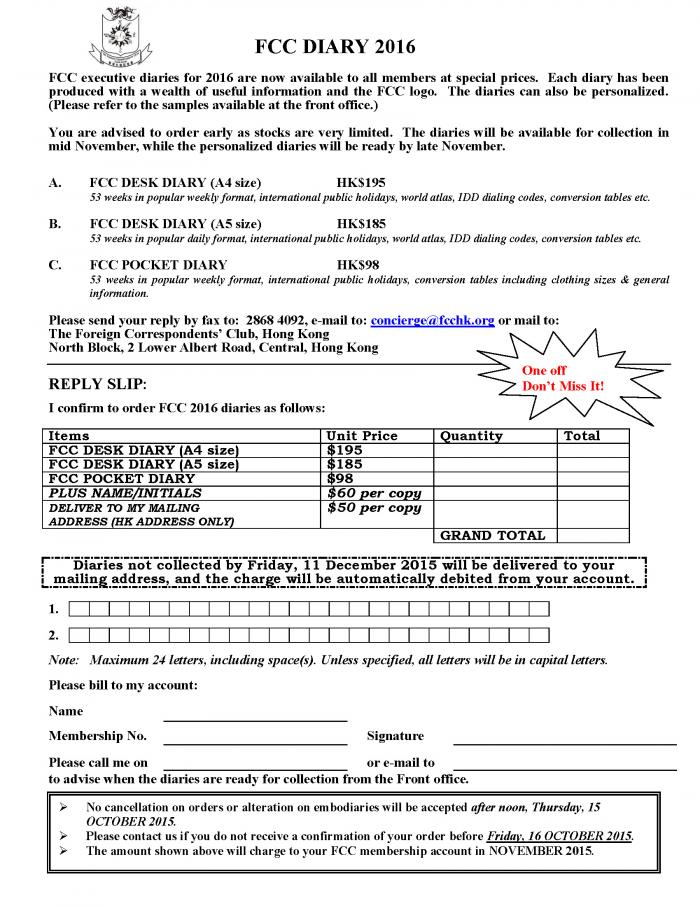
FCC 2016 Diary Order

2016FCCDiariesOrderForm-700x906

January 2016

History & Background

The Correspondent lives on

It might surprise you to know that it wasn’t until 1987 that The Correspondent magazine began to appear regularly in its current format. Other issues had appeared from time to time in the 1960s, 70s and early 80s, but not on a regular basis. By the mid-80s it had been reduced to an eight-page newsletter that came out infrequently.

We have been only able to locate some surviving 1970s issues and one or two from the 1960s. Mind you, some of those issues were not dated inside or outside magazine, but given paper quality and style they probably date from the late-70s.

It was in 1987 that Club member Viswa Nathan came up with the idea of publishing a monthly glossy magazine that would be supported by advertising. Viswa made a go of it from the first issue. It’s not an easy business to find enough ads to cover the costs of producing the magazine, but these were boom days in Hong Kong and all the hongs had ad budgets for small-circulation magazines.

By the mid-1990s it became harder to get ads and it was no longer possible to take for granted ads from the hongs. The exception was the 50th anniversary of the FCC in Hong Kong special issue (1999) which was fully supported by ads due to the hard work of editor Saul Lockhart. From that time the magazine became financed fully by the Club, with the occasional ad income as a supplement to the budget.

Many of the ads in that issue were from the media industry; including one gem (as you would expect) from The Economist, which read, “Congratulating the FCC on 50 years of intoxicating journalism”. Sadly, as the media industry struggles with the digital revolution and the consequent falling ad revenue and diffuse readership, budget for ads has dried up.


Digital age

Digital fallout also reaches The Correspondent from time to time as some argue that we don’t really need an expensive magazine when we can put it online. At some future time it may be online, however the demand for a magazine remains as the FCC’s November 2015 survey overwhelmingly shows.

During 2015 Club news and news features from The Correspondent plus website-only stories have appeared on the website. With the launch of the redesigned website in January 2016 there will be a greater an interaction between the website and the magazine which will enhance the effectiveness of both.

The combination produces the best from both worlds – as the likes of the FT, SCMP, New York Times, Monocle, The Economist and others are attempting, mostly successfully, to do. The publications that get this formula right will be the ones left standing.

Meanwhile, the magazine goes on as it should. A correspondents’ club without one would be a strange beast.

An integral part of the magazine is the production house that makes it all possible. Since the late 80s, production has been in the hands of Viswa Nathan, Mike Bishara, Firstline, Richard Cook at WordAsia and Terry and Aira Duckham at Asiapix. In fact, Asiapix, through two separate stints has the longest connection to the magazine,

The Communications Committee oversees the magazine, website and other publications usually in a very hands-on way.

Saul Lockhart was editor of the magazine for about four years until he left Hong Kong in 2002. Other editors who served for varying lengths of time include Simon Twiston-Davies, Peter Cordingly, Karl Wilson, Diane Stormont, Richard Cook and Paul Bayfield.

If you want to catch up with past issues of the magazine please refer to the FCC’s website.

FCC Journalism Conference: Covering News in the Era of Digital Disruption

20160323FccJournalismConference_img02
FCC Journalism Conference:
Covering News in the Era of Digital Disruption
A day of expert panels and workshops for journalists at every stage of their career
SATURDAY, APRIL 23, 2016
09:30 – 18:30
HK$395

The FCC’s inaugural conference Covering News in the Era of Digital Disruption offers a day of expert panels and workshops focusing on the multiple challenges facing journalists in a rapidly changing media landscape.

With speakers from many of the world’s news leaders, the conference will give insight and practical advice on such issues as cybersecurity, sourcing through social media, writing for online and mobile, conflict reporting, following the money using documents, the art of long-form journalism, maximising photo impact and challenging sources.

The conference opens with a session on how to kick-start your career in journalism and ends with a look into the future of media. Speakers are from such industry leaders as CNN, the BBC, Reuters, AFP, Bloomberg, the New York Times, the Wall Street Journal, the Financial Times, the Guardian, Storyful and Quartz. Please see the attached programme for details.

We hope the event will prove rewarding for all journalists, from beginners to seasoned correspondents, at a fraction of the price of typical conferences at $395 for the whole day, including a light breakfast, lunch and post-event drinks.

20160323FccJournalismConference_img03 Sign-up will first be open exclusively to Correspondent and Journalist members who register by Friday 08 April 2016, on a first-come first-saved basis
20160323FccJournalismConference_img03 To sign-up contact concierge at 2521-1511 or [email protected]
20160323FccJournalismConference_img03 Once signed-up you will be contacted to select your preferred workshops
20160323FccJournalismConference_img03 No cancellations will be accepted after noon on Friday 15 April 2016
4c2a6a782639108b425339d6a1829d69-150x74


Elections & Voting Rules

Venue Hire

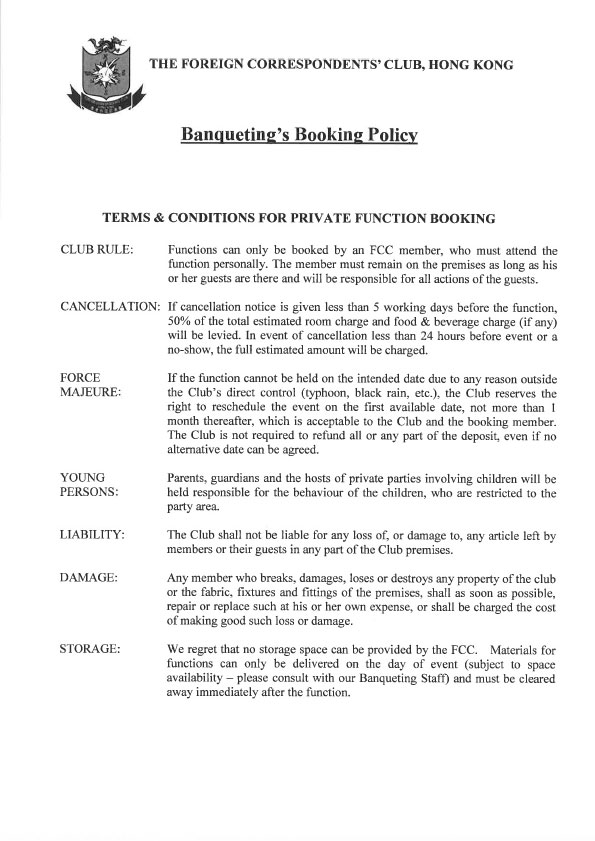
From conferences to cocktails to wedding receptions, the FCC has had the privilege of organising and hosting many special events for members. We offer a variety of venue spaces and catering packages. The venues, subject to availability, include: Dining Room, Verandah, Bert’s, Hughes room and Burton room. Please contact our experienced Banqueting team to explore whether any of our venues are suitable for your next event.

For bookings, please email [email protected], or call [telnumlink]+852 2521 1511[/telnumlink] / [telnumlink]+852 2844 2828[/telnumlink]


Banqueting's-Booking-Policy

Digital age

Digital fallout also reaches The Correspondent from time to time as some argue that we don’t really need an expensive magazine when we can put it online. At some future time it may be online, however the demand for a magazine remains as the FCC’s November 2015 survey overwhelmingly shows.

During 2015 Club news and news features from The Correspondent plus website-only stories have appeared on the website. With the launch of the redesigned website in January 2016 there will be a greater an interaction between the website and the magazine which will enhance the effectiveness of both.

The combination produces the best from both worlds – as the likes of the FT, SCMP, New York Times, Monocle, The Economist and others are attempting, mostly successfully, to do. The publications that get this formula right will be the ones left standing.

Meanwhile, the magazine goes on as it should. A correspondents’ club without one would be a strange beast.

An integral part of the magazine is the production house that makes it all possible. Since the late 80s, production has been in the hands of Viswa Nathan, Mike Bishara, Firstline, Richard Cook at WordAsia and Terry and Aira Duckham at Asiapix. In fact, Asiapix, through two separate stints has the longest connection to the magazine,

The Communications Committee oversees the magazine, website and other publications usually in a very hands-on way.

Saul Lockhart was editor of the magazine for about four years until he left Hong Kong in 2002. Other editors who served for varying lengths of time include Simon Twiston-Davies, Peter Cordingly, Karl Wilson, Diane Stormont, Richard Cook and Paul Bayfield.

If you want to catch up with past issues of the magazine please refer to the FCC’s website.

The Correspondent lives on

It might surprise you to know that it wasn’t until 1987 that The Correspondent magazine began to appear regularly in its current format. Other issues had appeared from time to time in the 1960s, 70s and early 80s, but not on a regular basis. By the mid-80s it had been reduced to an eight-page newsletter that came out infrequently.

We have been only able to locate some surviving 1970s issues and one or two from the 1960s. Mind you, some of those issues were not dated inside or outside magazine, but given paper quality and style they probably date from the late-70s.

It was in 1987 that Club member Viswa Nathan came up with the idea of publishing a monthly glossy magazine that would be supported by advertising. Viswa made a go of it from the first issue. It’s not an easy business to find enough ads to cover the costs of producing the magazine, but these were boom days in Hong Kong and all the hongs had ad budgets for small-circulation magazines.

By the mid-1990s it became harder to get ads and it was no longer possible to take for granted ads from the hongs. The exception was the 50th anniversary of the FCC in Hong Kong special issue (1999) which was fully supported by ads due to the hard work of editor Saul Lockhart. From that time the magazine became financed fully by the Club, with the occasional ad income as a supplement to the budget.

Many of the ads in that issue were from the media industry; including one gem (as you would expect) from The Economist, which read, “Congratulating the FCC on 50 years of intoxicating journalism”. Sadly, as the media industry struggles with the digital revolution and the consequent falling ad revenue and diffuse readership, budget for ads has dried up.

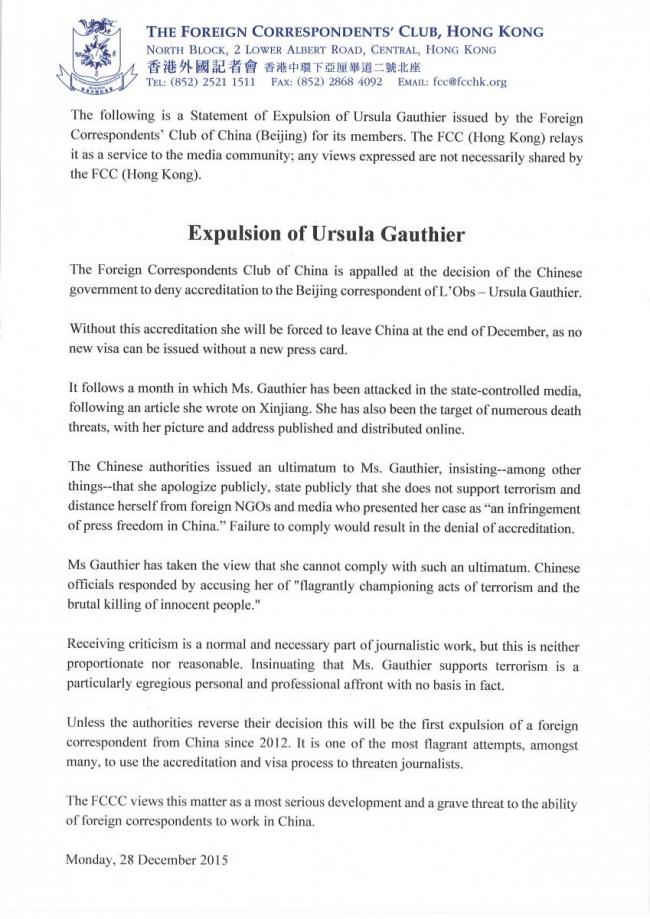
Expulsion of Ursula Gauthier

2196_001_0-650x919

We measure site performance with cookies to improve performance.