Members Area Logout

An Open Letter to Commissioner of Police Chris Tang Regarding His Comments on Prosecuting ‘Fake News’

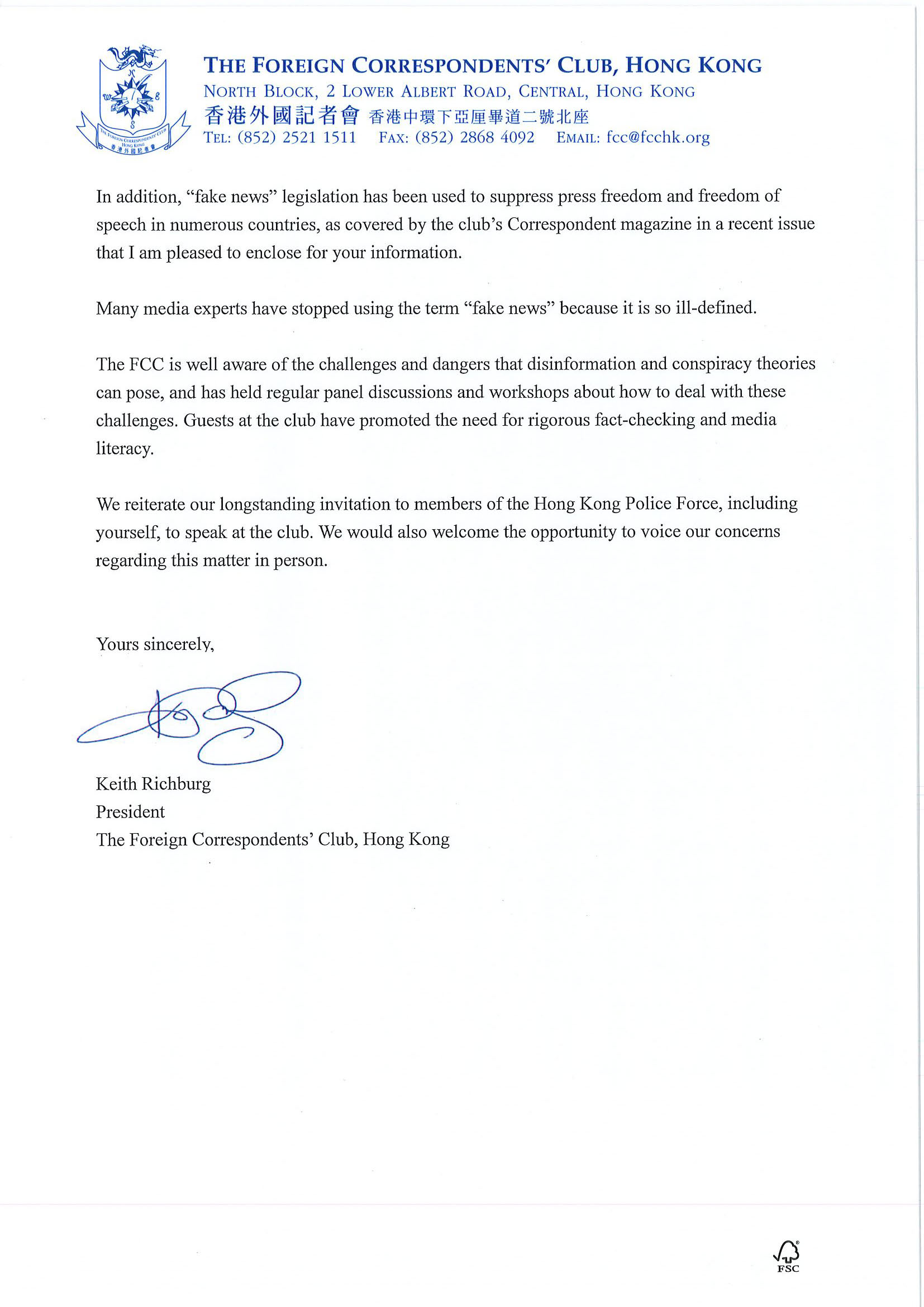
The Foreign Correspondents’ Club, Hong Kong on 22 April delivered a letter to Commissioner of Police Chris Tang seeking clarity regarding his recent comments on prosecuting “fake news.” The FCC is publishing the letter in full below.


Related: How ‘Fake News’ Legislation Stifles Critical Reporting

The FCC Condemns the Prosecution of Journalist Bao Choy

The Foreign Correspondents’ Club, Hong Kong strongly condemns the prosecution of Bao Choy, the former RTHK journalist convicted on Thursday for her use of a public database in the course of reporting a documentary.

The government’s actions against Choy set a dangerous precedent. They open the door to further legal action against journalists for engaging in routine reporting. They will also deter journalists from accessing legally available public records in Hong Kong.

Although Choy will not go to jail, she will be left with a criminal record and be forced to pay an HKD 6,000 (US$774) fine for only doing her job. In delivering her verdict, the judge accused Choy of misrepresenting herself and asked her to find other ways to seek the information she needed for her report.

However, the government has narrowed the categories of who could access the data in question and why. It is clear that Choy was singled out and punished for a search that is routinely conducted by journalists in Hong Kong. Choy’s documentary investigated the actions of police during an attack on protesters and commuters that took place at the Yuen Long MTR station on July 21, 2019.

While we appreciate that the judge overseeing the case spared Choy jail time, citing the merits of her reporting and the public interest involved, we wish the prosecutors had shown similar restraint and never brought this case in the first place.

The FCC Expresses Concern About the Media Environment in Myanmar

The Foreign Correspondents’ Club, Hong Kong is alarmed and deeply concerned about the rapidly deteriorating media environment in Myanmar and the dangers faced by journalists reporting there. Since February 1, when the military seized power in a coup, journalists and media organizations have been relentlessly targeted by security forces. Publishing licenses have been revoked, journalists have been arrested, beaten and at least one has been shot while working. The offices of media organizations have been raided. Some journalists have gone into hiding or fled the country.

The crackdown is wide ranging; international media organizations, large and small platforms as well as ethnic media outlets have all been affected. All of the gains the country made in recent years towards a freer press environment stand to be lost if the targeting of the media continues.

Despite these threats and at great personal safety risk, journalists continue to fearlessly report, bringing the stories and images of a country in crisis to the world. Security forces should allow reporters to work without interference. Those arrested should be immediately released and the charges against them dropped so they can return to their jobs and families.

In an effort to aid the important work of reporters, below is a list of media outlets and assistance organizations currently active in Myanmar. The FCC commends their work and is providing links for members and the public to donate to their efforts:

Burma News International

Friends of Myanmar

Frontier Myanmar 

The Irrawaddy

Myanmar Labour News

Myanmar Now

Print for Crisis

The exhibition “Myanmar’s Bold Anti-coup Movement”, featuring the work of Frontier Myanmar’s photojournalists, is currently on display at the FCC through April 30. Non-members are welcome to view the exhibition from 10am-12 noon and 3-5:30pm daily.

The FCC Condemns the Attack on the Epoch Times’ Printing Presses

The Foreign Correspondents’ Club, Hong Kong strongly condemns the attack on the Epoch Times’ printing presses and calls for the perpetrators to be brought swiftly to justice.

The newspaper posted CCTV images of the four attackers smashing equipment with sledge hammers and said that they had threatened staff with violence during the early morning raid on Monday 12 April.

The FCC insists that media should be able operate freely without fear of violence in Hong Kong regardless of their political stance.

The Epoch Times’ printing plant was targeted in a similar attack during the Hong Kong protests in November 2019.

The FCC Calls on Government to Maintain Public Access to Companies Registry Data

The Foreign Correspondents’ Club, Hong Kong, urges the government to reconsider the proposed changes to the Companies Ordinance that will remove from public access certain identifying details of company directors. The FCC believes such changes will be harmful to press freedom and transparency in the city.

The companies registry is an important tool long used by journalists to improve accountability, expose wrongdoing, and bring to light important matters of public concern. Financial, legal and compliance professionals also make extensive use of the companies registry in the course of ordinary business. Restricting access to the residential addresses and Hong Kong ID card numbers of company directors, as proposed by the government, will greatly diminish the utility of the companies registry and impede the work of a wide range of professionals working in Hong Kong’s public interest.

While the FCC shares the government’s concern about “doxxing”—of which journalists are frequent targets—the club does not believe that the proposed changes will have a meaningful impact on the practice. The FCC welcomes the opportunity to share additional input on the proposal.

The FCC Expresses Solidarity With Journalists Working in Myanmar

The Foreign Correspondents’ Club, Hong Kong, expresses its solidarity with journalists working in Myanmar and calls on the military government to respect media freedom.

The FCC also calls for all restrictions to be lifted on the internet and communications, which are essential both for journalists in the exercise of their profession and for the free flow of information.

The club will continue to monitor the situation in the days and weeks ahead.

Asian Press Clubs’ Joint Statement on Haze Fan

The Foreign Correspondents’ Clubs and Associations of Japan, Hong Kong, Jakarta, the Philippines, South Asia, Taiwan and Thailand are very concerned to learn that Haze Fan, a Chinese employee working for Bloomberg News, has been detained in Beijing.

The FCCs stand by the Foreign Correspondents’ Club of China in its efforts to seek an explanation on why the Chinese authorities detained Fan.

The clubs also join together in expressing alarm at reports of deteriorating conditions for journalists working for international media in China.

Fan has worked with Bloomberg since 2017. Other outlets she worked for before include Al Jazeera, CBS News, CNBC, and Thomson Reuters.

She has been missing since Monday, December 7th. Bloomberg received confirmation of her arrest on ‘suspicion of engaging in activities that jeopardize national security’ only on Thursday.

Chinese nationals perform invaluable roles in support of foreign media in China. Without their work, it would be difficult for foreign media to operate in China, and their safety is a matter of the highest concern.

Foreign Correspondents’ Club of Japan
Foreign Correspondents’ Club of Hong Kong
Foreign Correspondents’ Club of Jakarta
Foreign Correspondents’ Association of the Philippines
Foreign Correspondents’ Club of South Asia
Taiwan Foreign Correspondents’ Club
Foreign Correspondents’ Club of Thailand

International Press Institute Issues Statement on Impunity for Crimes Against Journalists

On October 30, the International Press Institute, which has been defending press freedom since 1950, released the following statement:

Impunity for crimes against journalists has continued to remain high, as governments are failing to bring perpetrators to justice, the International Press Institute (IPI), a global network of editors, media executives and leading journalists, said ahead of the International Day to End Impunity for Crimes against Journalists on November 2.

Since last October, as many as 52 journalists have lost their lives due to their work, according to the Vienna-based IPI’s Death Watch. At least 24 were killed in targeted attacks. An additional 15 cases are considered to be likely targeted attacks but remain under investigation regarding the motive. Seven other journalists were killed in Syria and one in Iraq covering armed conflict, and two died in Iraq and one in Afghanistan reporting on civil unrest. An additional two journalists were killed while on assignment. In almost half of the cases, those responsible are still at large,

An IPI analysis of these cases shows an alarmingly insufficient response by authorities to grave crimes against journalists. So far, arrests have only been made in 10 cases, five each in the Americas and Asia.

“The unbroken cycle of impunity for crimes against journalists fuels further violence against the press at a time when the free flow of news is more valuable than ever”, IPI Deputy Director Scott Griffen said. “The failure to bring those who kill journalists to justice is unacceptable and an attack on the public’s right to receive information.”

As in the year prior, the Americas accounted for the highest number of killings with 21 journalists murdered, including eight in Mexico, five in Honduras, two each in Colombia and Venezuela, and one each in Brazil, Guatemala, Haiti and Paraguay. In Asia, 11 journalists were killed, three in the Philippines, two each in India, Indonesia and Pakistan, and one each in Cambodia and Bangladesh. In Africa, two journalists were killed in Nigeria, and one each in the Democratic Republic of the Congo and Somalia. One journalist died in a targeted attack in Yemen, and another was found dead in his car in Iraq, while in Qatar, the death of an imprisoned journalist is under investigation.

In Mexico, arrests were made only in one of eight cases on IPI’s Death Watch. Despite Mexico’s being one of the most dangerous countries for journalists to work, the government there has decided to stop funds allocated for upholding the Law for the Protection of Human Rights Defenders and Journalists (LPPDHP). Although underfunded, since its establishment in 2012, a federal safety mechanism had benefited over 1,200 individuals, 33 percent of whom were journalists.

In Brazil, Colombia and Honduras, the killers are still at large, while in Haiti, Paraguay and Venezuela, arrests have been made connection with the killings.

Amongst Asian countries, the Philippines has arrested suspects in two of three murders, while Indonesia has apprehended the alleged masterminds of the two killings in the country. In India, the police have arrested suspects in one case, and filed a case against the accused in another killing. The police in Pakistan have filed a case against suspects in one of two murders. However, no progress has been reported in investigations into the killings that took place in Bangladesh and Cambodia.

In Africa and the Middle East, no arrests have been reported in the seven cases on IPI’s Death Watch.

“Unfortunately, even the fact of arrests does not necessarily indicate genuine progress in an investigation into the killing of a journalist, given that all too often the only people who are arrested are the triggermen, while the masterminds remain free”, Griffen noted. “Authorities must ensure that every single person involved in the murder of a journalist is brought to justice.”

Alarmingly, little progress has been made in bringing perpetrators to justice even for the most high-profile and shocking murders in recent years. A public inquiry and trial are underway in the killing of Maltese journalist Daphne Caruana Galizia, who died in a car bomb explosion in 2017. Last month, a court in Slovakia acquitted the suspected mastermind behind the 2018 murder of journalist Ján Kuciak.

Saudi Arabia, meanwhile, has made a mockery of justice in the gruesome 2018 murder of Washington Post columnist Jamal Khashoggi.  After intense international pressure, the Saudi government admitted that Khashoggi had been murdered in what it described as a “rogue operation”. However, it then charged 11 without revealing their names or their alleged role in the killing. The trial that began in March 2019 was shrouded in secrecy and despite requests by the United Nations, international observers were not allowed to attend the proceedings. In December, five of the suspects were sentenced to death (later overturned) and three others were given prison sentences, while the remaining three were exonerated.

The Foreign Correspondents’ Club of Thailand expresses fears over press freedom and journalists’ safety

The Foreign Correspondents’ Club of Thailand (FCCT) has expressed concerns over the “new risks” to journalists covering the unrest in Thailand and called on the authorities to “respect the role and responsibilities” of all media. Below are the FCCT’s statements in full.

The FCCT released the following statement on October 18, 2020. 

As protests continue in Thailand, the FCCT is concerned about the safety and security of all involved, including members of the media – both foreign and Thai. In particular provisions of the new emergency decree place vaguely defined criteria for news coverage that could see journalists arrested for simply doing their job. The arrest, albeit temporary, of a Thai journalist on Friday night highlights the new risks for media in covering events. The FCCT urges the authorities to respect the role and responsibilities of all media in Thailand.

The FCCT released the following statement on October 19, 2020. 

Response From Chinese Foreign Ministry to FCC Statement on New Police Accreditation Policy

On September 23, the Foreign Correspondents’ Club, Hong Kong, published a statement opposing a restrictive new accreditation policy for journalists in the city as detailed in a 22 September letter from the Hong Kong Police. The same day, the Office of the Commissioner of the Ministry of Foreign Affairs in Hong Kong released a response to that statement, which we publish here. 

Commissioner’s Office urges FCC Hong Kong to immediately stop meddling with Hong Kong affairs

The spokesperson of the Commissioner’s Office expressed strong disapproval of and firm opposition against the unwarranted remarks FCC Hong Kong made about the Hong Kong police force’s amendment of the definition of “media representatives” under the Police General Orders, and urged the organization to immediately stop meddling with Hong Kong affairs on the pretext of press freedom.

The spokesperson pointed out that some anti-China troublemakers in Hong Kong who proclaimed themselves as journalists deliberately obstructed the police from enforcing the law and even assaulted police officers during the anti-amendment protests last year, hampering the interviewing and reporting work of other journalists and seriously undermining law and order. The truth is not to be distorted. By anxiously whitewashing the fake journalists, FCC Hong Kong is attempting to endorse the rioters and condone their “burn with us” violence, thus sowing more trouble in the city.

The spokesperson emphasized that there is no such thing as absolute press freedom above the law. Hong Kong is part of China, and any media practitioner in the HKSAR shall strictly and voluntarily abide by national laws applied to Hong Kong and local laws. No organization or individual shall seek privileges above the law, impede the HKSAR Government’s law-based governance, or endanger China’s national security and Hong Kong’s prosperity and stability on the pretext of press freedom.

The spokesperson said that it is only right and proper for the relevant HKSAR authorities to strengthen the management of and services for the media, and amend the policy to address prevalent maladies and set things right, so as to better safeguard the legitimate rights of recognized media outlets and journalists and protect press freedom in Hong Kong. We urge FCC Hong Kong to observe national and local laws and regulations, stop provoking trouble on purpose, and refrain from meddling with Hong Kong affairs under any pretext.

We measure site performance with cookies to improve performance.