Members Area Logout

Why Clubhouse Is an Unlikely Forum for Free Speech and Connection

Known for its free-flow virtual discussions and debates, Clubhouse has become a valuable resource for curious audiophiles in an era of isolation. By Erin Hale

Chances are you’ve heard of the “invite-only” app Clubhouse – or maybe you’ve already tuned in.

Unlike Twitter, Facebook, LinkedIn or Instagram, which are mostly fuelled by text, photos and videos, Clubhouse delivers a continuous livestream of audio conversations on everything from tech and business to arts, culture, sex, music, science, parenting, wellness, politics and human rights issues.

At the heart of the audio app are real-time discussion “rooms”, in which users can chime in by virtually “raising their hand” with the click of a button or simply listen anonymously.

Launched in the spring of 2020, Clubhouse burst into the mainstream nearly a year later in January 2021 when Tesla CEO Elon Musk participated in a live discussion moderated by venture capitalists and a Facebook executive.

Musk drew a then-record of 5,000 listeners to the room, propelling the app from niche to buzzworthy as a wave of celebrities followed suit. Even so, a much-discussed “air of exclusivity” remains, as users need an invitation to participate.

Jeremiah Owyang US-based tech analyst Jeremiah Owyang says Clubhouse offers real-time connection during COVID-19. (Photo: Supplied)

But these factors alone are not the only forces thrusting Clubhouse into the limelight, says Jeremiah Owyang, a technology analyst at San Francisco-based Kaleido Insights and an early Clubhouse convert. The app also reflects the global COVID-19 zeitgeist to “stay connected” in the face of social restrictions, travel bans and lockdowns.

“Clubhouse launched at the perfect moment; the world was going into quarantine and humans wanted to connect, even though they were physically separated,” says Owyang. “Real-time video resulted in ‘Zoom fatigue’ – it was just too much – and text-based social networks left us craving more human connection.

“So social audio is the ‘Goldilocks Medium’ as it’s the best of both worlds,” he says. “Since Clubhouse launched, many competitors have followed suit, and tech giants are planning to incorporate real-time voice into their existing communication suites.”

When he joined in 2020 as User No. 3,121, Owyang says there was only one Clubhouse room, populated mostly by residents of the US West Coast. Over the past year, Clubhouse has grown from 1,500 users in May 2020 to more than 10 million as of May 2021. While still dwarfed by Facebook and Twitter, the app has broadened its appeal, features, markets and available languages.

But for some, the app’s rising profile has made it riskier to use. For a short while after Musk’s appearance in early 2021, Clubhouse began to host rooms where users in China, Hong Kong and Taiwan could talk to each other live in Mandarin and Cantonese.

The rooms ranged from uncensored discussions about Chinese identity to Hong Kong’s protest movement, and included one 16-hour marathon session on Uyghur camps in Xinjiang that drew a reported 4,000 users. Users have also opened discussion rooms for Thai dissidents while other conversations have seen Saudi Arabians, Egyptians and Iranians tackling sensitive topics such as abortion, sexual harassment and political reform.

Clubhouse – a much sought-after invitation.

Given the app’s wide range of casual chats, panels, interviews, on-the-ground perspectives and expert insights, it’s no surprise that curious types and audiophiles have flocked to sign up to hear thoughts on topical issues from activists, experts, celebrities and ordinary people alike.

“Whenever I opted into a group that involved mainland Chinese, Taiwanese and Hong Kong users, I would treat it as though it was the last opportunity that a free, open discussion could take place,” says Hong Kong-based freelance journalist Ezra Cheung, who joined Clubhouse a few weeks after its release at the suggestion of a tech-savvy friend. “Once mainland Chinese authorities censored Clubhouse, I doubted that the same or similar scenarios would easily occur on mainland soil.” 

Users in mainland China were only able to access Clubhouse from September to October 2020, but many users appeared to still be using it with a VPN until February. Despite the ban, many sensitive conversations still take place about issues like democracy movements in Hong Kong, Thailand, and Myanmar as well as China-Taiwan relations.

“The environment Clubhouse has created – which allows people to come and go at will – is a reminder that not just your opinions matter. Others’ views matter too, so listen to them, and you’ll never be let down,” Cheung says. 

Cheung mostly uses Clubhouse to listen and learn, but the app can also offer a chance to organise discussions and network in a more casual setting. Members can engage during discussion, as well as ask for permission to reach out directly afterwards. Many language learners have also joined the bandwagon, opening rooms to practice speaking languages, such as Mandarin or German.

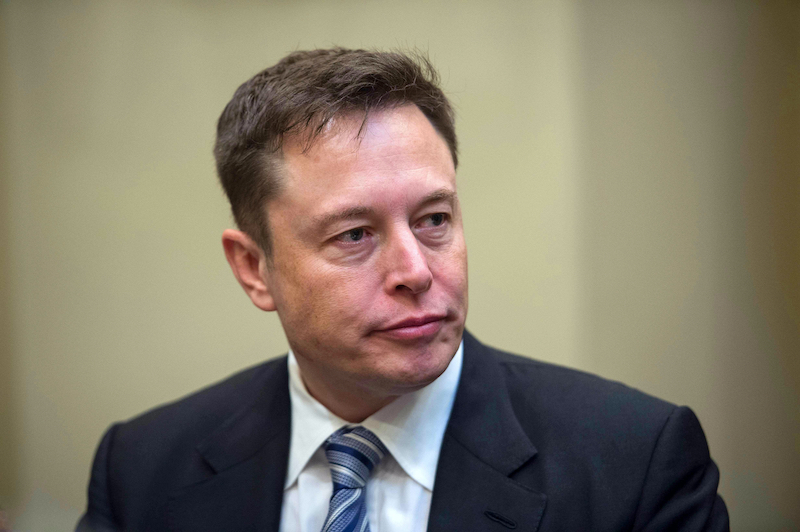
Tesla tycoon Elon Musk Tesla tycoon Elon Musk.

After some initial hesitancy about speaking on such a public platform, Hong Kong-based writer and cultural critic Vivienne Chow took the plunge and joined Clubhouse. From time to time, she has listened to the more sensitive discussions about Hong Kong politics.

“It was an interesting and moving experience… even as an audience member. Of course things are getting more difficult in terms of what we can or cannot say in public as we are still figuring out where the red line holds under the National Security Law in Hong Kong,” she says, adding that Clubhouse has many purposes beyond discussing politics. For instance, Chow has co-founded two “clubs” (discussion rooms that meet regularly): “Arts & Peeps: Asia and Beyond” on the arts; and “Astro Classmates,” on astrology.

“The great thing about Clubhouse is that it allows me to connect with people from the art world internationally – people I’d normally meet at art fairs or events but can’t because of the pandemic,” Chow says. “I’ve hosted and participated in chat rooms, mostly in English, [and had] enjoyable, insightful conversations. And I’ve met a lot of new contacts. It’s like the new LinkedIn.”

She most enjoys the opportunity to share “cultural memories” with other users, including a discussion about a 1994 Chinese rock ‘n’ roll concert in Hong Kong that starred musicians like Dou Wei, He Yong, Zhang Chu, and the heavy metal rock band Tang Dynasty.

For users who had not been able to attend – including many prominent organisers and music critics from China – she was able to bring the experience to life for them. “I ‘raised my hand’ to speak, sharing my tale and memories of that fantastic concert. Fellow speakers were delighted that they finally got to hear about the concert from someone who was actually there.”

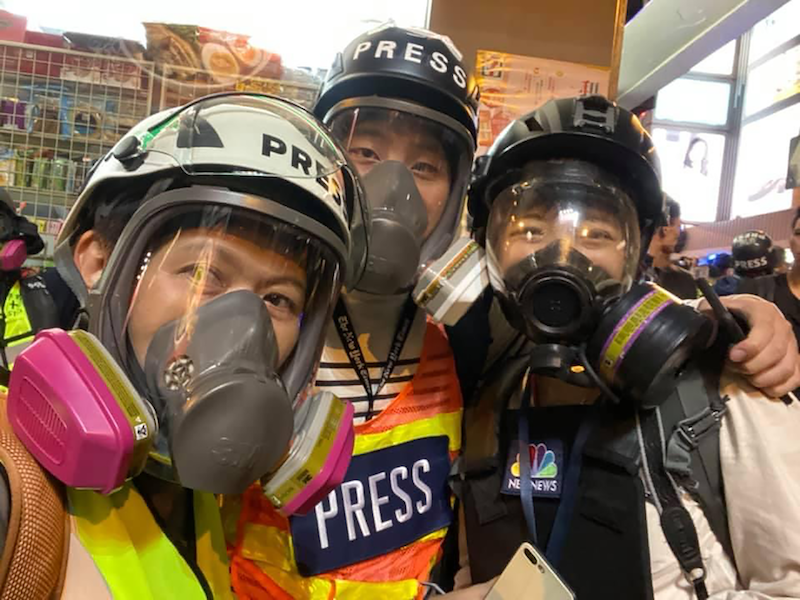
Freelance journalist Ezra Cheung (centre) in front line reporting mode. (Photo: Supplied)

As Clubhouse is little more than a year old, members are still figuring out how to best use the app as the potential – and perils – of audio-based social media become more apparent.

Even as the world returns to normal after COVID-19, some users may find the digital world is still the best venue for free and open discussion. For others, including those in Hong Kong, it may be one of the only places left.


Take 5: Clubhouse Tips

  1. Word to the Wise
    Clubhouse doesn’t record your conversations, but it’s best to assume that whatever you say is public and could be recorded by another user.
  2. Tune In
    There are tens of thousands of rooms on Clubhouse. Hop in and out of ongoing chats or follow other users to see what they’re up to.
  3. Mark Your Calendar
    Many Clubhouse discussions are scheduled in advance, so you can add interesting events to your calendar.
  4. Be Polite
    Although you can stay anonymous, it’s best to follow the same social etiquette as you would with a face-to-face chat.
  5. Explore Alternatives
    If you fall in love with audio chatting, check out similar apps, such as “Stereo”, “Wavve” and “Discord”. Twitter is also beta-testing its Clubhouse alternative “Spaces.”

Erin Hale is a freelance journalist based in Taipei, where she writes about Taiwan politics, culture and cross-straits relations. She was previously based in Hong Kong and Cambodia.

2021 Human Rights Press Awards Winners on Why Their Work Matters

It is lamentable that there was no shortage of entries for the 25th edition of the Human Rights Press Awards, which are organised by the FCC, Amnesty International and the Hong Kong Journalists Association. But as Rhea Mogul reports, the high standard of submissions was inspirational.

At the helm of any news story is a fierce commitment to telling the truth. Under increasing political and societal pressure, journalists now more than ever understand the need for urgent, accurate and nuanced reporting that holds power to account and defends vulnerable communities.

Despite increasing challenges, journalists’ unwavering quest for the truth remains one of the bulwarks of free expression and a free press. Their storytelling has exposed uncomfortable realities and given a voice to the voiceless.

Now in its 25th year, the Human Rights Press Awards sets out to celebrate the work of journalists from across Asia who have demonstrated tremendous courage in honouring these principles. Organised by the FCC, the Hong Kong Journalists Association (HKJA) and Amnesty International Hong Kong, this year’s winners were announced on 6 May.

Even in the face of particularly difficult times, which included a global pandemic and political upheaval, the winning journalists delivered original and compelling rights-related reporting that exposed wrongdoing.

The Correspondent spoke with a selection of winners about their work, what it reveals and why it matters.


Photography: Single Image
‘The Struggle’ by Alex Chan Tsz-yuk, CityDog.by

Freelance journalist Alex Chan Tsz-yuk’s winning photograph of a Hong Kong protester being held to the ground by two policemen was taken on 10 May 2020, after clashes broke out between the police and anti-government protesters in Mong Kok. Some 230 people were arrested that day, and the HKJA strongly condemned police treatment of reporters covering the event.

Alex Chan: “I saw three very young protesters get arrested. One young man – the one in the photograph – was trying to reach for something as the police arrested him, but he was pushed to the ground. His fingers then spread open to show the protest slogan ‘five demands, not one less’. That is why I named it ‘The Struggle’ because I think it matches what Hong Kong people are facing after the passing of the National Security Law. They continue with their struggle under political repression.

“That day was one of the most unfriendly journalists ever experienced at the hands of the Hong Kong police. Soon after I took the shot, I was pepper sprayed mercilessly. Some journalists, including myself, were forced to kneel down and stop recording. But instead of stopping, I took out a GoPro and continued my work.  

“The police also told us to show our press cards and made us say our names in front of a camera. They said they had recorded us for illegal assembly. During the very unpleasant experience, my only thought was that I need to protect the pictures I took, and try to publish it as soon as possible. As a journalist I will keep doing my work, document and tell the truth.”


Explanatory Feature Writing: Chinese
‘From Faceless to Voiceless: A Documentary Report of Hong Kong Citizens in Anti-Extradition Law Amendment Bill Movement and National Security Law’ by Hung-Chin Chen, Tzu-Lei Yang, Long-Hei Chan, Yu-Ju Lee, Tzy-Tyng Chen, Hanshun Wang, Ling-Wei Hsu, Yu-Fang Lin, Cheng-He Mi, Ya-Wun Jheng, Yi-Ching Wu, Yu-Chieh Chen, Yi-Fen Kao and Chun-Hsien Lee, Mirror Media

Journalists from the Taiwan-based publication Mirror Media spent one year documenting how the lives of Hong Kong protesters changed after the implementation of the National Security Law. The judges praised their probing interviews, which encapsulated the feelings of Hong Kong people.

Hung-Chin Chen, one of the winning journalists on the Mirror Media team, explains: “I visited Hong Kong in 2019, during the pro-democracy movement, and interviewed nine Hong Kong people. Some were normal people like us, who were valiant protesters; others were legislators and scholars. Back then, we wanted to paint a picture about these people and understand what made them take to the streets, what they were feeling when they protested and what made them desperately fight for power under any circumstances.

“None of us could foresee that the National Security Law would soon be imposed on Hong Kong. In less than one year, we knew that the lives of these nine people would have changed drastically. We strongly wanted to write a follow-up report about what happened to them. 

“I felt sorry that some of them chose not to be interviewed again for fear of what would happen. I also felt so thankful that some were brave enough to accept, and told us that they were continuing with their defiance and protests. 

“Others told us that they had started hiding their social media posts out of fear. We tried conveying what this must have felt like, and how the new law changed their lives.

“Journalism is the first rough draft of history. We hope we can do our best to show our readers the truth and real change that Hong Kong has been facing.” 


Documentary Video: Chinese

Paul Lee, Bao Choy, Sze-sze Cheng, Flora Yeung, Judy Chan and Yiu-ling Wong, Radio Television Hong Kong

RTHK’s investigation into the Yuen Long attack of July 2019, which saw an armed mob beat commuters and protesters inside a subway station, was praised by the judges for “chasing the smallest clues” and “interrogating the powerful without fear or favour.”

Freelance producer Bao Choy was convicted and fined HK$6,000 in April for making false statements while obtaining vehicle registration records during her research. RTHK had tried to withdraw its entries from the competition but HRPA organisers declined to cooperate. In the wake of her conviction, we spoke with Choy and her teammate Sze-sze Cheng about their investigation and reporting process.

Bao Choy: “A year after the attack, many of the victims still haven’t found justice and the assailants remain unpunished. This should not be accepted in a civilised city. We therefore decided to reopen the investigation and look at all the tiny details which could provide more information and the forces behind the attack.

“A team of four spent a few months re-watching all the online footage from the night, as well as CCTV footage. We had to mark every tiny clue, and use those clues for further investigation. We used a spreadsheet to share our discoveries, partnering in teams of two to approach the alleged assailants because of security concerns.”

Sze-sze Cheng: “The process was long, but very rewarding. The most memorable part was when we approached villagers and asked for their responses. It was dangerous, but it was part of our job and we had to do it.”

Choy: “It was extremely difficult to get people to talk to us about this particular incident. It seems those white clad-men involved were asked to remain silent. In some ways, their silence reflects a part of the truth.

“Being truthful and transparent are the core values of our work as journalists. Winning this award is recognition of our team and effort. It is proof that we will counter those who want to erase or rewrite history.” 

Cheng: “Our reporter Bao Choy was charged and convicted of false declaration. I think that’s the most cynical thing, and she did her best to fight press freedom. Our work is a part of history and serves as important documentation.”


WINNER – Photography (Single Image)

The Struggle
Alex Chan Tsz Yuk, CityDog.by
Hong Kong, 10 May 2020
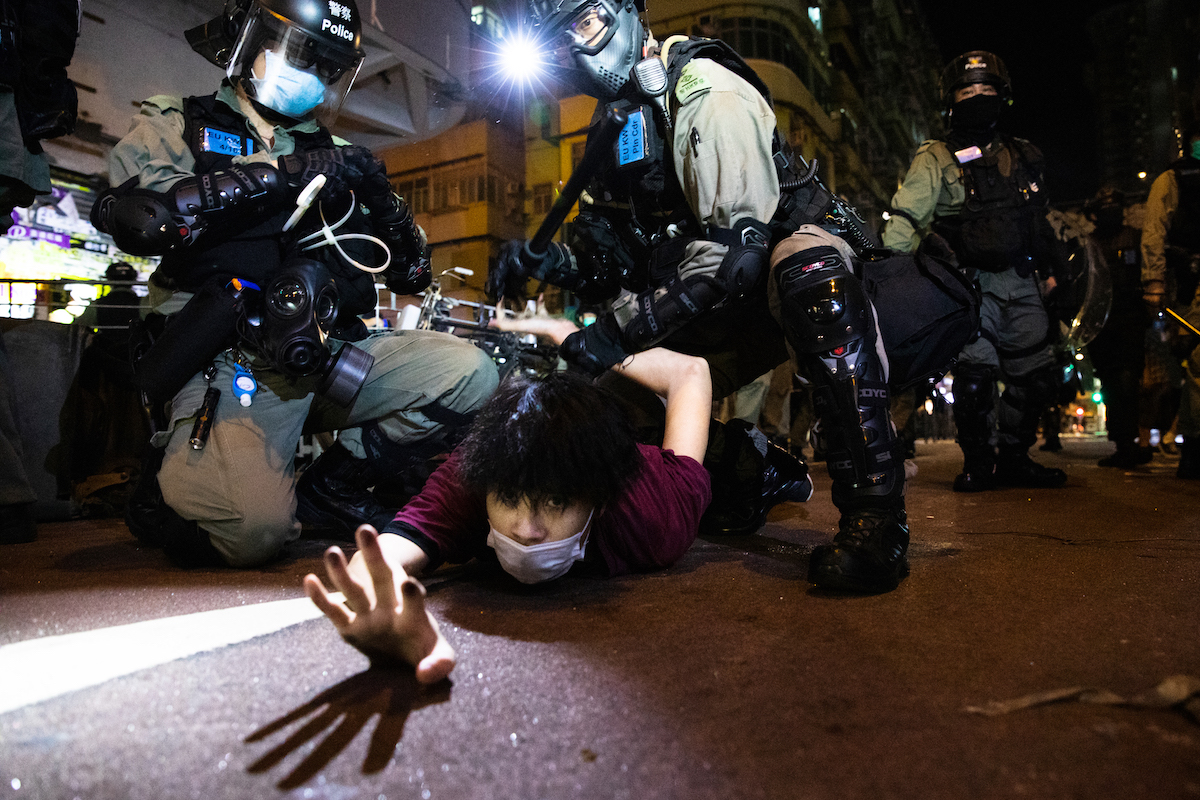
Protestor arrested Hong Kong A protester signals “Five demands, not one less” while getting arrested in Mong Kok.


WINNER – People’s Choice Photo Award

Little Brother and Little Sister
Fung Hoi Kin, Ming Pao
Hong Kong, 6 September 2020
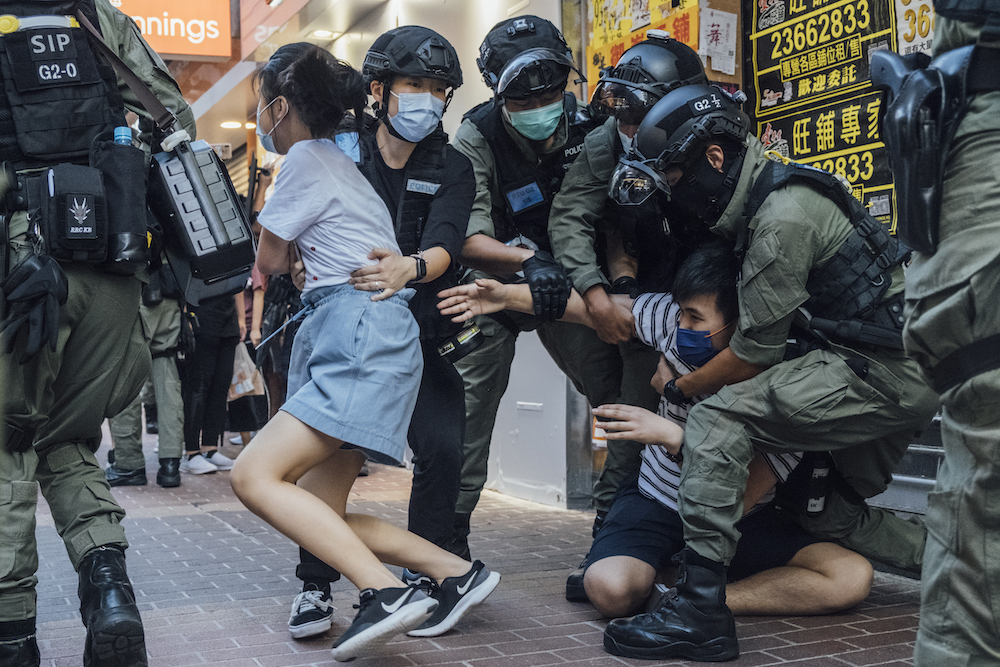
When police “kettled” a crowd of demonstrators in Hong Kong, two young childen – brother and sister – attempted to flee but were grabbed by heavily armed officers. In a futile attempt to protect her, the boy reached out to his sibling.

‘Little Brother and Little Sister’ won the People’s Choice Award with more than 21,000 online votes. The Correspondent spoke with one of the HRPA organisers, Mary Hui, about the winning shot. 

“The photo was taken at the height of the mass protests. As has been widely reported, the Hong Kong police increasingly adopted a tactic of ‘kettling’ protesters and other citizens who happened to be near an area of protest, making mass arrests by sweeping up large groups of people,” says Hui. 

“This image of two underage siblings dressed in shorts and a T-shirt being forcibly restrained and overpowered by fully geared-up riot police officers is very striking. The widely documented use of heavy force by the police, and the unaccountability of the officers, was and continues to be a major public grievance that has severely damaged trust in law enforcement, and more broadly, the government. 

“I imagine that many people who voted for this photo thought that the image captured and represented these complexities in a split second.” 


MERIT – Photography (Single Image)

A Mob out for Blood
Danish Siddiqui, Reuters
India,
24 February 2020
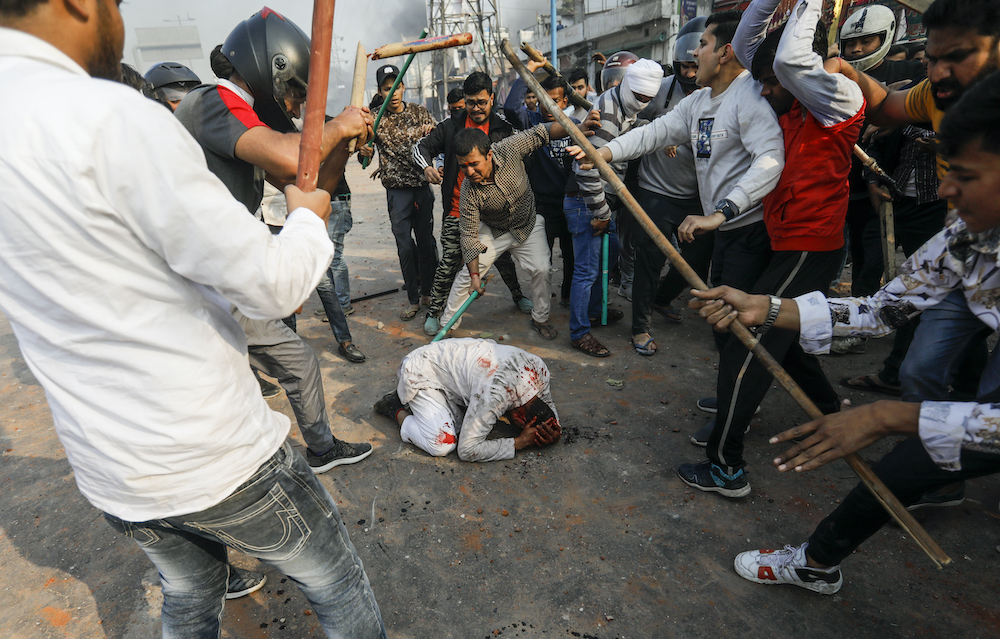
A group of men chanting pro-Hindu slogans, beat Mohammad Zubair, 37, who is Muslim, during protests sparked by a new citizenship law in New Delhi. Zubair was on his way home from a mosque when he came across a large Hindu crowd. “They saw I was alone, they saw my cap, beard, clothes and saw me as a Muslim,” Zubair said. “They just started attacking, shouting slogans. What kind of humanity is this?”


WINNER –  Photography Series

Citizenship Law Protests
Danish Siddiqui, Reuters, India
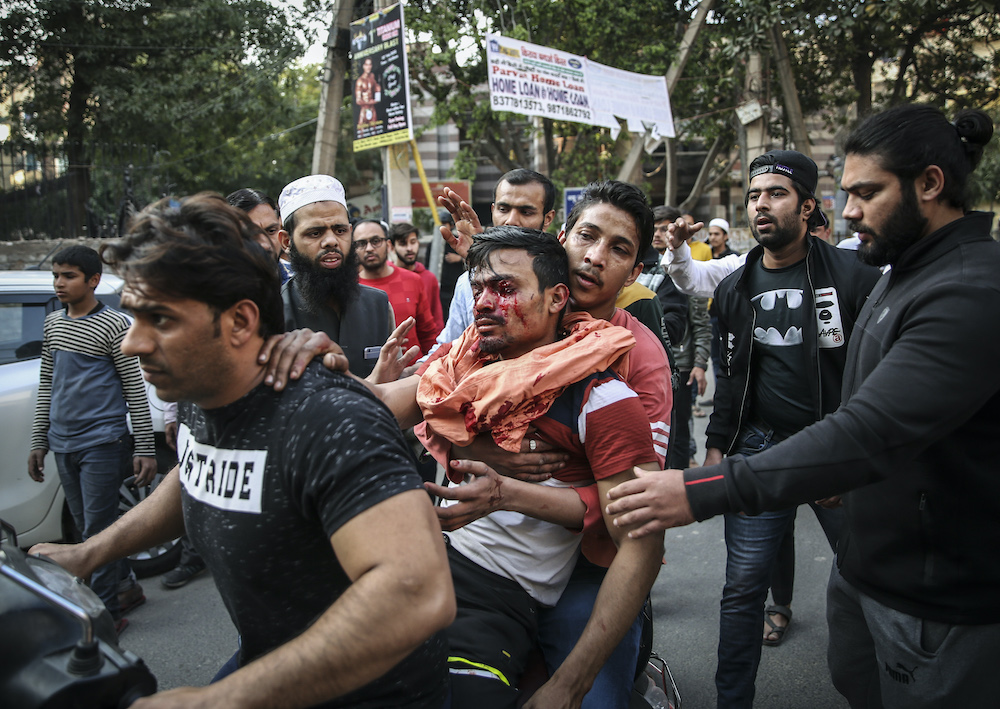
An injured man is rushed to a hospital after clashes erupted over a new citizenship law in New Delhi on 25 February 2020.
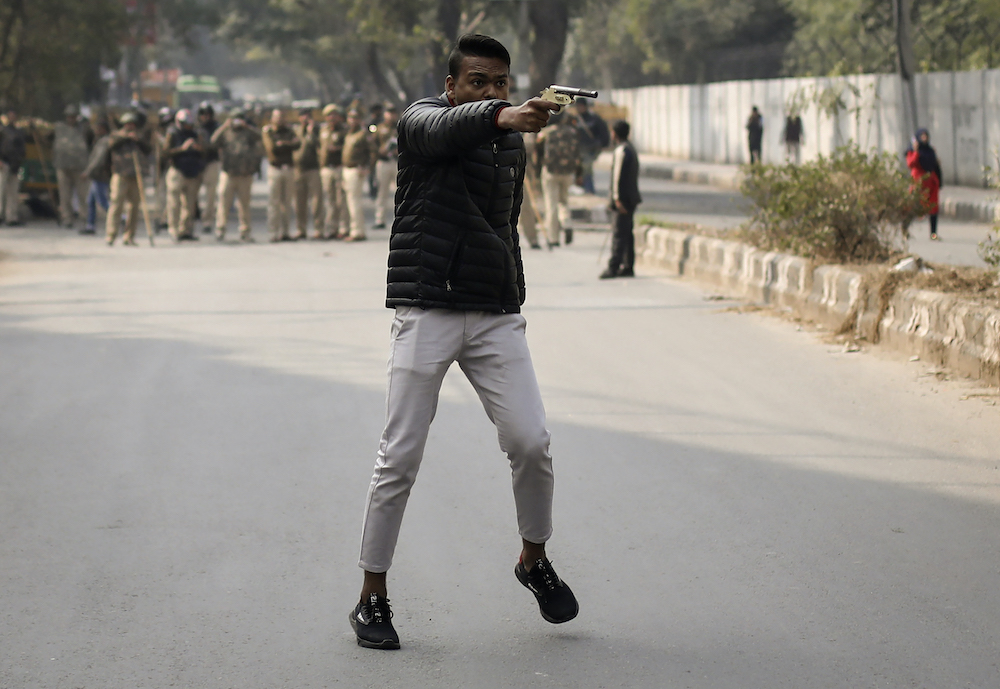
 

A man brandishes a gun during a protest outside the Jamia Millia Islamia university in New Delhi on 30 January  2020.


MERIT –  Photography Series

Pro-Democracy Protests in Thailand
Lillian Suwanrumpha, Mladen Antonov and Jack Taylor, AFP, Thailand
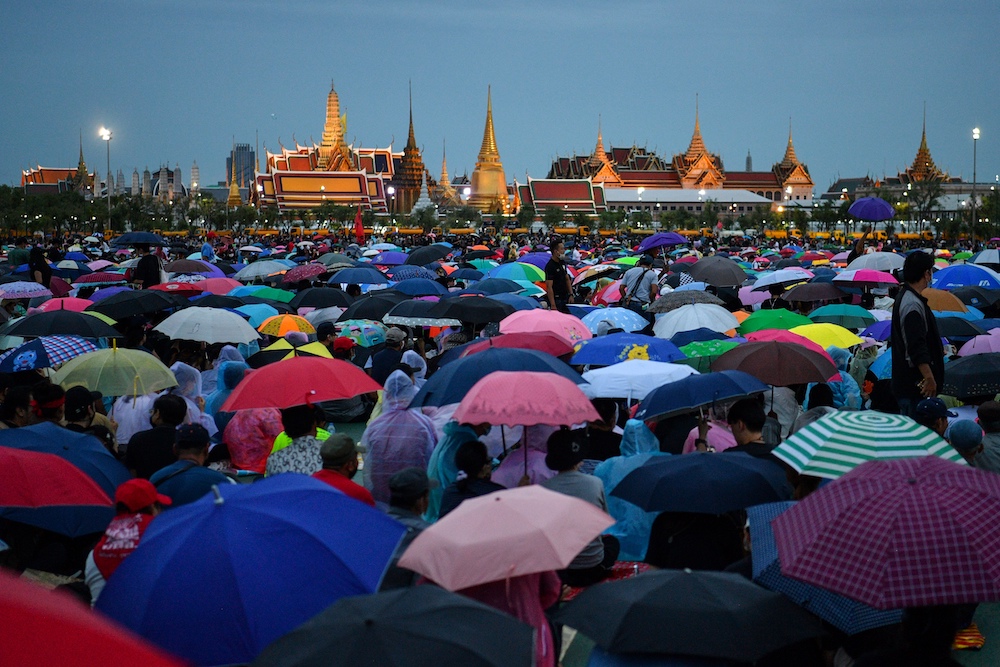
Anti-government protesters gather in Sanam Luang during a pro-democracy rally in Bangkok on 19 September 2020.
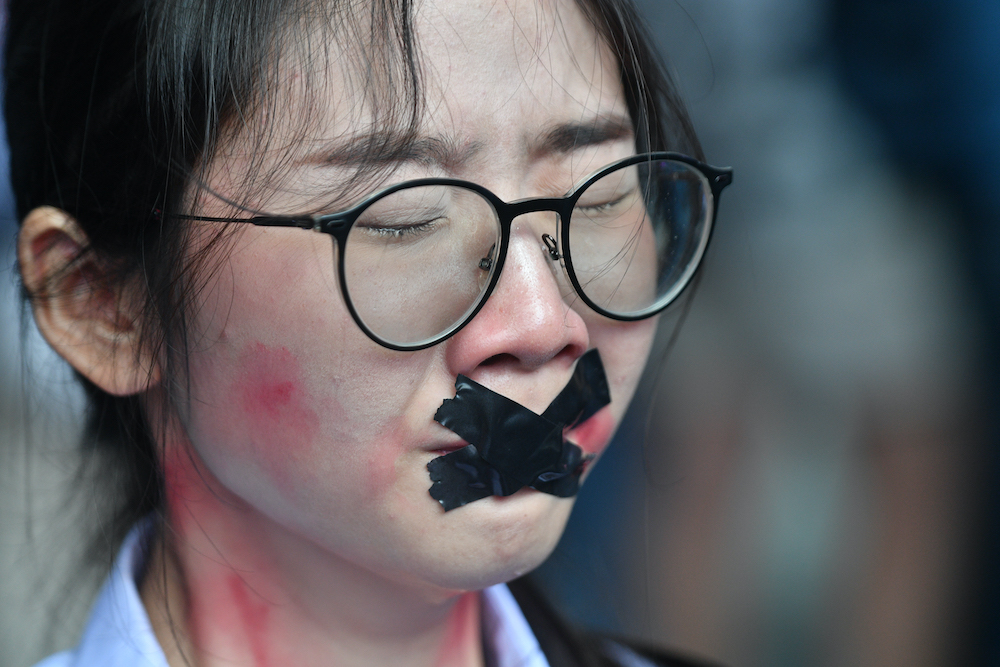
 

A protester portraying a victim of abuse at school grimaces during a ‘Bad Student’ rally in Bangkok on 21 November 2020.


MERIT –  Photography Series

Plight of the Poor in India’s Lockdown
Jewel Samad, Arun Sankar, Money Sharma, Bhuvan Bagga, Sajjad Hussain Indranil Mukherjee and Himanshu Sharma, AFP, India
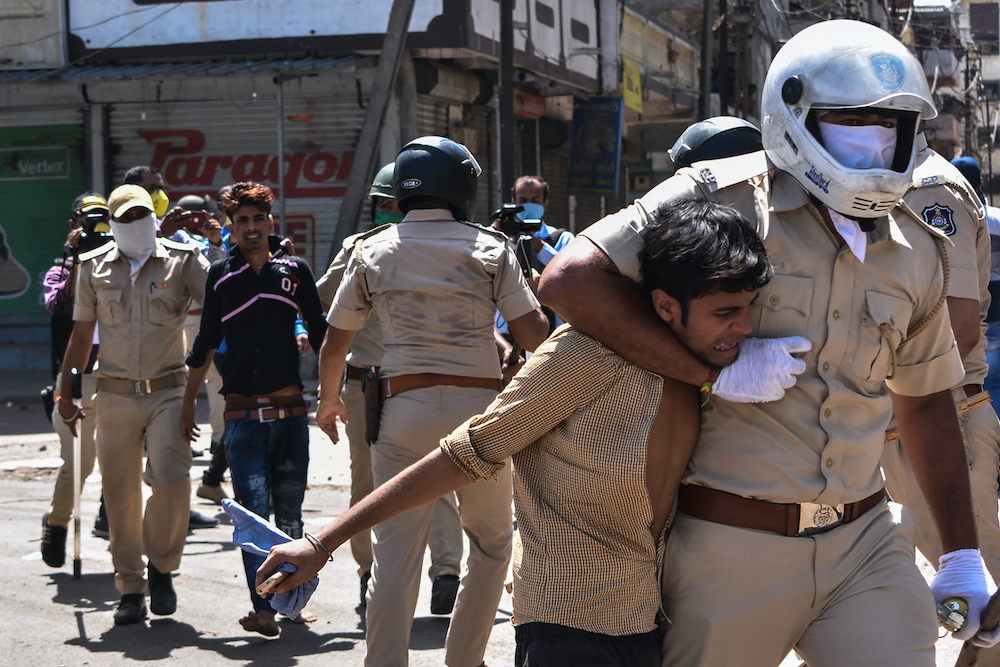
Police detain stranded migrant workers in Surat during a nationwide coronavirus lockdown on 4 May 2020.
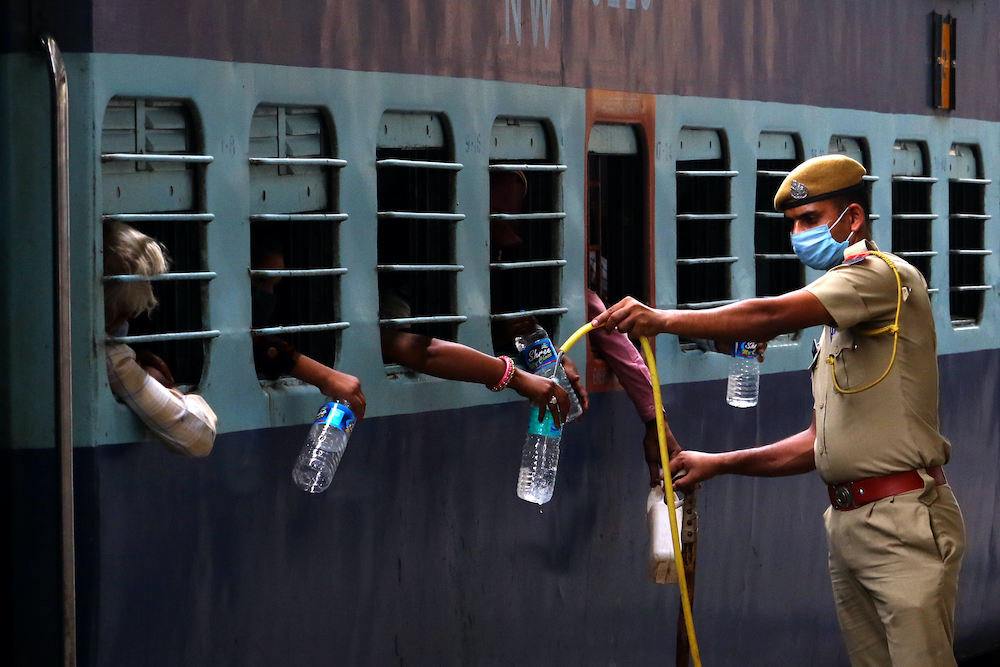
 

A policeman fills up bottles with water for migrant workers in Ajmer after the government eased a nationwide lockdown on 18 May 2020.



Rhea Mogul is a Hong Kong-based journalist interested in gender issues and minority rights. Her work has appeared in a number of publications including Forbes.com, Hong Kong Free Press and South China Morning Post.

The Troubling Reality of Press Freedom in Singapore

Journalists shopping around for a new home base in Asia may find that the Little Red Dot has thick red lines. Alexis Ong reports from Singapore.

Beijing is no longer a spectre that looms over Hong Kong, but a very tangible presence in the form of the National Security Law, which came into effect on 30 June 2020.

Since then, many Hong Kong-based journalists and media outlets have been tempted to consider alternative home bases in Asia, including Singapore. But press freedom in the city-state is arguably more draconian.

Having written a story for The Initium on how Singapore could be impacted by Hong Kong’s instability, Singaporean journalist and activist Kirsten Han explained that the city-state is far from a bastion of press freedom.

“If you’re someone who wants to leave Hong Kong because you’re troubled by the erosion of civil liberties like freedom of assembly, freedom of expression, and freedom of the press – why would you come to Singapore?” she asks.

On the 2021 World Press Freedom Index, Singapore ranks 160th out of 180 nations and territories – two spots down from its previous position at 158. The index classifies Singapore as “black” – the lowest possible category – alongside notoriously repressive countries like North Korea, China, Syria and Saudi Arabia. Hong Kong hovers at 80, down from 48th in 2009. Hong Kong’s status may be gradually declining, yet it’s still far from the black zone.

Kirsten Han Freelance journalist and editor Kirsten Han spoke about press freedom in Singapore at the FCC in 2018. (Photo: Sarah Graham/FCC)
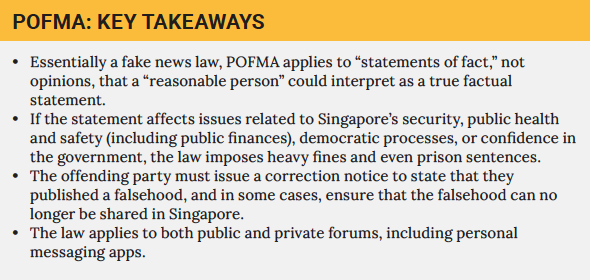
“Singapore wants to be a model for development, but it’s actually a counter-model for press freedom,” says Daniel Bastard, head of the APAC desk at Reporters Without Borders (RSF), alluding to the controversial Protection from Online Falsehoods and Manipulation Act (POFMA) introduced in May 2019.

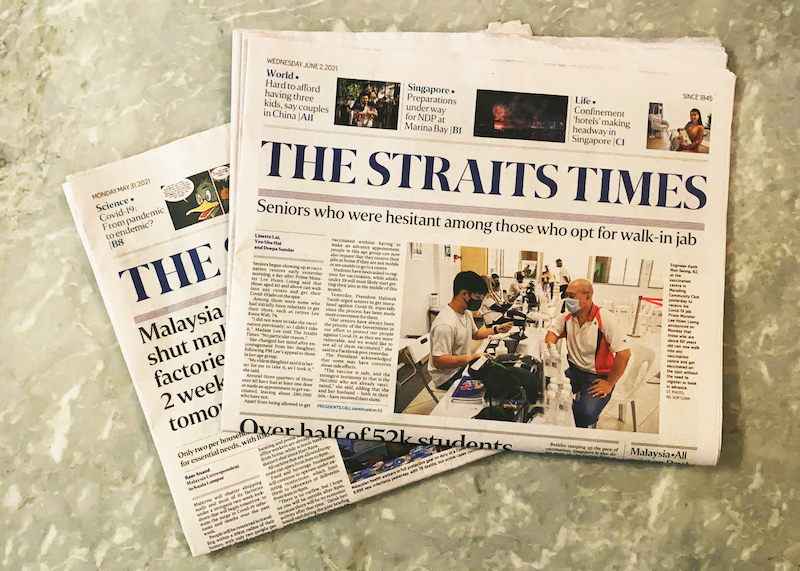
The law affords the People’s Action Party (PAP) – Singapore’s ruling political party – the right to combat “fake news,” according to the official position. The Straits Times (ST), a pro-government paper with links to the PAP, recently defended the law as a necessity in a new COVID-19 reality where disinformation runs rampant.

While the law focuses on providing public corrections to alleged falsehoods,     it has also been used against local activists and the political opposition, which the government calls an “unfortunate coincidence”. Serious incidents can also be punished with hefty fines or even a prison sentence.

The law’s broad legislative wording, coupled with the enormous power wielded by the government, poses a threat to independent Singaporean media. Take the case of historian Dr Thum Ping Tjin, the founder and managing director of New Naratif, one of the few independent outlets in the country, as an example.

In 2020, the POFMA office issued a warning to Thum after he posted a video claiming that POFMA outlawed all government criticisms and effectively turned ministers into arbiters of truth. Given the legal consequences, Thum chose to post the necessary corrections while still challenging the law.

Then, of course, there are the “red lines that journalists should not cross, and if they do, it means very stressful lawsuits,” says Bastard. These are also called out-of-bounds markers (or “OB markers”) to indicate topics that aren’t suitable for open public discussion, like racism, LGBTQ issues, religion, or the finer points of government surveillance; OB markers are purposely kept vague.

He compares the system to China’s state media, albeit with a little more room for independent writers like Han. But those who incur the PAP’s wrath will likely face a team of government lawyers, which Bastard compares to a “David versus Goliath” fight.

A Singapore High Court judge ruled in February 2020 that, under POFMA charges, the burden of proof lies with the individual, who must prove the statement in question is true – not for the government to prove it is false.

That same month, in the case of The Online Citizen (TOC), another independent outlet, the court dismissed editor Terry Xu’s appeal against a correction order. TOC had published an article about supposed human rights infringements at Changi Prison, even though Xu pointed out that words like “allege” and “allegation” were used six times in the text.

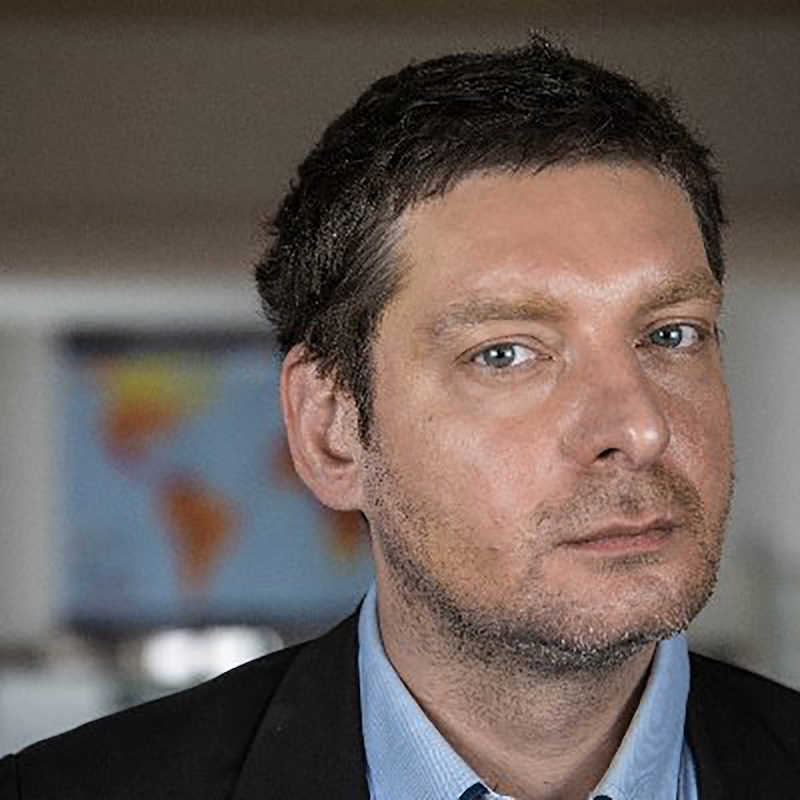
DANIEL BASTARD Daniel Bastard, head of the APAC desk at RSF.
Despite this, the government deemed TOC guilty of spreading misinformation. The appeals process can cost thousands of dollars, depending on how long the hearing takes. In Xu’s POFMA case, he claimed that his appeal would cost at least SG$10,000, or roughly HK$58,350.

In addition to POFMA, says Bastard, the Singapore government also exerts influence within news organisations. “I believe, still now, that the [Hong Kong] government doesn’t nominate the chief editors and directors of publications, as the government does in Singapore,” explains Bastard. “So in Hong Kong, you still have some editorial freedom or at least autonomy. That doesn’t really exist in Singapore at all.”

Han, who previously served as the editor-in-chief of New Naratif, says the ST is a case in point. It’s owned by Singapore Press Holdings (SPH), and the firm’s chairpersons are usually either PAP civil servants or closely involved with the party. The current editor-in-chief, Warren Fernandez, was almost nominated as a PAP candidate in 2006.

At the 2019 World News Congress in Glasgow, the World Editors Forum elected Fernandez as president. “I couldn’t believe it, but it dawned on me that people outside Singapore don’t understand the context of Fernandez being [chief editor] of ST – and how far from independent the paper is in Singapore,” she recalls.

In early May 2021, SPH announced a plan to restructure into a non-profit “limited by guarantee” company, to be chaired by ex-PAP minister Khaw Boon Wan. As reported by Today Online (another state-funded publication run by Mediacorp): “A company limited by guarantee is an entity that does not have share capital or shareholders but, instead, has members who act as guarantors of the company’s liabilities.” The changes will allow SPH (which is still primarily a real estate company) to diversify its funding, a move predicted by former ST Editor-in-Chief Patrick Daniel.

Strait Times With strong links to the People’s Action Party, The Straits Times is emphatically pro-government.
While the shift to a non-profit model is welcome, concerned watchdogs and local opposition have also expressed concerns over Khaw’s appointment as a missed opportunity to create a more independent media environment.

According to academic Cherian George, Khaw’s new role is just another entry in SPH’s long history of appointing former politicians and civil servants with “no prior industry experience” into leadership positions. It also toes the line of the far-reaching 1974 Newspaper and Printing Presses Act (NPPA), which put ministers in control of publishing permits. The PAP views the NPPA as a necessity for “moral policing” and social harmony, and to hold publishers accountable for their content.

But it’s clear that as social media becomes an increasingly powerful way for people to communicate, old methods of censorship and content regulation are quickly becoming obsolete.

RSF works with the UN Human Rights Council (UNHRC) to evaluate Singapore for its Universal Periodic Review. According to Bastard, Singapore has accepted 117 past recommendations from the UNHRC – not a single one related to press freedom. “It’s never good for states to be criticised over human rights, even if the PAP government obviously doesn’t care about press freedom,” he says.

But despite POFMA and the censorious climate it creates, the 2020 election showed that young, politically engaged Singaporeans are driving meaningful conversations around historically sensitive topics, such as race, class and independent media. 

“Young Singaporeans have been doing great at normalising certain discussions… and setting new expectations for our political and public discourse,” says Han. “In the long-term, [this] will make a big difference to Singapore.”

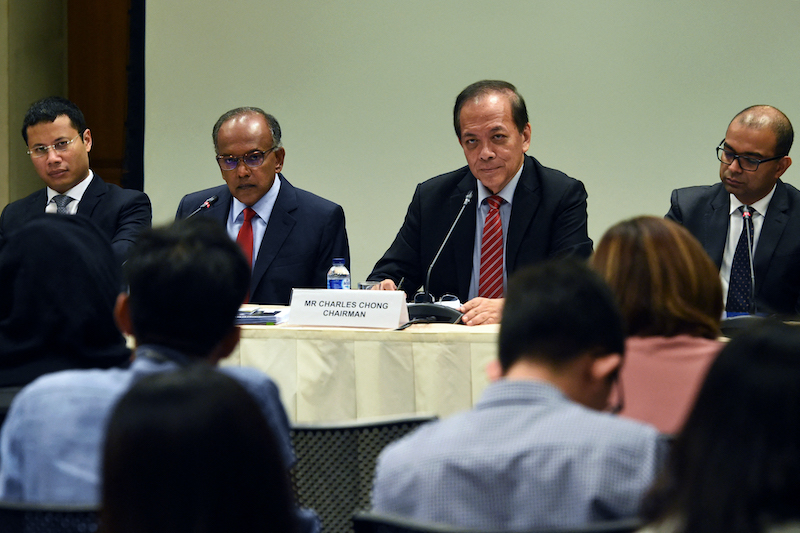
Singapore Fake News Committee Charles Chong (right), deputy speaker of the parliament and chairman of the Select Committee on Deliberate Online Falsehoods, attend a press conference in Singapore on 20 September 2018. (Photo: Roslan Rahman/AFP)

Plan Bs

For those seeking an alternative homebase in Asia, RSF’s Daniel Bastard suggests:

Taiwan  

Although Taiwanese media needs legislative reform to strengthen its independence, the government hasn’t taken concrete steps to address that yet, RSF reports.

“Taiwan is definitely the regional model for press freedom,” says Bastard. “Though the media is quite polarised, there are good legal guarantees.”


South Korea  

South Korea still follows a system where public broadcast managers are appointed by the government, however, it is better than many countries in Asia.

“South Korea would be a second possible homebase, with president Moon [Jae-in] being quite protective with press freedom,” says Bastard.

“Things can change drastically with another government, though; the situation was quite bad under president Park [Geun-hye].”


Alexis Ong is a freelance culture journalist based in Singapore. Her favourite beats are emerging tech, video games, and internet culture.

Looking Back on a Year of Eroding Press Freedom Under the National Security Law

Editor’s Note: As The Correspondent went to press on 17 June, NSL police were once again searching Next Digital headquarters after arresting Apple Daily’s editor-in-chief Ryan Law and four other executives for alleged collusion with foreign forces.

Read the FCC’s official statement regarding Apple Daily’s closure here


How did Hong Kong media react to a catch-all law that sent shockwaves through the territory and beyond? Jennifer Creery explores the law’s far-reaching ramifications.

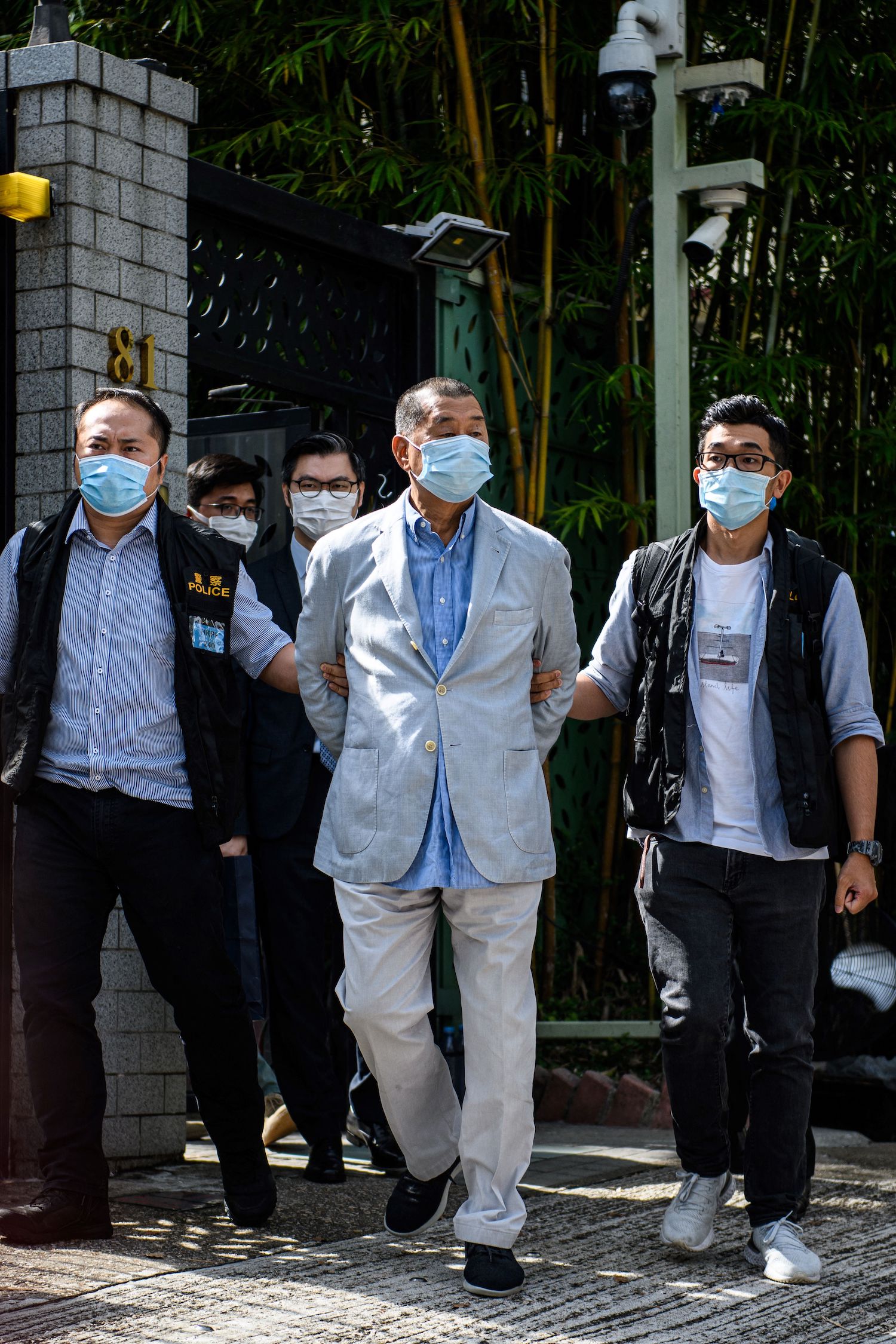
Jimmy Lai Police lead Hong Kong pro-democracy media mogul Jimmy Lai, 72, away from his home after he was arrested under the NSL on 10 August 2020. (Photo: Vernon Yuen / AFP)
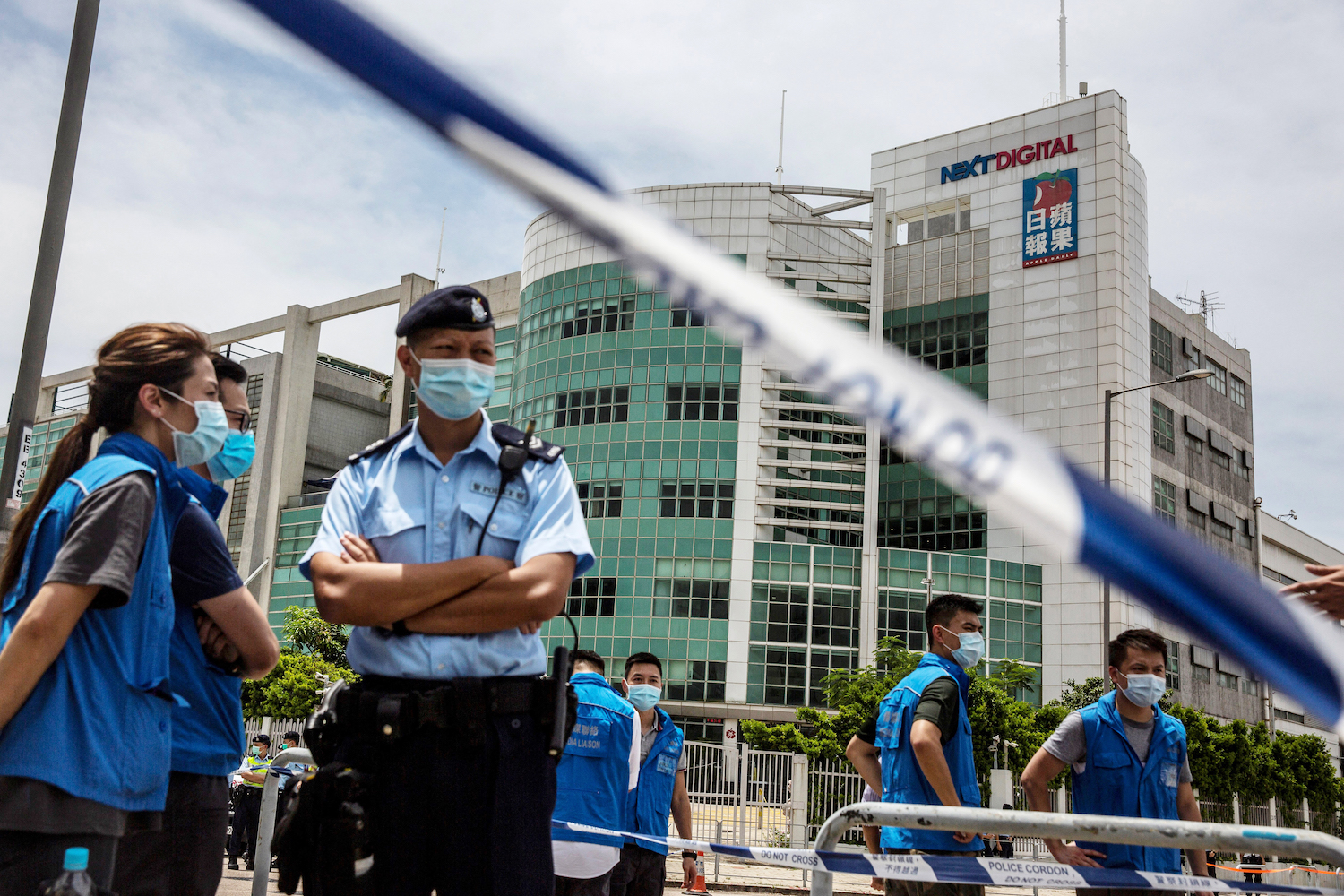
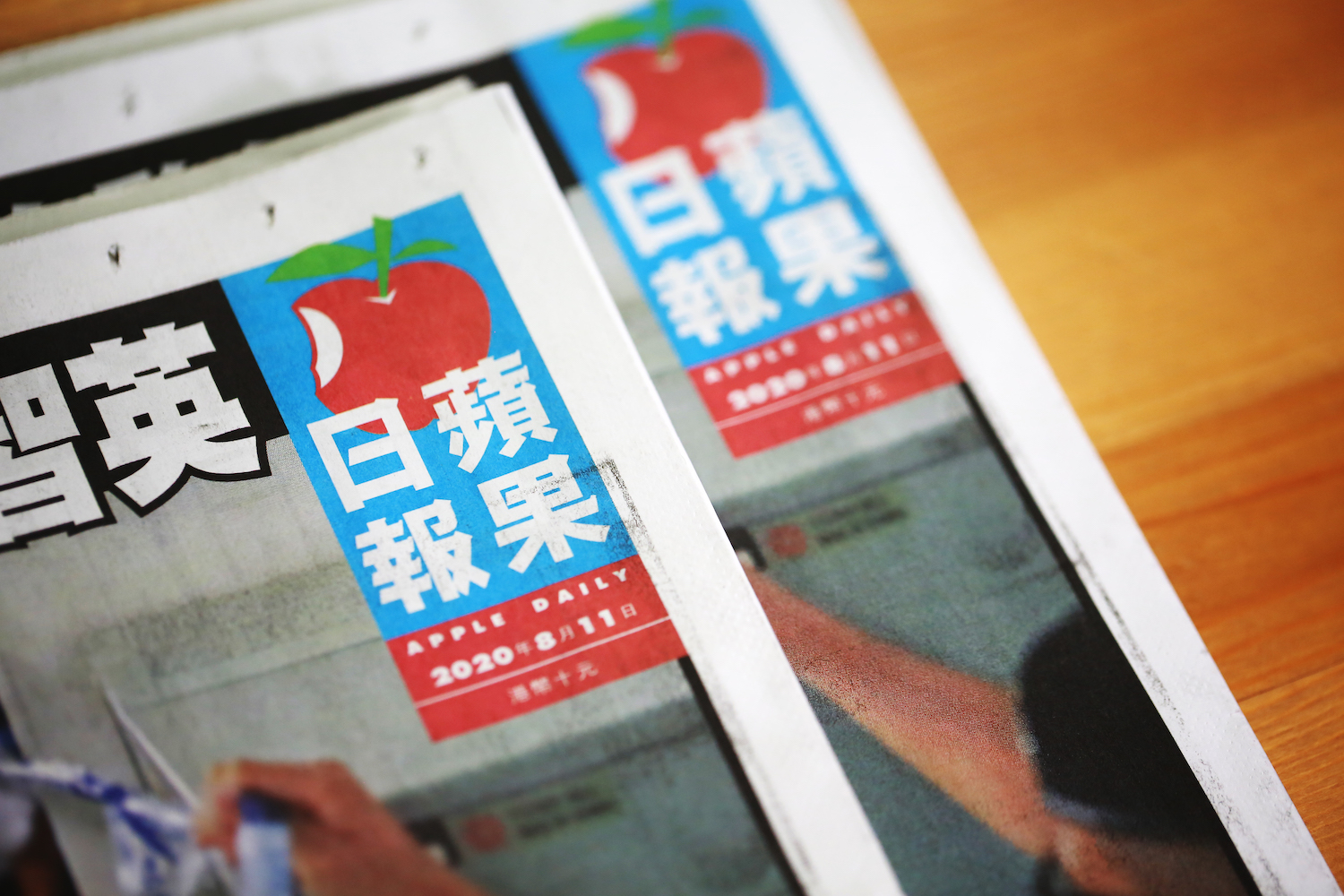
On the morning of 10 August 2020, hundreds of national security police raided the Tseung Kwan O office of Next Digital, the parent company of pro-democracy newspaper Apple Daily. Winding up the slate staircase, uniformed officers made their way into the newsroom on the second floor, occasionally stopping to inspect items on desks. Just hours earlier, police had arrested the company’s founder, Jimmy Lai, at his home in Ho Man Tin for alleged collusion with foreign forces. 

The unprecedented arrest and raid were two of the first major acts against the press carried out under the National Security Law (NSL), enacted on 30 June 2020. Just days after the law was passed, Hong Kong Chief Executive Carrie Lam said she could guarantee press freedom if journalists could also guarantee “that they will not commit any offences” under the law.

Long a thorn in the side of the establishment, Apple Daily was a predictable first target. Founded in 1995, the tabloid made a name for itself with its celebrity gossip, shoe-leather reporting and criticism of Beijing. It doubled down on its position during months of street protests that began over an ill-fated extradition bill in 2019, drawing the ire of government officials. Police said in a statement on Facebook that officers had entered the building with a search warrant to investigate an offence related to the legislation.

In the year since the NSL became a reality, Hong Kong’s media landscape has undergone a seismic shift: The New York Times has started moving approximately one-third of its Hong Kong staff to Seoul in South Korea; iCable fired 40 staff last December; and civil servants working for public broadcaster RTHK have been required to pledge allegiance to the government. 

RTHK has also deleted critical programmes across its web and social platforms; axed politically contentious shows; and attempted to pull submissions from awards, while its freelance producer, Bao Choy, was found guilty of knowingly making false statements to obtain vehicle licence records – making her the first person to be convicted of a crime related to the Yuen Long mob attack on 21 July 2019. In May, RTHK fired journalist Nabela Qoser, known for her tough questioning of officials.

“It’s pretty unprecedented for anyone anywhere in the civil service to lose their job,” says David*, an RTHK staffer who asked not to be identified in order to speak freely. “Civil service contracts are the golden rice bowl.”

His account of the last three years tells a bleak tale of shifting goalposts and self-censorship, accelerated under the new Director of Broadcasting Patrick Li. Previously the Deputy Secretary of Home Affairs, Li was ushered in during an overhaul of the organisation after the law’s introduction.

Hundreds of police officers search the Next Media offices following the arrest of Jimmy Lai. Hundreds of police officers search the Next Media offices following the arrest of Jimmy Lai. (Photo: Isaac Lawrence/ AFP)
According to David, an interview with democratic district councillor Michael Mo was axed from the programme “Letter to Hong Kong” without explanation; a re-recording of the segment with the Hong Kong Journalists Association (HKJA)’s Chris Yeung was also rejected under murky circumstances. In the end, Eugene Chan, the president of the pro-Beijing Association of Hong Kong Professionals, put in an appearance instead.

“The HKJA is facing an increasingly difficult environment in defending journalists’ rights,” Yeung tells The Correspondent. “The association is itself being targeted by pro-Beijing media and groups. [But] we will continue to speak up and stand alert.”

In another instance, David says, senior management from RTHK’s editorial committee questioned producers over whether a show on Myanmar could be interpreted as a commentary on Hong Kong – up to four hours before going on air in March. “It’s intimidation and creating deliberate uncertainty,” says David.

For the news writing team, he says, one method for working around political sensitivities has been to lead articles with government or police statements, thus giving credence to the stories.“We’re relying on doing things in the shadows and hoping [management] doesn’t notice. But of course, that’s not the way you should be doing it. You should be taking pride in your work.”

David’s experience cuts across many newsrooms in Hong Kong. HK01, an online outlet known for its investigations and close government contacts, faced an internal dilemma in the tumultuous months before the enactment of the law, according to a reporter, John*, which is not his real name.

John says both HK01’s founder, Yu Pun-hoi, and Chief Editor Ernest Chi Pan-year, asked staff to update the headline of an article containing arrest figures because it created a “negative image” of police and was too sympathetic towards protesters: “I think [Chi] wanted to maintain a good relationship with police. In the past they were only sensitive to [mainland] Chinese government issues,” says John.

At Next Digital, the situation has grown increasingly tense since the raid and arrest last August. As staff gathered on the floor of the newsroom on 5 May, Cheung Kim-hung, chief executive of Next Digital, responded to rumours that authorities would force the newspaper to close in the coming months, declaring: “Apple Daily will not close on its own.”

It was a defiant stance but provided little relief for some staff. “They felt that management didn’t have a contingency [plan] in place and that their fears had been dismissed,” says Oscar*, which is not his real name, a reporter who attended the meeting.

Apple Daily Founded before the Handover, Apple Daily has rarely held back from running hard news stories, especially when it comes to lambasting Beijing.
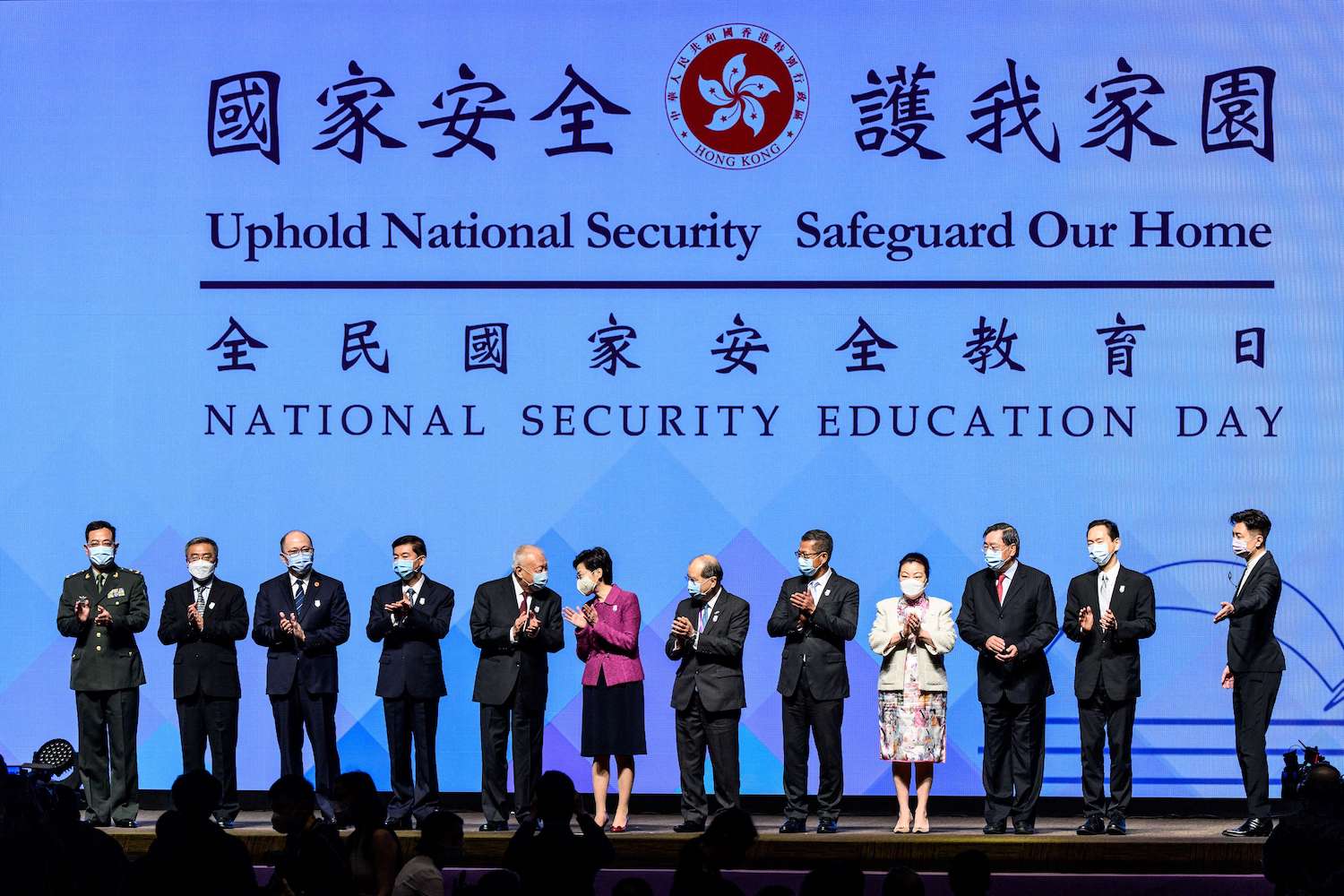
For over a year, Next Digital staff had been feeling pressure from the police. Between April 2020 and 2021, the police public relations bureau sent at least 89 “misleading report” letters to Apple Daily. In response to a report on a Hong Kong Police College open day to mark National Security Education Day on 15 April, the force criticised a photo caption reading, “What have [police] taught the next generation?”, and accused the publication of “distorting the original purpose” behind the event.  

In an email reply, a police representative told The Correspondent that the department sent the letters to improve public understanding in order to “earn their support and trust … There has been an overwhelming volume of unfounded information circulated in the society over the last few years,” wrote the representative. “Police absolutely respect freedom of speech and freedom of the press.” 

Despite management reaffirming its commitment to editorial independence after the NSL, Apple Daily has not been immune to internal controversy. On 15 April, the Equal Opportunities Commission released a letter that chided the newspaper for its continued use of the term “Wuhan pneumonia” to describe COVID-19, which was first detected in the capital of Hubei. 

Within a week, Apple Daily replaced the term with “Pneumonia epidemic”. Some staff saw it as a capitulation. “I think that incident was the first [of its kind] – that’s why it drew such a response,” Oscar says.

The inaugural National Security Education Day on 15 April 2021 was not greeted with universal acclaim. (Photo: Anthony Wallace/AFP)


The working conditions for many local journalists were far from ideal before the NSL brought added risks and pressures. Low salaries and long hours, coupled with increasing output quotas and news fatigue, meant that several years into the profession left journalists burnt out and looking for alternative career options.

“I want to leave but which media can I go to?” asks John, who laments a scarcity of well-paid positions on teams similar to his at HK01. “[Journalists] have a higher level of education; we have a bachelor’s degree, but our salaries are so low. And after the protests [and NSL] we could get charged – so why do we stay here and do this job?”

Some have chosen to leave. Three HK01 staffers, one of whom was senior, have immigrated to the UK, according to John. Several former staff at Apple Daily have also departed for places including the UK, Oscar says, due to poor working conditions, worsened by political pressures.

This kind of industry brain drain threatens to usher in a generation of younger, inexperienced journalists who may lack the judgement, skills and sources to provide the quality of journalism delivered by their predecessors. In particular, they may have yet to establish in-roads with government officials or police officers, relying on carefully tailored press conferences and statements.

“It’s impossible for new journalists to build those sources,” says Oscar, pointing to the precarious nature of building trust in professional relationships after the NSL. “If you have watched i-Cable TV after the mass walkout [in December 2020], there is quite an obvious difference in the quality of the programmes.”

Now that the NSL is a day-to-day reality, Oscar casts a gloomy eye over his career. He says he had, like many other journalists, pursued a career as a reporter with hopes that a more informed society would lead to democratic development. “To end up in a completely opposite direction – it is not what I expected.”

*Name changed to protect the individual’s identity, owing to potential professional or legal ramifications.


Jennifer Creery is an FCC Clare Hollingworth fellow and Curated Content Editor at the Financial Times. Prior to her current role she was an editor at Hong Kong Free Press.

The Correspondent, July – September 2021

Introducing the FCC’s New Members: May 2021

An Everest mountaineer, a feng shui expert, a guidebook publisher and a raft of other “usual suspects” comprise the latest batch of new FCC faces.


Erika Behrens

I have been a consul at the German Consulate General in Hong Kong since last July and head of the Consular Section there. Together with my husband, Wolfhard, who is now retired, we have served in German embassies in Thailand, Zaire, India, Egypt, China and Switzerland. Our common hobby is travelling to learn more about political, economic and social issues worldwide. We hope to meet club members with the same interests and to better understand the environment in Hong Kong and beyond.


Isabel Lijun Cao

I’ve been in various roles with the media industry for more than 20 years, most recently as regional director at The Economist Group’s Hong Kong office. Previously, I worked as the head of editorial and programmes APAC at EuroFinance. I spent the first part of my career with Xinhua, as a foreign correspondent and senior editor in Beijing, Afghanistan and London. I’ve lived in Hong Kong for more than a decade with my husband and two sons. In my free time, I practice yoga. 


David Wan Chang

I was born and bred in Hong Kong and went to high school and college in Washington, DC. I am CEO of Franklin Templeton Investments and my career has included working at global banks and trust companies. I have also volunteered for special educational needs schools. I enjoy a cigar (okay, not at the FCC) with some single malts over a good chat with friends or, even better, journalists.


Blake Evans-Pritchard

I run the editorial team at Asia Risk, covering the derivatives markets, financial regulation and risk management at banks. I have been in Hong Kong for six years, and previously reported on international war crimes trials in The Hague. Originally from England, I have also spent time as a journalist in Africa and Europe. I also run City Trail Publishing together with my wife. We wrote the first guidebook to an independent South Sudan in 2011, and have published an expat guidebook to Hong Kong. We’re now compiling a Hong Kong for Kids guidebook.


Neil Gardner

I was born and schooled in the UK, but as an expat child, my father exposed me to African jungles and Arabian deserts. That lit my spirit of wanderlust, which brought me to Hong Kong – where I am the chief customer officer for Generali – via Australia, China, Korea, Indonesia and Thailand. I love Hong Kong. I don’t call it home, even though my children do, as they have lived most of their lives here. Instead, as the FCC has such an amazing atmosphere, I think I’ll call the club my second home.


Adam Harper

Like a lot of expats, I came to Hong Kong for a couple of years to get some international experience. That was in 2004. At the start of 2020, with an impeccable sense of timing, I started my own communications consultancy, Ashbury. I’m from the UK and married with two children – and another on the way. I started out as a journalist with EuroWeek and have also worked as a capital markets banker and corporate communications specialist. When I’m not working, I have a passion for rugby, skiing and the novels of John le Carré.


Mark Hayden

I was a military brat living between Taiwan and Washington, DC in the 1960s. After graduate studies in 1981, I went into banking in Taiwan and later supply chain management. I’ve been in Hong Kong since 1999 and love being a bridge builder between Eastern and Western cultures and business practices as the regional managing director for Cato Overseas. Mandarin is my first language (having attended Taiwanese schools from kindergarten) and my wife, Susan, is Taiwanese.


Klaus Koehler

I am a representative at Woodburn Accountants & Advisors, which specialises in inbound investment to China and Hong Kong. We offer companies a one-stop-shop approach to their corporate service needs. I arrived in Hong Kong in 1970 from my native Germany and worked in a trading company just as China was opening up to the world and when Shenzhen was a village. My travels have taken me throughout Asia, and in my 50 years here I have seen change at a speed that was unimaginable in my early days. 


Heidi Lee Oi Yee

I am a partner at Howse Williams focusing on mergers and acquisitions, public takeovers, and regulatory and compliance work for Hong Kong-listed companies. Born, bred and educated in Hong Kong, I am also the past president of Rotary Club of Hong Kong Northeast where I enjoyed devoting my spare time to charitable work and socialising with fellow Rotarians. I like hiking, baking and drinking, as it gives me time to mingle with friends. 


Justin Li

I am an aspiring architect raised in Hong Kong and Canada. After graduating from the University of Toronto, and having returned to Hong Kong to be closer to my family and look for new opportunities, I became one of the key designers in the Ma Wan Old Village revitalisation project, which won the Silver Award in the Hong Kong Institute of Planners Awards 2020. In my spare time, I enjoy sketching, hiking and playing basketball.


Quentin Li

I was born in Canada, grew up in Hong Kong and returned to Canada to pursue my undergraduate degree. Four years in Montreal taught me not to mess with Canada’s winter, so I eventually returned to Hong Kong to pursue a career in finance. I’m currently a financial investment professional at Goldman Sachs Investment Management Division covering clients in Greater China. Outside of work, I enjoy playing basketball and collecting modern sports cards, in particular Michael Jordan, LeBron James and Luka Doncic rookie cards.


Jeremy Lightfoot

Having evacuated the British Virgin Islands as Hurricanes Irma and Maria approached in 2017, I lived out of a suitcase in New York, Cayman, London and Cyprus before finally arriving in Hong Kong. Originally a barrister, I run a litigation team for an offshore firm, Carey Olson, spending my days on disputes involving Asia and the Caribbean. My goal for 2021 is to learn to surf. If I declare that in writing here, I’ll have to learn in order to avoid embarrassment – peer pressure has its advantages, so please do remind me.


Patricia O’Rorke

I was born in Hong Kong and this is my fourth time living here. There’s obviously something pulling me back. I have been frequenting the club for 30 years with my generous friends and always felt at home here, so decided it was finally time to join myself. Originally from a nursing background in London, real estate has kept me busy from the late 1980s. I have been with Habitat Property for the last 11 years, and am now a senior consultant.  


Peter Parks

I am a staff photographer for Agence France-Presse and I see myself coming full circle, returning to Hong Kong after 16 years away as bureau photographer in Beijing, Shanghai and Sydney. I first arrived in Hong Kong in 1993 working as a freelancer, then joined the Hong Kong Standard before AFP in 1996. I covered the handover, bird flu, the economic crisis and SARS before leaving and now find myself returning to an even more serious pandemic and a whole new political climate.


Vasavi Seethepalli

I am thrilled to be part of the FCC. And even happier to have been in Hong Kong for the last 13 years, I couldn’t have chosen a better place. I started my editorial journey as a freelance writer. Later, I worked as an editor at Hong Kong Living and now I’m the publishing chair at the American Women’s Association, one of the oldest women’s communities in Hong Kong, where women from all walks of life inspire each other.


Priya Subberwal

I am a classical feng shui consultant with a background in interior design. My journey into this unusual field began with a glance at a zodiac coffee table book in 2006. Since then I have received formal Chinese metaphysics training in Singapore, Taiwan, Malaysia, China and Hong Kong. I started my own company, Disha Limited, in 2016. Disha comes from the Sanskrit word dishadhara, which means ‘direction’. I am also a yoga enthusiast, bridge player and an avid reader. I love the FCC’s vibrant atmosphere and enjoy socialising with friends and family there.


Lee Sullivan

I am a lead educator at the English Schools Foundation and the International Baccalaureate Organisation for Asia-Pacific. Egypt, Kazakhstan, United Arab Emirates and the UK are among my previous work locations. Having married into the local Cantonese culture, I now consider Hong Kong my home. My wife, Daisy, and I are delighted to join the FCC, as we are attracted by its history, culture and heritage. Most of all, we look forward to connecting with the FCC intelligentsia and engaging with fellow members.


Michael Tomordy

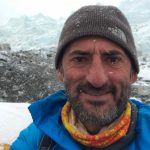
After a brief spell in the British Army, I moved to Hong Kong from London in 1997 to work on Chek Lap Kok Airport with a consulting engineering and architecture practice. I am currently the managing director of Engage Asia, a resilience and technology consultancy, and am a technical expert at international arbitrations. My hobbies include mountaineering and I summited Mount Everest in 2018. I am currently training for a one-month self-supported expedition to Alaska in May and may be seen dragging a tyre to the Peak.


Robert Wrixon

Like many Irish people, I have spent years abroad. After eight years in US universities, I lived in Japan, Malaysia, Australia, England and Mongolia before settling down for the past nine years and getting married in Hong Kong. As managing director of Starboard Global, I invest venture capital in critical mineral exploration and normally travel to project sites around the world. I make time for Ireland/Munster rugby, Arsenal football, and the wife and two kids (not necessarily in that order). Looking forward to meeting and boring the pants off many FCC members in future.

Recipe: How to Cook Singapore Noodles

Born and bred in Hong Kong, Executive Chef Johnny Ma knows a thing or two about Cantonese cuisine. Ma shares his recipe for Singapore noodles, so you can recreate this popular FCC dish at home.

A staple at Cantonese restaurants around Hong Kong, Singapore noodles don’t actually come from Singapore. Despite the name, these noodles were invented right here in the city after the British introduced curry powder.

The combination of rice noodles and curry powder felt like a nod to the Indian-Chinese fusion dishes in Singapore, so they named it after the city-state. Today, Singapore noodles can be found in Cantonese communities across Australia, Canada, the US and India.

Typically made with springy vermicelli noodles, Chinese char siu, scrambled eggs, prawns, bell peppers, soy sauce and a dash of curry powder, these humble noodles hit the spot when we’re craving a quick yet satisfying meal after a long day.


Chef Ma’s Singapore Noodles Recipe:

Ingredients:

30gm shelled prawns (submerge in ice water with 2 tbsp sugar for 30 min)

1 tsp canola oil

2½ tsp Asian fish sauce

150g dried rice stick noodles

2pcs cloves garlic, minced

1 tsp soy sauce

1 tsp Shaoxing wine

¼ tsp ground white pepper

¼ tsp sugar

2½ tbsp vegetable oil

2 eggs, beaten with two pinches salt

30g char siu (Chinese roast pork)

¼ medium onion, thinly sliced

½ medium red bell pepper, julienned

10g carrot, julienned

1 tbsp curry powder

30g ham, thinly sliced

30g squid

10g scallions, thinly sliced 

2 tsp sesame oil

salt to taste

Instructions:

  1. Drain and pat shrimp dry with paper towels and place in a bowl. Add 1 tsp canola oil and 1/2 tsp fish sauce. Mix well and set aside in the refrigerator.
  2. Place rice noodles in a large bowl and cover with boiling water. Let stand for 5 minutes.
  3. Drain noodles in a colander, rinse with cold running water, then drain until dry. Using scissors, cut the bundle of noodles in half.
  4. Place garlic in a small bowl and add soy sauce, Shaoxing wine, white pepper, sugar, and 2 tsp fish sauce. Mix well and set sauce aside.
  5. Heat 1 tsp vegetable oil in a wok or nonstick skillet over high heat, tilting to swirl oil, until smoking.
  6. Add eggs, cook undisturbed for about 10 seconds, and then gently move the eggs with a spatula until they start to firm. Break the eggs into small pieces, then set aside in a large bowl.
  7. Add shrimp and stir-fry for 30 seconds. Add roast pork and onion. Stir-fry for another 30 seconds.
  8. Add red bell pepper and stir for 30 seconds, then add carrots. Add 1 tsp curry powder, season with salt. Cook, tossing, until evenly distributed. Scrape wok contents into bowl with eggs.
  9. Wipe wok clean. Heat 2 tbsp vegetable oil on high until smoking. Add noodles. Stir-fry for 30 seconds.
  10. Add sauce and remaining curry powder. Stir until evenly distributed. Add eggs, shrimp, roast pork, squid, ham, and vegetables. Stir-fry for 30 seconds.
  11. Season with salt and remove from heat.
  12. Add scallions, drizzle with sesame oil, mix well, and transfer to a large serving bowl.
  13. Enjoy!

Meet Alex Lee Shu Yeung, FCC Financial Controller

Alex Lee, 53, has been a friendly face in the finance department over the past three decades.

Tell us a little about yourself. How did you find your way to the FCC?

Alex Lee: I was born here in Hong Kong, then later studied in the UK. In 1986, I became a cost controller – planning and controlling the budget – at the Hong Kong Hilton. That’s where I met a financial controller from the FCC, who invited me to join her team. That was 1992, almost 29 years ago.


What does your current role entail?

AL: Our department covers audits, purchasing, cost control and members’ accounts. I am very interested in the fluctuations in our numbers because it shows our progress and challenges.

To control prices, you need to consider the cost of the ingredients, how the chef designs the menu, and how they use the ingredients. If the price is too high, members won’t order it.


Which events have been the most significant during your years at the FCC?

AL: Apart from the Handover and the New Millennium party, one that really sticks in my mind is the Po Leung Kuk Charity Ball in 2002. We hosted 1,000 guests and had to make all the arrangements, including selling raffle tickets, auction items, and working with many different agencies. It was a brilliant success, and I learned a lot.


How has the pandemic affected your work?

AL: The biggest impact has been the group restrictions – no evening dining or events, like the New Year’s Eve party. We anticipated some of the holiday events might be restricted and, luckily, saved on costs.

Overall, COVID-19 restrictions are tough to plan around but we admire the leadership from General Manager Didier Saugy, who has kept a tight rein on costs and identified opportunities to generate new revenue. This has kept us on track – as well as newly inspired – during the crisis.


Anything else you’d care to add?

AL: I’d like to thank the Board, especially Treasurer Tim Huxley, who has given me so much support. And I’d like to thank all nine of my staff, a couple of whom have been with us for more than 20 years. The back office is a wonderful place to work.


Put your calculator down for a second. Where do you go to relax?

AL: While the beaches are closed, I have been cycling with my wife and children in the New Territories. My son is 10 and showing signs of becoming a mathematician; my daughter, who prefers painting, is two years younger.

I’m thrilled because she’s learned to ride her bike without stabilisers, so we can go further and faster now. My favourite cycling trail is Sha Tin to Ma On Shan because of the water, fresh air and nature.


Did you know?

The FCC has a spacious back office on Arbuthnot Road, where the club’s finance, HR and IT teams work. The office used to be in the basement but was relocated in 1998 to make more room for member facilities.


50 Years On: The Table Tennis Match That Changed the World

Ping-Pong Diplomacy signalled the first step towards normalising US-China relations back in 1971. A youthful Jonathan Sharp was on hand to watch events unfold.

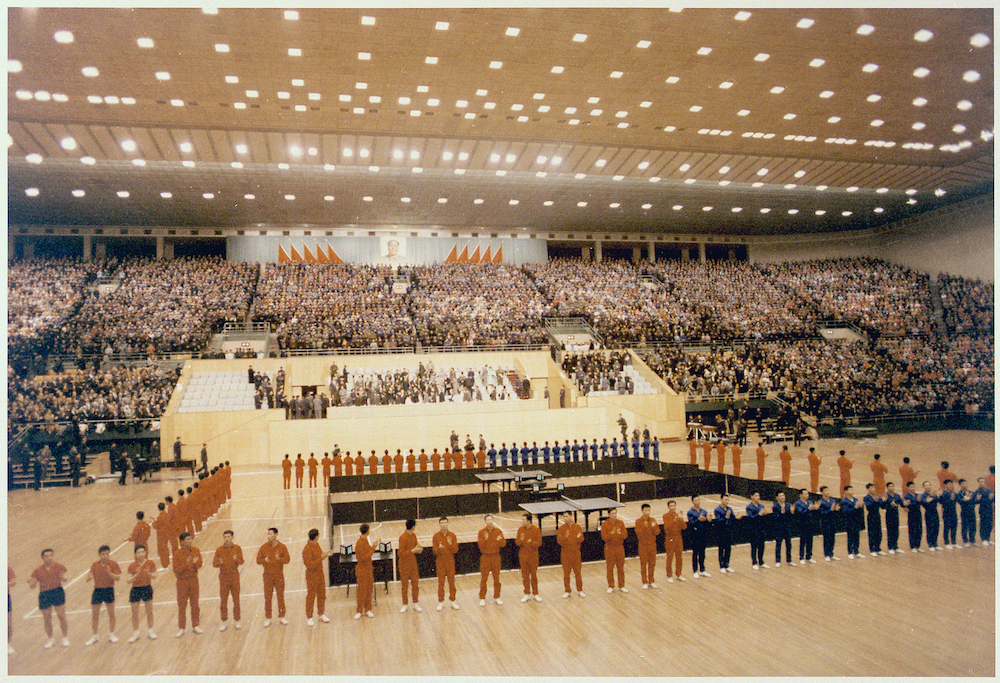
A ping-pong exhibition match in Beijing in 1972, which Nixon attended. A ping-pong exhibition match in Beijing in 1972, which Nixon attended. (Photo: US National Archives and Records Administration)

As an increasingly anxious world watches the growing rivalry between the United States and an ascendant China, this April marks the 50th anniversary of an event in Beijing (then Peking) that changed the world.

Dubbed ‘Ping-Pong Diplomacy’, a surprise Chinese invitation to a US table tennis team to visit the People’s Republic of China paved the way to mending long-severed ties between the world’s most powerful nation and its most populous.

This Chinese initiative, a classic example of Beijing using sport to further its political and strategic goals, was hailed as one of the key developments of the late 20th century. One could also argue that Ping-Pong Diplomacy sowed a seed for the tensions that strain China-US relations today.

It was my good luck to cover the match for Reuters. The global landscape then was far removed from today, with China slowly emerging from the grimmest days of the Cultural Revolution, one of the deadly political storms unleashed by Mao Zedong. The economy was blighted, and the horrors of famine were recent. Today’s glittering modernity was a distant dream.

China also faced an increasingly hostile Soviet Union, formerly an ally, with clashes erupting along their mutual border. Beijing needed better relations with the US as a counterweight to the Soviets.

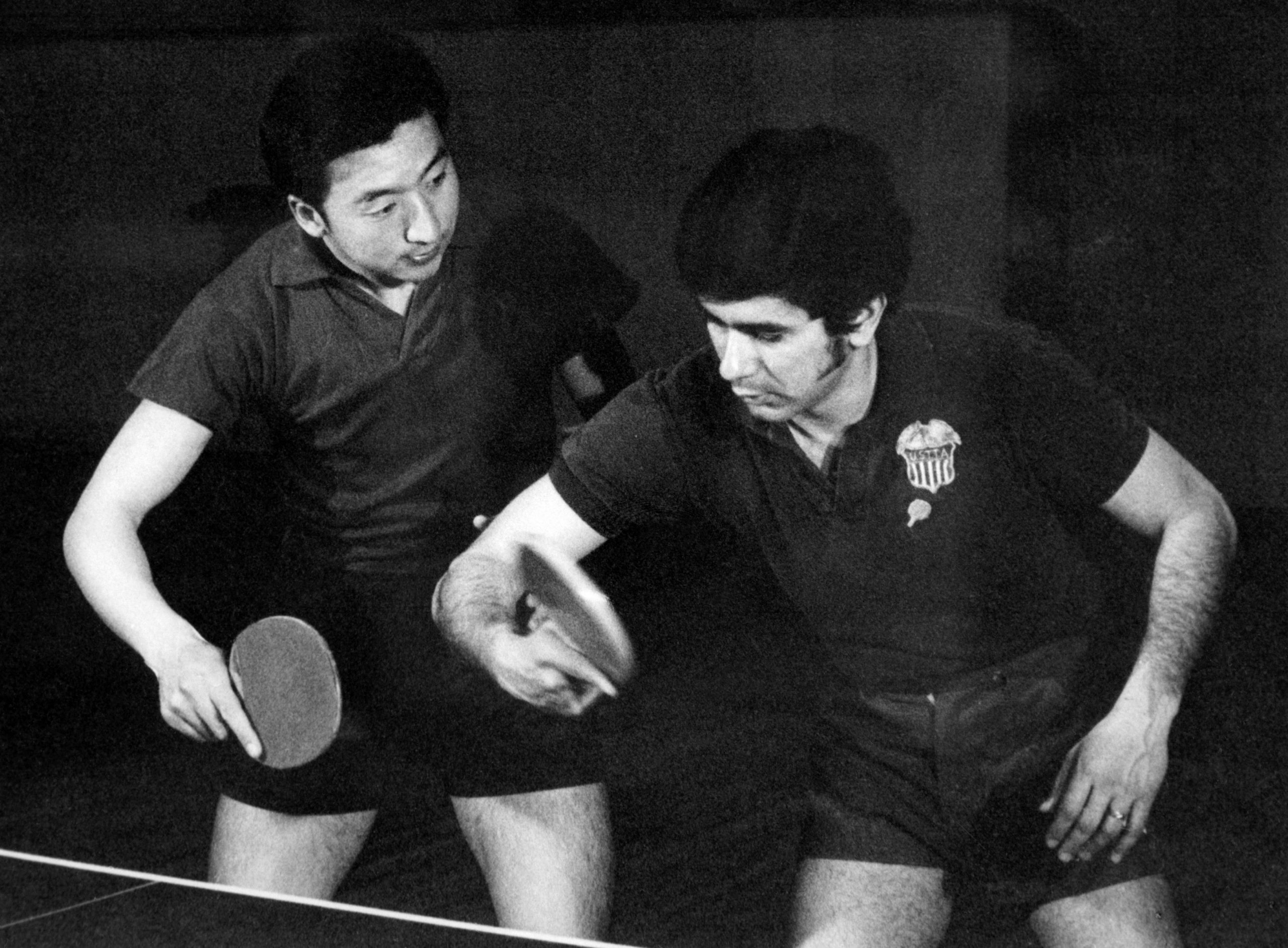
An American table tennis player (right) trains with a Chinese player in April 1971 in Beijing An American table tennis player (right) trains with a Chinese player in April 1971 in Beijing. (Photo: AFP)

For its part, the US was still mired in the Vietnam conflict. President Richard Nixon had pledged to bring his country out of Vietnam with honour. Improving relations with China, which strongly supported North Vietnam, might help to achieve that goal. And Nixon, too, sought to use Beijing to counterbalance Moscow – or to “play the China card”, as was said at the time.

Both China and the US had motives to thaw their relations, which had been in near deep freeze since the Communists took power. As a symbol of that enmity, American passports were marked “not valid for travel into or through mainland China”.  

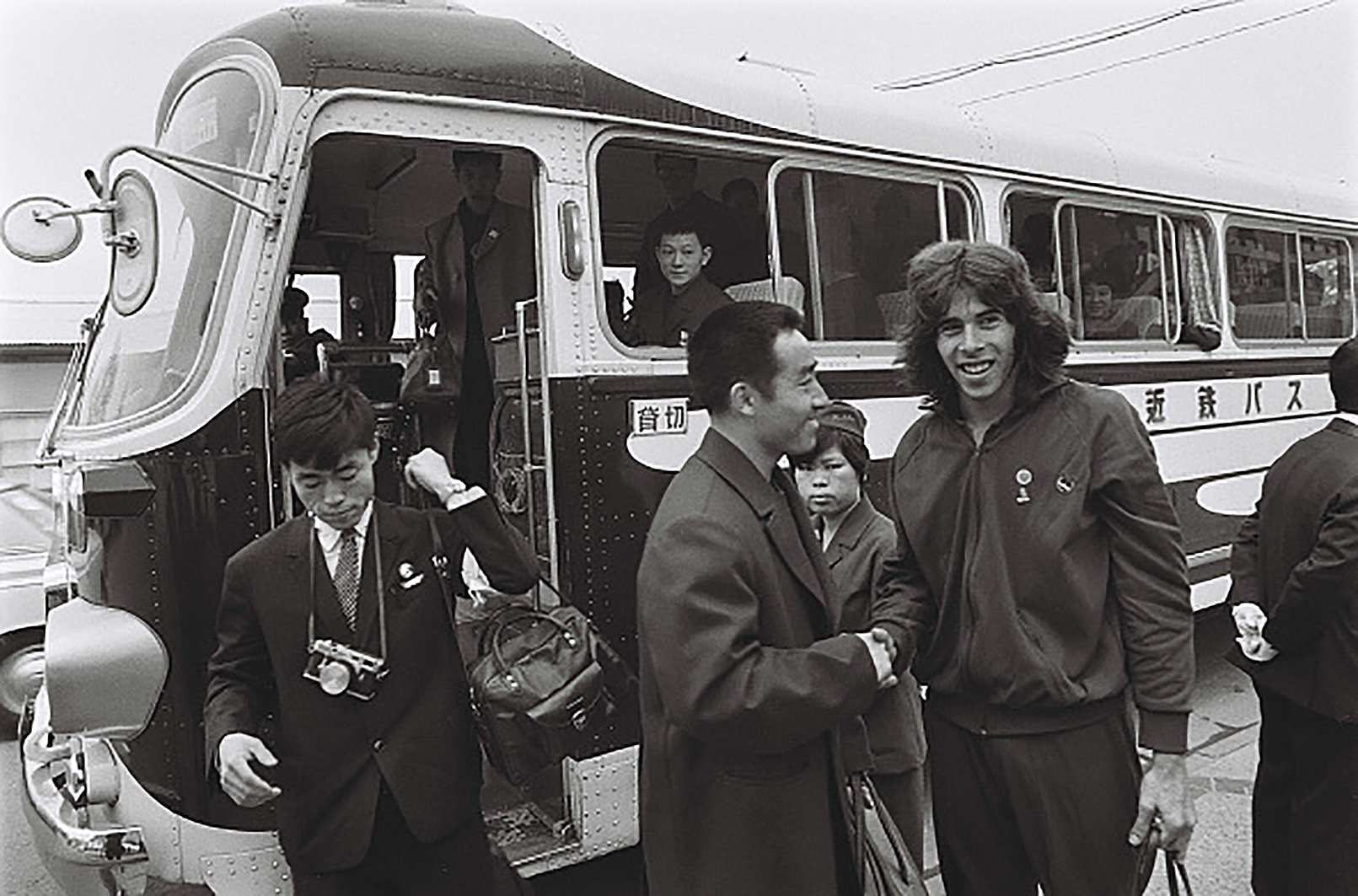
The curtain rose on the diplomatic breakthrough in Nagoya, Japan, host to the 31st World Table Tennis Championship in March 1971. Following an encounter between the flamboyant American player, Glenn Cowan, and China’s star Zhuang Zedong, Mao approved an invitation for the Americans to visit China.

The US accepted. Diplomats in Japan blacked out the not-valid-for-China line in the Americans’ passports. But how to get to Beijing? Such was China’s isolation, there were no flights from Japan, or indeed from virtually anywhere.

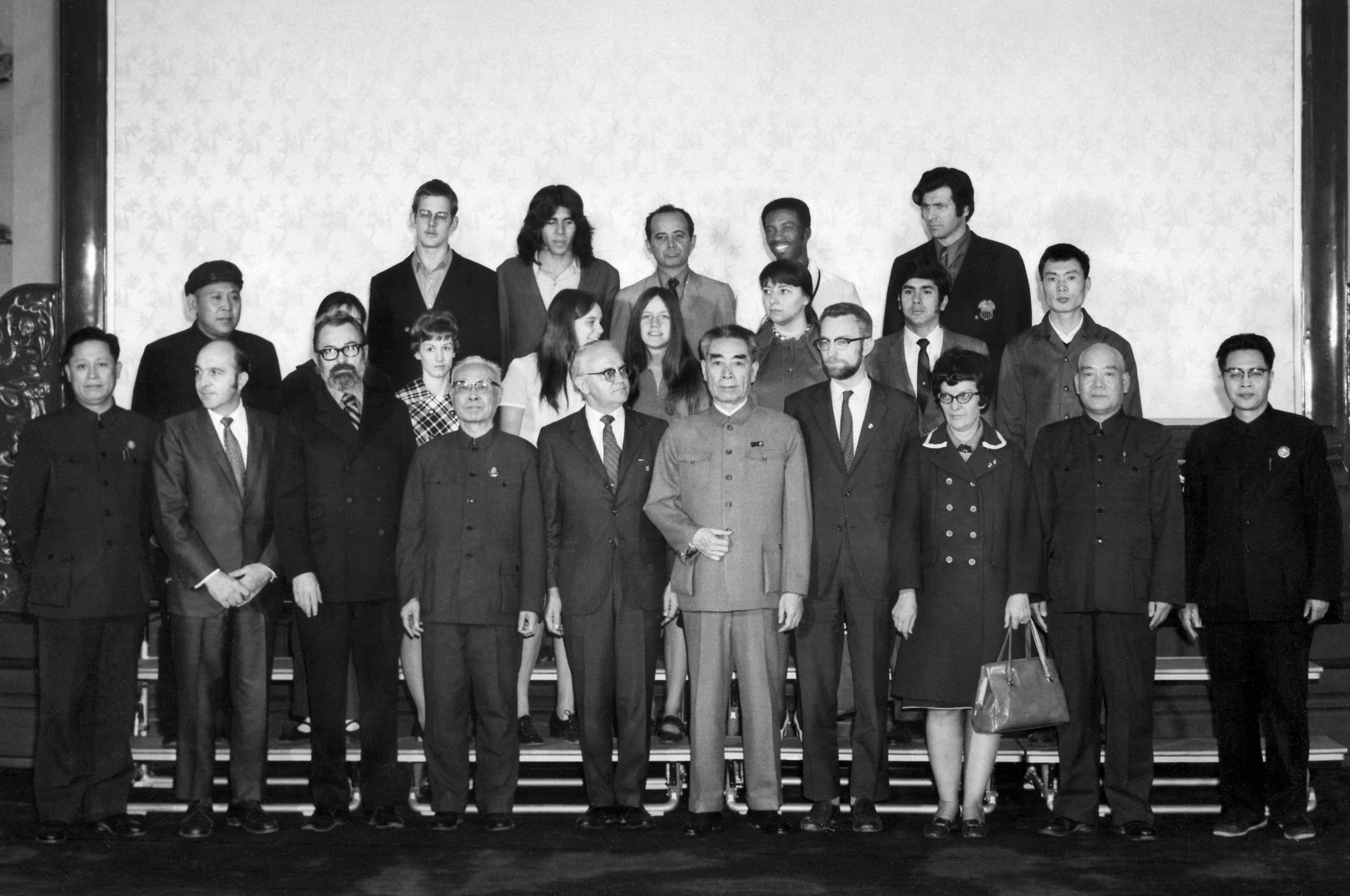
The American delegation of players poses with Chinese communist leaders in April 1971. The American delegation of players poses with Chinese communist leaders in April 1971. (Photo: AFP)

The Americans flew to one of the few entry points, Hong Kong, and walked across a diminutive railway bridge at Lo Wu which marked the border. From there, they took the train to Guangzhou and flew to Beijing.

Ping-Pong Diplomacy was also a turning point for Reuters, and for me personally. At that time the news agency had no reporters in the Chinese capital. Its last China correspondent, Anthony Grey, had endured 27 months of vindictive and humiliating house arrest between 1967 and 1969.

His ‘crime’? British authorities in Hong Kong had arrested pro-China media workers during the 1967 unrest, and Grey’s confinement served as retaliation. His books about the ordeal, Hostage in Peking and The Hostage Handbook, remain riveting reading.

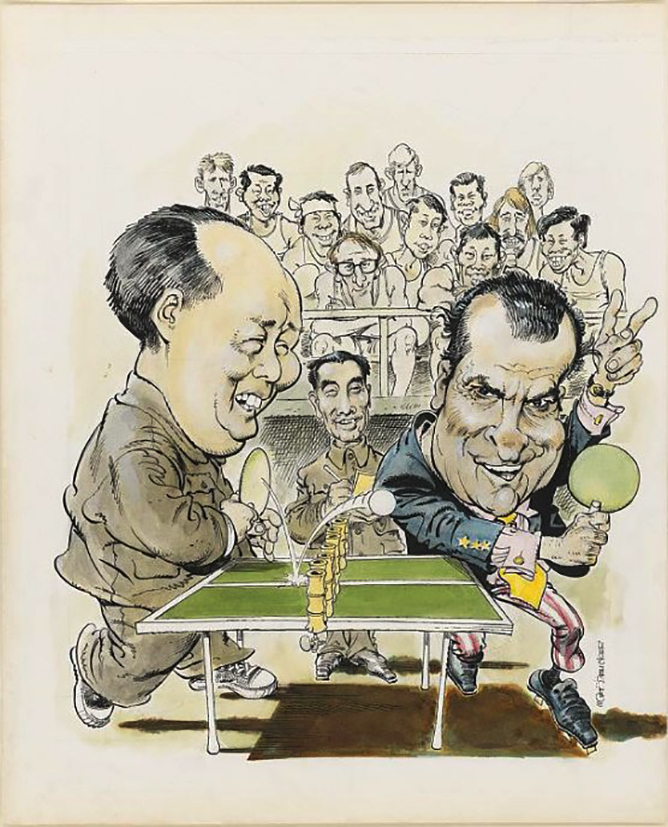
Famous American caricaturist Mort Drucker depicts Mao Zedong and Richard Nixon playing ping pong. Famous American caricaturist Mort Drucker depicts Mao Zedong and Richard Nixon playing ping pong. (Photo: © Mort Drucker)

Reuters was offered a reporter’s visa to cover the table tennis drama, and, as I came off an overnight shift at the 24-7 China-watching Hong Kong bureau, I was told to collect the precious document from the China Travel Service office in Kowloon. The next morning, carrying my typewriter and £300 (which would be roughly HK$20,600 today) from the Hong Kong bureau chief, I crossed the Lo Wu bridge for my first, long-sought glimpse of Mao’s China.

I was not in the least apprehensive about being the first Reuters staffer in China following Grey. I was just excited. The situation in 1971 had changed since 1967 when the Cultural Revolution mayhem was at its height.

So it was that in the afternoon of 14 April, in Beijing’s Great Hall of the People, Premier Zhou Enlai told the Americans that they had “opened a new page in the relations of the Chinese and American people”.

Zhou also took a question about the hippie movement from shaggy-haired Cowan. Wearing a floppy yellow hat, a T-shirt emblazoned with “Let It Be” and purple, bell-bottomed trousers, Cowan cut an incongruous figure amid the almost universal drabness of 1971 China.

The Premier said he didn’t know a lot about it, but “youth wants to seek the truth and out of this search, various forms of change are bound to come forth… when we were young, it was the same too.”

To my alarm, Zhou also remarked on the presence of a Reuters correspondent, and that he had read my reports about China. I asked Zhou what he thought of them. He said some reflected the reality, and some didn’t. ‘I’ll take that,’ I thought.

The actual ping-pong matches seemed fairly routine. The Chinese players far outclassed the nine Americans, who were handed a few games for the sake of face. But ultimately this wasn’t really a sports event.

Glenn Cowan (right) shakes hands with China’s Zhuang Zedong after catching a ride with the Chinese ping-pong team in Nagoya, Japan on 4 April 1971. Glenn Cowan (right) shakes hands with China’s Zhuang Zedong after catching a ride with the Chinese ping-pong team in Nagoya, Japan on 4 April 1971. (Photo: The Asahi Shimbun)

Filing copy in those days of primitive communications – even telephone calls from China to the outside world were an on-off possibility – was a numbingly slow process. It involved handing in my typed stories at a post office where the words were counted and paid for on a per-word basis. Hours would elapse before my prose – doubtless well-examined by censors – reached Reuters in Hong Kong.

Speaking of surveillance, I made a point of giving my minders the slip to see the house where Grey had been incarcerated.

I repeated this token gesture of remembrance regularly when I was based in Beijing with Reuters in the 1970s and ‘80s. What Grey endured must not be forgotten.

After Ping-Pong Diplomacy, events moved rapidly. US National Security Advisor Henry Kissinger paid a secret visit to Beijing in July in 1971 and Nixon made his historic visit to China in February the following year.

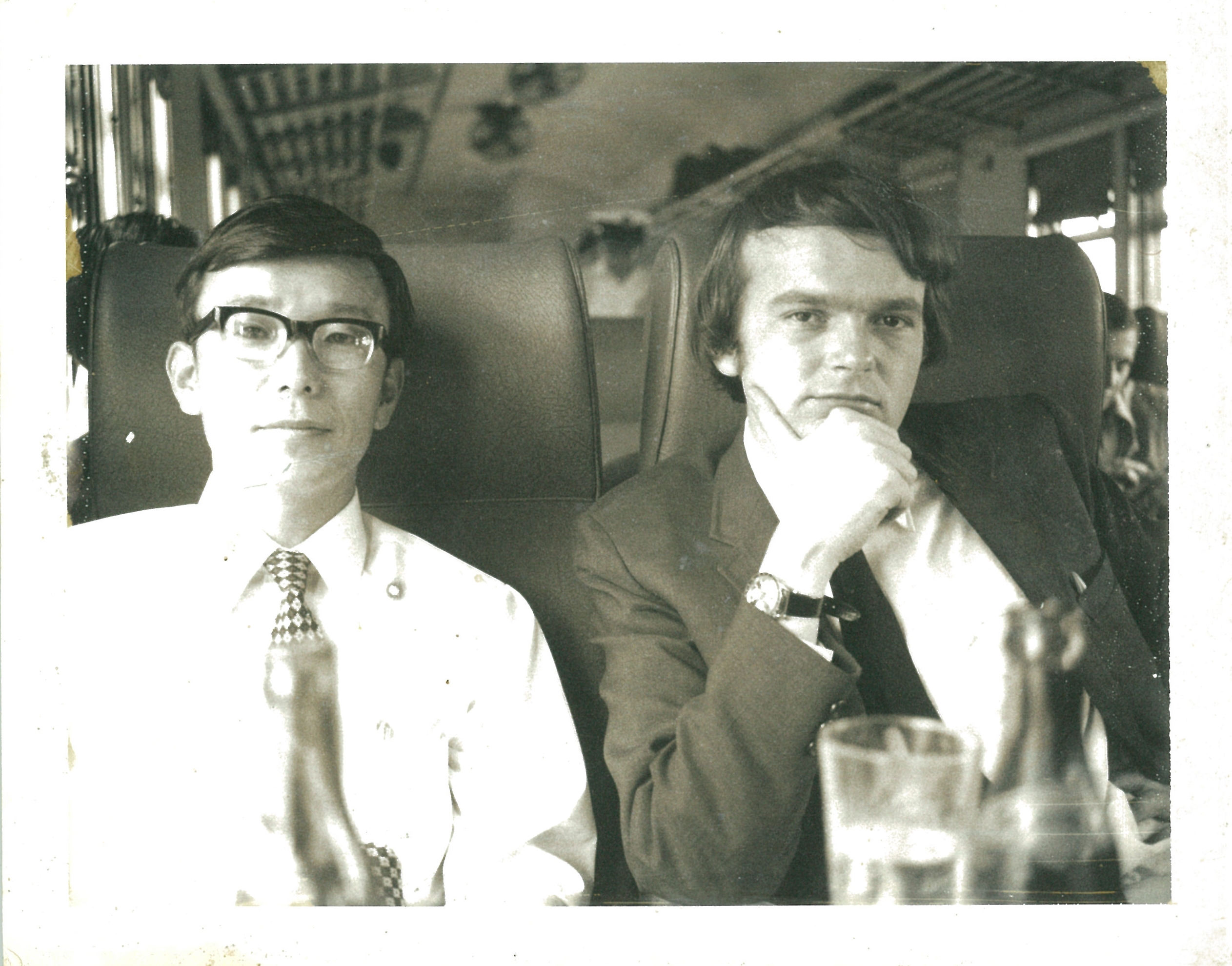
Jonathan Sharp covering Sino-US Ping-Pong Diplomacy in 1971. Jonathan Sharp (right) covering Sino-US Ping-Pong Diplomacy in 1971.

Full diplomatic relations between China and the US followed in 1979, just as China was opening to the world and gearing up to become the economic – and geopolitically assertive – powerhouse that it is today.

Few could have imagined 50 years ago during Ping-Pong Diplomacy that China is now better known for its aggressive “wolf warrior” diplomacy.


A Dispatch from 1970s China

“Breathlessly describing everything I saw during my visit – as first-time reporters to China tended to do – I mentioned in an article, written in Shanghai while on my way home from the capital, that I had seen two Chinese airforce jets take off at the airport.

Being an aviation buff, I recognised them as a Chinese-manufactured version of the Russian MiG-19. About an hour after filing, and clearly, before the story had been transmitted, an official approached me and said, deadpan, that there was one sentence in my report that was “not in the best interests of Sino-British relations”, terming Reuters as a British government organ.

He indicated the few words about the jets. Hastily, I deleted the offending reference and heard nothing more. International relations remained undisturbed.”

– Jonathan Sharp


Jonathan SharpIn 30 years at Reuters, apart from Ping-Pong Diplomacy and three years based in Beijing, Jonathan Sharp covered wars in Vietnam, Lebanon and Angola, the release of US hostages in Iran (1981), Steve Jobs’ launch of Macintosh (1984) and the release of Nelson Mandela (1990).

What Really Happened to Flight MH370?

Former FCC President Florence de Changy’s trenchant investigations point to a secret cargo, an abortive hijack and an insidious cover-up. By Kate Whitehead

Malaysian Airlines

Flight MH370 took off from Kuala Lumpur for Beijing on 8 March 2014 with 239 people on board. Halfway across the Gulf of Thailand, the Boeing 777-200ER vanished from air traffic controllers’ screens without a trace.

The plane’s mysterious disappearance captivated the world. And when French daily Le Monde despatched its Hong Kong-based correspondent, Florence de Changy, to Kuala Lumpur to report on the tragedy, the veteran journalist had no idea it would lead to an ongoing, seven-year investigation and two books on the subject. The first, Le Vol MH370 n’a pas disparu [‘Flight MH370 Did Not Simply Disappear’], was published in 2016 by Les Arènes, and has since been translated into three languages with updates in each edition.

This February, HarperCollins published her second book: The Disappearing Act: The Impossible Case of MH370, which connects the dots from de Changy’s earlier investigations to reach a bold conclusion that discredits the official narrative as a sophisticated, costly and clumsy fabrication.

To recap: Within days of flight MH370’s disappearance, authorities claimed the plane had made a U-turn, flown back over Malaysia, and eventually crashed in the southern Indian Ocean. This was the official narrative when de Changy began reporting in Kuala Lumpur. But when she returned a year later to revisit the story, she discovered many details that simply did not add up.

De Changy speaks with Malaysian Member of Parliament and Admiral Mohamad Imran bin Abdul Hamid.

“One year on, and there was not a shred of tangible evidence that the plane had crashed in the Indian Ocean – not a single piece of debris,” says de Changy, who served as FCC President from 2017 to 2019.

Her follow-up story for Le Monde revealed gaping holes in the official narrative, which got people talking. In May 2015, the paper sent de Changy to the Maldives, where people claimed they had seen the doomed plane. Such tips turned out to be red herrings, but her articles caught the attention of French publisher Les Arènes, which led to a book deal.

“I started moving at a different speed, slower and more thoroughly,” says de Changy of writing Le Vol MH370 n’a pas disparu, which was published on the second anniversary of the plane’s disappearance.

When official pronouncements didn’t add up, de Changy sought out insights from sources across Asia.

Step by step, interview after interview, de Changy discovered a wealth of intelligence and incongruencies. Among her interviews, the investigative reporter spoke with MH370 pilot Zaharie Ahmad Shah’s friends and family members. They protested what they considered a smear campaign to ultimately blame him for the incident by questioning his mental health and fitness to fly. De Changy also gained access to confidential records, which convinced her the pilot had been okay to fly.

Her investigation concluded that MH370 made no U-turn; no one turned off the transponder and ACARS (Aircraft Communications Addressing and Reporting Systems), as claimed by then Prime Minister Najib Razak; the plane never crashed in the southern Indian Ocean; and the subsequent Australian search operation was either a deliberate or passive act of diversion.

During her investigations, she assembled new evidence that begins to tell a different story and raises new questions. “I identified a problematic [electronic] cargo on the plane that had not been X-rayed, which is a no-no in terms of aviation safety, that was delivered under armed escort to the airport,” says de Changy. The 2.5-tonne cargo was listed as “Motorola walkie-talkies and chargers”.

Flight MH370 Possible Flight Paths Click to enlarge. (Sources: BBC; Australian Transport Safety Bureau Flight Path Analysis; Florence de Changy)

She also learned two US AWACS (Airborne Warning And Control Systems) – mobile, long-range radar surveillance and control centres for air defence – had been operating in the area. At first, de Changy didn’t know what to make of this information. But after the Chinese edition of her first book came out in 2017, a military contact informed de Changy about AWACS’ jamming capabilities, which led her to a hypothetical conclusion.

“Plan A was likely a cargo ‘confiscation’ [hijack] operation to cloak the plane with two AWACS, force it to land, seize the problematic consignment and let it fly off again. The plane would have landed in Beijing with a slight delay, a non-event by Chinese aviation standards at the time,” says de Changy, who points out that the intercept was planned at the point where Vietnamese air traffic controllers would have assumed responsibility from their Malaysian counterparts.

She believes this scenario – based on a mix of sources, clues and confidential documents – failed because the experienced pilot refused to go along with Plan A. “Disaster happened when the plane was about to reach Chinese airspace at around 2:45 am off the northern coast of Vietnam,” she says. De Changy hypothesises that the plane was shot down accidentally or intentionally – most likely by a fighter jet, missile or a new laser-guided weapon system that the US had been testing in the region.

In The Disappearing Act, de Changy continues to untangle this complex web of information. It’s well worth reading to find out about the confidential documents and off-the-record conversations that led to her conclude the official narrative is a fabrication.

A recovered Boeing 777 wing flap identified to be part of the missing Malaysia Airlines flight MH370 on display during a memorial event in Kuala Lumpur on 3 March 2019.(Photo: Mohd Rasfan / AFP)

She admits there are still some gaps in the story but hopes that this book could motivate more people to come forward. De Changy has been trying to track down the two Cathay Pacific pilots who flew over the Vietnam coast the day after the incident and reported spotting a massive field of metallic debris to air traffic control. Although this report is in the official log, she hasn’t been able to identify the pilots. Perhaps this might be the time for them to speak up, says de Changy.

“With each [new book] deadline, you revisit documents, relaunch new leads, call people again – with every deadline, the story improves, and you push it further,” says de Changy.

Any book that dares to debunk the official narrative is bound to invite grilling, and de Changy has braced for criticism. However, she has already received many endorsements to date. Veteran investigative journalist Edward Jay Epstein says the book is a must-read for anyone wishing to understand one of the greatest mysteries of the 21st century.

A family member of a Chinese passenger from the missing Malaysia Airlines flight MH370
protests outside the Yonghegong Lama temple in Beijing. (Photo: Goh Chai Hin / AFP)

Clare Rewcastle-Brown, editor-in-chief of London-based Malaysian investigative news outlet Sarawak Report, adds that it “demystifies the world’s greatest aviation secret”, and the Financial Times’ Victor Mallet comments: “with ruthless forensic skill, Florence de Changy has dismantled and discredited the official versions of what happened to the ill-fated flight MH370”.

De Changy concludes: “As a senior journalist who has worked in this part of the world for some time, I could not let this nonsensical story go unexplained. I feel a duty to get to the bottom of it.”

Visit the FCC to purchase ‘The Disappearing Act: The Impossible Case of MH370’. Better yet, leave your book at the front desk and de Changy will swing by to sign it for you.


Screen Time

In 2018, de Changy’s French publisher sold the rights of Le Vol MH370 n’a Pas Disparu for an Anglo-French TV mini-series.

“It’s a five-figure deal [in euros], but don’t forget that in most of these deals, you share about half with the publisher, and your agent usually takes a cut as well,” says de Changy.

Looking ahead, de Changy may also have another TV project in the works in the US.

In 2019, when Harper-Collins announced the publication of her new book, Netflix expressed great interest. But the project remains under wraps for now.


Kate Whitehead is the author of two books about the Hong Kong underworld and has worked for the South China Morning Post and Discovery magazine. She contributes to local and international media outlets while also working as a psychotherapist.

We measure site performance with cookies to improve performance.