Former LegCo President Jasper Tsang says The Chinese Central Government should speak to Hong Kong Pan-democrats
Former Legislative Council President and veteran pro-Beijing politician Jasper Tsang said he believed many members of the rival pan-democratic camp “satisfy the requirements to be patriotic,” but he said many of them failed to draw a line between themselves and the radicals.
Tsang called for the pan-democrats to reorient themselves and find new roles. He was previously quoted saying one sign of the success of China’s “one country, two systems” governing policy over Hong Kong was whether Beijing resumes dialogue with the pan-democrats. However he told a luncheon crowd at the Foreign Correspondents’ Club Hong Kong on July 7, 2022 that “the timing is not right yet” to open a dialogue because the city was still recovering from the upheaval.
Asked about the 47 opposition candidates arrested for running in a primary election for the since-postponed Legislative Council elections, Tsang said, “Taking part in the primary election is not illegal. And if you check, not everybody who took part in the primary election has been prosecuted.”
The 47 targeted, Tsang said, “were arrested and may be prosecuted because of suspected offences defined in the new NSL, four very specific offences and very clearly targeted. Either you sort of call for Hong Kong independence to try to break Hong Kong away from China, or you want to subvert the so-called government institutions. And most of them were suspected of having committed this offence.”
“What they told the public was, look, we’re gonna win the majority of the seats in LegCo and after that, we will make the government accede to our political demands,” something which Beijing considered a grave threat, Tsang told the luncheon gathering.
Tsang said people involved in the 2019 extradition bill protests were not conscious of being manipulated by foreign powers, but that many politicians in United States had spoken in support of the protests and said Hong Kong people are fighting for democracy. He also said protest leaders were received by top U.S. officials in Washington and that American officials had bragged to him about fomenting similar “colour revolutions” in other Asian countries he did not name.
Asked to share information with the audience of any proof of involvement by foreign forces, Tsang replied, “I don’t know. It’s pure logic. Pan-democrats would be angry at them too, if they (the foreign powers) had done nothing.”
Tsang said he regretted many young people engaged in violent acts during the 2019 protests and were now in prison and with arrest records. He said it will be up to the Correctional Services Department to help integrate those young people back into society.
Tsang also encouraged the FCC to invite Chief Executive John Lee Ka-chiu to speak at the Club and to take questions.
To watch the whole talk, please visit the FCC’s YouTube channel on youtube.com/fcchkfcc.
##
Obituary: Robin Lynam – ‘He put the “Gentle” Into Gentleman’
By Andrew Dembina
“Van Morrison’s playing reminds us that he used to be quite a sharp acoustic guitarist… a welcome inclusion on an engaging, enthusiastic but inessential set.” So concluded an incisive review of a then new CD called The Skiffle Sessions, published in the May 2000 issue of HMV’s now defunct magazine The Voice, penned by the late long-time Hong Kong resident and part of the furniture at the FCC’s Main Bar for decades: Robin Piers Lynam.
While pulling no punches in his music writing – mostly on rock, jazz and blues – for a great many publications, Lynam reached his conclusions via a wide, long-accrued knowledge that was closely rivaled by his in-depth understanding of food and (alcoholic) drink, another of his preferred areas of focus as a contributing writer.
While he would often tell it like he saw it in media or social gatherings, Lynam was not one to put someone down for the sake of it – generally, that is. On occasion, I recall him reaching boiling point when a know-it-all at a media gathering veered into verbose overdrive – or, even worse, got a fact wrong.
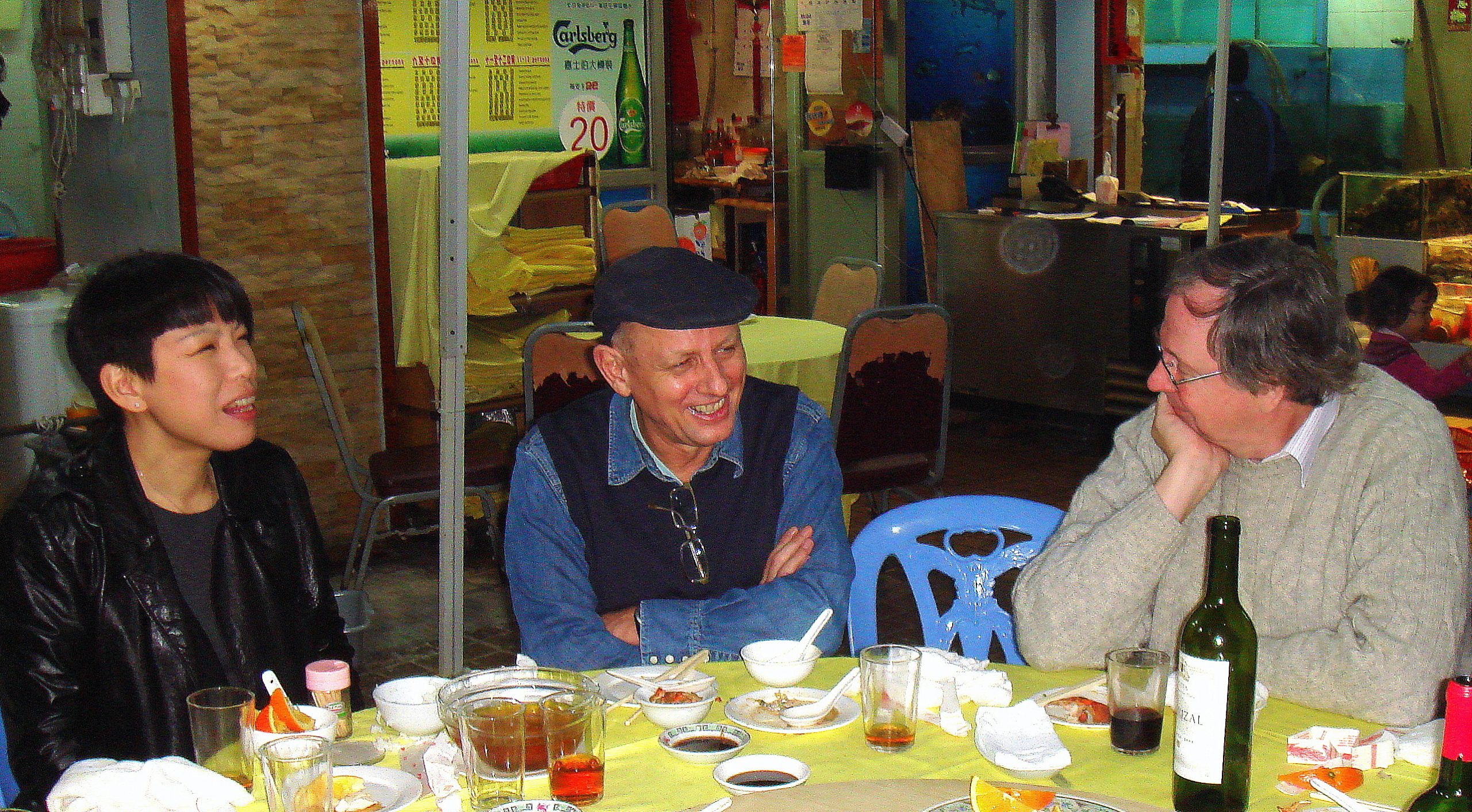
L to R: Angelica Cheung, Mark Graham & Robin. Photo by Steve Knipp.
Anyone who knew him well loved this acerbic side of the otherwise exceptionally courteous, intelligent and witty Lynam. He “put the ‘gentle’ into gentleman” was one of the most apt tributes to appear on the Facebook page of Karin Malmstrom, his long-term partner, following his premature passing in the early hours of 20 February. A struggle with prostate cancer which shifted to his colon, bouts of chemotherapy and finally, ensuing surgical procedures were to take an accumulated toll. Appreciative remarks about Lynam, in social media and elsewhere, also expressed shock that he was gone far too soon, having just turned 63.
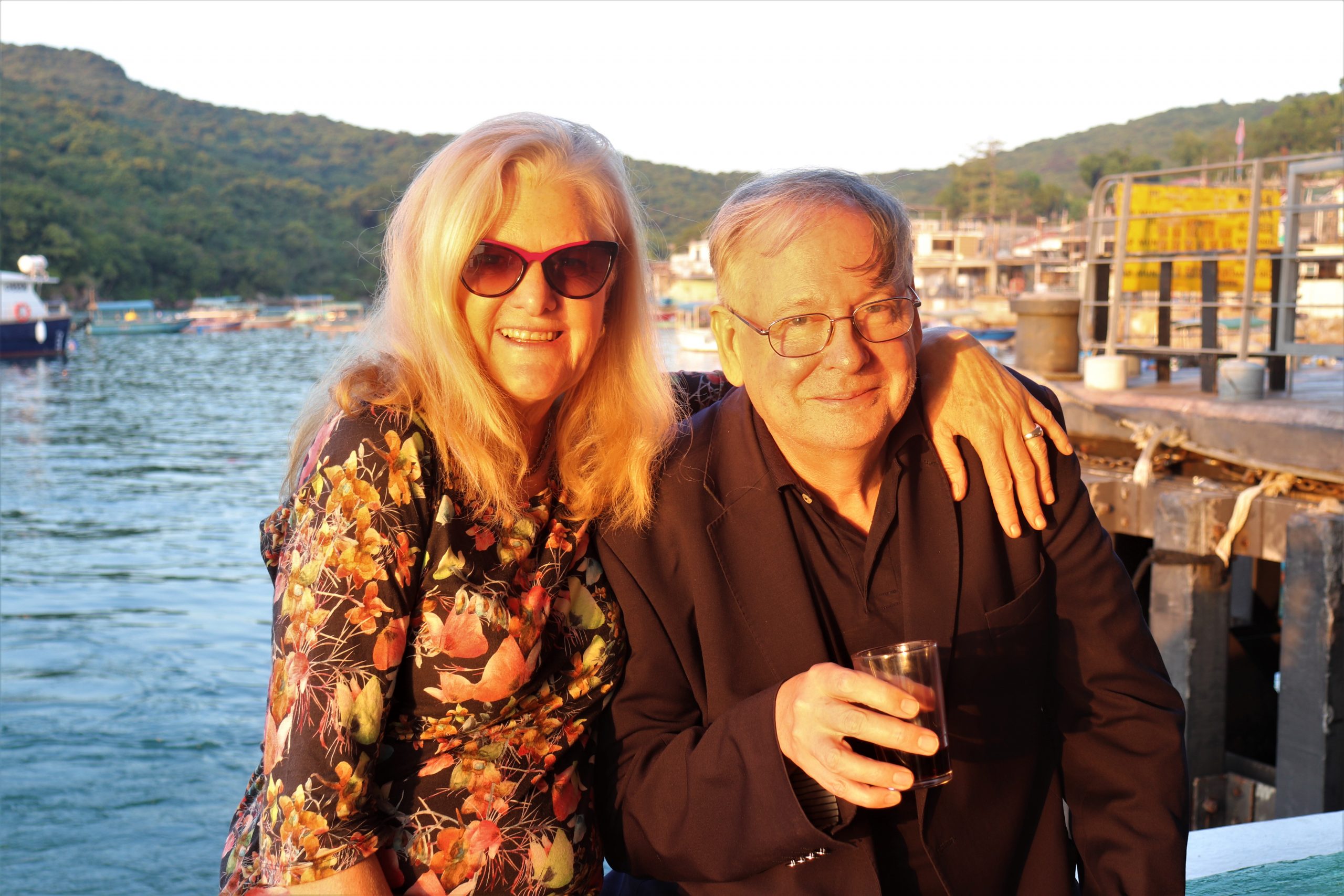
L to R: Karin and Robin. Photo by Chris Davis.
Despite illness hampering his activities for a while, Lynam had managed to catch up with his good friend and host of a longstanding Christmas get-together, Chris Davis, editor of Banking Today, in Hong Kong. “Lynam was a great pal for more than 30 years – it was not unusual to see each other two or three times each week,” he says. “He and Karin joined us for our journos’ and friends’ Christmas lunch for 20 years or more.
“Last year, he had to see us just before that lunch, as he couldn’t be exposed to many people [in his condition]. Previously, he was always the first to arrive and last to leave – his conversation was always as eloquent on his first glass as it was after his third bottle. With a pithy comment, he could say or write in one sentence what might take others 1,000 words.
“They both also played music at my wedding party in 2005. I miss him so much – he was one of my closest friends.”
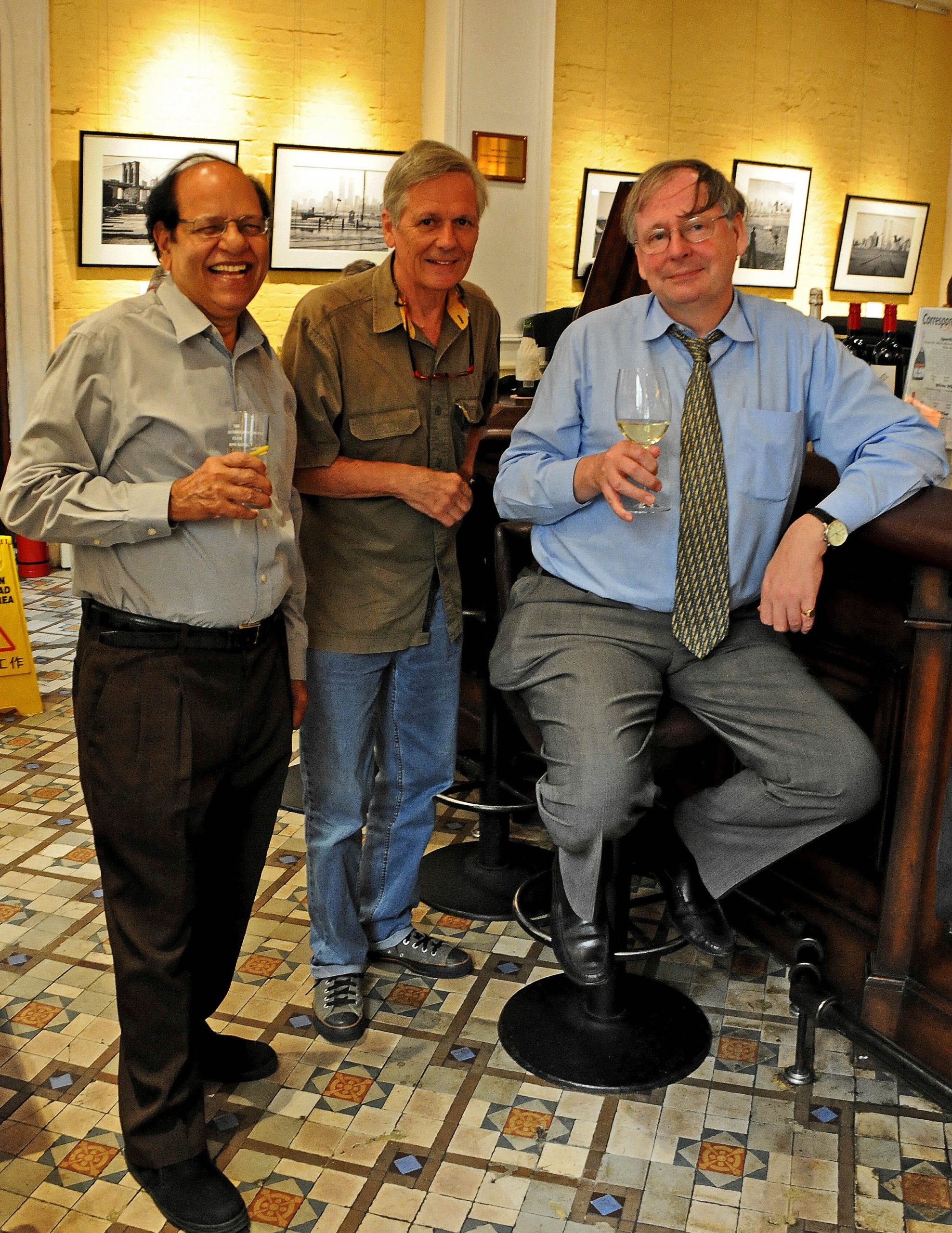
L to R: The late Gopi Gopalen with FCC pals Bob Davis & Robin Lynam. 2011. Photo Steven Knipp.
Davis travelled on a number of press trips over the years, which were made all the more colourful for Lynam’s presence. One of Davis’ fondest memories is when “as someone with absolutely no interest whatsoever in sport – he actually went to the Rugby World Cup in Australia [in 2003], which I was also attending. He’d said ‘no thanks’ to the invitation from the PR company at first, but then they told him there would be some wine to try.” That changed Lynam’s mind and they had a great time – even at the rugby games.
Lynam was born in London in February 1959. Both his father and brother served in the British armed forces and he spent part of his early childhood in Tripoli, Libya, while his father was posted there. Family bonds were strong. “Robin was very close to his mum and dad,” says Malmstrom, “and he adored his [late] brother Jeremy [who was stationed in Hong Kong for some years].” Lynam attended Dulwich College Prep School and Cranbrook School, before moving to University College London to study English literature. He was also very fond of his cousin, the English actress Jenny Agutter, who he would occasionally see in London.
“My best memory of Robin is through knowing him as a child,” recalls Agutter, who was six years his senior. “Spending time with him over many years, I think always of his warmth and humour. When my husband and I visited Hong Kong, we had the benefit of his wealth of knowledge about food, and the joy of discovering great restaurants with him. I loved being in his company.”
Bernie Kingston, a young tutor at Cranbrook when Lynam was there, recalls: “He told me that he played guitar, and I told him I had always been fond of The Shadows and could play Apache note-perfect, so for fun we formed Bernie and The Jets, which may have been his first band.”
British TV presenter Sankha Guha, who studied at UCL at the same time, says: “Lynam was one of my closest friends over the years and across continents. From the moment we met, we plotted the hijacking of the university newspaper together.”
Upon arrival in 1982 in Hong Kong, Lynam’s first work was for Hong Kong Tatler and Hong Kong Business magazines. The editor of Tatler at that time, Steve Knipp, recalls his impression of the budding contributor: “a lovely guy, he was a true Edwardian-era English gent.
“As our arts and culture correspondent, he penned a stack of insightful, beautifully written film and book reviews, plus profiles of visiting jazz musicians.
“Lynam told me he had zero interest in ever taking a fixed staff post. I think installing him in a petite office cubicle would have been like trying to put a seagull in a birdcage – very noisy, quite messy and short-lived.
“Later, when I joined Travel & Leisure, I sent him on trips, including to then-exotic Shanghai on an old rust-bucket coastal liner. He loved it.”
While Knipp agrees with the consensus that Lynam was a kind and gentle fellow, he recalls some fearless tendencies: “On a press trip to Spain, he and I found ourselves in a dingy waterfront dive in Barcelona, well past midnight. The scruffy, unshaven barman looked like a super-sized Tony Soprano. Lynam smiled at him and said something in debauched Spanish; the scowling barman walked away, returning a minute later with two glasses and a bottle of sparkling white Cava wine.
“Lynam poured two glasses, sniffed his, then instantly held up his hand, waving to the brute behind the bar. I feverishly asked what the problem was. He glanced at me through the gloom and said, ‘Mr Knipp, as a colonial American, you may not be aware of this, but our wine has clearly not been properly chilled. The barman must bring us another bottle, promptly, and at the proper temperature.’
“Thankfully, I was able to convince him to let this late-night barbarism slide.”
Malmstrom, a strategic advisor to Cotton Council International who arrived in Hong Kong in 1980, met Lynam at the FCC. They became a romantic item in 1996, having both worked together planning events on club committees when she was Second Vice President. “At that time, one of his Mind Your Head bandmates retired and they invited me to join [playing an electric blue violin]. Being in his company sparked so much happiness.
“He was always so thoughtful,” she continues, describing their blossoming as a couple. “He made me feel very appreciated. He would surprise me with all sorts of information, insights about so many topics, especially arcane facts about 1960s and 1970s musicians and old movies.”
The couple enjoyed travel but with different preferences: “He was used to five-star hotels, I didn’t mind a backpacker hostel,” Malmstrom says. “We met in the middle and enjoyed years of globetrotting. He loved Paris and each time we visited he insisted on making a pilgrimage to Harry’s New York Bar [known for its live jazz, as much as its cocktails].”
Other journeys took them to North Korea, Cuba and the Blues Highway from Chicago to New Orleans – in time for its annual jazz festival. “We were fortunate to squeeze in possibly the best trip – just before Covid hit two years ago – when we lazily cruised aboard The Strand Hotel’s luxury riverboat on the Irrawaddy.
Lynam was formerly married to Gillian Smith “and they have remained good friends throughout the years,” says Malmstrom.
And how would Malmstrom most want Lynam remembered? “He was a kind, clever and caring soul whose wit and humour filled people’s lives with joy,” she replies, which seems spot-on – as long as some fool was not spouting nonsense within earshot for too long.
2021 in Review: Our Most Popular Guest Speakers on YouTube
Between in-person events at the club and virtual events on Zoom, we hosted dozens of guest speakers in 2021. In case you didn’t already know, we post videos of all guest speaker events on the FCC HK YouTube channel, which allows us to reach audiences far beyond Hong Kong and our membership.
Unsurprisingly, some of our events have gained a lot of traction on YouTube. These are the most popular ones that took place in 2021.
#1: Eric X. Li
Views: 143,985 and counting
#2: Marianna Spring
Views: 2,112 and counting
#3: Barkha Dutt and Rana Ayyub
Views: 2,065 and counting
#4: Regina Ip
Views: 1,641 and counting
#5: Fareed Zakaria
Views: 1,285 and counting
#6 (tie): Henry Litton
Views: 1,211 and counting
#6 (tie): Hans van de Ven
Views: 1,211 and counting
#8: Cheng Huan
Views: 1,176 and counting
#9: Fuchsia Dunlop
Views: 1,034 and counting
#10: Dr. Li Shan
Views: 910 and counting
2021 in Review: The Year in FCC Zoom Events
For the second year in a row, the FCC wasn’t able to host as many in-person events featuring guest speakers as we normally would due to the ongoing pandemic. Fortunately, we made up for it with our ongoing series of Zoom events featuring notable guests from around the globe, including diplomats, authors, judges, and journalists such as Bob Woodward, Fareed Zakaria and Evan Osnos.
In total, we hosted more than three dozen Zoom events this year, so scroll down to see the lineup and watch videos of those you may have missed.
February 9: ‘Social Media Bans’ Panel
Freedom of expression has its limits when it comes to spreading falsehoods and promoting real-world violence, a panel of experts including Maria Ressa, Craig Silverman and Alejandro Reyes said during this Zoom event.
February 22: ‘Myanmar on the Edge’ Panel
In a pre-dawn operation on February 1, Myanmar’s military moved to take control of the government, detaining civilian leader Aung San Suu Kyi and other elected officials in a coup. In the aftermath, the FCC hosted a discussion on Myanmar with Ai Fowle, Manny Maung and Wai Wai Nu.
February 23: Evan Osnos
A staff writer at The New Yorker, Osnos is the author of Joe Biden: The Life, the Run, and What Matters Now, which was released in October 2020. The FCC invited Osnos to participate in a virtual book talk to discuss the biography, which draws on lengthy interviews with Biden and conversations with more than a hundred others.
February 24: Bob Woodward
During Donald Trump’s tumultuous presidency, legendary investigative journalist and author Bob Woodward produced two best-selling books that pulled back the curtain on the often chaotic inner workings of the administration. The FCC invited Woodward to discuss his reporting process, the final days of the Trump presidency and much more.
February 26: Dr. Li Shan
In his first public remarks since the formation of the Bauhinia Party in March 2020, party chairman Li Shan said he wanted the new political party to bridge Hong Kong’s blue-yellow divide to solve the city’s pressing social problems.
March 4: Esther Chan
Governments and journalists both have a role to play in combating the spread of COVID-19 vaccine-related misinformation, First Draft APAC Bureau Editor Esther Chan said In a virtual workshop hosted by the FCC.
March 8: Carmela Fonbuena
“If we don’t fact-check information that’s spreading on the ground, that’s what people will believe if no one corrects it,” journalist Carmela Fonbuena said while discussing her latest book, Marawi Siege: Stories From the Front Lines.
March 9: Elizabeth Becker
Three pioneering women correspondents — Frances FitzGerald, Catherine Leroy and Kate Webb — changed the nature of modern war reporting and even the course of history with their coverage of the Vietnam War, Elizabeth Becker said in this FCC book event.
March 16: Fuchsia Dunlop
English food writer and cookbook author Fuchsia Dunlop, an expert in Sichuan cuisine, recognised the importance of calling out cultural appropriation but also highlighted the benefits of intercultural exchange during a Zoom webinar hosted by the FCC. “I don’t think the solution is that you should be confined to the food from your own heritage,” Dunlop said.
March 18: Bay Fang
Publicly-funded news organisations require firm protections from political influence in order to maintain editorial independence and avoid becoming propaganda units, said Bay Fang, president of Radio Free Asia, in a Zoom webinar hosted by the FCC.
March 23: Te-Ping Chen
Journalism and fiction are, by definition, opposite forms of writing, but as writer Te-Ping Chen explained in a book talk hosted by the FCC, the two aren’t as different as you might think. “In some ways, [writing] fiction and journalism is a similar process in as much as you are taking the material at hand,” Chen said, “except with fiction, the material at hand you can just draw from, in so many ways, a deeper universe around you.”
March 24: ‘Asian Hate in America’ Panel
The mass shooting in Atlanta that took the lives of six women of Asian descent is another tragic event in the United States’ long history of anti-Asian violence and discrimination, three Asian American women writers and journalists — Eileen Cheng-yin Chow, Jiayang Fan and Michelle He Yee Lee – said in a panel hosted by the FCC.
March 26: Sarah Frier
Instagram is typically thought of as a lighthearted platform for posting food photos and looking at your friends’ vacations snaps, but as Bloomberg journalist Sarah Frier, author of No Filter: The Inside Story of Instagram, explained in an FCC Zoom talk, it’s also rife with misinformation and illegal activity.
March 29: ‘Belt and Road at a Crossroads’ Panel
Nearly eight years after it was first announced, the Belt and Road Initiative has a mixed record of successes and failures, but the panelists who participated in a discussion hosted by the FCC said that greater transparency from China and better decision-making from its partner countries were both necessary for the BRI to move forward in a positive direction.
April 7: Christopher Robert Hill
The United States needs to be proactive in finding ways to communicate and collaborate more closely with China rather than pursuing a policy of decoupling, said Ambassador Christopher Robert Hill, a former career diplomat, in a talk hosted by the FCC.
April 8: Marianna Spring
Description goes here.Misinformation and conspiracy theories may be considered problems that primarily affect social media and online discourse, but as BBC specialist disinformation reporter Marianna Spring explained in a Zoom talk hosted by the FCC, the negative consequences of viral falsehoods spill over into real life all too often.
April 13: Fareed Zakaria
The relationship between the United States and China is set to define the global order for decades to come, and both countries will emerge strongly from the COVID-19 pandemic in different ways, said journalist and author Fareed Zakaria in a Zoom webinar hosted by the FCC.
On World Press Freedom Day, an FCC Hong Kong panel of speakers representing press clubs across Southeast Asia painted a dire portrait of press freedom in the region as various governments have vilified, attacked and even arrested journalists throughout the COVID-19 pandemic.
May 11: Barkha Dutt and Rana Ayyub
Local and independent reporters have played an essential and often high-risk role in revealing the true scale of India’s COVID-19 catastrophe while many in the mainstream media have preferred to parrot the government’s narrative, journalists Barkha Dhutt and Rana Ayyub said in an FCC webinar.
May 14: Henry Litton
Hong Kong’s judiciary has lost its former efficacy and judges need to focus on remedies and practical issues rather than esoteric arguments, said Henry Litton, former judge of the Court of Final Appeal, in an FCC webinar.
May 18: Fongyee Walker
Offering a fascinating look at the inner workings of the Chinese winemaking industry, Master of Wine Fongyee Walker highlighted the many business challenges facing producers during a Zoom talk. “There are people making terrific wine, but who do you sell it to?” said Walker. “You’re trying to sell a premium product to a market that almost doesn’t exist — it’s a huge challenge.”
May 31: Bill Bartles and Michael Smith
In September 2020, deteriorating relations between Australia and China led to a five-day diplomatic standoff during which the two remaining foreign correspondents employed by Australian media, Bill Birtles and Michael Smith, were evacuated from the PRC. In a Zoom event, the two journalists shared their accounts of the days leading up to their escape.
June 2: Ivan Hung
In a Zoom presentation, Professor Ivan Hung of the University of Hong Kong offered an in-depth update on the status of the global pandemic, covering topics including vaccinations, viral variants and asymptomatic transmissions.
June 24: Brian Stelter
On the day that Apple Daily published its last edition following 26 years of operation, CNN’s Brian Stelter said in a webinar that journalistic solidarity is needed in challenging moments such as these. “Nothing unites journalists more than a threat against a newspaper or a publication or against journalism itself,” Stelter said. “Nothing unites this industry more than a moment like this.”
June 29: Eric X. Li
China’s income disparity and environmental degradation are the biggest challenges currently facing the ruling Chinese Communist Party at the 100th anniversary of its founding, said Shanghai-based venture capitalist and political scientist Eric X. Li, who vigorously defended the party’s style of government while expressing doubts about liberal democracies around the world.
July 7: Hans van de Ven
As the Chinese Communist Party celebrated the 100th anniversary of its founding, Professor Hans van de Ven acknowledged the party’s success in a Zoom talk, but he also said that its history over the past century was never written in stone.
July 22: Marty Baron
The proliferation of online disinformation sites purporting to be legitimate news has created an incredibly difficult and hostile environment for journalism, said Marty Baron, former executive editor of The Washington Post, in a discussion moderated by FCC President Keith Richburg.
July 26: Antonio T. Carpio
Tensions and territorial disputes in the South China Sea are unlikely to result in warfare because of the Philippines’ mutual defence treaty with the United States, said former Philippine Supreme Court Justice Antonio T. Carpio.
August 24: ‘COVID-19’s Lasting Impact on India’ Panel
Bloomberg correspondent and FCC Correspondent Governor Iain Marlow moderated an insightful discussion on India’s handling of the first and second waves of the COVID-19 pandemic with a panel of revered experts of global health, public policy and economics.
China’s active approach to governing social welfare goals in the age of big tech has become a widely known attribute of the CCP’s modus operandi in recent years. However, according to a panel of experts, this starkly contrasting approach to regulation in the West poses a myriad of uncertainties for some of its largest companies looking to raise capital in U.S. equity markets.
September 23: Peter Martin
China’s so-called ‘Wolf Warrior’ diplomacy is not a new phenomenon but it has taken on a new dimension over the course of the pandemic, said Bloomberg reporter Peter Martin in a Zoom talk. “Some of China’s strengths have been highlighted; its ability to use its supply chains to produce massive amounts of vaccine and personal protective equipment, and to ship those around the world, kind of plays to a strength of the Chinese system,” Martin said.
October 19: Joanna Chiu
The author of China Unbound: A New World Disorder, which details China’s rapid international rise and the ways Western nations have contributed to a state of global disorder, Chiu explained how her reporting revealed “paranoid rhetoric” and a tendency of United Front effort to focus on individuals and “no-names” who don’t pose a meaningful threat to the CCP.
October 21: ‘Startups and Substack’ Panel
COVID-19 has caused widespread tragedy and turmoil, but a panel of journalists and media experts said that there have been upsides for journalists and newsrooms in the midst of the pandemic.
Technology has changed the way journalism is produced and distributed, but Reuters executive editor Gina Chua argued in favor of greater changes for the news business in a Zoom event hosted by the FCC. “What we do today is essentially the same thing we did 50 years ago,” Chua said.
2021 in Review: Looking Back at Our Guest Speaker Events
As the COVID-19 pandemic entered its second year, life in Hong Kong continued to be far from normal, and the Foreign Correspondents’ Club was no exception to the rule. Much like 2020, our ability to plan in-person events this year was severely reduced by government restrictions that prevented us from hosting our popular club lunches. (We organized plenty of Zoom events, however.)
Fortunately the situation improved in the second half of the year, and in August we were able to resume inviting notable guest speakers to the club. Here’s a look back at the lineup of speakers we hosted in 2021.
August 12: Matthew Marsh
For our first in-person speaker event of the year, Fox Sports Asia analyst (and FCC member) Matthew Marsh gave a behind-the-scenes look at F1 in the age of COVID.
“As a journalist, being able to talk to other journalists, being able to talk to team people, being able to watch the way they behave is critical,” Marsh said, comparing the experience of firsthand, in-person reporting versus remote reporting.
The flip side of that is… when I interview drivers on Zoom or whatever it is we’re using, it’s better. Would you believe?” he said.
September 1: Dr. Trisha Leahy
Dr. Trisha Leahy, chief executive officer of the Hong Kong Sports Institute (HKSI), joined the FCC for an in-person discussion about the lead-up to Hong Kong’s Olympic success.
“These are the results of the system we’ve been building for the last eight to 12 years,” Leahy said.
September 2: Harry Harrison
For over 20 years, award-winning political cartoonist Harry Harrison has put pen to paper satirizing Hong Kong life and politics for the South China Morning Post. Having recently released a new book, Add Ink: Cartoon Chronicles of Life in Hong Kong, Harrison appeared at the Foreign Correspondents’ Club to discuss his career and the process of drawing cartoons.
“I’m continuing doing what I do assuming I’m treading the right side of whatever invisible red line there. As far as I know, that’s what’s happening and they know what my cartoons are about. Either that or I’m sitting on a powder keg”, Harrison said.
September 14: Michael Schulman
In his insightful historical survey Superpower Interrupted: The Chinese History of the World, journalist and author Michael Schuman examines how the Chinese view their past and their place in the world—and how that affects their present policies and ambitions.
In a lunch talk at the FCC, Schuman said that his own experience of learning history had inspired the book.
“We are, I think, all in part shaped by our history and, more importantly, how we learn our history and how we perceive our history, or in some cases, misperceive our history,” Schuman said.
September 21: Regina Ip
Offering an overview of the relationship between China and Hong Kong, longtime public servant and politician Regina Ip, a member of the Executive Council and the Legislative Council, said that tensions between the mainland and the SAR were natural and to be expected.
“The implementation of ‘One Country, Two Systems’ was never expected to be painless and trouble-free,” Ip said. “It is a bold and innovative concept, but the accommodation of a small but radically different system within a large, continental-size economy, is bound to be fraught with tensions and challenges.”
In a presentation at the Foreign Correspondents’ Club, O’Neill recounted how Chiang and Vakhreva met while they were working, most unexpectedly, at the same heavy machinery plant in Yekaterinburg. She was born in Orsha in 1916 and fled war to the more favorably located Yekaterinburg. Chiang, meanwhile, had asked his father, Chiang Kai-shek, if he could study at Sun Yat-sen University in Moscow, where he excelled at learning Russian and drinking and dancing, among other things.
October 11: David Yeung
The role raising livestock for meat consumption plays in increasing greenhouse gas emissions is well known, but as Green Monday CEO David Yeung explained, eating seafood should be considered equally bad.
“There is a gigantic piece of the puzzle that is missing, that is not talked about and public awareness is extremely low, and it’s about the ocean,” Yeung said. He shared data showing that fishing has increased by 900% over the last 70 years, a trajectory that he called “utterly unsustainable.”
October 12: Cheng Huan
In a lunch talk during which he shared his thoughts and reflections on the 2020 National Security Law passed by the central government, senior barrister Cheng Huan said that Hong Kong has a legal obligation to enact its own national security law under Article 23 of the Basic Law as soon as possible.
“My biggest disappointment is that, for 17 years after 2003, one administration after another, and especially the members of LegCo, consistently failed to carry out their constitutional duty according to the Basic Law by not enacting Article 23,” Cheng said. “Because they failed to do so, Hong Kong now has a National Security Law imposed from above. This should never have been necessary.”
November 1: Biodiversity & Climate Change Panel
While COP26 took place in Glasgow, Laurence McCook of WWF Hong Kong, KPMG China partner Irene Chu and conservationist Dr. Billy Hau spoke at the FCC on November 1. During this lunchtime panel, the environmental experts spelled out Hong Kong’s ecological toll and outlined its role in creating a more sustainable world.
The WWF ranks the city’s ecological footprint (measuring human demand on land and water) as the third worst in Asia-Pacific and 14th worst globally.
November 3: Afghanistan Panel
Nearly 20 years after the defeat of the Taliban in November 2001, a panel of journalists told an audience at the FCC that no one could have predicted the ease with which the Taliban regained control of Kabul this past August.
CNN’s Anna Coren, who was on the ground in Afghanistan earlier this year, said that she and her colleagues sensed trouble because of the way in which the Taliban seized control of the provinces, but even they were surprised by what happened in Kabul.
“I don’t think in our wildest dreams we thought that the Taliban would just roll in on the 15th of August without a shot being fired, which is basically what happened,” Coren said.
November 9: Herald van der Linde
Anyone looking to invest or have a better understanding of how Asia’s stock markets function shouldn’t be paying attention to the performance of the Dow Jones Index, said renowned market analyst Herald van der Linde during a lunch talk at the FCC.
“You should look at what the bond market does first,” van der Linde said. “What happens there and how do we translate that back into the stock market?”
November 17: Capt. Alan Loynd
In a lunch talk at the FCC, Loynd discussed the highlights of his exciting and at times dramatic career, which included stints on cargo ships, passenger ships and avoiding attack in the Persian Gulf during the Iran–Iraq War, all of which is recounted in his recently published memoir All at Sea.
“I can’t remember a time when I didn’t want to go to sea,” Loynd said.
Reuters Executive Editor Gina Chua on How News Organizations Need to Innovate
Technology has changed the way journalism is produced and distributed, but Reuters executive editor Gina Chua argued in favor of greater changes for the news business in a Zoom event hosted by the Foreign Correspondents’ Club, Hong Kong.
“What we do today is essentially the same thing we did 50 years ago,” said Chua.
She said that technology should be used in smarter ways to create journalism that is more personalized and better serves readers.
“Technology is a solvable problem. What we really need, aside from capital, is imagination and culture. I think those are some of the big deficits,” said Chua, who added that young journalists will be key players in experimenting and driving innovation in the industry.
In a wide-ranging conversation moderated by FCC member and Wall Street Journal reporter Natasha Khan, Chua also spoke about the importance of language in journalism, why publications need to better understand their audiences, and how journalists should be engaging with statistics and social science methodology when working on stories “to prove that it matters.”
Chua, who transitioned in late 2020, is one of the most senior openly transgender journalists in the industry, and she also spoke about the importance of diversity in newsrooms.
“No single view is correct. Everyone’s ‘ordinary’ is different,” she said.
“Newsrooms need to be more representative of the communities they cover, and the stories need to be more representative of those communities.”
Chua also spoke openly about her personal journey of acceptance and self-understanding, and she said the experience of spending so much time at home during the pandemic had a positive effect on her transition.
“Life’s too short to be someone you don’t want to be,” said Chua.
Watch the full discussion below:
Alan Loynd on His Career at Sea and Recovering a 747 From Victoria Harbour
Who do you call when a 747 slides off the runway into Hong Kong’s harbour? You call Alan Loynd, who spent twenty years as Salvage Master with the Hong Kong Salvage & Towage Company. In a lunch talk at the Foreign Correspondents’ Club, Hong Kong, Loynd discussed the highlights of his exciting and at times dramatic career, which included stints on cargo ships, passenger ships and avoiding attack in the Persian Gulf during the Iran–Iraq War, all of which is recounted in his recently published memoir All at Sea.
“I can’t remember a time when I didn’t want to go to sea,” said Loynd.
He explained how growing up in post-World War II Britain meant he was surrounded by stories of exotic places his relatives had visited during the war, places like Japan, Indonesia and Hong Kong. Though the country setting in Devon looked idyllic, Loynd said that there were no jobs and it was quite an austere time, so he happily left for better opportunities in more exciting locales.
After working on cargo ships and passenger ships — “The cargo walked up the gangway on it’s own — I didn’t have to do anything” — Loynd ended up in salvage. He oversaw numerous salvage operations, notably the recovery of a 747 off Kai Tak in 1993 – the only time such an aircraft has been recovered intact from the sea anywhere in the world.
Now happily retired, Loynd has fond memories of his time at sea, but not so much that he’d want his children to follow in his footsteps.
“I had a lot of fun, but I’m glad my kids didn’t follow me,” said Loynd.
Watch the full discussion below:
Renowned Market Analyst Herald van der Linde: Want to Understand Stock Markets? Look at the Bond Market First
Anyone looking to invest or have a better understanding of how Asia’s stock markets function shouldn’t be paying attention to the performance of the Dow Jones Index, said renowned market analyst Herald van der Linde during a lunch talk at the Foreign Correspondents’ Club.
“You should look at what the bond market does first,” said van der Linde. “What happens there and how do we translate that back into the stock market?”
Van der Linde, who has worked at HSBC for more than 15 years and is currently Chief Asia Equity Strategist, is the author of the recently published book Asia’s Stock Markets from the Ground Up, a jargon-free beginner’s guide to understanding equities in the region. An FCC member, he previously wrote Jakarta: History of a Misunderstood City, which was released in 2020.
He highlighted the fact that bond yields have consistently declined in recent decades, thanks to more and more money being placed in fixed income instruments, which pushes interest rates down, but the trend could reverse if demographic changes cause a major shift in where money is invested.
He also said that many people focus on economic indicators such as GDP to analyze markets, but he disagrees with that approach.
“In particular in Asia, my view is that we don’t really have to look at that,” he said. “There’s a massive kind of disparity between what the economies are and what the markets are.”
He recommended digging deep to understand what drives companies’ profits, and he pointed out demographics, technology, government regulations and rising wealth as key factors to consider.
Van der Linde also addressed growing concerns over inflation, saying that he’s in the camp that believes the world is in a transitory stage and that inflation will calm down. Still, he admitted that the U.S. central bank had acknowledged that inflation was perhaps going to last longer than initially expected.
But he also said the central bank shouldn’t necessarily respond to pressure to raise interest rates to combat inflation, because growth had been prematurely stifled in the past as a result of such moves.
“The central bank has got to be careful because we’ve been in this situation three or four times over the last ten years,” said van der Linde.
Watch the full discussion below:
The Fall of Kabul Was a Surprise That No One Saw Coming – FCC Panel
Nearly 20 years after the defeat of the Taliban in November 2001, a panel of journalists told an audience at the Foreign Correspondents’ Club that no one could have predicted the ease with which the Taliban regained control of Kabul this past August.
“I’m still in shock and denial even two months later,” said Mujib Mashal, South Asia bureau chief at The New York Timesand previously the newspaper’s senior foreign correspondent in Afghanistan. “Some of us did see that this was coming, but everyone was sort of surprised and shocked by how sudden and how complete the collapse was.”
CNN’s Anna Coren, who was on the ground in Afghanistan earlier this year, said that she and her colleagues sensed trouble because of the way in which the Taliban seized control of the provinces, but even they were surprised by what happened in Kabul.
“I don’t think in our wildest dreams we thought that the Taliban would just roll in on the 15th of August without a shot being fired, which is basically what happened,” said Coren.
Reflecting on the months leading up to the American withdrawal, Mashal said that the problems were evident in the negotiations.
“They were trying to build a peace process on a decision to withdraw that had been made already, and very clearly without much flexibility,” said Mashal. “It felt like it was a last-ditch effort.”
As for the present situation, James Edgar, a journalist for Agence France-Presse based in Kabul, offered a sobering account of daily life there.
“Access to money is extremely difficult. People are really desperate to get cash in hand, and that isn’t happening. People are going to work but they aren’t getting paid.”
Watch the full discussion below:
FCC Panel: How Hong Kong Can Become More Sustainable and Fight Climate Change
While COP26 took place in Glasgow, Laurence McCook of WWF Hong Kong, KPMG China partner Irene Chu and conservationist Dr. Billy Hau spoke at the FCC on November 1. During this lunchtime panel, the environmental experts spelled out Hong Kong’s ecological toll and outlined its role in creating a more sustainable world.
The WWF ranks the city’s ecological footprint (measuring human demand on land and water) as the third worst in Asia-Pacific and 14th worst globally. To change that, Chief Executive Carrie Lam announced in her October 2021 policy address that Hong Kong will spend about HK$240 billion to reduce the effects of climate change over the next 20 years. As part of this plan, the city aims to stop using coal for electricity by 2035 and reduce carbon emissions from public transit.
This is a start, but not enough, according to the speakers. “I’m frustrated at times,” said Hau, a terrestrial ecologist who consults the government. “The Hong Kong government really needs to increase the policy significance.”
According to the speakers, the administration will need to work closely with the corporations that call the city home. For instance, Hong Kong can incentivise eco-conscious initiatives, such as sustainable supply chains and eco-conscious developments.
Hong Kong has also become an active borrower of green debt, recently selling nearly US$4 billion of green bonds to international investors in November 2021. Green bonds have become a popular investment tool in recent years, as they allow governments, corporations and banks to raise funds to use for environmentally conscious activities.
Sustainable finance practices — regulations, standards and investment products tied to environmentally and socially conscious outcomes — have also picked up in Hong Kong. “We are still at the beginning of that journey,” said Chu.
She added that corporations and banks still need to equate environmental factors, like biodiversity loss, to capital loss. “The better you can connect the two, the more you can introduce policies or incentives or rules to change behaviour,” said Chu.
Products that create monetary value now, such as oil, will mean little if the rest of the world has crumbled. “Without bees to pollinate your crops, you don’t have food, and without food, it doesn’t matter what you have in your bank account,” said McCook, who works as the Director of Oceans Conservation at WWF.
The speakers also urged the government, companies and individuals to recognise the threats against biodiversity. Hong Kong’s development projects directly impact the natural habitats of animals, including endangered Chinese white dolphins. Beyond construction, Hong Kong’s consumers have a significant impact on supply chain practices.
“The footprint of Hong Kong is much larger than the geographic area,” said McCook. He used the example of the city’s seafood intake. According to the WWF, Hong Kong is the world’s eighth-largest seafood consumer, consuming 66.5 kg per capita in 2017. Conscious consumers can impact the type of seafood bought and sold in Hong Kong by buying sustainably sourced products and expressing their concern to vendors.
But there’s reason to be hopeful, said Chu. “Because of COVID-19, there is more awareness and urgency to act because people associate the pandemic with climate change.”